
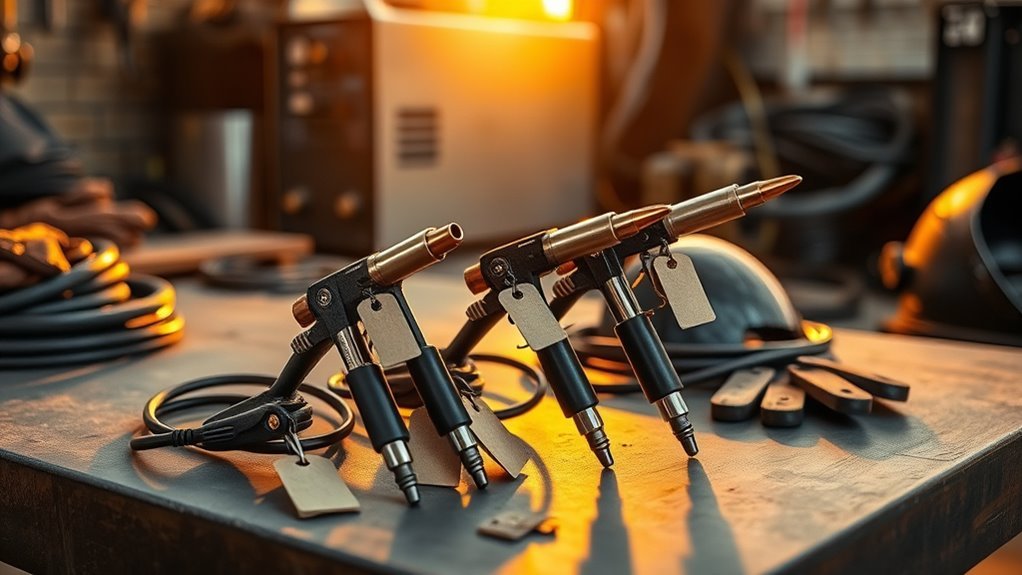
A replacement MIG welding gun can cost about $100 for a basic light-duty model or more than $5,000 for a specialized aluminum gun. Most professional air-cooled guns fall between those extremes. Your final price depends on amperage, duty cycle, cable length, connector type, cooling method, wire size, and whether the gun includes a spool or pull motor.
Quick Answer
A replacement MIG welding gun can cost about $100–$300 for light-duty use, $550–$1,300 for many professional models, and $1,500–$5,700 or more for specialized push-pull, water-cooled, fume-extraction, or aluminum guns. Compatibility, amperage, duty cycle, cable length, cooling, and consumables determine the actual cost.
Key Takeaways
- The price normally covers the gun-and-cable assembly, not the welding machine, wire feeder, shielding gas, wire, or complete PPE kit.
- Many current 250-amp professional guns list for roughly $575–$800, while high-amperage standard guns can exceed $1,300.
- Spool, push-pull, fume-extraction, and water-cooled guns cost more because they add motors, hoses, controls, extraction parts, or cooling equipment.
- A gun must match the feeder connector, trigger plug, wire diameter, liner, consumables, cable length, amperage, and duty cycle.
- Contact tips, nozzles, diffusers, liners, PPE, welding wire, and shielding gas add to the total cost of ownership.
Note: Prices in this guide are U.S. planning figures and manufacturer list-price examples checked in July 2026. Dealer prices, promotions, cable lengths, connectors, and included consumables can change the amount you pay.
Average Price Ranges for Different Types of Welding Guns
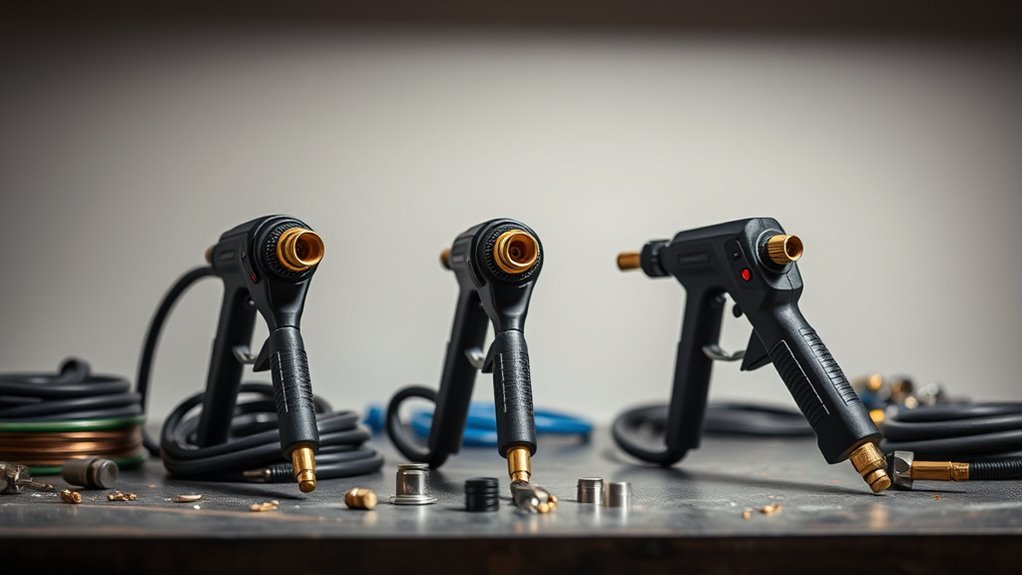
The term welding gun can describe several different products. A basic replacement MIG gun is much less expensive than a push-pull gun for aluminum or a water-cooled production system. Check exactly what is included before comparing prices.
| Gun Type | Planning Range | Typical Use |
|---|---|---|
| Light-duty replacement MIG gun | About $100–$300 | Home, farm, automotive repair, and occasional fabrication |
| Professional 200–250 amp air-cooled gun | About $550–$800 | Repair shops, fabrication, maintenance, and moderate production |
| Heavy-duty 350–550 amp gun | About $800–$1,350+ | High-amperage fabrication and production welding |
| Spool gun | About $500–$900+ | Occasional aluminum welding and short soft-wire feed paths |
| Push-pull or specialized aluminum gun | About $1,500–$5,700+ | Frequent aluminum work, long cables, and demanding wire feeding |
| Water-cooled or fume-extraction system | Often $1,000–$5,000+ for the gun and supporting equipment | High-heat production, long arc-on time, or source-capture applications |
These figures do not normally include the welding power source, feeder, work lead, gas cylinder, regulator, welding wire, water cooler, or fume-extraction unit. A complete industrial system can cost far more than the gun itself.
Compare gun-only prices with gun-only prices. A low-cost replacement gun and a complete push-pull welding package are not equivalent purchases.

The DeLonghi Water Filter helps reduce scale buildup and unwanted impurities that can affect your coffee machine's performance and taste. Its active carbon and ion-exchange technology helps improve brew consistency, maintain flavor, and reduce the need for frequent descaling. Designed as an OEM authorized replacement part, it fits select DeLonghi models for reliable everyday maintenance.

Aegend Swim Goggles are designed to help swimmers enjoy a clear, comfortable, and secure fit in the pool. Built for adults and youth, they aim to reduce leaking and provide full eye protection for training, recreation, and water sports. Their versatile design makes them a practical choice for men and women looking for dependable swim eyewear.

The ZELUS Weighted Vest adds adjustable resistance to workouts, helping boost strength, endurance, and calorie burn during training sessions. Designed for a secure one-size-fits-most fit, it uses evenly distributed weight and reflective detailing for comfort and visibility while running, walking, or exercising. Practical storage pockets make it easy to carry small essentials as you stay focused on fitness goals.
Brand and Model Price Comparisons

Brand matters, but the model configuration matters more. Cable length, amperage, wire size, rear connector, duty cycle, cooling method, and included consumables can change the price within the same product family.
Brand Price Ranges
The following examples use current manufacturer list prices or MSRP ranges available in July 2026. They are reference points rather than guaranteed dealer quotes.
| Model | Configuration | July 2026 List Price or MSRP |
|---|---|---|
| Miller MDX-250 | 250 amp, 10 ft., .030–.035 in. wire | $667 |
| Miller MDX-250 | 250 amp, 15 ft., .035–.045 in. wire | $715 |
| Lincoln Magnum PRO 250L | 250 amp professional MIG gun | About $578–$651 |
| Lincoln Magnum PRO Curve HDE 550 | 550 amp heavy-duty gun | About $914–$1,327 |
| Lincoln Magnum PRO 100SG | 10 ft. spool gun for aluminum | About $650 |
| Lincoln Magnum PRO AL FC 225 Air | 25 ft. specialized aluminum gun | About $5,725 |
Tweco, Bernard, Miller, Lincoln Electric, and other manufacturers offer overlapping amperage classes. Some manufacturers publish MSRP online, while others direct buyers to distributors. Compare identical cable lengths, connectors, wire ranges, and ratings rather than choosing by logo alone.
Older models such as the Miller M-100 may still appear as used, leftover, or seller-specific inventory. Verify machine compatibility and consumable availability before treating an old listing as a bargain.
Model Feature Premiums
The following features commonly raise the price:
- Higher amperage and duty cycle: More copper, heavier conductors, and heat-resistant parts are needed.
- Longer cable: A 15- or 25-foot assembly normally costs more than a 10-foot version and may be heavier to handle.
- Push-pull motor: A motor in the gun helps feed soft wire such as aluminum over longer distances.
- Spool-gun design: The wire spool sits on the gun, shortening the soft-wire feed path.
- Water cooling: The gun needs coolant hoses and a compatible circulating system.
- Fume extraction: Source-capture parts add cost, size, seals, and maintenance requirements.
- Remote controls: Certain specialized guns include wire-feed or procedure controls in the handle.
- Consumable system: Premium liners, locking tips, heavy-duty diffusers, and interchangeable connectors may cost more initially but can reduce setup errors.
Note: Microprocessor arc control, adaptive arc stabilization, saved programs, and most diagnostics normally belong to the welding power source or wire feeder. They are not standard features of a conventional MIG gun.
Key Features That Drive Cost
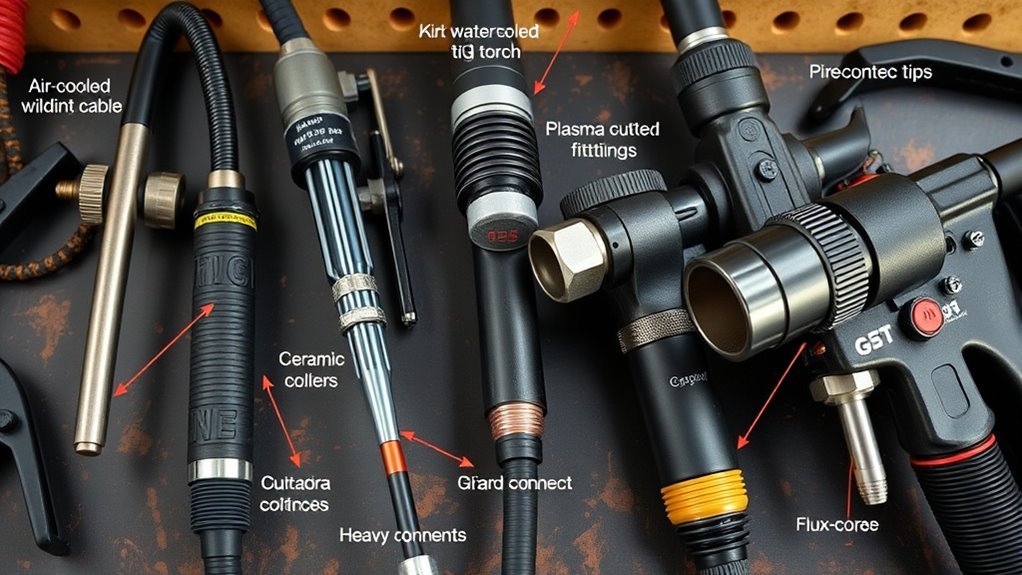
Amperage and Duty Cycle
Duty cycle is the share of a 10-minute period that a gun can operate at a stated amperage without exceeding its thermal rating. A 60% rating represents up to six minutes of welding followed by enough cooling time to complete the 10-minute period under the test conditions.
Do not compare amperage alone. A rating may differ depending on whether the manufacturer tested the gun with carbon dioxide or a mixed shielding gas. Match the gun rating to your actual process, gas, wire size, and arc-on time.
Miller’s MIG-gun selection guidance notes that air-cooled guns commonly cover approximately 150–600 amps, while water-cooled systems are used where heat, high amperage, or long arc-on time justifies the extra equipment.
Cable Length and Flexibility
A longer cable gives you more reach but can increase price, drag, weight, and wire-feeding resistance. Avoid buying extra length unless the work area requires it. Keep the cable as straight as practical while welding, especially when feeding softer or smaller-diameter wire.
Connector and Trigger Compatibility
The rear power pin, trigger plug, gas connection, and feeder interface must match the machine. A gun advertised as “universal” may still need a specific adapter or connector kit.
Wire Size, Liner, and Consumables
Check the supported wire-diameter range and confirm that matching contact tips, nozzles, diffusers, liners, and conductor tubes are readily available. A low purchase price can become expensive if replacement parts are hard to find.
Cooling and Specialized Feeding
Standard air-cooled guns are simple and portable. Water-cooled guns can provide a lighter, more flexible cable at high amperage, but they need a cooler and coolant hoses. Spool guns and push-pull guns improve soft-wire feeding but must match the machine’s controls and connector system.
How to Confirm MIG Gun Compatibility Before Buying
Use this checklist before ordering a replacement gun:
- Find the welder or feeder model number. Check its manual or manufacturer compatibility chart.
- Identify the rear connector. Match the power pin, gas seal, trigger plug, and control connector.
- Check wire diameter. Confirm that the gun, liner, contact tip, and drive system support the wire you use.
- Match amperage and duty cycle. Compare ratings using the same shielding gas and realistic arc-on time.
- Choose a practical cable length. Longer is not always better if it creates drag or feed resistance.
- Confirm consumable availability. Price the tips, nozzles, diffusers, liners, and replacement cable before buying.
Pro Tip: Give the distributor your welder or feeder model, serial number, wire size, process, shielding gas, and preferred cable length. Written compatibility confirmation is more reliable than matching the connector by appearance.
Warning: Do not install a gun with an underrated cable, incorrect power pin, damaged insulation, leaking gas seal, or incompatible trigger wiring. Overheating, electrical resistance, gas leakage, feeding problems, and equipment damage can result.
Accessory and Consumable Expenses
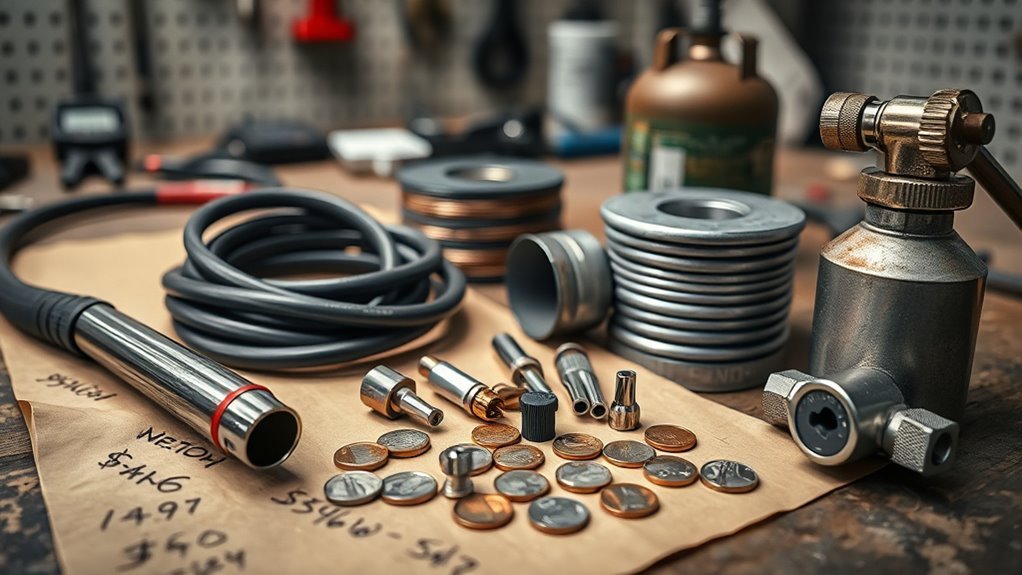
A welding gun’s purchase price is only one part of its cost. Contact tips, nozzles, diffusers, liners, conductor tubes, seals, and trigger parts wear at different rates depending on amperage, wire type, setup, spatter, and daily arc-on time.
| Cost Item | Why It Matters | Budget Approach |
|---|---|---|
| Contact tips | Wear, burnback, poor conductivity, or an enlarged bore can affect feeding and arc stability. | Keep several correct-size tips in stock. |
| Nozzles and diffusers | Spatter, damaged threads, or blocked gas ports can reduce shielding coverage. | Stock at least one compatible spare set. |
| Liners | Dirt, wear, kinks, and incorrect trimming can cause erratic wire feeding. | Include liner cost in scheduled maintenance. |
| Gun cable or conductor tube | Heat damage, crushed areas, loose connections, or worn threads may require repair or replacement. | Check replacement-part cost before buying a used gun. |
| Wire and shielding gas | These are welding-process costs rather than gun parts, but they affect the cost of every job. | Budget separately based on deposition rate and gas use. |
A reasonable starter allowance for spare tips, a nozzle, a diffuser, and a liner is often $50–$150, depending on the gun and package quantities. Production shops may spend much more because replacement frequency follows arc-on time and operating conditions.
An electric hand lifter or other material-handling device is not a standard MIG-gun accessory. Include such equipment only when the shop’s workflow requires it rather than adding it to every gun budget.
Safety Gear and Ancillary Equipment Costs
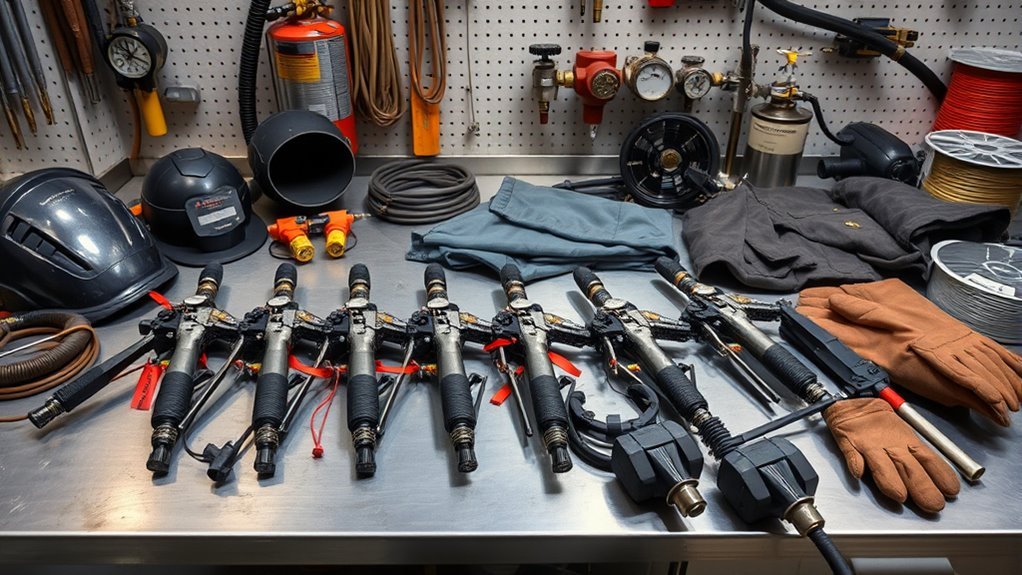
Safety equipment should be selected by hazard, process, amperage, work environment, and applicable workplace requirements—not by price alone. Inspect PPE before use and replace it when damaged, contaminated, worn through, or unable to function as designed.
| Item | Purpose | Buying Priority |
|---|---|---|
| Welding helmet | Protects the face and eyes from optical radiation, heat, and spatter when fitted with the correct filter shade. | Verify standards, shade range, condition, fit, and lens operation. |
| Safety glasses or goggles | Provide primary impact protection under the helmet. | Wear suitable primary eye protection with side protection as required. |
| Welding gloves and flame-resistant clothing | Protect against heat, sparks, spatter, and hot metal. | Choose coverage and material for the process and position. |
| Ventilation or local exhaust | Removes or controls welding fumes and gases near their source. | Assess the metal, coating, consumable, location, and exposure before welding. |
| Hearing and respiratory protection | May be required when noise or airborne exposure cannot be controlled adequately by other means. | Use equipment selected through the applicable workplace protection program. |
Warning: Do not weld in an area without adequate ventilation. OSHA’s welding requirements warn that welding can produce hazardous fumes and gases. Use suitable ventilation or local exhaust, keep combustibles away, and follow confined-space and respiratory-protection requirements where applicable.
OSHA guidance also states that a welding helmet should not be treated as stand-alone eye protection. Suitable safety glasses or goggles are worn beneath it, and the filter shade is selected for the process and amperage.

The Bosch Professional GBA 18V 5.0Ah CoolPack Lithium-Ion Battery delivers extended runtime for demanding trade and DIY applications. Its CoolPack technology helps protect the battery against overheating and supports longer service life, while the rugged design is built to handle tough jobsite use. Fully compatible with Bosch Professional 18V tools, it offers flexible power across the same voltage class.

This daily devotional helps parents pray purposefully for their children through a full year of Scripture readings, reflections, and guided prayer prompts. Written to encourage faithful family discipleship, it offers practical, biblically grounded support for parents who want to shape their prayers around God's Word. A foreword by Sinclair B. Ferguson adds trusted theological insight and encouragement.

This multi-purpose restoring cream helps soothe and support weakened, irritated skin while moisturizing areas affected by dryness, cracking, and daily discomfort. Formulated with copper, zinc, panthenol, and hyaluronic acid, it helps purify, calm, and restore the skin barrier for use on both face and body. Fragrance-free and non-comedogenic, it is suitable for the whole family and designed for high-tolerance care.
When to Buy New vs. Refurbished or Used
Buy new when uptime, warranty support, known compatibility, and predictable condition matter most. A used or refurbished gun can be reasonable for occasional work, a backup station, or a legacy feeder, but the discount is useful only when the gun does not need an expensive cable, motor, connector, or cooling-system repair.
Choose New When
- The gun will be used for production or safety-critical work.
- You need written compatibility support from the manufacturer or distributor.
- The model uses a push-pull motor, coolant circuit, extraction system, or electronic controls.
- Downtime would cost more than the initial price difference.
- You need a return policy and a clearly documented warranty.
Inspect a Used Gun Before Buying
- Confirm the exact model, amperage, cable length, wire range, and rear connector.
- Inspect the cable for burns, cuts, crushed sections, stiff spots, exposed conductors, and failed strain relief.
- Test the trigger and inspect its wiring and plug.
- Check the power pin, gas seals, threads, conductor tube, diffuser, and nozzle seating surfaces.
- Look for evidence of overheating at the connector and front end.
- Verify that liners and consumables are still available.
- For water-cooled guns, check hoses, fittings, and the gun body for coolant leakage.
- For spool or push-pull guns, test the motor and confirm control-box compatibility.
- Price a replacement cable, liner, and front-end parts before agreeing to the sale.
Pro Tip: A clean handle does not prove that the internal conductor, liner, or cable is healthy. Test-feed wire and make a weld at a realistic amperage before buying whenever the seller and worksite allow it.
Budgeting Tips for Selecting the Right Welding Gun
Set the budget after identifying the required specifications. Buying a cheaper incompatible gun or an oversized gun that causes unnecessary fatigue is not a saving.
- Set the required output. Record your normal and maximum amperage, shielding gas, wire size, and arc-on time.
- Confirm compatibility. Match the feeder, connector, trigger plug, liner, and consumable family.
- Choose the shortest practical cable. Extra reach costs more and may increase drag.
- Add startup parts. Include spare tips, a nozzle, a diffuser, a liner, and any required adapter.
- Add safety equipment. Include suitable eye, face, hand, body, ventilation, and fire-protection equipment.
- Estimate annual wear. Base replacement frequency on your records or expected arc-on time rather than a generic yearly figure.
- Compare warranty and parts support. A lower sticker price may not compensate for unavailable consumables or long downtime.
Illustrative First-Year Budget
The following example is a planning exercise, not a universal market quote:
| Professional MIG gun | $650 |
| Starter consumables and spare liner | $100 |
| Helmet, glasses, gloves, and protective clothing | $250 |
| Illustrative first-year replacement parts | $200 |
| Illustrative first-year total | $1,200 |
This total excludes the welder, feeder, wire, shielding gas, cylinder charges, electrical work, ventilation installation, and labor. Adjust each line to your shop and expected usage.
The best-value gun is the least expensive compatible model that can handle your real amperage, gas, wire, cable length, and arc-on time without creating excess heat or downtime.
Frequently Asked Questions
How heavy are typical welding guns, and does weight affect usability?
There is no dependable universal weight range because manufacturers may list the handle, gun body, or complete cable assembly differently. Amperage, copper content, cable length, cooling hoses, motor components, and extraction parts all affect handling. Compare the complete configured assembly and consider balance, cable drag, and welding duration.
Do welding guns require special insurance or certification to purchase?
An ordinary MIG gun generally does not require a special buyer license in the United States. Workplace use is different: employers may require training, hot-work procedures, PPE, ventilation controls, inspections, or proof of competence. Insurance requirements depend on the business, location, work, and policy.
Can welding guns be used safely indoors without ventilation?
Do not assume indoor welding is safe without ventilation. Welding can produce hazardous fumes and gases. Use adequate general ventilation or local exhaust suited to the metal, coating, consumable, and work area. Respiratory protection may also be required when engineering and work-practice controls do not reduce exposure adequately.
Are there tax credits or rebates for buying energy-efficient welding equipment?
Do not assume that an ordinary welding gun qualifies for a federal energy-efficiency credit. A gun bought and placed in service for a qualifying business may instead be eligible for depreciation or a Section 179 deduction, subject to income, property, and use rules. IRS Publication 946 explains the federal depreciation rules. State and utility programs vary, so confirm eligibility before buying and consult a qualified tax professional.
How long is a welding-gun warranty, and does it cover consumables?
Warranty length varies by brand and model and may be much shorter than the warranty on the welding power source. For example, ESAB’s U.S. warranty schedule lists GMAW torches at 90 days. Contact tips, nozzles, diffusers, liners, and similar wear parts are generally excluded. Read the exact warranty before purchase.
Is a MIG gun included with a new welder?
Many complete MIG welders include a compatible gun, but replacement power sources, wire feeders, and industrial packages may be sold in different configurations. Read the “what’s included” list rather than assuming a gun, regulator, work lead, spool gun, or safety equipment is part of the package.
Can any brand of MIG gun fit any welding machine?
No. Different machines use different power pins, trigger plugs, gas seals, control connections, wire sizes, and consumable systems. Some guns accept adapter kits, but compatibility must be confirmed for the exact feeder or welder model.
Conclusion
Welding-gun prices range from roughly $100 for a basic light-duty replacement to more than $5,000 for specialized aluminum and production equipment. Many professional 200–250 amp guns cost about $550–$800, while heavy-duty standard guns can reach $1,300 or more.
Do not choose by price alone. Match the gun to the feeder connector, trigger plug, wire size, shielding gas, amperage, duty cycle, cable length, and consumable system. Then add spare parts, PPE, ventilation, and expected maintenance to calculate the real cost. A compatible midrange gun with readily available consumables will often deliver better long-term value than either the cheapest listing or an oversized industrial model.
Sources
- Miller — Top Factors and Considerations for MIG Gun Selection — gun types, cooling, amperage, duty cycle, compatibility, and consumables.
- Miller MDX-250 Product Page — current model configuration, features, and manufacturer list price.
- Lincoln Electric — Semiautomatic Welding Guns — current gun families, amperage ratings, configurations, and MSRP examples.
- OSHA 29 CFR 1910.252 — welding safety, fumes, gases, ventilation, and general requirements.
- ESAB U.S. Warranty Coverage — GMAW torch warranty period and coverage distinctions.
- IRS Publication 946 — depreciation and Section 179 rules for qualifying business property.

This lightweight face cream delivers deep hydration with rice extract, ceramide, and nourishing lipids to help support a smoother, softer complexion. It is designed to moisturize while helping reduce moisture loss and improve the feel of sensitive or normal skin. The silky formula leaves skin feeling comfortable, protected, and refreshed.

This Milwaukee SHOCKWAVE socket adapter set is designed to convert drill and impact driver output for use with sockets, making it a versatile addition to any tool kit. Built for durability and repeated use, the adapters are engineered to deliver reliable performance on demanding fastening tasks. The compact 3-piece set covers common drive sizes for everyday repair and maintenance work.

This retractable car window shade helps block UVA and UVB rays to make rides more comfortable and protected for passengers. It includes a White Hot heat alert that turns white when the car is too hot, plus dual installation options for a secure fit in many vehicles. The safe-view mesh supports visibility while helping reduce glare, and the easy one-push retraction makes it simple to use when needed.
