
You’ll typically pay about $0.10–$2.00 per cubic foot for common welding gases, depending on type and purity. CO2 is cheapest (~$0.10–$0.25/ft³), argon and C25 sit midrange (~$0.42–$0.75/ft³), and pure helium is highest (~$1.50–$2.00/ft³). Larger tank sizes lower your effective cost per cubic foot. Flow rate determines how long a cylinder lasts, and the sections below explain how to estimate run times, compare refill options, and cut costs.
Quick Answer
- Welding gas costs between $0.10 and $2.00 per cubic foot, depending on type.
- CO2 is the cheapest option (~$0.10–$0.25/ft³); pure helium is the most expensive (~$1.50–$2.00/ft³).
- Common cylinders hold 40, 80, or 125 cubic feet. Larger tanks lower your cost per cubic foot.
- Refills typically run $60 for a 40 CF tank and about $70 for 80–125 CF tanks.
- Divide your tank volume (CF) by your flow rate (CFH) to estimate how many hours a cylinder will last.
Common Welding Gases and Typical Uses
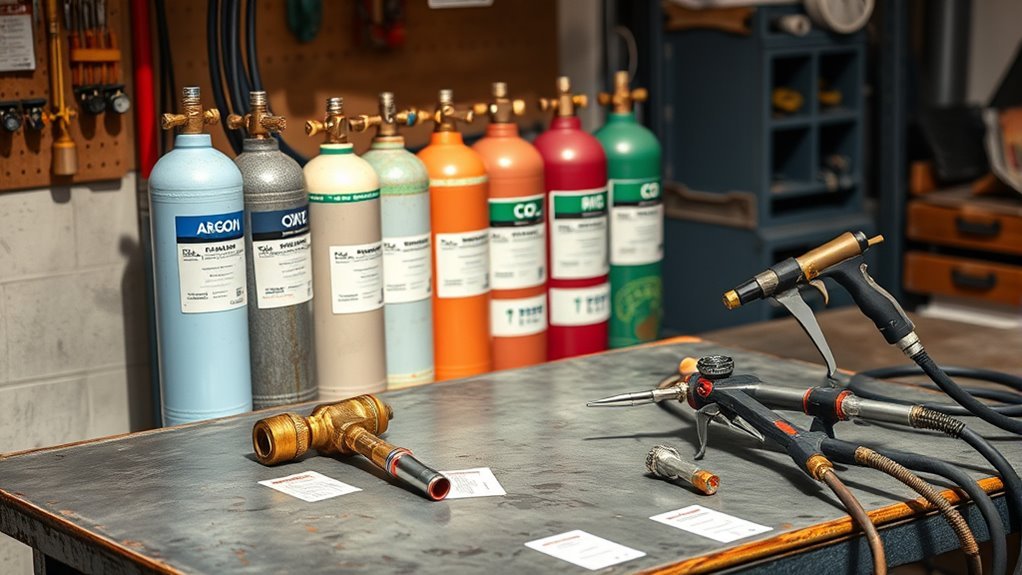
When choosing a shielding gas, match it to your process and metal. Argon is the go-to inert gas for TIG welding, especially on aluminum. Helium boosts penetration and heat when mixed with argon. C25 (75% Ar/25% CO2) gives stable MIG arcs on mild steel. CO2 alone is the cheapest option for deep penetration. Small O2 additions to argon mixes improve results on stainless steel.
Choose your gas based on joint design, base metal, and the weld profile you need. Argon prevents oxidation and keeps a calm arc on thin sections. Helium raises travel speed and penetration for thicker material. C25 balances arc stability and spatter control for general MIG work. CO2 maximizes heat input where deep fusion is needed. For a full breakdown of gas types and their applications, Miller Electric’s shielding gas guide is a useful reference.
Products Worth Considering

Wide Application: Effortlessly connect to Argon, Helium, and Argon/CO2 mixed gas tanks with the CGA-580 inlet nut. No adapters are necessary, ensuring a secure and leak-free setup right out of the box. Ideal choice for MIG TIG welding, chemical, industrial applications and electronics industry

CGA580 Inlet Connection: Welding gas regulators connects easily to argon and Co2 tanks, note that a CGA-320 adapter is required for use with Co2 cylinders. This product comes standard with the CGA-580 connector only

Includes 2 nuts and 2 nipples
Price Range per Cubic Foot by Gas Type
Cost per cubic foot is a key factor when picking a shielding gas, since prices vary widely by type and affect your operating expenses on every job. Argon runs about $0.50–$0.75/ft³, making it the standard choice for TIG. C25 (75% Argon/25% CO2) sits near $0.42–$0.50/ft³, which balances weld quality and cost. CO2 is cheapest at $0.10–$0.25/ft³ for MIG. Pure helium tops the list at roughly $1.50–$2.00/ft³ for high-heat jobs. Specialty blends vary by supplier and location, so expect some regional price difference.
| Gas Type | Typical Price (per ft³) | Typical Use |
|---|---|---|
| Argon | $0.50–$0.75 | TIG |
| C25 | $0.42–$0.50 | MIG |
| CO2 | $0.10–$0.25 | MIG |
| Helium | $1.50–$2.00 | High-heat applications |
Products Worth Considering

APPLICATION: The ARCCAPTAIN gas pressure regulator can be used with argon, helium, and carbon dioxide gas tanks.

60 CU FT ARGON CAPACITY - Mid-size cylinder for welding, metal fabrication, and more. Balances generous capacity with portability at 29 lbs for professional welders, fabrication shops, and mobile repair

All HP cylinders come with a 10 year hydrotest date stamped.
Tank Sizes, Purchase Costs, and Refill Prices
The most common welding gas cylinders hold 40, 80, and 125 cubic feet. New tanks typically cost about $230–$400 depending on size and gas type.
Refills usually run roughly $60 for 40 CF, $70 for 80 CF, and $70 for 125 CF. Plan refill frequency into your operating costs from the start.
Because refill labor and handling costs are similar across sizes, larger cylinders often give a lower cost-per-cubic-foot over time.
Products Worth Considering
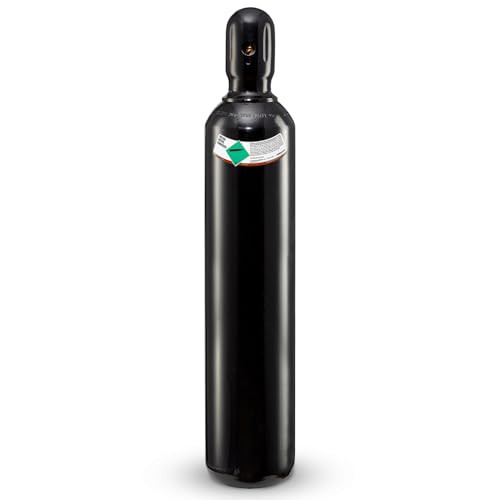
Welding Gas to Your Door - Get PrimeWeld's industrial grade Argon welding gas delivered right to your door. We offer different mixtures for any application, and you can purchase a tank without worrying about costly rental fees or wasted trips out to your local welding supply shop.


Comes with a CGA-580 valve for Argon, Nitrogen, Argon/CO2, Helium
Common Cylinder Capacities
Common welding cylinders come in 40, 80, 125, and 300 cubic foot (CF) sizes. Each carries different upfront and refill cost trade-offs. Smaller tanks cost less to buy but need more frequent fills. A 125 CF cylinder usually gives a lower per-fill labor cost. Regional policies may require you to buy rather than refill, which affects your annual total. Use the table below for a quick comparison.
| Size (CF) | Typical Cost Indicators |
|---|---|
| 40 | ~$230 purchase; ~$60 refill |
| 80 | mid-range purchase; ~$70 refill |
| 125 | ~$725 purchase; ~$70 refill |
| 300 | large capacity; fewer refills, higher upfront cost |
Upfront Purchase Costs
Match tank size to your expected usage and budget. A 40 CF cylinder is the cheapest to buy, often around $230, but you’ll refill it more often at about $60 per fill. An 80 CF tank typically runs $290–$320 upfront. A 125 CF cylinder ranges from $350–$725. Both 80 and 125 CF refills usually land near $70, so larger cylinders are more economical per usable cubic foot. Regional pricing can push some 125 CF fills up to $90, so check local rates.
Also factor in tank material. Aluminum cylinders weigh less but cost more than steel. If cash flow is tight, explore financing options and compare supplier terms to lower your total ownership cost.
Typical Refill Prices
Refill price is one of the biggest ongoing costs. A 40 CF refill runs about $60. Both 80 CF and 125 CF refills are roughly $70 each, so larger bottles give you a lower cost per usable cubic foot despite similar labor and HAZMAT surcharges. A filled 125 CF argon bottle typically costs $350–$400 to purchase initially. Local rates vary widely, and some CO2 fills have been reported as low as $38.
Always factor in regional pricing and any per-refill HAZMAT or service fees. Track your refill frequency to model annual spending and compare cylinder sizes against rental options.
Key factors to track:
- Refill frequency: your consumption rate, shift patterns, and how many spare cylinders you need.
- Hidden fees: delivery, HAZMAT, testing, and regulator servicing.
- Unit economics: cost per usable CF, capital tied up, and downtime risk.
How to Calculate Your Real Gas Cost for Projects
To get an accurate picture of your welding gas cost, add up the tank purchase price and recurring refill expenses, then convert them into a per-hour or per-project figure based on your expected flow rate and usage.
Start by listing the gas types you use, their tank sizes, and purchase prices (for example, $300 for an 80 CF TIG tank or $360 for a 125 CF 75/25 mix).
Add refill costs and frequency ($60 every two months for 80 CF; $70 quarterly for 125 CF).
Divide your annual total by estimated hours of use. An 80 CF tank at 10 CFH yields about 8 hours of welding.
Compare local refill prices, since they vary widely, then calculate per-hour and per-project costs for budgeting.
Products Worth Considering

Compatible with CGA-580 tanks: Easily attach this Gas Pressure Regulator/Flowmeter to your Argon, Helium, and CO2 tanks with its CGA-580 inlet connector

Set includes:3pcs Back cup, 20 collets, 8pcs collet body, 25pcs Alumina gas cup/ nozzle, 2 gasket
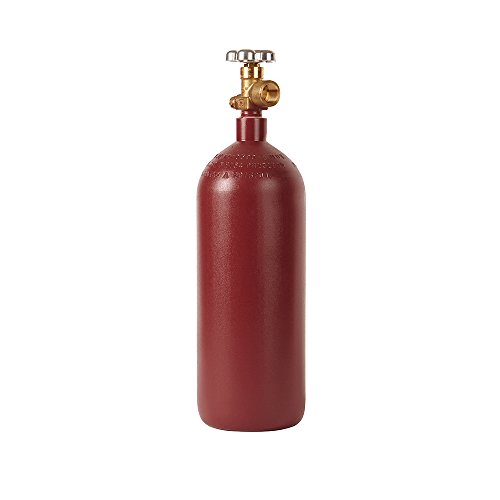
20 CU FT ARGON CYLINDER - Compact steel argon tank perfect for TIG welding, MIG welding, and hobby/small shop fabrication. 2015 PSI service pressure. Ultra-portable with 5.25" diameter x 18" height, 13.67 lb tare weight. Ideal for mobile welders, small shops, automotive repair, and DIY metalworking projects
Estimating How Long a Cylinder Will Last
Estimate cylinder duration by dividing tank volume (CF) by your welding flow rate (CFH) to get hours of use.
Use tank pressure to refine that estimate. A full cylinder reads about 2015 psi. At 1000 psi, about 50% remains, so multiply the remaining fraction by the nominal volume to get usable cubic feet.
Practical examples: 80 CF at 10 CFH lasts about 8 hours; at 40 CFH, about 2 hours. Use these numbers to plan cylinder swaps and monitor your gauges.
Flow Rate Calculations
Estimating cylinder duration is a simple division: take the tank’s usable volume in cubic feet and divide by your flow rate in cubic feet per hour (CFH) to get hours of use.
Use flow rate and gas efficiency to match your process needs. An 80 CF tank at 10 CFH yields about 8 hours. Typical flow rates range from 10–40 CFH, and higher flows shorten tank life.
Check the tank gauge for remaining gas (full is about 2015 psi; half is about 1000 psi) to confirm estimates. Keep in mind that gas type and welding process both affect the ideal flow rate and efficiency.
- Verify usable cylinder volume before calculating.
- Account for brief bursts of higher flow during starts and stops.
- Adjust flow to balance weld quality and gas efficiency.
Pressure-to-Time Estimation
Once you have the flow-based run time, estimate how long a specific tank will last by converting the pressure reading to usable volume and dividing by your set CFH. A full tank at about 2015 psi holds roughly 80 CF. At 1000 psi, it has about 40 CF remaining.
Divide by your flow rate: 80 CF / 10 CFH = 8 hours; 80 CF / 20 CFH = 4 hours. Monitor both the pressure gauge and flow rate, since any change in flow directly reduces duration. Common flow rates range from 10–40 CFH, so plan cylinder swaps and regulator adjustments accordingly. This gives you a quick planning tool for cylinder management and cost-per-hour budgeting.
| Gauge (psi) | Approx. CF |
|---|---|
| 2015 | 80 |
| 1000 | 40 |
Practical Usage Examples
When planning a job, divide the tank’s usable cubic feet by your set CFH to estimate run time. An 80 CF argon tank at 10 CFH lasts about 8 hours. At 20 CFH, it drops to roughly 4 hours.
Apply that math to match cylinder size to task duration and improve gas efficiency. Monitor pressure gauges closely. A full tank near 2015 psi declining toward 1000 psi is your signal to schedule a refill.
For quick jobs, use smaller cylinders. For production runs, choose larger tanks or bulk supply.
- 125 CF at 20 CFH is about 6.25 hours, a good fit for moderate continuous work.
- 40 CF at 15 CFH is about 2.67 hours, a poor choice for prolonged use.
Track psi-to-volume curves to sharpen your time estimates over time.
Where to Buy, Refill, or Lease Welding Gas
For welding gas, check local welding supply shops and national chains like AirGas or Northern Tool for purchase, refill, or lease options. Policies and prices vary by supplier and location, so always call ahead.
You can buy new or used tanks, or join a tank leasing program that lowers your upfront cost but adds recurring fees and return requirements.
Many suppliers refill 125 CF cylinders for roughly $65–$90, though availability varies. Some won’t refill 300 CF cylinders at all, which means you may have to buy a replacement instead.
Compare local vendors for price and service differences, since geography and inventory both affect what you’ll pay.
Verify refill policies, cylinder certification status, and any exchange programs before committing to avoid unexpected costs. For cylinder handling and safety guidelines, Lincoln Electric’s cylinder safety resource is worth reviewing.
Products Worth Considering
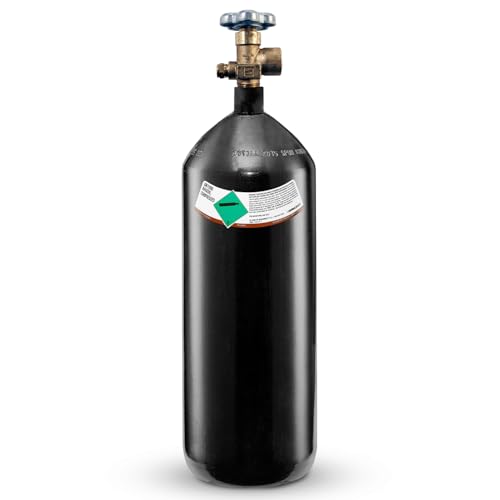
Welding Gas to Your Door - Get PrimeWeld's industrial grade Argon welding gas delivered right to your door. We offer different mixtures for any application, and you can purchase a tank without worrying about costly rental fees or wasted trips out to your local welding supply shop.

All HP cylinders come with a 10 year hydrotest date stamped.

Welding Gas to Your Door - Get PrimeWeld's industrial grade 75 %Argon 25% CO2 gas cylinder delivered right to your door. We offer different mixtures for any application, and you can purchase a tank without worrying about costly rental fees or wasted trips out to your local welding supply shop.
Alternatives to Shielding Gas and Cost-Saving Tips
Beyond buying and leasing, there are a few solid ways to cut or eliminate shielding-gas expenses.
One option is switching to self-shielded flux-cored wires for MIG applications. These eliminate gas costs entirely and work well on dirty or rusty material.
For many outdoor or heavy-structure jobs, stick welding is a practical alternative. It needs no gas, uses simple equipment, and holds up well in windy conditions.
Also consider process substitution where it makes sense. Plasma cutting or oxy-fuel systems may change your gas needs and improve overall efficiency.
- Buy larger tanks (125 CF or 300 CF) to lower per-cubic-foot refill costs and reduce refill frequency.
- Source bulk gas from local suppliers or online wholesalers to secure volume discounts.
- Review job requirements regularly to substitute gasless processes where it makes sense and cut consumable spend.
Frequently Asked Questions
How Do Gas Purity Grades Affect Welding Quality and Certification Requirements?
Higher gas purity improves weld quality and reduces defects. For critical certifications, you’ll need purer gas. Lower grades can cause contamination, rework, and failed qualification tests, so choose purity to meet your procedure and code requirements.
Are Rental Terms and Liabilities Different for Specialty Gases?
Yes. Rental agreements and liability clauses are stricter for specialty gases. You’ll face tighter handling, storage, and insurance requirements. Don’t overlook compliance, training, and return conditions, or you may face steep penalties.
What Environmental Regulations Govern Welding Gas Storage and Disposal?
You must follow OSHA cylinder rules, EPA hazardous waste and air emissions standards, DOT transport and storage rules, and applicable local codes. Maintain compliance through proper labeling, leak prevention, MSDS access, and disposal records.
Do Trade Restrictions or Tariffs Impact Imported Welding Gas Prices?
Yes. Import tariffs can raise prices when gas supply is constrained, adding per-unit costs and pushing buyers to change suppliers. Factor in duties, logistics, and currency shifts when building your procurement model.
Can Gas Mixtures Be Custom-Ordered and How Does That Change Cost?
Yes. You can custom-order gas mixtures. Pricing depends on specialty gas availability, blend complexity, certification, cylinder size, minimum order quantity, and delivery. Expect higher per-unit costs and longer lead times compared to standard pre-mixed gases.
Conclusion
When buying welding gas, balance cost against performance. Argon costs more per cubic foot but delivers cleaner TIG welds. CO2 is cheap but produces more spatter. Mixed gases sit in between. Factor in cylinder size, rental versus refill, and your hourly consumption to find your true per-project cost. With a bit of planning and the right process substitutions, you can cut expenses without giving up weld quality.
