
The Alaska trout stamp cost is $0 because Alaska does not require or sell a separate trout stamp. Most adult anglers need only a valid sport fishing license to fish for trout, although local seasons, bag limits, size limits, tackle rules, and annual harvest limits still apply. A separate stamp is required when fishing for king salmon unless an exemption applies.
Last updated: August 11, 2026. License fees and statewide licensing rules were rechecked against Alaska Department of Fish and Game information.
Quick Answer
No. Alaska does not require or sell a separate trout stamp, so the trout-stamp add-on costs $0. Residents age 18 or older generally need a $20 annual sport fishing license, while nonresidents age 16 or older pay $15 to $100 depending on duration. A separate king salmon stamp applies when fishing for king salmon, subject to exemptions. The $0 trout stamp does not mean trout fishing itself is license-free.
Key Takeaways
- The Alaska trout stamp cost is $0 because the state has no separate trout stamp.
- A resident annual sport fishing license costs $20.
- Nonresident licenses cost $15 for one day, $30 for three days, $45 for seven days, $75 for 14 days, or $100 annually.
- Fishing for king salmon normally requires a separate stamp, including catch-and-release fishing, except in stocked lakes or when an exemption applies.
- A harvest record is required only when retaining a species that has an annual limit; it is not required for every trout caught or released.
- Always check the regional regulation book and current emergency orders before fishing.
At a Glance
| Separate Trout Stamp | Not required; $0 add-on cost |
| Resident License | $20 annual sport fishing license |
| Nonresident License | $15 to $100, depending on duration |
| King Salmon Stamp | Required when fishing for king salmon unless an exemption applies |
| Harvest Record | Required when retaining a fish subject to an annual limit |
| Where to Buy | ADF&G online store, Fish and Game offices, or participating license vendors |
2026 Fee Check: If you encounter older Alaska fishing pages showing different license prices, use the current ADF&G license and stamp price list when making a purchase. The current list shows the $20 resident annual license and the $15, $30, $45, $75, and $100 nonresident options used in this guide.
Who Needs a Fishing License in Alaska?
Under the Alaska Department of Fish and Game sport fishing license rules, the following anglers generally need a license:
- Alaska residents age 18 or older
- Nonresidents age 16 or older
Resident anglers younger than 18 and nonresident anglers younger than 16 may sport fish without purchasing a license. However, an unlicensed youth angler needs a free Sport Fishing Harvest Record Card when retaining a fish that is subject to an annual limit.
Alaska residents age 60 or older may apply for a free Permanent Identification Card, commonly called a PID. Qualifying resident disabled veterans may apply for a free DV card. These credentials replace the ordinary sport fishing license while the holder remains eligible and maintains Alaska residency.
Who Qualifies as an Alaska Resident?
For licensing purposes, a resident generally must have maintained a home in Alaska for the previous 12 consecutive months, intend to remain in the state, and not claim residency or resident benefits elsewhere. The full test is explained on ADF&G’s residency overview.
Note: Owning property, visiting regularly, or receiving an Alaska Permanent Fund Dividend does not automatically establish fishing-license residency. Use the official residency definition before buying a resident license.
Annual sport fishing licenses are calendar-year licenses and expire December 31; buying one later in the year does not extend it for 12 months from the purchase date. Short-term nonresident licenses are valid only for their stated one-, three-, seven-, or 14-day period.
Does Alaska Require a Trout Stamp?
No. Alaska does not require a separate trout stamp. A valid sport fishing license covers trout fishing in fresh and salt water, provided the angler follows the rules for the region, drainage, water, and trout species being fished.
The Alaska trout stamp cost is $0 because the state does not issue a separate trout stamp. The underlying sport fishing license may still have a fee.
The absence of a trout stamp does not mean trout fishing is unregulated. Depending on the location, rules may control:
- Open and closed seasons
- Daily bag and possession limits
- Minimum or maximum fish sizes
- Annual harvest limits
- Catch-and-release waters
- Bait, hook, lure, and fly restrictions
Use ADF&G’s Sport Fishing Regulations page to select the correct region and then find the drainage or water you plan to fish.
Resident Fishing License Costs and Options
The standard Alaska resident annual sport fishing license costs $20. It covers lawful sport fishing for finfish and shellfish in fresh and salt water, but it does not replace a king salmon stamp, harvest record, or fishery-specific permit when one is required.
Current resident options listed by ADF&G include:
- Annual sport fishing license: $20
- Annual low-income fishing, hunting, and trapping license: $5
- Annual sport fishing license for the blind: $0.50
- Permanent Senior ID Card: Free for qualifying Alaska residents age 60 or older
- Disabled Veteran ID Card: Free for qualifying resident disabled veterans
- Resident annual king salmon stamp: $10 when required
Current fees are published on the official ADF&G license and stamp price list.
A resident license does not create a statewide trout bag limit. The legal limit comes from the regional and water-specific regulation applying where the angler is fishing.
If you need a broader comparison beyond trout-specific requirements, see our Alaska annual fishing license cost guide.
Nonresident License Types and Pricing
Nonresidents age 16 or older can select a license based on the length of their Alaska fishing trip:
- 1-day sport fishing license: $15
- 3-day sport fishing license: $30
- 7-day sport fishing license: $45
- 14-day sport fishing license: $75
- Annual sport fishing license: $100
Each option covers trout fishing during the license’s valid period. No additional trout stamp is needed.
Active-duty U.S. military or Coast Guard members and their dependents who are permanently stationed in Alaska for less than 12 months may qualify for a $20 nonresident military annual sport fishing license. They remain subject to nonresident fishing limits and must meet the official military-license conditions.
Pro Tip: Choose the shortest license whose valid period includes every day you plan to fish. Count actual fishing days rather than the full vacation length, and make sure all fishing dates fit inside the selected license period.
For visitor-specific license planning, see our Alaska nonresident fishing license cost guide.
King Salmon Stamp: When It’s Required
The king salmon stamp is separate from Alaska’s sport fishing license. It applies to king salmon, also called Chinook salmon, rather than trout.
When a King Salmon Stamp Is Required
An angler who is required to hold a sport fishing license must normally also carry a current king salmon stamp when fishing for king salmon in fresh or salt water. The stamp requirement applies to fishing for king salmon, so it can apply even when the angler plans to release every king salmon caught.
ADF&G’s statewide licensing exception is king salmon in stocked lakes. Local regulations and emergency orders should still be checked before fishing.
King Salmon Stamp Prices
Current king salmon stamp prices are:
- Resident annual stamp: $10
- Nonresident 1-day stamp: $15
- Nonresident 3-day stamp: $30
- Nonresident 7-day stamp: $45
- Nonresident 14-day stamp: $75
- Nonresident annual stamp: $100
- Nonresident military annual stamp: $30 for qualifying active-duty members and dependents
Who Does Not Need a King Salmon Stamp?
The following anglers generally do not need to purchase a king salmon stamp:
- Resident anglers younger than 18
- Nonresident anglers younger than 16
- Qualifying residents holding a Permanent Senior ID Card
- Qualifying residents holding a Disabled Veteran ID Card
- Residents holding a low-income sport fishing license
- Residents holding a blind sport fishing license
An exemption from buying the stamp does not erase annual harvest-record requirements. An exempt angler may still need to record a retained king salmon or carry a free harvest record card.
How to Purchase and Carry the Stamp
King salmon stamps are available through the ADF&G online store, participating license vendors, and Fish and Game offices. Follow ADF&G instructions for signing and carrying the license and stamp format you purchase.
Warning: Published season dates, bag limits, and methods can be changed by an emergency order. Emergency orders have the force of law and supersede the regulation booklet, so check the current order for the fishing area before each trip.
Harvest Record Cards and Trout Limits
A Sport Fishing Harvest Record Card is not a general trout permit, and anglers do not record every trout they catch. Harvest recording applies when a fish is retained from a species or fishery that has an annual limit.
When Is a Harvest Record Required?
All anglers must record a retained sport-caught fish when the applicable regulation gives that species an annual limit. Some Alaska rainbow trout and king salmon fisheries have annual limits, but many trout waters do not.
Licensed adults normally use the harvest-record area printed on or supplied with their fishing license. A separate free Sport Fishing Annual Harvest Record Card is required for:
- Resident anglers younger than 18
- Nonresident anglers younger than 16
- Resident Permanent Senior ID Card holders
- Resident Disabled Veteran ID Card holders
What Information Must Be Recorded?
Immediately after landing and retaining a fish subject to an annual limit, enter the following information in ink when using a paper harvest record:
- The fish species
- The harvest date
- The water where the fish was harvested
Do not wait until the end of the day. The standard annual harvest record does not require released trout to be entered. A separate fishery permit may require additional information, so follow that permit’s instructions when applicable.
The standard Sport Fishing Annual Harvest Record Card is carried and retained by the angler. ADF&G’s instructions say it is not turned in at the end of the season. If a card is lost, follow ADF&G replacement instructions and preserve the required harvest information.
Note: “Annual limit” is different from a daily bag limit. A water may have a daily trout limit without requiring an annual harvest entry. Look specifically for the words “annual limit” in the applicable regulation.
How to Find the Correct Trout Limit
Alaska has no single statewide trout limit that applies to every river, lake, and species. To find the correct rule:
- Select the correct region: Northern, Southwest, Southcentral, or Southeast.
- Read the region-wide freshwater rules.
- Find the drainage, river, lake, or management area being fished.
- Check for special trout, char, rainbow trout, steelhead, or fly-fishing rules.
- Review current emergency orders before leaving.
Emergency orders may close a fishery, change a bag limit, create catch-and-release restrictions, or modify allowable tackle.
How and Where to Buy Your Alaska License
Sport fishing licenses, king salmon stamps, and harvest record cards are available online and from many in-person sellers.
- Confirm your status. Determine whether you qualify as a resident, nonresident, nonresident military member, youth angler, senior PID holder, or DV cardholder.
- Select the correct duration. Residents normally buy an annual license. Nonresidents can choose one, three, seven, or 14 days, or an annual license.
- Add a king salmon stamp only when needed. Choose a stamp covering the required fishing period if the trip includes king salmon fishing and no exemption applies.
- Buy from an approved source. Use the ADF&G online store, a Fish and Game office, or a participating license vendor.
- Carry a valid signed credential while fishing. Depending on the format, this can be a printed license, a signed electronic copy or photo, or an eSigned license stored on your device.
- Download documents before going offline. Remote Alaska fishing areas may have weak or unavailable mobile service.
The official ADF&G General License Information page explains license validity, signatures, electronic formats, replacements, and harvest records.
Pro Tip: Save the license, stamp, regional regulations, and current emergency order as offline files or screenshots. Do not depend on opening a website while standing beside a remote river.
Special Licenses: Low Income, Blind, Seniors, and Disabled Veterans
Alaska provides several reduced-cost or free credentials, but there is no blanket exemption for every person with a disability.
Resident Low-Income License
A qualifying Alaska resident may purchase an annual low-income fishing, hunting, and trapping license for $5. Eligibility depends on Alaska residency and household income at or below the applicable poverty guideline. Proof of eligibility must be provided when requested.
Current income rules and thresholds are listed on the ADF&G Resident Low Income Licenses page.
Resident Blind Sport Fishing License
The annual resident sport fishing license for the blind costs $0.50. An affidavit is required, and application forms are available through ADF&G or participating license vendors.
Senior Permanent ID Card
A qualifying Alaska resident age 60 or older may apply for a free Permanent Identification Card. The PID replaces the ordinary sport fishing license while the holder remains an Alaska resident.
A PID holder does not purchase a king salmon stamp but must obtain a free harvest record card before retaining fish subject to an annual limit.
Disabled Veteran ID Card
A qualifying Alaska resident certified as 50% disabled or greater may apply for a free Disabled Veteran ID Card. The applicant must meet ADF&G residency and application requirements.
The card replaces the standard sport fishing license and exempts the holder from purchasing a king salmon stamp. A free harvest record card is still required when fishing for species with annual limits.
Application details for PID and DV credentials are available on ADF&G’s senior and disabled-veteran licensing page.
Practical Tips for Trout Fishing Compliance
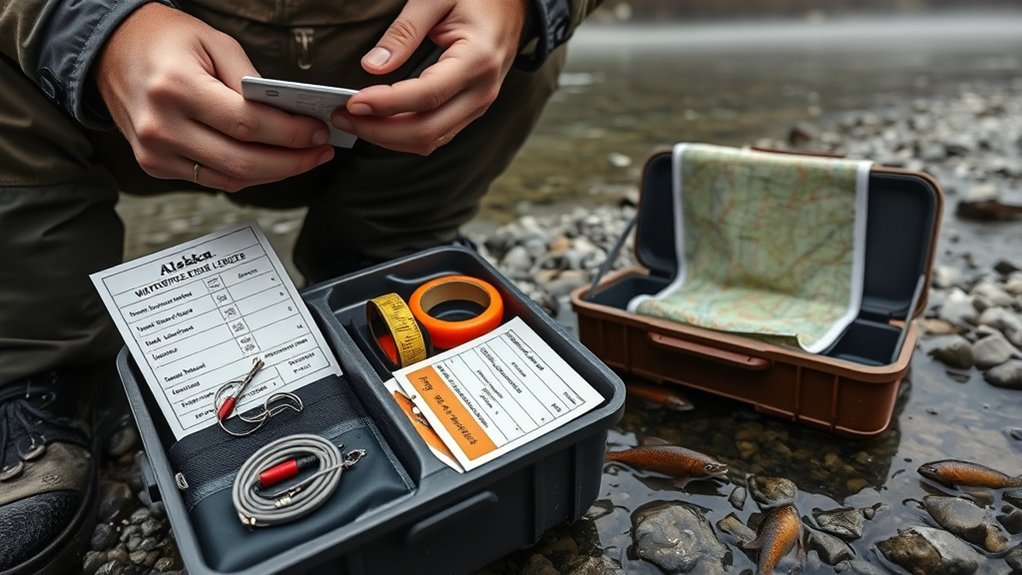
Use this checklist before fishing for trout in Alaska:
- Carry the correct license or exemption credential. Resident adults generally need the $20 annual license, while nonresident adults select a duration-based license.
- Do not buy a trout stamp. Alaska does not require one.
- Add a king salmon stamp when appropriate. This matters if the trip includes fishing for king salmon, even when kings will be released, unless an exemption applies.
- Identify the exact water. A rule for one lake, river section, tributary, or drainage may differ from a nearby location.
- Check species-specific rules. Rainbow trout, cutthroat trout, steelhead, lake trout, Arctic char, and Dolly Varden may be listed separately or in combined limits.
- Review tackle restrictions. Some waters are fly-fishing-only, artificial-lure-only, single-hook, bait-restricted, or catch-and-release.
- Check emergency orders. Visit the ADF&G Emergency Orders and Press Releases page immediately before the trip.
- Record annual-limit fish immediately. Enter the required species, date, and location information after retaining the fish.
- Respect private access. Obtain permission before crossing or fishing from private property. State fishing regulations still apply to the fishery.
- Keep documents available. Licenses, stamps, permits, harvest records, and retained catch must be shown to an authorized officer or ADF&G representative when lawfully requested.
Fishing regulations may change during the season. If this article differs from an ADF&G regulation, permit condition, or emergency order, the official rule controls.
Frequently Asked Questions
Do I need a trout stamp in Alaska?
No. Alaska does not require or sell a separate trout stamp, so the trout-stamp cost is $0. Most adult anglers still need the appropriate sport fishing license, and all anglers must follow the rules for the specific water and trout species being fished.
How much does it cost to fish for trout in Alaska?
There is no separate trout-stamp charge. A resident adult who needs a license generally pays $20 for the annual sport fishing license. Nonresident licenses currently range from $15 for one day to $100 annually. Qualifying youth, senior PID holders, and disabled-veteran cardholders may be exempt from buying the standard license.
Do I need a king salmon stamp if I only catch and release?
Normally, yes. The king salmon stamp applies when fishing for king salmon, not only when retaining one. The requirement is subject to ADF&G exemptions, including the stocked-lake exception and exemptions for certain youth and qualifying resident license or ID holders.
Do trout caught in Alaska need to be tagged before transport?
No general Alaska rule requires an angler to attach a visible tag to ordinary sport-caught trout. However, when someone possesses another angler’s unpreserved fish and the person who caught it is not present, the possessor may need a signed statement listing the fish type and number, where and when they were taken, and the catcher’s license number. Fishery-specific permits can impose additional rules.
Can I release trout without reporting them in Alaska?
Usually, yes. The standard annual harvest record applies when an angler lands and retains a fish subject to an annual limit. Released trout are not entered on that standard record. A special permit, research program, or emergency order may impose different reporting instructions, so check the rule for the specific fishery. Do not tag or mark a live fish unless an official permit authorizes it.
Are trout caught on private land treated differently?
Private ownership mainly affects access. Obtain the landowner’s permission before entering, crossing, parking on, or fishing from private property. The applicable state fishing season, bag limit, size limit, tackle rule, and harvest-record requirement still apply unless a separate law or regulation provides otherwise.
Do Alaska trout regulations change during the season?
Yes. The Board of Fisheries regulations provide the starting rules, but ADF&G can issue emergency orders that open or close waters, change bag limits, create catch-and-release restrictions, or modify fishing methods. Emergency orders may be issued during the season and supersede the published regulation summary.
Is special catch-and-release gear required for trout in some areas?
It can be. Some waters require catch-and-release fishing, a single hook, an artificial lure, or fly-fishing gear. Fly-fishing-only waters have specific fly, hook, and weight rules. Read the regulation for the exact water rather than assuming one tackle rule applies throughout Alaska.
Do children need an Alaska trout fishing license?
Resident children younger than 18 and nonresident children younger than 16 do not need a sport fishing license. A youth angler must still follow all fishing limits and tackle rules and must carry a free harvest record card when retaining a fish subject to an annual limit.
Is a harvest record card required for every trout angler?
No. A harvest record is needed when an angler retains a fish from a species or fishery with an annual limit. Licensed adults can normally use the harvest-record area associated with their license. Unlicensed youth and PID or DV cardholders need a separate free card when an annual limit applies.
Conclusion
The Alaska trout stamp cost is $0 because the state does not require a separate trout stamp. Most adult trout anglers still need the correct sport fishing license: residents generally pay $20 per year, while nonresident licenses range from $15 for one day to $100 annually. Add a king salmon stamp only when fishing for kings and no exemption applies.
Before fishing, confirm the rule for the exact river, lake, or drainage and check current emergency orders. Carry the required license, stamp, permit, or harvest record, and immediately record any retained fish subject to an annual limit. These steps help prevent a licensing or regulation mistake from disrupting the trip.
Sources
- Alaska Department of Fish and Game — Sport Fishing Licenses, King Salmon Stamps, IDs, and Harvest Record Cards — license ages, stamp requirements, exemptions, and harvest records
- Alaska Department of Fish and Game — License, Stamp, and Tag Prices — current resident, nonresident, military, low-income, blind, and king salmon stamp fees
- Alaska Department of Fish and Game — General License Information — validity, electronic licenses, age rules, exemptions, and harvest-record guidance
- Alaska Department of Fish and Game — Sport Fishing Regulations — regional and water-specific fishing regulations
- Alaska Department of Fish and Game — Emergency Orders and Press Releases — current in-season changes that supersede published regulations
- Alaska Department of Fish and Game — Senior and Disabled Veteran Licensing — PID, DV, eligibility, application, and harvest-card requirements
- Alaska Department of Fish and Game — Residency — 12-month domicile and resident-license qualification rules