

If you’re a non‑resident angler in California, you’ll pay $169.82 for an annual sport fishing license (valid 365 days) or choose short‑term visitor options: One‑Day $20.52, Two‑Day $31.58, Ten‑Day $62.90. Some fisheries also require report cards (e.g., salmon $8.90, sturgeon, spiny lobster) and an Ocean Enhancement Validation ($7.05) south of Point Arguello. Reduced veteran/service discounts exist. Carry your license while fishing; continue for purchase steps, validations, and rules.
Who Needs a Non-Resident Sport Fishing License in California
If you’re 16 or older and not a California resident, you must purchase a non‑resident sport fishing license to fish in California waters, unless you’re fishing from a public ocean pier (which is exempt).
You’ll need to meet license eligibility requirements that distinguish residents from non-residents and verify age. Policy dictates that non-resident options include full annual and short-term permits; choose based on trip length and compliance needs.
Confirm residency and age, then choose either an annual or short-term non‑resident fishing permit to match your trip.
You’re responsible for fishing regulations compliance at all times, including carrying the license and any species-specific report cards or validations required by law.
Enforcement focuses on visible proof of authorization and adherence to bag limits, seasons, and gear restrictions. If you fail to hold the appropriate permit, you face citations and potential forfeiture of gear.
To minimize risk, confirm eligibility requirements before you fish, select the correct license duration, and retain copies of any validations tied to targeted species.
Annual Non-Resident Sport Fishing License Fee and What It Covers
Costing $169.82, the Annual Non‑Resident Sport Fishing License lets non‑California residents aged 16 and older fish state waters for 365 days from the purchase date.
You get permission to target a wide range of species under California fishing regulations, and you must carry the license while fishing to remain compliant. The fee directly supports conservation, stock assessments, and habitat management, aligning user-pay policy with resource sustainability.
- License benefits include year-round access for one fee.
- Fee revenues fund fisheries science and habitat restoration.
- You must possess the license on your person while fishing.
- Compliance with fishing regulations reduces enforcement actions.
- The license applies to state waters for 365 days post-purchase.
This is a policy-centered product: the $169.82 price reflects program costs and conservation priorities.
When you buy the annual license, you gain legal access and contribute to resource management, so make certain you understand species rules, size/bag limits, and seasonal closures that remain in force for all anglers.
Short-Term License Options for Visitor Anglers
Looking for a brief visit? You can choose among short term fishing licenses tailored to visitor anglers. You’ll pick a One-Day ($20.52), Two-Day ($31.58), or Ten-Day ($62.90) nonresident option depending on trip length and budget. Each license authorizes legal take for the stated consecutive period and applies to anglers aged 16 and older. Policy note: these short-term licenses are exempt from the Ocean Enhancement Validation that’s normally required south of Point Arguello, reducing compliance steps for ocean visits.
| License Type | Price |
|---|---|
| One-Day | $20.52 |
| Two-Day | $31.58 |
| Ten-Day | $62.90 |
| Age Requirement | 16+ |
Consider license benefits: you avoid annual commitment, match coverage to stay duration, and minimize regulatory add-ons for ocean fishing. Choose the shortest valid option that covers your trip to maintain compliance while optimizing cost.
Required Report Cards and Validations for Non-Residents
When you’re fishing in California as a non-resident, you must carry and complete specific report cards and validations tied to species and location.
Non-resident anglers in California must carry and complete species- and location-specific report cards and validations.
You’re subject to clear report card requirements and validation costs that apply even if a general fishing license isn’t required.
Key mandated items and fees include the North Coast Salmon Report Card ($8.90) for specified rivers, the Sturgeon Fishing Report Card required for all sturgeon take, and the Spiny Lobster Report Card with a non-return penalty if not filed.
Ocean fisheries south of Point Arguello require an Ocean Enhancement Validation ($7.05).
Failure to possess or submit required cards can lead to citations or fines.
- North Coast Salmon Report Card: $8.90, river-specific
- Sturgeon Fishing Report Card: mandatory for all sturgeon activity
- Spiny Lobster Report Card: required; non-return fee applies
- Ocean Enhancement Validation: $7.05 south of Point Arguello
- Always carry completed cards while fishing to remain compliant
Where and How to Purchase Your License
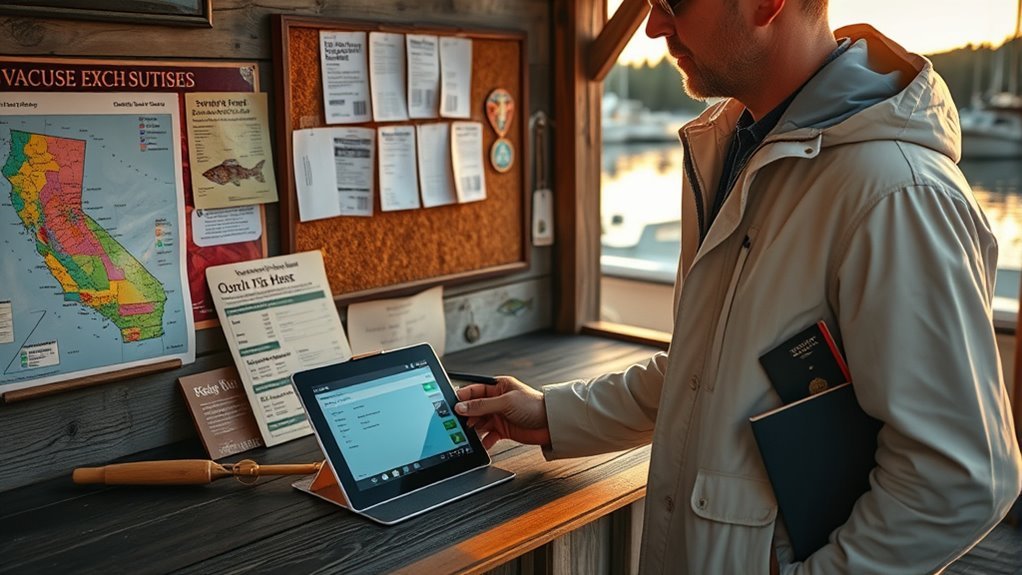
If you plan to fish in California as a non‑resident, you can buy your license online through the California Department of Fish and Wildlife (CDFW), by phone at (800) 565-1458 via an authorized agent, or in person at licensed retailers such as sporting goods stores and bait shops.
Use license purchase methods that match your schedule: online purchases are immediate and provide a printable record; telephone sales via the authorized sales agents number allow card transactions and confirmation; retail agents handle same-day issuance.
The standard non‑resident sport fishing license is $169.82 for ages 16+, valid one year from purchase; a ten‑day option costs $62.90 for consecutive ten‑day use.
Note payment policy: CDFW license sales offices don’t accept cash—use debit/credit cards or checks.
Keep proof of purchase on you while fishing and verify species or area endorsements separately. These procedural details minimize compliance risk and guarantee you meet state licensing requirements.
Reduced and Special-Category Fees Available to Non-Residents
If you qualify as a disabled veteran or recovering service member, California offers reduced or fee-exempt non-resident licenses—verify your status and documentation before purchase.
Short-term visitors can also choose the ten-day non-resident license at $62.90, while eligible low-income or honorably discharged applicants may pay the $9.79 reduced fee or receive a free license in specific categories.
You’ll still need to meet the same reporting and validation requirements as residents to remain compliant.
Disabled Veteran Rates
Although non-resident disabled veterans often face higher recreational fees, California offers a reduced-fee sport fishing license of $10.29 through the Department of Fish and Wildlife that cuts costs for qualifying individuals.
You’ll find this benefit under disabled veteran benefits and fishing license eligibility policies: non-resident veterans get the same access to special-category licenses as residents, promoting inclusivity.
To obtain the $10.29 license, you must submit required forms and evidence, including a VA letter confirming a 50%+ disability rating. The process is designed to be streamlined and verifiable.
- VA disability letter (50%+)
- Completed CDFW application forms
- Proof of non-resident status
- Comparable access to special-category licenses
- Policy supports parity and verification standards
Recovering Service Members
When you’re a non-resident recovering service member, California offers a substantially reduced annual sport fishing license—$9.79 versus the standard $169.82—provided you submit a verification letter from your commanding officer or doctor; that reduced-fee license is renewable up to your documented recovery date without additional paperwork.
You must meet service member eligibility criteria and submit recovery documentation to CDFW to qualify. Policy specifies the verification letter as sufficient proof; once accepted, renewal remains automatic until the recovery date on file.
This reduced fee targets active recovery cases and differs from other exemptions (e.g., low-income or disabled waivers). Keep copies of your verification letter and a clear recovery date to avoid processing delays.
Contact CDFW for application steps and any state-specific confirmation requirements.
Short-Term Reduced Options
Because short-term options give flexibility for visitors, non-residents can choose from one-day ($20.52), two-day ($31.58) or ten-day ($62.90) sport fishing licenses, each valid for consecutive calendar days and subject to the same regulations as resident licenses (including species report card requirements).
You’ll find these short term options targeted to visitor anglers needing temporary access without annual commitment. Fees are fixed: one-day $20.52, two-day $31.58, ten-day $62.90.
Special reduced-fee categories exist for qualifying non-residents (low-income, disability), subject to verification and the same reporting rules. Use the shorter permits for targeted trips; use the ten-day when stays overlap multiple outings.
Check eligibility and carry proof for reduced fees at point of purchase.
- One-day: $20.52
- Two-day: $31.58
- Ten-day: $62.90
- Reduced-fee eligibility required
- Same rules as residents
License Possession, Replacement, and Care
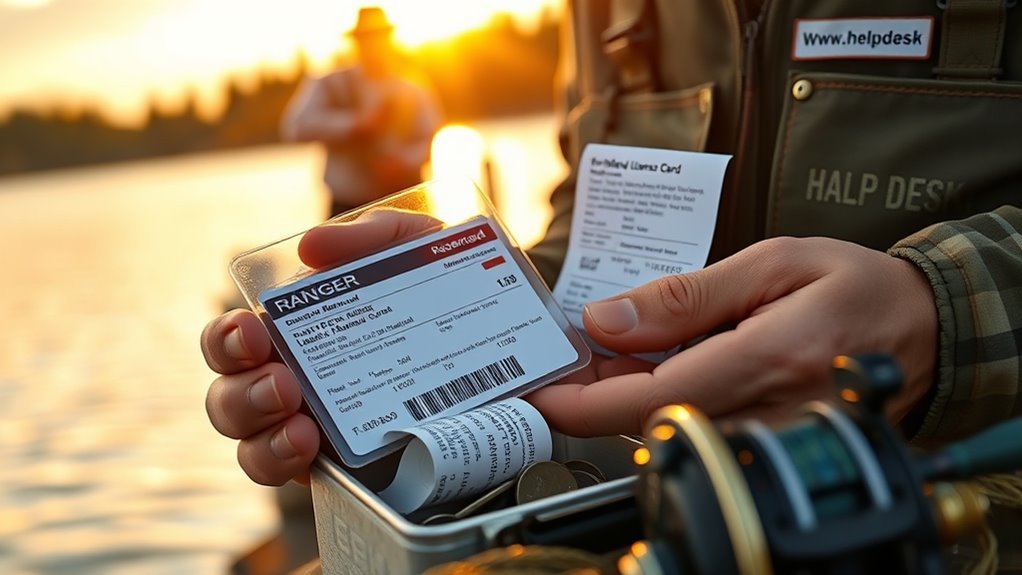
You must carry your California non‑resident sport fishing license (valid 365 days from purchase at $169.82 for ages 16+) on your person while fishing to meet regulatory requirements.
If the license is lost or destroyed, you can purchase a duplicate online, at CDFW offices, or from authorized agents for a small fee to restore legal standing.
Protect the card by storing it in a cool, dry place (avoid heat lamination), since discolored but legible licenses remain valid.
Carrying Your License
Although it’s required that a valid sport fishing license be kept in your immediate possession while fishing (diving excepted), the agency advises against heat-laminating the card since extreme heat can discolor or damage it; discoloration won’t invalidate the license as long as text and signature remain legible.
You must present the license on request for license verification; keep it accessible and protected from heat and moisture to guarantee fishing regulations enforcement can be completed without dispute. Treat the card as an official document: don’t alter signatures or cover information that inspectors need to read.
- Keep the card in an inside pocket or waterproof sleeve.
- Avoid vehicles or gear exposed to high temperatures.
- Don’t laminate; use protective sleeves.
- Store digital purchase receipts with the card.
- Check readability before each trip.
Replacing Lost Licenses
If your sport fishing license is lost or damaged, you can get a replacement online or at a California Department of Fish and Wildlife (CDFW) license sales office for a small fee.
However, sturgeon fishing report card duplicates are only issued in person at CDFW offices.
Follow lost license procedures promptly to avoid citation risk—you’re required to have the license in immediate possession while fishing.
Use the duplicate license process through the online portal or sales office for standard licenses; request sturgeon report card duplicates at a CDFW office.
Don’t heat-laminate licenses; heat can invalidate them.
Discolored licenses remain valid if text and signature are legible, but protect cards from extreme heat and moisture.
Keep documentation of replacement transactions in case of enforcement inquiries.
Protecting License Condition
Having a replacement process doesn’t remove the obligation to keep your fishing license in immediate possession while fishing (except when diving); enforcement expects a readable card or electronic proof on demand.
You’re responsible for license preservation and damage prevention: protect the card from heat, water, and chemicals so text and signature remain legible. Discolored cards stay valid if readable; heat-laminating can cause damage and invalidate the license. If lost or destroyed, obtain a duplicate online or at CDFW offices for a small fee.
- Keep the license in a shaded, cool pocket or waterproof sleeve.
- Avoid heat sources and direct sunlight that can darken printing.
- Don’t heat-laminate or apply adhesives.
- Check legibility before each trip.
- Replace promptly if unreadable or lost.
Rules, Penalties, and Responsible Angling Practices
Because non-resident anglers must buy a Nonresident Sport Fishing License ($169.82 for ages 16+), you should know the legal requirements, penalties, and best practices that govern fishing activity.
You must follow fishing regulations and sustainability practices: adhere to bag limits, size limits, and closed seasons designed to protect stock and guarantee long-term harvest. Certain species require report cards—salmon and sturgeon often need separate reporting even when no additional license is required.
Enforcement is strict: fishing without a valid license can trigger penalties starting at $1,000 and may lead to misdemeanor charges. Inspectors may check licenses and report cards on-site; noncompliance increases fines and potential legal exposure.
Practice responsible angling: respect wildlife, properly dispose of waste, and apply catch-and-release techniques when appropriate to minimize mortality.
Maintaining documentation, knowing season dates, and following posted rules reduces risk, supports conservation objectives, and helps you avoid costly penalties while preserving fisheries for future visitors.
Frequently Asked Questions
Do Non-Residents Need a Separate License for Pier or Shore Fishing?
Yes — you’ll need the appropriate non-resident license for both pier fishing and shore fishing unless an exemption applies. Check specific state regulations, required permits, daily limits, and fee schedules to guarantee compliance before fishing.
Are There Age Exemptions for Visitor Anglers From Other States?
Yes — you’ll usually enjoy limited visitor angler exemptions: most states set age restrictions, commonly exempting those under 16 or over 65, so check specific state regulations and fee tables for exact eligibility and documentation requirements.
Can I Use a California License to Fish in Federal Waters Offshore?
No, you can’t: federal waters require adherence to fishing regulations and often accept state licenses only when federal rules and license reciprocity apply; verify NOAA or regional fishery management policies to confirm applicability and any permits needed.
Do License Fees Fund Specific Conservation Projects I Can Learn About?
Yes — license funding supports conservation projects you can track; think of dollars as seeds sprouting measurable outcomes. You’ll find data-driven reports, grant lists, and project metrics on state wildlife agency and angler-program websites.
Is There a Refund if I Can’t Use My License Due to Travel Cancellation?
Refunds depend on agency refund policies; you’ll typically get no automatic refund for travel disruptions unless the issuing authority offers prorated or emergency exceptions. Check the specific state fish and wildlife policy and documentation requirements promptly.
Conclusion
You’ll pay a clear, stated fee based on residency and license type, and you’re required to carry valid documentation and any report cards or validations while fishing. Short-term options lower cost for brief visits; reduced categories cut rates for eligible non-residents. Follow rules to avoid fines and protect fishery data—compliance feeds management and conservation decisions. Think of your license as a key: it grants legal access while funding science-based policy that sustains the resource.
