

If you plan to fish in California as a visitor, the right license depends on your age, residency, trip length, fishing location, and target species. California’s license fees change periodically, so this guide uses the official 2026 prices and explains the report cards, validations, exemptions, purchase methods, and possession rules that nonresident anglers need to know.
Quick Answer
A 2026 California nonresident sport fishing license costs $174.14 and remains valid for 365 days. Visitor licenses cost $21.09 for one day, $32.40 for two consecutive days, or $64.54 for ten consecutive days. Report cards and area-specific validations may increase the total cost.
Last Updated: July 28, 2026
Key Takeaways
- Most nonresidents age 16 or older need a California sport fishing license.
- The 365-day nonresident license costs $174.14 in 2026.
- One-day and two-day licenses are exempt from the Ocean Enhancement Validation; the ten-day license is not.
- Report cards may be required even when the angler is under 16, fishing from a public pier, or fishing on a Free Fishing Day.
- Most licenses can be displayed through the official CDFW License App, but physical report cards are still required.
- Fishing rules vary by species, water, season, gear, and marine protected area.
2026 Fees at a Glance
| License, Validation, or Report Card | 2026 Fee |
| 365-Day Nonresident Sport Fishing License | $174.14 |
| One-Day Sport Fishing License | $21.09 |
| Two-Day Sport Fishing License | $32.40 |
| Ten-Day Nonresident Sport Fishing License | $64.54 |
| Ocean Enhancement Validation | $7.30 |
| Second Rod Validation | $20.26 |
| Recreational Crab Trap Validation | $2.98 |
| North Coast Salmon Report Card | $9.21 |
| Steelhead Report Card | $10.29 |
| Sturgeon Fishing Report Card | $8.13 |
| Spiny Lobster Report Card | $12.70 |
For 2026, a California nonresident can pay $21.09 for a single fishing day or $174.14 for a license covering 365 days from purchase.
Who Needs a Nonresident Sport Fishing License in California?
In most cases, a person who is 16 or older must have a valid California sport fishing license before attempting to take fish, mollusks, crustaceans, invertebrates, amphibians, or reptiles in California inland or ocean waters.
CDFW generally defines a resident as someone who has lived continuously in California for at least six months immediately before applying. Certain active-duty members of the United States Armed Forces and people enrolled in the Job Corps may also qualify as residents. Other visitors normally pay the nonresident rate.
You do not need the nonresident license solely because you are visiting California. The requirement depends on your age and the activity you perform. Attempting to catch fish can count as fishing even when you release everything you catch.
When a Sport Fishing License Is Not Required
- Anglers under 16: A general sport fishing license is not required, although species report cards may still be required.
- Qualifying public ocean piers: No sport fishing license is required when angling from a legally defined public pier in ocean or bay waters.
- Free Fishing Days: California’s 2026 Free Fishing Days are July 4 and September 5.
These exemptions do not cancel bag limits, size limits, seasons, gear restrictions, closures, or report-card requirements.
Warning: A beach, bank, seawall, private dock, promenade, or ordinary jetty is not automatically a license-free public pier. Check the CDFW public-pier definition and location list before relying on the exemption.
Even on a qualifying public pier, you may need a physical report card when fishing for sturgeon or taking spiny lobster. Species-specific gear limits also remain in force.
Annual Nonresident Sport Fishing License Fee and Coverage
The 2026 California 365-Day Nonresident Sport Fishing License costs $174.14. It is available to nonresidents age 16 or older and remains valid for 365 consecutive days beginning on the purchase date.
For example, a license purchased on July 28, 2026, would generally remain valid through July 27, 2027. It does not expire at the end of the calendar year.
The license authorizes recreational fishing where fishing is otherwise open, but it is not an all-inclusive permit. Depending on where and how you fish, you may also need:
- An Ocean Enhancement Validation
- A Second Rod Validation
- A Recreational Crab Trap Validation
- A salmon, steelhead, sturgeon, or spiny lobster report card
- A local access permit or fee charged by a lake, park, marina, or land manager
Bag limits, possession limits, minimum sizes, seasonal closures, marine protected areas, and gear restrictions still apply. Review the current California fishing regulations for the exact water and species you plan to fish.
Pro Tip: The annual license costs less than three ten-day licenses. It can be the better value when you expect several trips or more than 20 to 30 fishing days spread across the year.
Products Worth Considering

USA, License, plate, Vintage, tag, lot, set, plates, number, wall, decor, art, bar, restaurant, design, gift, cool, nice, american, america, hawaii, alaska, california, texas

Comes with pre-drilled holes for easy installation
Short-Term License Options for Visitor Anglers
California offers three short-term choices for residents and visitors who do not need a full 365-day license.
| License Type | 2026 Price | Validity |
| One-Day Sport Fishing License | $21.09 | One specified calendar day |
| Two-Day Sport Fishing License | $32.40 | Two consecutive calendar days |
| Ten-Day Nonresident Sport Fishing License | $64.54 | Ten consecutive calendar days |
The one-day and two-day licenses are exempt from the Ocean Enhancement Validation requirement. The ten-day license is not exempt. A ten-day license holder fishing in applicable ocean waters south of Point Arguello must also purchase the $7.30 validation.
Short-term licenses do not replace required species report cards. For example, a visitor using a one-day license still needs the appropriate physical report card when fishing for steelhead or sturgeon.
Note: The two-day and ten-day licenses cover consecutive days. You cannot pause the license between outings or divide it into separate weekends.
Products Worth Considering

Durable Material: Car license plate is crafted from high-quality ETP (electrolytic tinplate) with 2 layers of clear epoxy lacquer coating making the car tag water-proof, rust-proof, and weather-resistant

【MATERIAL】: oFloral License plate frame is made from premium quality aluminum, which can provide long-lasting protection from corroding, rusting and aging, durability for long lasting usage.Personalized Car Frame Can Perfect to Put on Your Front of Car or for Decorative Purposes Around the House Like in Your Bedroom, Garage, Basement, Ect.

Material :High-Quality Metal Aluminum With High Gloss Stamped Metal License Plate.Lightweight, Waterproof,Anti-Rust And Very Durable.
Required Report Cards and Validations for Nonresidents
A general sport fishing license may not be the only item you need. California uses validations to authorize certain locations or fishing methods and report cards to collect fishing-effort and catch information for specific fisheries.
Area and Gear Validations
- Ocean Enhancement Validation — $7.30: Required when a fishing license is required in ocean waters south of Point Arguello in Santa Barbara County. It is not required with a one-day or two-day sport fishing license or while fishing from a qualifying public pier.
- Second Rod Validation — $20.26: Allows the use of two rods or lines in many inland waters. It cannot override rules limiting anglers to artificial lures, barbless hooks, or one rod. It is not required for ordinary ocean fishing.
- Recreational Crab Trap Validation — $2.98: Required when using a recreational crab trap as defined by California regulations. It is not required for hoop nets or crab loop traps. Beginning January 1, 2026, anglers using crab traps from a Commercial Passenger Fishing Vessel are no longer required to hold this validation.
Species Report Cards
- North Coast Salmon Report Card — $9.21: Required when fishing for salmon in the Smith River System or Klamath-Trinity River System.
- Steelhead Report Card — $10.29: Required when fishing for steelhead in inland waters.
- Sturgeon Fishing Report Card — $8.13: Required when fishing for sturgeon in California. White sturgeon fishing is catch-and-release only, and green sturgeon may not be targeted or taken. CDFW states that the 2026–2027 card is scheduled to become available August 15, 2026, for the October 1 through June 30 season.
- Spiny Lobster Report Card — $12.70: Required for every person taking spiny lobster. The card must be reported online or returned by April 30 following the season. A person who misses the deadline may be charged a $21.60 non-return fee when buying the following season’s card.
- Abalone Report Card: Not available because the recreational abalone fishery is closed.
Report-card requirements apply even to people who do not need a general fishing license, including children under 16, qualifying public-pier anglers, and people fishing on a Free Fishing Day.
Warning: Proof that you purchased a report card in the CDFW License App does not replace the physical report card. Carry the actual card and complete entries as required by the rules for that fishery.
Report cards follow their own seasons and reporting deadlines. They do not automatically remain valid for the full 365-day term of your general license. Check the CDFW Sport Fishing Licenses and Report Cards page before each trip.
Where and How to Purchase a California Fishing License
You can purchase a California nonresident sport fishing license through any authorized CDFW sales channel:
- Online: Use the CDFW Online License Sales and Services portal.
- By telephone: Call CDFW’s authorized telephone sales agent at (800) 565-1458.
- From a license agent: Sporting-goods stores, bait-and-tackle shops, and other approved retailers may issue licenses.
- At a CDFW office: Select CDFW license sales offices process license transactions and special applications.
Products Worth Considering

CUSTOMIZE NOW – Add your personalized text. (Not embossed or stamped). Printed with a subtle shadow effect to create a dimensional look.
CALIFORNIA STATE FLAG DESIGN: Features a textured, raised California flag design for an authentic, high-end look and feel.

PREMIUM QUALITY: Crafted from high-grade materials, our License Plate is built to withstand the elements and maintain its vibrant appearance over time. It is resistant to fading, cracking, and peeling, ensuring long-lasting performance.
Online Purchase Steps
- Create or retrieve your CDFW customer record.
- Confirm your legal name, date of birth, identification information, and residency status.
- Select the 365-day, one-day, two-day, or ten-day license.
- Add any required validations or report cards.
- Review the start dates carefully, especially for short-term licenses.
- Pay and save the transaction record.
- Print any temporary or short-term document provided by the system and add eligible license items to the CDFW License App.
CDFW states that an online 365-day license purchase can produce a temporary document that is valid immediately for up to 30 days while the physical license is mailed. Short-term documents begin on the date selected during the transaction.
Payment Methods
Online purchases generally require a Visa- or Mastercard-branded credit or debit card. CDFW’s License and Revenue Branch and regional license counters do not accept cash. Those offices accept checks, money orders, and qualifying Visa or Mastercard debit and credit cards.
Pro Tip: Buy report cards before traveling to a remote fishing area. A digital license can work offline after it is refreshed in the app, but a physical report card must still be in your possession.
Reduced and Special-Category License Fees
California offers reduced-fee licenses to certain disabled veterans and recovering service members. These programs can apply to qualifying residents and nonresidents, but applicants must be approved before buying the reduced license.
Other free and reduced-fee programs have separate rules. Some are limited to California residents, so nonresidents should not assume that every disability, senior, or low-income category applies to them.
Disabled Veteran Rates
A resident or nonresident may qualify for a reduced-fee disabled-veteran sport fishing license when the person:
- Was honorably discharged from the United States Armed Forces; and
- Has a service-connected disability rating of at least 50 percent.
The 2026 price is $10.04 at a CDFW office or $10.54 from a license agent.
To prequalify, submit identification and a Department of Veterans Affairs Benefit Summary Letter showing the character of discharge and combined service-connected disability rating. CDFW allows applicants to upload documents through their customer record, mail them to a license sales office, use the agency’s secure upload process, or fax them as directed on the official application page.
Recovering Service Members
A recovering service member is a member of the Armed Forces, National Guard, or Reserve who is receiving outpatient medical treatment, recuperation, or therapy for a serious service-related injury or illness.
The 2026 reduced license costs $10.04 at a CDFW office or $10.54 from a license agent.
The applicant must provide a letter from a commanding officer or military medical doctor confirming eligibility and the expected recovery date. Once CDFW records that date, the member can renew the reduced license through the documented recovery period without submitting the same verification letter each year.
Short-Term Options Are Standard Visitor Licenses
The one-day, two-day, and ten-day licenses are not special disability or income-based discounts. They are standard short-term options available to visitors:
- One day: $21.09
- Two consecutive days: $32.40
- Ten consecutive days: $64.54
A short-term license holder remains subject to the same seasons, limits, closures, and report-card requirements as other anglers.
Note: California’s low-income senior reduced license is limited to qualifying California residents age 65 or older who receive SSI or CAPI. It is not a general discount for nonresident seniors.
License Possession, Replacement, and Care
Your valid license must be on your person or in your immediate possession while fishing, subject to the special rules for divers. You may carry the physical license or display an eligible license through the official CDFW License App.
Carrying or Displaying Your License
The CDFW License App can display resident and nonresident 365-day licenses, one-day, two-day, and ten-day licenses, and several validations.
You do not have to carry the physical license when the app can display the active license on your device. However:
- A screenshot, photograph, or saved image of the license is not valid.
- The license must be displayed through the official app.
- The app should be refreshed while connected to the internet before the trip.
- The app can store refreshed licenses for offline display.
- A dead battery, damaged screen, or malfunctioning phone can leave you unable to show the required license.
- Physical report cards are still required.
For divers, California Fish and Game Code allows a license to remain in the boat when diving from a boat or within 500 yards of shore when diving from shore.
Replacing a Lost or Damaged License
A duplicate sport fishing license can be purchased online, from a license agent, or at a CDFW license sales office. The listed 2026 duplicate sport fishing license fee is $14.30.
Lost report cards are handled separately from ordinary licenses, and the procedure may differ by fishery. Follow the current instructions on the relevant CDFW species page and report any fishing activity recorded on the lost card as required.
Keep transaction confirmations until the replacement appears in your CDFW customer record.
Protecting a Physical License
Store the physical document in a waterproof sleeve or protected pocket. Keep it away from direct sunlight, vehicle dashboards, heaters, fuel, solvents, and other sources of heat or chemical damage.
- Do not heat-laminate a CDFW license.
- Check that the printed text and signature remain readable.
- A discolored license may remain valid when all required information is legible.
- Replace a document that is lost, destroyed, or unreadable.
- Carry a charged phone or a physical backup when relying on the app.
Rules, Penalties, and Responsible Angling Practices
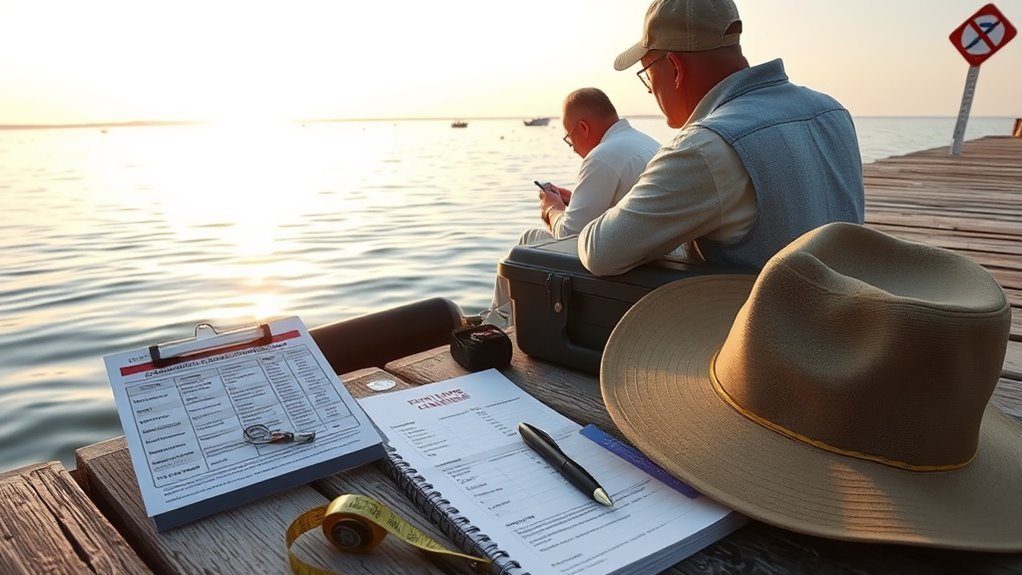
A fishing license authorizes fishing only when the fishery is open and your equipment, location, catch, and conduct comply with current regulations.
Before fishing, confirm:
- The season is open for the target species and location.
- Your hooks, lines, traps, nets, and bait are legal.
- You understand the daily bag and possession limits.
- Every retained fish meets the minimum or maximum size rule.
- You are outside closed areas and marine protected areas where take is prohibited.
- You have the required report card and validations.
- You know whether the fish must be recorded immediately.
California Fish and Game Code Section 12002.2 states that a first violation of the sport fishing license requirement is an infraction punishable by a statutory fine of $100 to $1,000. A second qualifying conviction within five years carries a statutory range of $250 to $1,000.
If a person had a valid license at the time of the citation but failed to display it, and the fishing activity was otherwise lawful, the court may reduce the fine to $25. That provision does not excuse fishing without first obtaining the required license.
Warning: License possession is only one part of compliance. Closed-season, over-limit, undersized-fish, illegal-gear, protected-species, and marine-protected-area violations can carry separate penalties.
Responsible anglers also reduce avoidable harm by handling fish carefully, using an appropriate release tool, keeping undersized or prohibited fish in the water when required, retrieving fishing line and hooks, and disposing of bait and waste properly.
Frequently Asked Questions
Do nonresidents need a license for pier or shore fishing?
A license is not required when angling from a legally defined public pier in California ocean or bay waters. A license is generally required for beach, bank, seawall, dock, and other shore fishing when the angler is 16 or older. Report cards, seasons, bag limits, and gear rules still apply on public piers.
Are visitor anglers under 16 exempt?
Yes. A person under 16 generally does not need a California sport fishing license. The child must still follow all fishing regulations and obtain any required species report card, including cards required for steelhead, sturgeon, North Coast salmon, or spiny lobster.
Are nonresident seniors exempt from buying a license?
No general California exemption applies to nonresident seniors. The low-income senior reduced license is limited to qualifying California residents age 65 or older who receive SSI or CAPI benefits.
Does a ten-day license include the Ocean Enhancement Validation?
No. Only the one-day and two-day sport fishing licenses are exempt. A ten-day license holder must purchase the $7.30 Ocean Enhancement Validation when fishing in applicable ocean waters south of Point Arguello.
Can I display my California fishing license on my phone?
Yes. Most sport fishing licenses and validations can be displayed through the official CDFW License App. Screenshots are not valid. Physical report cards must still be carried when fishing under a report-card requirement.
Can I use a California license in federal waters offshore?
A California sport fishing license is generally the state recreational license used when fishing off California, but state and federal rules can apply at the same time. Federally managed fisheries may have additional seasons, depth limits, closures, gear rules, registrations, or permits. Check both CDFW ocean regulations and NOAA recreational fishing guidance before an offshore trip.
Do fishing license fees support conservation programs?
Sport fishing revenue forms part of the funding used for California fish, wildlife, access, enforcement, hatchery, monitoring, and management programs. Exact allocations vary by account and budget year, so readers seeking project-level details should review CDFW budget and program documents rather than assume that every license dollar is assigned to one specific project.
Can I get a refund after canceling my trip?
Generally, no. CDFW states that sport fishing licenses, validations, and report cards are valid and considered in use from the time of purchase, so the fees are nonrefundable.
Conclusion
A California nonresident sport fishing license costs $174.14 for 365 days in 2026. Short-term visitors can instead pay $21.09 for one day, $32.40 for two consecutive days, or $64.54 for ten consecutive days.
Choose a license that covers every planned fishing day, then check whether your location, gear, or target species requires an additional validation or physical report card. Keep the license available through the official app or as a physical document, review the current regulations for the water you plan to fish, and confirm any seasonal change shortly before your trip.
Sources
- California Department of Fish and Wildlife — Sport Fishing Licenses and Report Cards — 2026 license fees, validations, report cards, reduced-fee programs, duplicates, refunds, and general licensing rules.
- California Department of Fish and Wildlife — CDFW License App — electronic license display, offline access, screenshot restrictions, and physical report-card requirements.
- California Department of Fish and Wildlife — Beach, Pier, Jetty, and Breakwater Fishing — public-pier definition, license exemption, and pier restrictions.
- California Department of Fish and Wildlife — Fishing Regulations — current freshwater and ocean seasons, limits, closures, and gear rules.
- California Fish and Game Code Section 7145 — license age, possession, and diving provisions.
- California Fish and Game Code Section 12002.2 — statutory penalties for sport fishing license violations.
