
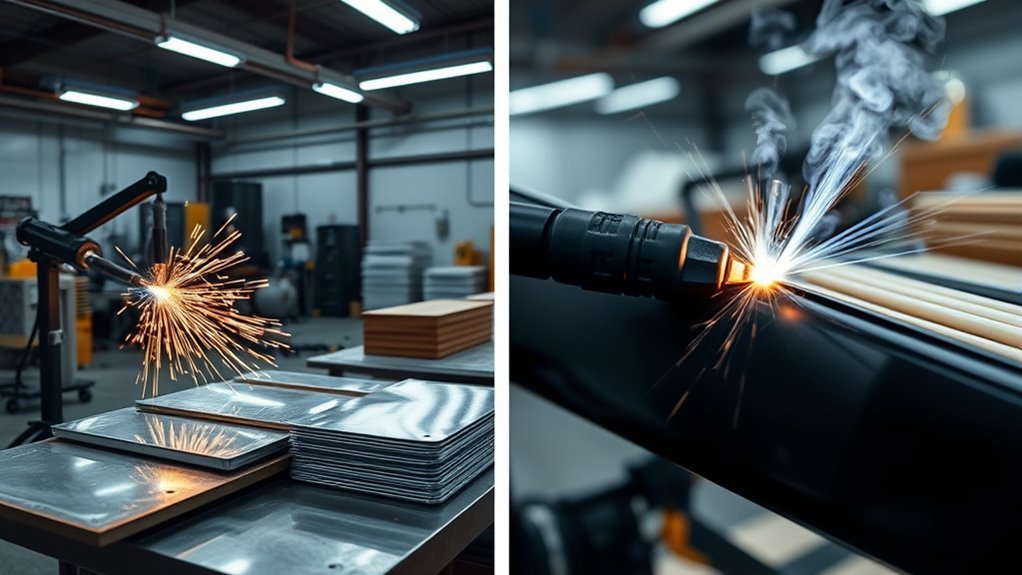
Aluminum welding usually costs more than a small thermoplastic repair because it often adds shielding gas, filler metal, specialized wire feeding or AC TIG equipment, careful cleaning, and skilled labor. The comparison can reverse when plastic welding requires extrusion or fusion machinery, custom tooling, qualified operators, cooling time, or testing. For repairs, aluminum versus plastic is usually not a free choice: the existing part determines the material, and an OEM procedure, code, or engineering requirement may require replacement instead of welding.
Last updated: August 10, 2026
Quick Answer
For a small, permitted repair, aluminum welding generally has a higher setup and consumable cost than basic hot-air thermoplastic welding because aluminum may require AC TIG or aluminum-capable MIG equipment, argon, filler metal, dedicated cleaning, and specialized wire feeding. Plastic welding can cost as much as or more when the job involves professional extrusion, butt fusion, pressure piping, ultrasonic or hot-plate equipment, automation, operator qualification, or extensive testing.
Key Takeaways
- Aluminum is usually more expensive for one-off repairs because shielding gas, specialized wire feeding, filler metal, cleaning, and skilled labor add cost.
- Plastic welding is not one process. Hot-air repair tools can be inexpensive, while professional extrusion, butt-fusion, hot-plate, ultrasonic, and automated systems require greater investment.
- For an existing repair, the material is normally fixed by the part. The real decision may be whether an approved weld repair or replacement is permitted.
- Neither material is automatically stronger, faster, cheaper, or longer-lasting in every application.
- Structural vehicle parts, pressure systems, tanks, and safety-critical components must follow the applicable OEM procedure, code, and inspection requirements.
- Compare complete lifecycle cost, including preparation, labor, testing, finishing, downtime, and replacement risk.
Note: This comparison covers fusion welding of aluminum and compatible thermoplastics. Thermoset materials generally cannot be remelted and welded like PE, PP, PVC, or other thermoplastics. Some products called plastic “welding” may instead use solvents, adhesives, staples, or mechanical reinforcement.
Aluminum vs. Plastic Welding Cost Comparison
| Cost Factor | Aluminum Welding | Thermoplastic Welding |
|---|---|---|
| Entry-level equipment | Usually higher because a complete setup may include an AC TIG machine or aluminum-capable MIG system, wire-feeding equipment, gas cylinder, regulator, torch, and dedicated cleaning tools. | A small hot-air repair kit may cost less, but professional extrusion, fusion, ultrasonic, and automated equipment can require a major investment. |
| Consumables | Filler metal, argon, tungsten or contact tips, liners, nozzles, abrasives, solvents, and dedicated stainless brushes. | Matching rod or extrudate, nozzles, heating elements, filters, scrapers, cleaning materials, and sometimes compressed air. |
| Skill and qualification | Heat control, oxide removal, filler selection, and wire feeding can increase training time. Structural and pressure work may require formal procedure and welder qualification. | Simple cosmetic repairs may have a lower entry barrier, but tanks, geomembranes, and pressure piping can require trained or qualified operators and documented procedures. |
| Cycle time | MIG can provide high deposition rates, while TIG is slower but gives greater control. Cleaning, fit-up, distortion control, and inspection affect total time. | Speed varies widely. Heating, pressure, travel speed, cooling, bead count, and fixturing determine the complete cycle. |
| Typical advantage | Greater stiffness, temperature capability, structural load capacity, and established metal-fabrication practices. | Low weight, chemical resistance, corrosion resistance, electrical insulation, and economical fabrication in suitable applications. |
| Best-value use | Load-bearing assemblies, high-temperature service, transport structures, frames, and durable fabricated parts when the alloy is suitable. | Chemical tanks, liners, ducts, membranes, housings, pipes, and nonstructural repairs when the polymer suits the service conditions. |

This daily devotional helps parents pray purposefully for their children through a full year of Scripture readings, reflections, and guided prayer prompts. Written to encourage faithful family discipleship, it offers practical, biblically grounded support for parents who want to shape their prayers around God's Word. A foreword by Sinclair B. Ferguson adds trusted theological insight and encouragement.

Affresh Washing Machine Cleaner tablets are designed to deep clean inside the washer, helping remove odor-causing residue, grime, soap scum, and bacteria from hard-to-reach components. The slow-dissolve formula helps keep front load, top load, and HE machines smelling fresh and running at their best with a simple monthly cycle.

Meguiar’s Ultimate Compound is designed to remove stubborn stains, bird dropping marks, oxidation, light scratches, and swirl marks from automotive paint. Its advanced abrasive technology helps restore a smoother, clearer finish without scouring clear coats, making it a reliable choice for paint correction before waxing. Use it by hand or with a dual action polisher to prepare your vehicle for a brilliant final shine.
Which Is Cheaper for Common Welding Jobs?
There is no reliable national dollar gap that applies to every aluminum-versus-plastic job. The useful comparison is the complete process required for the actual part. Setup cost and unit cost are also different questions: automation can raise capital cost while reducing labor and per-part cost when production volume is high enough.
| Job Type | Typical Cost Pattern | Main Reason |
|---|---|---|
| Small nonstructural thermoplastic crack | Often a lower-cost repair when hot-air welding is permitted and the polymer is identified. | Modest equipment and consumable requirements can keep setup time low. |
| Small aluminum repair | Often carries higher setup cost than a basic thermoplastic repair. | Shielding gas, filler, cleaning, aluminum-capable equipment, wire feeding, and heat control add requirements. |
| Thick thermoplastic tank or sheet fabrication | Plastic-welding cost can rise substantially. | Extrusion equipment, matching extrudate, multiple beads, operator proficiency, and testing may be required. |
| Thermoplastic pressure piping | No automatic low-cost advantage. | Fusion equipment, alignment, facing, controlled heating and cooling, inspection, documentation, and code requirements can dominate cost. |
| High-volume plastic assembly | High initial equipment cost can lead to low unit cost at sufficient volume. | Ultrasonic, hot-plate, vibration, infrared, or laser systems can automate repeatable joints. |
| Production aluminum welding | Per-part cost does not have to remain high. | MIG, pulsed processes, fixtures, and automation can improve deposition rate and throughput. |
Important: For repair work, aluminum versus plastic is usually not a free material choice. You normally have to repair the material already used in the part, and the applicable OEM procedure, code, engineering specification, or damage condition may require replacement instead of welding.
For deeper standalone pricing, see our aluminum welding cost guide, welder hourly rate guide, and ultrasonic plastic welding machine cost guide.
Cost Drivers: Materials and Consumables
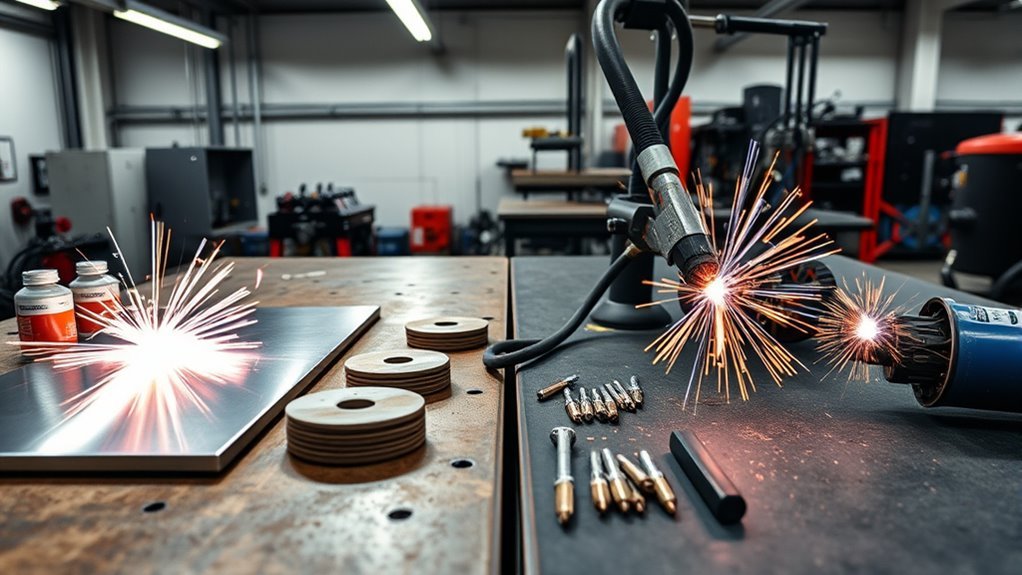
Consumables create a noticeable cost difference in small repair work. Aluminum welding commonly uses argon shielding gas, a compatible filler alloy, torch or gun consumables, and cleaning materials. MIG welding may also need an aluminum-compatible liner, drive rolls, spool gun, or push-pull feeder.
Miller’s aluminum MIG guidance recommends thorough cleaning, suitable shielding gas, appropriate wire feeding, and filler selection. These are not optional details: contamination and poor wire delivery can create porosity, lack of fusion, irregular feeding, or rework.
Filler metal must be selected for the base alloy and service requirements. Common aluminum fillers include 4043- and 5356-family products, but neither is automatically correct for every job. Strength, crack sensitivity, ductility, corrosion conditions, service temperature, and appearance after anodizing may affect the choice.
Thermoplastic welding may use fewer consumables, but it is not always filler-free. Hot-gas speed welding and extrusion welding normally use compatible rod or extrudate. Costs may also include specialty nozzles, heating elements, filters, scrapers, compressed air, and test coupons.
The plastic must first be identified. Welding unknown, contaminated, painted, weathered, or incompatible plastics can produce a weak joint even when the bead looks acceptable. In most cases, the filler and both parent parts should be the same polymer family or a combination approved by the material or equipment supplier.
Pro Tip: Compare the cost of a complete working system, not the advertised price of the power source or heat gun. Include gas delivery, wire feeding, tips, nozzles, filler, ventilation, fixturing, PPE, testing tools, and electrical requirements.
Equipment Requirements and Capital Investment

Aluminum often requires a higher initial investment for low-volume shop work. Depending on the part, a fabricator may use AC TIG, pulsed AC TIG, aluminum-capable MIG, resistance welding, laser welding, or another qualified process.
Common Aluminum-Welding Equipment
- AC TIG machine for controlled welding of many aluminum parts
- Aluminum-capable MIG power source
- Spool gun or push-pull wire-feeding system
- Argon cylinder, regulator, flowmeter, hoses, and leak checks
- Dedicated stainless-steel brushes and clean abrasives
- Fixtures, chill bars, backing, or distortion-control equipment
- Fume extraction, welding helmet, gloves, protective clothing, and fire controls
AC TIG is not the only way to weld aluminum. MIG commonly uses direct-current electrode positive with suitable shielding gas and wire feeding. American Welding Society guidance on aluminum welding explains that GTAW commonly uses AC for aluminum, while GMAW is also a valid production process. Process selection still depends on the alloy, thickness, joint, required quality, and production needs.
Common Thermoplastic-Welding Equipment
- Hot-air hand welder or speed-welding tool
- Extrusion welder for thicker sheet, tanks, and larger beads
- Butt-fusion or socket-fusion machine for compatible pipe
- Hot-plate, infrared, ultrasonic, vibration, or laser equipment for production parts
- Temperature controls, air supply, pressure controls, and fixtures
- Scrapers, beveling tools, rollers, and inspection equipment
- Local exhaust ventilation and heat-resistant PPE
Leister’s plastic-fabrication guidance explains that thermoplastic welding combines thermal energy and pressure and that temperature, pressure, and welding speed must be controlled. Professional plastic fabrication therefore involves more than aiming a basic heat gun at a crack.
The cheapest tool is not necessarily the cheapest process. Setup time, failed joints, inspection, downtime, and replacement risk can cost more than the welding equipment itself.
Skill Level and Labor Costs

Aluminum frequently carries a labor premium because the operator must control heat input, cleanliness, travel speed, filler addition, distortion, and joint fit-up. Soft aluminum MIG wire also requires correct drive-roll pressure and a suitable feeding system.
That does not mean plastic welding is automatically unskilled. ASTM C1147-14(2022) notes that the mechanical performance of welded thermoplastic structures depends heavily on the welding operation, procedure, equipment, and operator proficiency. The standard covers hot-gas, extrusion, and machine welding and can be used to assess welder qualification.
Training and Certification
The required training depends on the work rather than the material name alone. A cosmetic thermoplastic tab repair and a coded chemical-storage tank do not have the same qualification burden. Likewise, a decorative aluminum cover and a structural aluminum frame require different levels of procedure control and inspection.
Possible requirements include:
- Employer or manufacturer training
- Procedure qualification records
- Welder or operator performance qualification
- Production test coupons
- Visual, bend, tensile, leak, pressure, or nondestructive testing
- Documentation required by an OEM, customer specification, AWS code, ASME code, ASTM practice, or local regulation
Course prices and certification costs vary too much by location, process, code, and training provider to support one universal aluminum-versus-plastic price range.
Time to Proficiency
Many beginners find aluminum more difficult than mild steel because the material conducts heat quickly, has a persistent oxide layer, and can move from insufficient fusion to burn-through or distortion with little warning. TIG also requires coordinated control of the torch, filler, travel, and often a foot or hand amperage control.
Basic hot-air plastic repair can be learned more quickly, but repeatable professional plastic welding still requires correct temperature, pressure, speed, preparation, filler compatibility, and bead geometry. Overheating may degrade the polymer rather than improve fusion.
Labor Hour Rates
There is no reliable national rule that aluminum welders bill one fixed amount and plastic welders bill another. Published employee wages are not the same as a shop’s customer-facing rate. A repair invoice may include overhead, insurance, equipment recovery, gas, inspection, administration, travel, minimum charges, and warranty risk.
The U.S. Bureau of Labor Statistics’ May 2025 national Occupational Employment and Wage Statistics data report a mean wage of $27.29 per hour and $56,760 per year for welders, cutters, solderers, and brazers; the median hourly wage was $25.84. Those employee wage figures do not establish a national aluminum repair rate, a thermoplastic welding rate, or a shop’s customer-facing hourly charge.
For a useful comparison, ask each shop to quote the same scope:
- Part identification and condition
- Crack or seam length
- Material thickness
- Access and disassembly
- Preparation and cleaning
- Welding process
- Inspection or testing
- Finishing and coating
- Warranty
- Turnaround time
How to Estimate the Total Welding Cost
A practical estimate should include more than arc time or tool price. Use this formula:
Total job cost = inspection and setup + labor + consumables + testing + finishing + travel or downtime + contingency for approved rework.
1. Inspection and Setup
Identify the material, measure the damage, confirm access, select the process, determine whether the part is repairable, and prepare fixtures. For vehicle, pressure, lifting, or structural work, confirm the governing procedure before estimating a weld repair.
2. Labor
Estimate all hands-on time, including disassembly, cleaning, beveling, tacking, welding, cooling, dressing, inspection, reassembly, and cleanup. A short weld may still incur a minimum service charge because setup can take longer than welding.
3. Consumables
For aluminum, include filler, gas, tungsten or contact tips, liners, abrasives, solvent, and coating materials. For plastic, include matching rod or extrudate, nozzles, heating-element wear, scrapers, reinforcement materials where approved, and test pieces.
4. Testing and Finishing
Add visual inspection, leak testing, pressure testing, test coupons, destructive testing, nondestructive examination, grinding, blending, polishing, painting, anodizing-related work, texture repair, or protective coating as required.
5. Lifecycle Cost
Estimate expected service life, maintenance, access for future repairs, downtime, replacement cost, chemical exposure, fatigue, temperature, UV exposure, and the consequences of failure. A cheap repair is poor value if it fails early or is not permitted by the applicable procedure.
Process Speed, Efficiency, and Throughput
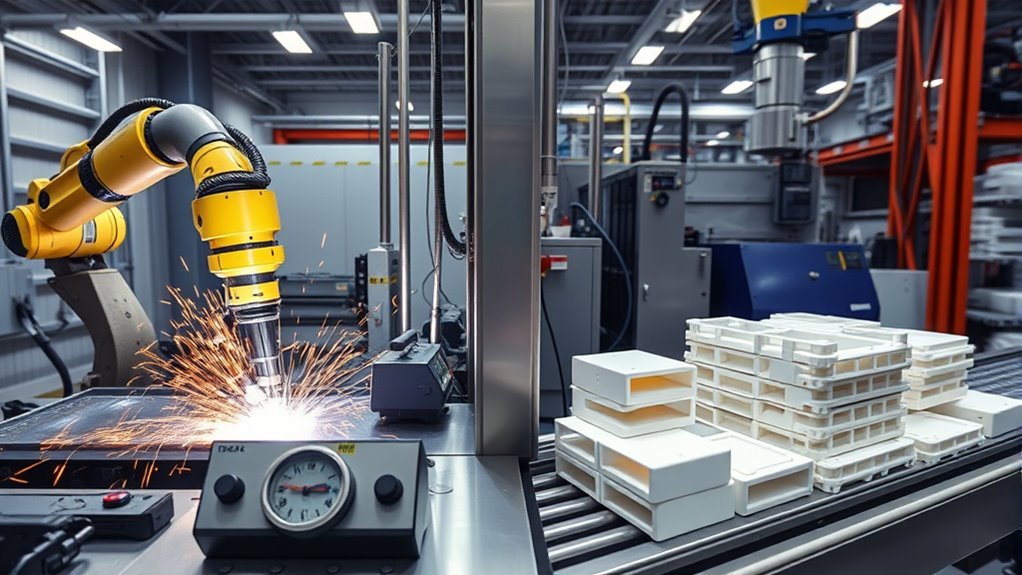
Material alone does not determine welding speed. The useful measure is total cycle time from preparation through inspection.
Aluminum Process Speed
Aluminum MIG can provide high deposition rates and is widely used in production. TIG is normally slower but offers close control for thin material, visible welds, repairs, and complex joints. Automation, pulsed processes, repeatable fixtures, and good fit-up can reduce cycle time.
Aluminum can also increase total time through oxide removal, degreasing, tack sequencing, distortion control, interpass cleaning, crater control, and inspection.
Plastic Process Speed
Plastic-welding speed varies by method. An ultrasonic production weld may be completed quickly, while a thick extrusion weld may require several passes, controlled preheating, cooling, and testing. Butt-fusion work includes facing, alignment, heating, joining pressure, and a specified cooling period.
Hot-gas welding speed depends on the polymer, filler size, nozzle, bead design, material thickness, operator technique, and joint access. Moving too slowly can overheat or degrade the material; moving too quickly can produce poor fusion.
Production Throughput
High-volume manufacturers should compare:
- Parts per hour
- Fixture loading and unloading time
- Heating and cooling time
- Consumable changes
- Reject and rework rates
- Inspection time
- Automation maintenance
- Energy use
- Operator staffing
A plastic process can be faster than aluminum in one production line and slower in another. The process study should use the actual joint and equipment rather than a general material assumption.
Joint Strength, Durability, and Lifecycle Value
Aluminum generally offers greater stiffness, higher useful temperature capability, and better suitability for many load-bearing structures than common thermoplastics. It also provides a favorable strength-to-weight ratio and natural corrosion resistance in many environments.
However, a welded aluminum joint is not automatically as strong as the original base material. Welding can reduce strength in the heat-affected area of some heat-treatable alloys and tempers. Joint design must therefore use the allowable welded properties required by the applicable design standard.
Thermoplastic joints can perform well when the polymer, filler, procedure, and service environment are compatible. Plastics may offer excellent resistance to selected chemicals and do not rust, but designers must account for creep, temperature, UV exposure, permeation, stress cracking, fire behavior, and long-term pressure derating.
ASTM C1147-14(2022) provides a method for evaluating the short-term tensile weld strength of chemical-resistant thermoplastics. Its existence highlights why a plastic weld should be evaluated by procedure and test results rather than appearance alone.
Note: “Stronger” is meaningful only after defining the load, temperature, chemical exposure, required service life, safety factor, joint geometry, and allowed failure mode.

These Stanley MaxSteel straight aviation snips are built for clean, controlled cutting through sheet metal and other tough materials. Serrated cutting edges help prevent slippage for more accurate results, while the double pivot action delivers increased cutting power with less effort. Designed for dependable performance, they are a practical choice for metalworking, HVAC tasks, and general workshop use.

This silky, lightweight K-beauty face primer visibly smooths skin and minimizes the appearance of pores for a refined, velvety look. Its soft-matte finish helps reduce shine and creates a smooth base that supports longer-lasting makeup wear without feeling heavy. Suitable for all skin types, it works well under powder, liquid, or cream foundation and is designed to glide on evenly for a flawless finish.

The COOK'S CHOICE XL Better Breader Bowl makes coating chicken, fish, vegetables, and more fast, tidy, and consistent. Its extra-long tray helps prevent overcrowding, while the integrated sifter promotes even coverage with less waste. Designed for easy cleanup and convenient storage, it is a practical choice for home cooking, air frying, frying, and outdoor meal prep.
Common Applications and Industry Use Cases
The lowest-cost method depends on what the finished part must do. A cosmetic cover, structural frame, chemical tank, pressure pipe, appliance housing, and vehicle bumper system cannot be evaluated by the same rules.
Automotive Repairs and Bumpers
Plastic welding may be suitable for certain bumper covers, tabs, liners, housings, and trim when the polymer can be identified and the vehicle maker permits the repair. The technician may use hot-air welding, approved reinforcement, adhesives, or another OEM-authorized method.
Aluminum body panels may sometimes be repaired or welded, but the procedure depends on the exact vehicle and component. Structural members, bumper beams, reinforcements, crush boxes, and parts near sensors may be replacement-only.
Warning: Never assume a damaged aluminum bumper reinforcement should be welded. Follow the vehicle-specific OEM repair manual. For example, Ford guidance reported by I-CAR states that damaged bumper reinforcements are not repairable and must be replaced. Repairs near radar, parking sensors, or other ADAS components may also be restricted.
For a collision estimate, include scanning, calibration, corrosion protection, one-time-use fasteners, refinishing, and any required destructive test welds. These costs can exceed the price of the visible weld.
Industrial Piping and Tanks
Aluminum may be selected for lightweight structures, selected process equipment, transportation tanks, or services where its mechanical properties and corrosion behavior are suitable. Fabrication may require qualified procedures, compatible filler, leak testing, nondestructive examination, and code documentation.
Thermoplastics such as HDPE, PP, PVC, CPVC, PVDF, and other engineered polymers are used in piping, ducts, liners, and tanks. Their value often comes from chemical resistance and freedom from rust, but the correct polymer must be selected for the fluid, concentration, temperature, pressure, permeation risk, and expected service life.
Plastic pressure systems are not automatically low-pressure or noncritical. ASME NM.1-2022 addresses the design, materials, manufacturing, fabrication, installation, inspection, examination, and testing of thermoplastic pressure-piping systems.
| Design Question | Why It Changes Cost |
|---|---|
| What chemical is being handled? | Material compatibility can determine whether aluminum or a specific polymer is acceptable. |
| What are the pressure and temperature? | Allowable pressure and long-term strength change with material, temperature, wall thickness, joint type, and code. |
| What testing is required? | Leak, pressure, coupon, tensile, visual, or nondestructive testing adds labor and documentation. |
| How costly is downtime? | Access, drainage, cleaning, gas freeing, curing, cooling, inspection, and restart time may dominate the repair cost. |
Consumer Goods and Appliances
Aluminum welding is used in frames, heat exchangers, cookware, housings, transportation products, electronics, and appliances when stiffness, heat transfer, corrosion resistance, appearance, or weight are important.
Plastic welding is common in tanks, containers, housings, toys, appliance parts, medical products, membranes, and automotive components. High-volume manufacturing may use ultrasonic, vibration, hot-plate, infrared, or laser processes rather than handheld hot-air welding.
For production work, the lowest unit cost usually comes from a stable process with short cycle time, low scrap, simple inspection, and reliable automation. A more expensive machine can reduce unit cost when production volume is high enough.
Repairability, Maintenance, and Long-Term Costs
Aluminum can provide long service life, but repairability depends on the alloy, temper, casting or wrought form, crack location, fatigue history, contamination, access, and governing procedure. Some parts can be welded successfully; others should be replaced.
Long-term aluminum costs may include:
- Inspection for fatigue cracking
- Repair of coatings or anodized finishes
- Control of galvanic corrosion where dissimilar metals meet
- Distortion correction
- Qualified repair procedures and testing
Thermoplastic systems do not rust, but they can age through UV exposure, thermal cycling, creep, stress cracking, chemical attack, oxidation, or repeated mechanical loading. Some polymers are easy to repair in the field, while others are difficult to identify, contaminated, reinforced, multilayered, or unsuitable for fusion welding.
Long-term plastic costs may include:
- Polymer identification
- Surface removal around degraded material
- Matching repair material
- Leak or weld-factor testing
- UV protection
- Replacement when the surrounding material has aged or cracked
The best lifecycle choice is the one that remains safe and functional in the actual service environment. Initial welding cost is only one part of that decision.
Choosing the Right Method: Cost vs. Performance
Use the following decision process before choosing aluminum welding, plastic welding, another joining method, or replacement.
1. Identify the Exact Material
For aluminum, determine the alloy, temper, product form, thickness, coating, and service history. For plastic, identify the polymer, reinforcement, additives, weathering, contamination, and whether it is a thermoplastic that can be fusion-welded.
2. Confirm That Welding Is Permitted
Check the drawing, OEM manual, engineering specification, pressure code, tank standard, customer requirement, and equipment manufacturer’s instructions. Do not quote a structural or safety-critical weld before confirming repairability.
3. Define the Required Performance
- Static and fatigue load
- Impact resistance
- Pressure and leak tightness
- Temperature range
- Chemical exposure
- UV and weather exposure
- Appearance
- Expected service life
- Acceptable failure mode
4. Compare the Complete Cost
Include inspection, preparation, fixtures, labor, consumables, equipment, testing, finishing, disassembly, calibration, travel, downtime, warranty, and future maintenance.
5. Consider Alternatives
Depending on the design, a better option may be:
- Adhesive bonding
- Mechanical fastening
- Riveting
- Bolted inserts
- Overmolding
- Plastic staples combined with an approved repair system
- Brazing or soldering where suitable
- Part replacement
- Redesigning the joint for easier assembly or service
Pro Tip: When comparing bids, ask each supplier to state the process, preparation, filler, inspection, finishing, exclusions, turnaround, and warranty. A lower quote may simply omit work included by another shop.
Safety Differences and Required Controls
Both processes can cause burns, fire, eye injuries, and harmful airborne exposure. The controls differ by material and process.
Aluminum-Welding Safety
Arc welding creates intense ultraviolet and infrared radiation, hot metal, electrical hazards, and fumes or gases. Coatings, oils, solvents, paint, and contaminants can create additional hazards when heated.
OSHA’s welding requirements call for ventilation and controls appropriate to hazardous fumes and gases. Appropriate PPE may include a welding helmet with the correct filter shade, safety glasses, flame-resistant clothing, welding gloves, hearing protection, and respiratory protection selected through a proper hazard assessment.
Plastic-Welding Safety
Heating a polymer above its correct processing range can release decomposition fumes. The hazard depends on the polymer, additives, contamination, temperature, and process. Do not weld an unidentified plastic or assume that odor is an adequate warning.
The UK Health and Safety Executive’s guidance on controlling fumes during plastics processing explains how to minimize and control plastics fume during heating, extrusion, and similar processing work.
Warning: Do not weld inside a tank, vessel, enclosed vehicle compartment, or other confined space without a formal hazard assessment. Residues, oxygen deficiency, flammable vapor, and inadequate ventilation can create fatal conditions.
Frequently Asked Questions
Why is aluminum welding often more expensive than plastic welding?
For a small repair, aluminum often requires more setup and consumables, including shielding gas, compatible filler, dedicated cleaning, heat control, and sometimes specialized MIG wire feeding or AC TIG equipment. The advantage can disappear when the plastic job requires extrusion or fusion machinery, tooling, operator qualification, cooling time, or testing.
Can aluminum and plastic be welded together directly?
Not with ordinary aluminum or thermoplastic fusion-welding equipment. Their melting behavior and bonding mechanisms are different. A mixed-material assembly may instead use adhesives, mechanical fasteners, inserts, overmolding, or a specialized industrial hybrid-joining process designed and tested for that material pair.
How do environmental regulations affect welding costs?
Costs may include fume extraction, air monitoring, hazardous-material controls, waste handling, fire permits, worker training, respiratory-protection programs, and recordkeeping. The exact requirements depend on the process, materials, coatings, workplace, and jurisdiction.
Are there safety differences between aluminum and plastic welding?
Yes. Aluminum arc welding involves arc radiation, electricity, hot metal, fire risk, metal fumes, and gases. Plastic welding involves hot tools, burns, fire risk, and polymer fumes that vary with material and temperature. Both require material identification, ventilation, suitable PPE, and process-specific controls.
Can the welding method affect product recyclability?
Yes. A clean aluminum assembly made from compatible alloys is generally easier to place in an established metal-recycling stream than a mixed-material assembly. Plastic recyclability depends on polymer type, additives, contamination, labels, coatings, reinforcements, and local recycling capacity. Joining dissimilar materials can make separation more difficult.
Is post-weld painting or coating costlier for aluminum or plastic?
Either can be more expensive depending on the finish. Aluminum may require oxide control, blending, conversion coating, primer, paint, or restoration of an anodized appearance. Plastic may require texture repair, adhesion promoter, flexible refinishing materials, color blending, and restrictions near sensors. Quote the required finish rather than assuming one material is always cheaper.
Is plastic welding cheaper than aluminum welding for a small nonstructural repair?
A permitted hot-air thermoplastic repair is often cheaper because setup and consumable needs can be modest. Aluminum may still be economical when the shop is already equipped, the part is easy to access, and little finishing is needed. A local scope-matched quote is more reliable than a national price estimate.
Can every type of plastic be welded?
No. Fusion welding is mainly used with compatible thermoplastics. Thermosets do not normally soften and remelt in the same way. Multilayer, fiber-reinforced, heavily weathered, contaminated, or unidentified plastics may also require a different repair method or replacement.
Conclusion
Aluminum welding usually costs more than a simple thermoplastic repair because it often requires shielding gas, specialized filler and wire feeding, careful preparation, and experienced labor. That comparison changes when the plastic job involves professional extrusion equipment, pressure piping, automation, qualification, controlled cooling, or extensive testing.
Choose aluminum when its stiffness, temperature capability, structural performance, or service life justifies the fabrication cost. Choose a compatible thermoplastic when chemical resistance, low weight, corrosion resistance, insulation, or economical production provides better value. For a repair, first confirm that welding is permitted at all. Then compare scope-matched quotes that include preparation, process, testing, finishing, downtime, exclusions, and warranty instead of comparing only the welder or heat gun purchase price.
Sources
- Miller — How to Successfully MIG Weld Aluminum — aluminum cleaning, shielding gas, filler selection, and wire-feeding requirements.
- American Welding Society — Busting the Myths around Welding Aluminum — AC GTAW, GMAW, aluminum filler, and process guidance.
- Leister — Plastic Fabrication Know-How — thermoplastic welding principles, parameters, equipment, and extrusion welding.
- ASTM C1147-14(2022) — thermoplastic weld-strength evaluation and operator-proficiency considerations.
- ASME NM.1-2022 — Thermoplastic Piping Systems — design, fabrication, inspection, examination, and testing requirements.
- U.S. Bureau of Labor Statistics — May 2025 National OEWS Data — national employee wage data for welders, cutters, solderers, and brazers.
- I-CAR — Ford Bumper Reinforcement Repair Guidance — Ford position on damaged bumper reinforcements.
- OSHA 29 CFR 1910.252 — ventilation, confined-space, and safety requirements for welding, cutting, and brazing.
- UK Health and Safety Executive — Controlling Fume During Plastics Processing — plastics-fume exposure-control guidance.

The DeLonghi Water Filter helps reduce scale buildup and unwanted impurities that can affect your coffee machine's performance and taste. Its active carbon and ion-exchange technology helps improve brew consistency, maintain flavor, and reduce the need for frequent descaling. Designed as an OEM authorized replacement part, it fits select DeLonghi models for reliable everyday maintenance.

This versatile makeup brush set includes essential face and eye tools plus two blending sponges for smooth, polished application. Designed with soft synthetic bristles and an ergonomic handle, it helps create even coverage with cream, liquid, powder, and eyeshadow products. The included latex-free sponges expand when wet for a seamless, full-coverage finish and are easy to clean and maintain.

The Wera 889/4/1 K Rapidaptor Universal Bit Holder is built for fast, secure bit changes with one hand, helping you work more efficiently on a wide range of screwdriving tasks. Its self-locking mechanism holds bits firmly and wobble-free, while the free-spinning outer sleeve adds stability during use. Designed to fit standard 1/4-inch hex drive bits, it is a practical accessory for power tools and everyday fastening jobs.
