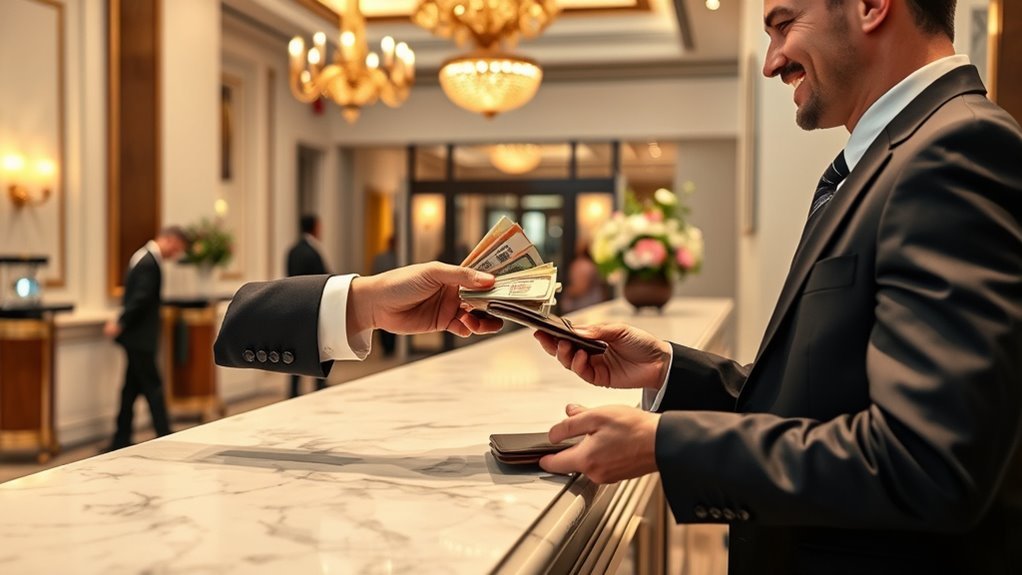
Hotel concierge tipping depends on the service you receive, not the price of your hotel room. In the United States, simple questions rarely require a gratuity, while reservations and personalized arrangements often deserve one. Knowing what counts as routine help, and what takes extra effort, makes it easier to thank the right person without overspending.
Quick Answer
For a U.S. hotel concierge, no tip is needed for directions or simple questions. Consider $5 to $10 for a standard reservation, $10 to $20 for more involved arrangements, and $20 to $50 or more for complex requests or extensive help. These are voluntary guidelines, not required charges. Local customs and hotel policies may differ.
Key Takeaways
- A concierge tip recognizes time, skill, coordination, and problem-solving rather than every conversation.
- A difficult reservation or detailed itinerary can justify more than a routine booking.
- You can tip after each completed task or give a designated total at checkout.
- Digital tips and service charges may be shared among employees, so confirm who receives the money.
- Tipping customs change by destination. U.S. amounts should not automatically be used abroad.
What Does a Hotel Concierge Do?

A hotel concierge helps you plan activities, make arrangements, and solve problems during your stay. Depending on the property, services may include restaurant reservations, event tickets, transportation, tours, spa appointments, and special celebrations.
A concierge can also help before you arrive. For example, you might contact the hotel to arrange anniversary flowers, book several restaurants, or organize transportation from the airport.
A concierge differs from a front-desk agent. Front-desk staff mainly handle check-in, room keys, billing, and room assignments. Concierges focus on destination knowledge and personalized arrangements, although both roles may overlap at smaller hotels.
At some luxury properties, you may see a concierge wearing crossed golden keys. These identify a member of Les Clefs d’Or, an international association of experienced hotel concierges.
Its members are known for their local knowledge and professional connections. However, the golden keys do not create a special tipping requirement. The appropriate amount still depends on the help you receive.
Hotel Concierge Tipping Guide: U.S. Amounts
For most U.S. hotel stays, concierge tips are based on the difficulty of the request. You usually give a flat amount for a completed service rather than a percentage of your room rate.
The following ranges provide practical starting points. They are suggestions, not fixed fees.
Suggested U.S. Tip Ranges
| Service | Suggested U.S. Tip |
| Directions, a map, or a quick recommendation | No tip required; offer a sincere thank-you |
| Standard restaurant, spa, or transportation booking | $5 to $10 |
| Popular reservation, theater tickets, or several coordinated bookings | $10 to $20 |
| Hard-to-get tickets, urgent changes, or a custom itinerary | $20 to $50 or more for substantial work; smaller amounts may also be appropriate |
| Extensive help throughout a luxury stay | Use judgment; $50 to $100+ may fit truly exceptional work |
The Emily Post Institute’s general tipping guide recommends $5 to $10 for tickets or restaurant reservations. For hard-to-get tickets or reservations, it lists $15 or, alternatively, 10% to 20% of the ticket price.
That percentage is an etiquette option for certain ticket arrangements, not a standard rule for every concierge service. You do not need to calculate a tip from the cost of an expensive hotel room or an entire vacation.
A hotel manager interviewed by Southern Living also describes $5 to $10 as a practical amount for a dinner reservation. Larger tips may be appropriate when a concierge spends considerable time organizing several activities or handling complex requests.
The best rule is simple: tip for effort and results, not merely for speaking with the concierge.
When You Do Not Need to Tip
You normally do not need to tip a hotel concierge for a quick question or basic information. These services are part of the assistance available to hotel guests.
Examples include:
- Giving directions inside the hotel
- Providing a map or brochure
- Suggesting nearby restaurants or attractions
- Explaining hotel amenities or opening hours
- Calling your room with basic information
A friendly thank-you is enough for these routine requests.
For example, asking where to find a nearby coffee shop does not normally justify a tip. However, asking the concierge to research several suitable restaurants, compare availability, and arrange a group reservation involves more effort.
The same distinction applies to transportation. Simply pointing you toward a taxi stand is different from coordinating a difficult transfer or finding an alternative ride during a disruption.
You should never feel obligated to hand over money just because you approached the concierge desk.
What Should Affect the Tip Amount?
The right concierge tip depends on the work involved, the difficulty of your request, and the service delivered. Consider the following factors rather than applying the same amount to every interaction.
Time and Complexity
A request requiring several phone calls, research, follow-up, or coordination usually deserves more than a task completed in a minute.
For example, securing one available restaurant table is a routine booking. Planning dinner, transportation, theater tickets, and a surprise celebration for a group requires more work.
The concierge may also need to confirm schedules, communicate with several businesses, and adjust arrangements when plans change.
Difficulty and Access
Hard-to-find tickets, sold-out reservations, same-day changes, and unusual experiences may require persistence and strong local contacts.
A larger gratuity can recognize that additional effort. However, a concierge cannot guarantee access to a fully booked restaurant or sold-out event.
Do not expect staff to bypass rules, pressure another business, or obtain tickets through improper methods.
Also remember that the tip is separate from the price of tickets, transportation, tours, or other services. Ask about any booking fees or cancellation terms before confirming an arrangement.
Urgency and Problem-Solving
Last-minute requests can require extra effort, especially when your original plans have fallen through.
For example, a concierge who finds replacement transportation during a travel disruption may provide more valuable help than one who completes a routine booking.
Urgency alone does not require a higher gratuity. Consider what the employee actually needed to do.
Quality of the Result
Good concierge service includes listening carefully, communicating clearly, following up, and delivering what was reasonably promised.
However, a successful result is not the only factor. A concierge might spend considerable time trying to arrange something that remains unavailable.
If the effort was exceptional but the request could not be completed, a small thank-you tip is still a reasonable choice. It remains voluntary, and you do not have to pay for an unsuccessful request.
Your Budget
Concierge tipping guidelines are flexible. Choose an amount you can comfortably afford instead of feeling pressured to match the largest suggested figure.
A modest tip and sincere appreciation are better than spending beyond your travel budget.
Warning: Do not treat a tip as a bribe or offer money in advance with the expectation that a concierge will break rules. Tip after legitimate service has been completed.
When Should You Tip the Concierge?
You can tip a concierge after a completed task or at the end of your stay. Both approaches are acceptable. The best choice depends on how often you use the service and whether the same employee assists you throughout your visit.
For a single restaurant or ticket reservation, a tip after the booking is confirmed is a straightforward option. You can hand it directly to the concierge who completed the task.
For several arrangements spread across a longer stay, one total at checkout may be more practical. The AAA Club Alliance’s hotel tipping guidance also identifies checkout as a common time to recognize concierge assistance.
If your concierge arranged activities before your arrival, you can thank that person after checking in, when the arrangements are confirmed, or at checkout.
You do not need to tip the same person twice for one completed booking unless they later provide substantial additional assistance.
When more than one concierge has helped, you can tip each person separately. Alternatively, ask whether the hotel has a pooled gratuity system and how the money is distributed.
Pro Tip: Ask for the concierge’s name when making your request. If several employees work different shifts, this helps you direct an end-of-stay or cashless tip to the correct person.
Cash, Digital, and Cashless Tipping Options

Cash remains a simple way to tip a hotel concierge. However, some hotels also offer digital tipping, mobile payments, or the option to add a gratuity to your room bill.
How to Tip a Concierge in Cash
Hand the tip directly to the employee with a brief thank-you. For a small amount, you do not need an envelope.
An envelope can be useful when giving a larger gratuity or leaving a total at checkout. You can write the employee’s name on it to make your intention clear.
Use bills rather than a collection of loose coins. Discreet tipping is generally more considerate than making a public display of the amount.
How to Tip a Concierge Without Cash
Some properties provide QR codes, mobile payment options, or digital gratuity systems. Others may let you request a tip on your room bill.
Before paying, confirm that the option belongs to the hotel and that the money can reach the person you want to recognize.
Digital gratuities may go directly to an employee or into a shared staff pool. The process depends on the hotel’s payment system.
What if You Cannot Leave a Tip?
A written compliment can still recognize excellent work. Mention the employee by name in a guest survey, online review, or message to the hotel manager.
Positive feedback may help management identify employees who provide exceptional service. It does not provide the same financial benefit as a tip, but it is still a useful way to show appreciation.
Check Service Charges and Hotel Policy
Some hotels include gratuities in a package, while others charge separate service fees or follow policies that limit cash tipping. Check what your reservation covers before deciding whether to leave an additional amount.
This matters at all-inclusive resorts, private clubs, and certain luxury properties.
A mandatory service charge is not the same as a voluntary tip. The Internal Revenue Service’s guidance on tips and service charges distinguishes payments freely chosen by customers from charges required by businesses.
In U.S. tax treatment, a mandatory service charge is not considered a tip, even if the hotel distributes some of the money to employees.
As a guest, your main concern is whether the hotel’s existing charge covers concierge gratuities. A resort fee or general service charge does not automatically mean that your concierge receives a direct tip.
Ask the front desk whether concierge gratuities are included, accepted, pooled, or assigned to specific employees.
Note: “Gratuity included” does not always explain who receives the money. Confirm the hotel’s policy before assuming that an added fee goes directly to the concierge.
Tipping a Concierge Outside the United States
Hotel concierge tipping customs vary by country, city, and property. An amount considered normal in the United States may be unnecessary or unusual elsewhere.
These differences are especially relevant when you travel internationally or stay at an all-inclusive resort.
- Japan: Tipping is generally not customary at hotels. The Japan National Tourism Organization explains that tipping is uncommon and not expected. In certain exceptional situations, a discreet gratuity may be offered in an envelope, but this is not a general requirement.
- United Kingdom: Hotel tipping is voluntary and usually not expected. VisitBritain’s hotel guidance confirms that guests can choose to tip for particularly good service without treating it as an obligation.
- Continental Europe: Practices differ between countries and properties. Some hotels include service in their rates, while modest gratuities may be appreciated for exceptional arrangements. There is no single tipping amount that applies across Europe.
- Latin America, the Caribbean, the Middle East, and other parts of Asia: Customs vary by destination and resort type. Some hotels encourage tips, some include service charges, and others discourage gratuities.
When tipping abroad, local currency is usually the most practical choice. If the custom is unclear, ask the hotel discreetly before offering money.
How to Work Well With a Hotel Concierge
Clear requests and respectful communication help a concierge provide better service. You do not need to offer money in advance to receive professional assistance.
Use these practical habits when asking for help:
- Share the details: Give the date, time, party size, budget, dietary needs, mobility requirements, and preferred location.
- Explain your priorities: Say whether price, convenience, atmosphere, accessibility, or a special occasion matters most.
- Be realistic: A sold-out event or fully booked restaurant may remain unavailable despite the concierge’s effort.
- Allow enough time: Contact the concierge early for multiple bookings, large groups, and special celebrations.
- Respond promptly: Confirm your preferred option before availability changes.
- Show appreciation: Thank the employee and recognize exceptional work through a suitable gratuity or a compliment to management.
For example, instead of requesting any restaurant near the hotel, explain that you need a quiet dinner location within walking distance, with vegetarian choices and a suitable table for your group.
That information lets the concierge make more useful recommendations without repeated questions or unnecessary bookings.
Frequently Asked Questions
Are you supposed to tip a hotel concierge?
Not for every interaction. In the United States, no tip is normally needed for directions or simple questions. A tip is appropriate when the concierge makes a reservation, obtains tickets, coordinates plans, or solves a meaningful problem.
How much should you tip for a restaurant reservation?
About $5 to $10 is a practical U.S. range for a standard reservation. Consider $10 to $20 when the restaurant is very popular, the party is large, the request is urgent, or the concierge coordinates extra details.
Do you tip before or after the concierge helps?
Tip after the service is completed. For several requests over a longer stay, you may tip after each major task or give a clearly designated total at checkout.
Do you tip the front-desk person at a hotel?
Routine check-in, key replacement, and billing help do not normally require a tip. If a front-desk employee performs a separate concierge-style task or goes far beyond routine duties, a small tip or written compliment may be appropriate if hotel policy allows it.
Can you tip a concierge without cash?
Often, yes. Ask whether the hotel offers QR-code tipping, mobile payment, or a gratuity added to your room bill. Confirm that the payment will go to the specific concierge rather than a general pool.
Should you tip at an all-inclusive hotel?
Check the property’s rules. Some all-inclusive hotels include gratuities, some allow extra tips, and some discourage staff from accepting cash. Do not assume the policy is the same at every resort.
Conclusion
Hotel concierge tipping should reflect the effort behind the service. Routine questions need only a thank-you, while reservations and more complex arrangements may deserve a gratuity.
For a U.S. hotel stay, $5 to $10 is a useful starting point for a standard booking. Increase the amount for extensive or difficult work when your budget allows. Tip after the service or at checkout, and confirm local customs and hotel rules before giving money.
Sources
- Emily Post Institute: General Tipping Guide — U.S. concierge tipping ranges and no-tip situations.
- Southern Living: Should You Tip a Hotel Concierge? — guidance from an experienced hotel manager on timing, amounts, and cashless options.
- Les Clefs d’Or International — the role and identification of professional golden-keys concierges.
- Japan National Tourism Organization: Tipping in Japan — official guidance on Japanese tipping customs.
- Internal Revenue Service: Tip Recordkeeping and Reporting — distinction between voluntary tips and mandatory service charges.
- AAA Club Alliance: Hotel Tipping Guide — timing of hotel gratuities, checkout tipping, and cashless methods.
- VisitBritain: Accommodation Options — official guidance on voluntary tipping in British hotels.