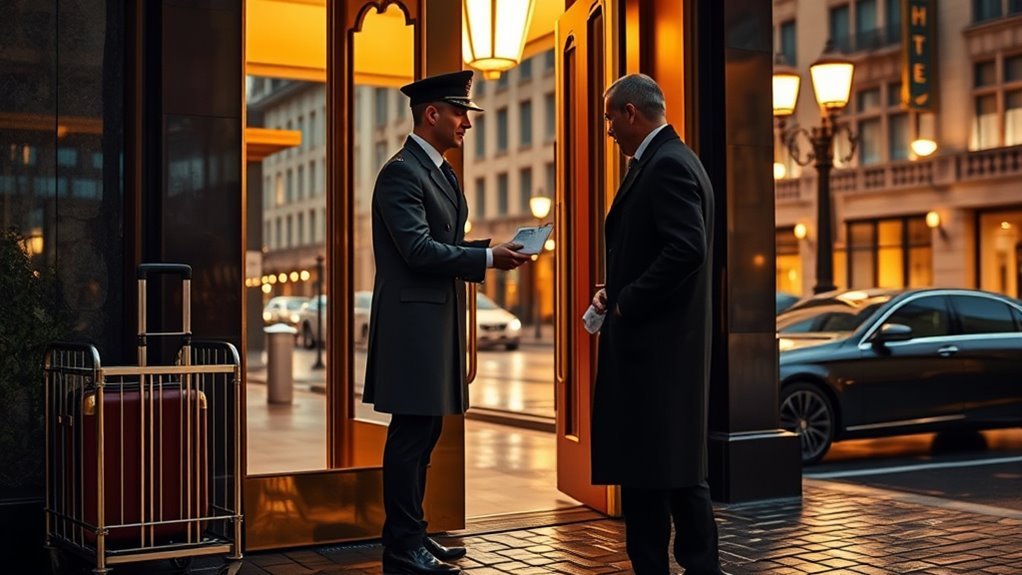
In the United States, you usually do not need to tip a hotel doorman merely for opening the door. A small tip is appropriate when the doorman performs a useful service, such as hailing a cab, handling bags at the curb, finding transportation in bad weather, or solving an arrival problem. The amount should reflect the time, effort, and local tipping culture.
Last updated: September 7, 2026
2026 source check: Doorman amounts were rechecked against Emily Post; cashless hotel-tipping guidance against AAA’s July 23, 2026 update; and QR-code safety against the FTC’s September 3, 2026 alert.
Quick Answer
In the U.S., you do not need to tip a hotel doorman just for opening the door. Emily Post lists $1 to $2 for hailing a cab, plus $1 if it is raining; $1 to $4 when a doorman carries luggage; and $1 to $4 for service beyond normal duty. Repeated separate services can be tipped individually or recognized with one cumulative tip.
Key Takeaways
- A smile and thank-you are enough when a doorman only opens the door.
- About $1 to $2 is the Emily Post range for hailing a cab; add $1 when the doorman does so in the rain.
- For luggage, Emily Post suggests about $1 to $4 when a doorman carries bags; tip bell staff separately if they take over the luggage.
- Emily Post lists $1 to $4 for service beyond normal duty; there is no universal published $5 to $10 hotel-doorman standard for one exceptional task.
- Cash is direct, but some hotels offer verified QR codes, hotel apps, mobile wallets, or other hotel-approved cashless tipping methods.
- International customs vary, so check local tourism guidance instead of automatically applying U.S. habits.
How Much Should You Tip a Hotel Doorman in 2026?
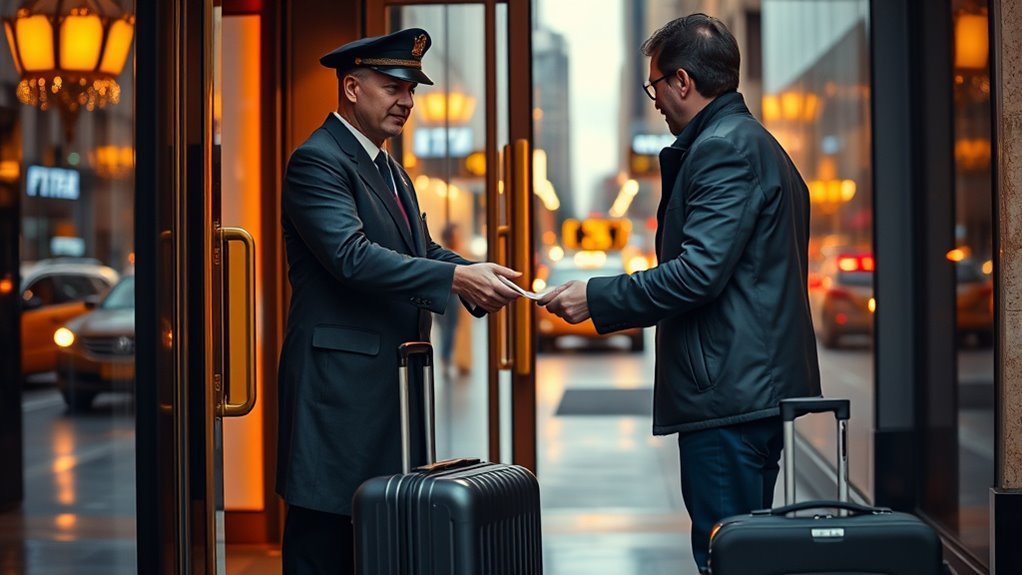
There is no single required hotel doorman tip. The most useful approach is to match the tip to the service performed.
Scope: This guide covers hotel doormen and door attendants. Residential apartment-building doormen follow different tipping customs, especially around the holidays.
According to the Emily Post Institute’s travel tipping guidance, a smile and thank-you are enough when a doorman simply opens the door. Its current travel table lists $1 to $2 for hailing a cab, plus $1 if it is raining; $1 to $4 for carrying luggage; and $1 to $4 for service beyond normal duty.
For a modern U.S. hotel stay, the following ranges are practical:
- Opening the door or offering a routine greeting: No tip is required.
- Hailing a taxi or helping locate a rideshare: About $1 to $2 for quick assistance.
- Giving a quick direction or routine answer: No tip is normally needed.
- Hailing a cab in the rain: About $2 to $3 for a straightforward hail, based on Emily Post’s $1 to $2 cab range plus $1 for rain.
- Handling bags at the curb: About $1 to $4 when the doorman carries luggage; increase the amount when the task takes extra time or effort.
- Beyond-normal or repeated assistance: Emily Post lists $1 to $4 for a beyond-duty service. For several separate services, tip each service or give one cumulative amount that reflects the work performed.
These are voluntary guidelines, not mandatory charges. Do not treat a higher flat amount as required merely because the hotel is expensive, the weather is poor, or the employee is especially friendly; base the tip on the actual service performed.
At a Glance
| Routine Door Opening | No tip required; offer a friendly thank-you. |
| Taxi or Rideshare Help | About $1 to $2 for a normal cab hail; add $1 if it is raining. Treat extra luggage handling or prolonged problem-solving as separate additional service. |
| Luggage Help | About $1 to $4 when the doorman carries luggage; if bell staff take over, tip them separately for their service. |
| Exceptional Assistance | Emily Post lists $1 to $4 for service beyond normal duty. For repeated separate help, tip per service or give one cumulative amount based on the work completed. |
| Best Time to Tip | At the time of service, unless the same doorman assists you repeatedly during a longer stay. |
Doorman vs. Bellhop, Concierge, and Valet
Before deciding how much to tip, identify which employee provided the service. Hotel roles sometimes overlap, but they are not identical.
- Doorman or door attendant: Manages the entrance, opens vehicle doors, welcomes guests, hails taxis, directs rideshare drivers, and may help move bags from a vehicle to the curb or lobby.
- Bellhop, bell attendant, or porter: Carries luggage between the lobby and guest room, stores bags, and may deliver items to the room. See the hotel bellman tipping guide for per-bag guidance.
- Concierge: Provides local information and handles restaurant reservations, tickets, transportation planning, and special arrangements.
- Valet: Parks and retrieves vehicles.
Tip the person who performs the work. If a doorman unloads your bags and a bell attendant then carries them to your room, each employee has provided a separate service. You may tip both, but you do not need to give each person the full amount for the entire luggage journey.
Note: Job titles differ by hotel. At a small property, one employee may act as doorman, bell attendant, and transportation coordinator. Base the tip on the tasks completed, not the name on the uniform.
How to Determine the Right Tip Amount for Service Quality
Look at what the doorman actually did, how long it took, and how difficult the task was. A five-second door opening does not require the same tip as finding transportation during a thunderstorm or controlling several pieces of luggage in a crowded entrance.
The hotel’s price or star rating can affect guest expectations, but it should not be the only factor. A modest hotel employee who provides difficult hands-on help may deserve more than a luxury-hotel employee who performs a routine task.
Factors Influencing the Tip Amount
| Factor | How It Affects the Tip |
|---|---|
| Time | A task that takes several minutes may justify more than a quick greeting or direction. |
| Physical effort | Heavy, oversized, fragile, or numerous bags can justify the upper end of the doorman’s $1 to $4 luggage range. Bell staff use separate per-bag guidance. |
| Conditions | Rain, snow, extreme heat, heavy traffic, and crowded events make curbside work harder. |
| Complexity | Coordinating several vehicles or resolving a transportation problem may merit a larger tip. |
| Frequency | Repeated help from the same employee can be recognized with periodic tips or one larger end-of-stay tip. |
| Local custom | The same service may be commonly tipped in the U.S. but not in Japan or parts of Europe. |
Recognizing Exceptional Service
Exceptional service involves more than friendliness. It usually means the doorman noticed a need, spent extra time helping, or resolved a problem that could have delayed or disrupted your trip.
Examples include locating an accessible vehicle, coordinating several cars for a group, protecting luggage during a storm, finding a lost driver, remembering an important pickup time, or assisting repeatedly during a multi-day stay.
Emily Post lists $1 to $4 for service beyond normal duty. For repeated or multi-step help, there is no universal hotel-doorman total; recognize separate services individually or give one cumulative tip that reflects how many tasks the employee completed and how difficult they were.
Pro Tip: Keep several $1 and $5 bills in an easy-to-reach pocket before arriving. You can then tip the correct employee without searching through luggage at the curb.
When to Tip Your Doorman
For one-time assistance, tip when the service is completed. Immediate tipping makes it clear which task you are recognizing and ensures the correct employee receives the money.
Arrival and Departure
Arrival and departure are the most common times to tip because doormen often help guests move safely between a vehicle and the hotel entrance.
A tip is appropriate when the doorman unloads bags, keeps luggage out of traffic, finds a taxi, directs a rideshare driver to the correct entrance, or assists while you manage children, mobility equipment, or several pieces of luggage.
If the doorman only opens the car or hotel door and offers a greeting, a polite thank-you is enough.
Special Services
Consider a tip when a doorman provides one of these services:
- Quick taxi or rideshare help: About $1 to $2.
- Hailing a cab in the rain: About $2 to $3 for the straightforward cab hail itself.
- Handling bags at the curb: About $1 to $4 when the doorman carries luggage.
- Coordinating several cars or a complicated pickup: Use the $1 to $4 beyond-normal-duty range as a published reference for the doorman’s extra service; recognize additional distinct tasks separately.
- Solving an unusual arrival or departure problem: No universal fixed amount applies; use the published beyond-duty range as a reference and base any cumulative tip on the actual work completed.
Simple directions do not normally require a tip. A tip becomes more fitting when the employee researches an answer, walks you to a difficult-to-find location, or spends meaningful time arranging help.
Frequent Visits and Longer Stays
If the same doorman assists you repeatedly, you can tip each time a substantial service occurs. You can also give one larger tip near the end of the stay, provided you can identify the employee who helped you.
There is no required $20, $30, or $50 long-stay amount. Consider the number of services, their difficulty, and what you have already tipped. For example, several taxi pickups and luggage assists over a week may justify a larger total than one greeting each morning.
When giving an end-of-stay tip, hand it directly to the employee when possible. Mentioning the employee by name in a positive review or manager comment can provide additional recognition without replacing fair wages or turning the tip into a request for preferential treatment.
How Do You Tip a Hotel Doorman Without Cash?
Cash remains the most direct option, but digital hotel tipping has become more common. Current AAA hotel-tipping guidance notes that some properties use QR codes, mobile wallets, hotel apps, or other phone-based payment systems.
Available methods vary by hotel. When you do not have cash:
- Ask the front desk: Confirm whether the hotel has an official tipping platform.
- Check the employee selection: Make sure the system lets you identify the doorman or correct department.
- Ask about card or folio tipping: Some properties may offer an approved way to add a gratuity without cash, but this is not universal.
- Use an official hotel app: This is safer than sending money to an unverified personal account.
- Request change: The front desk may be able to exchange a larger bill for smaller denominations.
Note: Digital tips may be assigned to an individual, pooled by a team, or distributed through payroll. Ask how the system works when you want one specific doorman to receive the tip.
Warning: Verify a tipping QR code with the hotel before entering payment information. In a September 3, 2026 alert, the Federal Trade Commission warns that fraudulent QR codes can lead to fake sites that steal money or personal information. Preview the destination URL and watch for misspellings or switched letters before opening it.
How Tipping Practices Vary Globally for Hotel Doormen
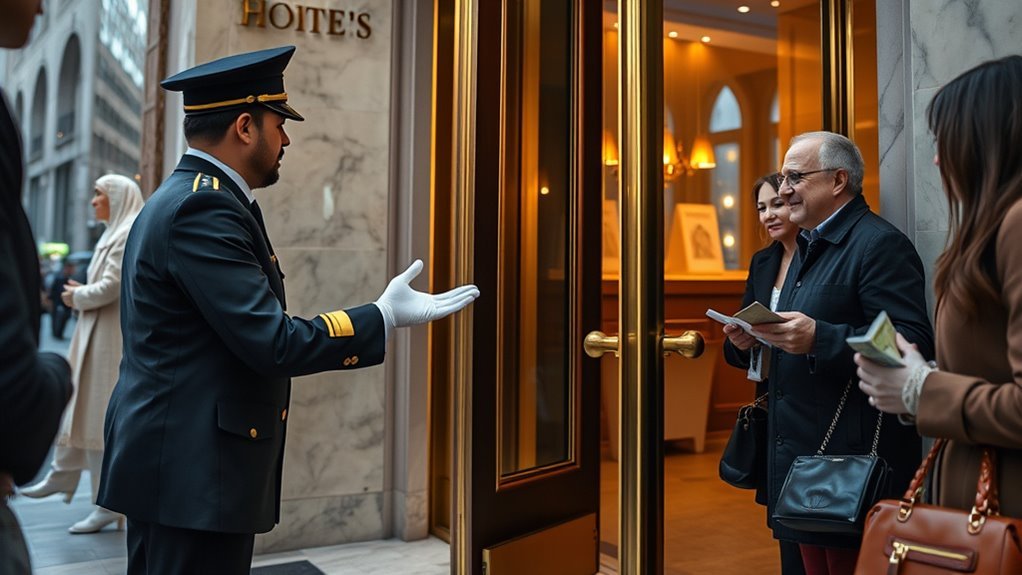
Hotel tipping customs can change from one country to the next. Do not assume that a U.S. dollar amount or custom applies everywhere.
- United States: Small service-based tips are customary for taxi help, luggage handling, valet service, and other hands-on assistance.
- Japan: The Japan National Tourism Organization says tipping is generally uncommon in hotels, restaurants, taxis, and similar services. A sincere thank-you is normally more appropriate.
- Britain: VisitBritain says tipping is not expected to the same degree as in some other countries. It gives approximately £2 as an example when a hotel porter carries luggage to a room.
- Continental Europe: Expectations vary by country, and a service charge may already be included. Check the destination’s official tourism guidance or ask the hotel before tipping.
- Mexico: Tips are common in many tourism settings, but Mexico’s Federal Consumer Protection Agency states that gratuities are voluntary and cannot be demanded as a compulsory charge.
Use local currency when practical, check whether a service charge is already included, and ask the hotel discreetly when customs are unclear.
When to Tip More for Great Service
Tip more only when the doorman performs more work, not simply because the hotel is upscale or the entrance is busy. Emily Post’s published reference is $1 to $4 for service beyond normal duty; if several separate services occur, recognize them individually or with one cumulative tip.
Exceptional Service Recognition
Consider the upper end of the range when the doorman:
- Handles oversized, fragile, or numerous bags.
- Finds transportation during heavy rain, snow, a strike, or a major event.
- Coordinates several vehicles for a family or group.
- Helps resolve confusion involving a driver, pickup point, or missing luggage.
- Provides repeated, personalized assistance throughout the stay.
Do not assume these situations create a standard $5 to $10 charge. Emily Post’s published reference is $1 to $4 for service beyond normal duty. If the doorman performs several separate services, you may tip each one or give a larger cumulative amount that reflects the total work.
Difficult Requests Fulfilled
| Request Type | Practical Tip | What to Consider |
|---|---|---|
| Securing transportation | $1 to $2; add $1 in rain | This is the published cab-hailing reference. If the employee also handles luggage or performs beyond-normal-duty work, recognize that separate service too. |
| Heavy luggage at the curb | $1 to $4 | Use the upper end when the bags are heavy or awkward; if bell staff take over, tip them separately for their service. |
| Complex group pickup | $1 to $4 reference | Use the published beyond-normal-duty range as the reference for the coordination itself; treat luggage handling as a separate service when applicable. |
| Repeated exceptional help | No universal fixed total | Tip each substantial service or give one cumulative end-of-stay amount based on the number and difficulty of services. |
| Memorable special-occasion help | Guest’s discretion | A larger tip is optional when the service required substantial planning or personal attention. |
Busy Days and Major Events
Hotel entrances can become crowded during conferences, sporting events, festivals, holidays, and severe weather. A doorman may need to manage traffic, answer questions, move luggage, and locate vehicles at the same time.
Tip according to the help you personally receive. A busy lobby does not automatically create a higher required tip. For a cab hail, use the $1 to $2 reference and add $1 in rain; for luggage or beyond-normal-duty help, use the separate $1 to $4 reference. If several services occur, recognize them individually or with one cumulative tip.
When You Do Not Need to Tip
A hotel doorman tip is generally unnecessary when:
- The employee only opens the hotel door or offers a routine greeting.
- You receive a quick answer that requires no additional work.
- No personal service is performed.
- The hotel confirms that gratuities are included and distributed to the door staff.
- Local custom discourages tipping.
- The employee politely declines the money.
If a doorman declines a tip, do not insist. Offer a sincere thank-you and consider mentioning the employee’s name to a manager or in a guest survey.
Tipping Mistakes to Avoid at Hotels
The most common mistake is tipping by job title without noticing who completed the task. Watch where your bags go and which employee arranges the vehicle so the correct person receives the gratuity.
Other mistakes include:
- Tipping for every door opening: Routine door service does not require payment.
- Using one flat amount for every task: A taxi hail, five heavy bags, and a complex group pickup involve different levels of effort.
- Assuming a resort fee includes staff tips: Ask whether any mandatory charge is distributed to the doorman or bell team.
- Paying the wrong department: A general hotel charge may not reach the employee who helped you.
- Scanning an unverified QR code: Confirm that the code and payment page belong to the hotel.
- Applying U.S. customs abroad: Check official destination guidance first.
- Using tips to request preferential treatment: A gratuity should recognize completed service, not pressure an employee to break rules or favor one guest.
Warning: Do not assume that a resort fee, destination fee, service charge, or “staff appreciation” charge automatically replaces a direct doorman tip. Ask the hotel what the charge covers and whether it reaches the employee who assisted you. For more detail, see whether tipping is included in resort fees.
How Tipping Affects Hotel Staff
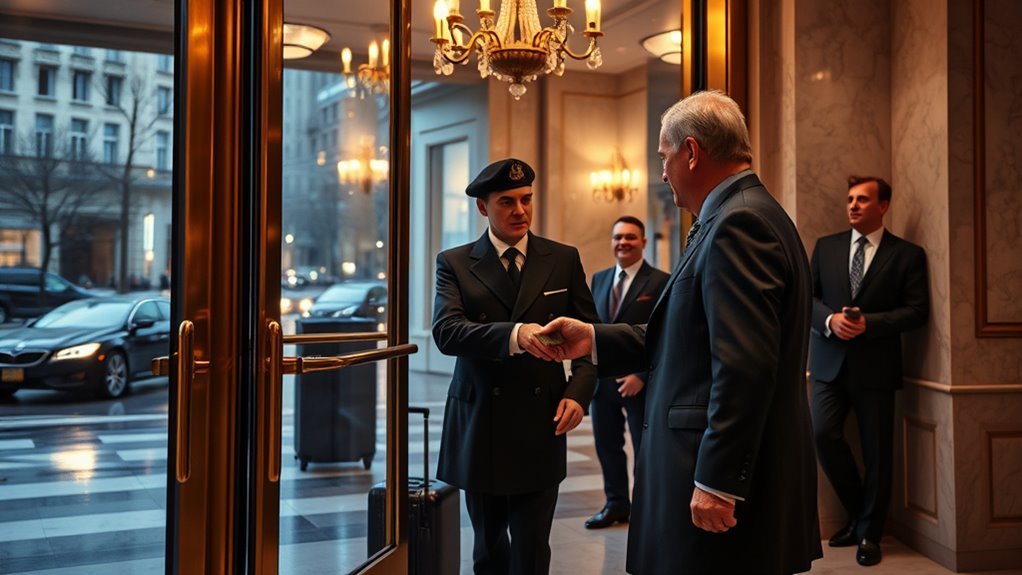
A tip provides direct recognition for useful service and may supplement an employee’s income. It should not be treated as a substitute for fair wages or as a guarantee of special treatment during a future stay.
Guests can also recognize good work by:
- Using the employee’s name when thanking them.
- Submitting a positive guest survey.
- Emailing the hotel manager with specific praise.
- Mentioning the employee by name in a factual review.
- Reporting helpful service to the front desk before departure.
A good hotel tip recognizes a service that required real time or effort; it does not need to accompany every routine interaction.
Recognition is most useful when it is specific. Instead of saying only that the staff was good, explain that the doorman protected your luggage in the rain, located a missing driver, or coordinated a difficult pickup.
A Simple Rule for Doorman Tipping
Use three questions to make a quick decision:
- Did the doorman perform a personal service? If not, a thank-you is enough.
- How much effort did it require? Brief cab help may merit $1 to $2, while luggage or difficult transportation help may merit more.
- What is customary here? Check the hotel and destination before using U.S. ranges abroad.
When in doubt, a small service-based tip is better than applying an inflated flat amount to every interaction. Generosity is welcome, but it remains voluntary.
How to Check Local Tipping Practices
Before traveling, use sources that reflect the destination and hotel rather than relying on one worldwide chart.
- Official tourism websites: These are useful for country-specific customs.
- The hotel’s front desk: Ask whether staff accept tips and which payment methods are available.
- Your room or booking terms: Check whether gratuities or service charges are already included.
- Established etiquette organizations: Use them for general U.S. service guidance.
- Recent hotel guidance: Confirm that an article reflects current cashless options and prices. For trip planning, use the U.S. hotel tipping budget guide to estimate tips across several hotel roles.
When sources disagree, follow the hotel’s policy, local custom, and the actual effort involved in the service.
Sources
- Emily Post Institute — General Tipping Guide — U.S. doorman, bellhop, housekeeping, concierge, and valet guidance.
- AAA Club Alliance — Hotel Tipping: 5 Things Every Traveler Should Know — July 23, 2026 guidance on hotel tipping timing, bell staff, valets, and cashless tipping.
- Japan National Tourism Organization — Tipping in Japan — official guidance on Japan’s low-tipping culture.
- VisitBritain — Useful Travel Information — official British tipping expectations and hotel porter guidance.
- Mexico Profeco — Gratuities Are Voluntary — official consumer guidance covering tourism and hotel services.
- Federal Trade Commission — See a QR code parked somewhere? Don’t scan it…yet! — September 3, 2026 QR-code safety guidance.
Frequently Asked Questions
How much do you tip a hotel doorman for hailing a cab?
Emily Post lists $1 to $2 for hailing a cab and says to add $1 if it is raining. If the doorman also handles luggage or performs beyond-normal-duty work, treat that as a separate service rather than automatically using a higher cab-hailing rate.
Do you tip a doorman every time they open the door?
No. You usually do not need to tip when a doorman simply opens the hotel or vehicle door. A friendly thank-you is enough. Tip when the employee performs additional work, such as finding transportation, handling luggage, or resolving an arrival problem.
What is the difference between a doorman and a bellhop?
A doorman normally manages the hotel entrance, vehicle doors, taxis, rideshares, and curbside arrivals. A bellhop or porter normally carries luggage between the lobby and guest room. Tip the employee who performs each service.
Should you tip a hotel doorman in cash?
Cash is usually the most direct method. When you do not have cash, ask whether the hotel offers an official app, verified QR code, mobile-wallet option, or another hotel-approved cashless method. Confirm that the payment reaches the intended employee.
Does a hotel service charge include the doorman’s tip?
Not necessarily. Resort fees, destination fees, service charges, and staff gratuities can be distributed differently. Ask the front desk whether the charge covers door staff before assuming that a separate tip is unnecessary.
How much do you tip a hotel doorman for carrying luggage?
Emily Post’s U.S. guidance suggests about $1 to $4 when a doorman carries luggage. If a bell attendant takes over and carries the bags to your room, treat that as a separate service and tip that employee separately.
Do you tip a hotel doorman for giving directions?
Usually not for a quick direction or routine answer. A tip becomes more appropriate when the doorman spends meaningful time researching an answer, walks you to a hard-to-find location, or arranges additional help.
Should you tip a hotel doorman at arrival or departure?
Tip when a specific service is completed, whether that happens at arrival, departure, or during the stay. If the same doorman helps you repeatedly, you can instead give a larger end-of-stay tip that reflects the services provided.
Conclusion
Hotel doorman tipping does not need to be complicated. In the U.S., no tip is required for a routine door opening. Emily Post lists $1 to $2 for hailing a cab, plus $1 in rain; $1 to $4 for carrying luggage; and $1 to $4 for service beyond normal duty.
Tip the employee who performs the service, use hotel-approved cashless payment methods when needed, and check local customs before applying U.S. ranges abroad. If one doorman provides several separate services during a stay, tip each substantial service or give one cumulative amount that reflects the work.