
Welding prices are best treated as planning ranges, not fixed national rates. A quick shop repair, a mobile gate repair, and a code-controlled structural weld can have very different totals. The clearest estimate starts with the job location, metal, dimensions, joint condition, finish, and any inspection requirements.
Quick Answer
Most U.S. residential and light-fabrication welders charge about $60 to $125 per hour, often with a one- or two-hour minimum. Your total depends on travel, setup, metal, access, joint preparation, process, finishing, and any engineering or inspection. Get two or three itemized quotes based on the same scope.
Key Takeaways
- A common planning range is $60 to $125 per hour, but minimum charges can control the price of a small repair.
- Mobile work usually costs more because the welder must cover travel, setup, fuel, and equipment time.
- TIG, aluminum, stainless steel, tight access, old coatings, grinding, and inspection can add labor.
- The cheapest process is not always the correct process. The metal, joint, load, and required code should guide the choice.
- For structural, pressure, lifting, vehicle-safety, or life-safety work, hire a contractor qualified for the exact process and application.
At a Glance
| Typical Hourly Range | About $60–$125 for many residential and light-fabrication jobs |
| Common Minimum | One to two labor hours, sometimes plus travel or a call-out fee |
| Main Cost Drivers | Process, metal, thickness, access, preparation, finish, travel, engineering, permits, and inspection |
| Best Budgeting Step | Send the same photos, measurements, material details, and finish requirements to two or three qualified welders |
Typical Welding Prices and National Averages
Current consumer pricing data from Angi’s 2026 welding cost guide places many professional welding services at about $60 to $125 per hour. Small jobs often have a minimum charge, while larger fabrication work may be quoted as a fixed project price.
There is no single national price for a “standard welding job.” A broken chair bracket brought to a shop may take little arc time. A mobile repair can require loading equipment, driving, setting up screens and ventilation, preparing the joint, welding, grinding, and cleaning the site. Custom gates, stairs, trailers, structural members, tanks, and pressure piping require different skills and controls.
The hourly rate is only one part of the bill. Minimum time, travel, preparation, materials, finishing, and inspection can matter just as much.
A contractor’s billable rate is not the same as an employee’s take-home wage. The rate may also cover the welding machine, vehicle, gas cylinders, consumables, insurance, administration, maintenance, nonbillable travel, and business overhead.

The DeLonghi Water Filter helps reduce scale buildup and unwanted impurities that can affect your coffee machine's performance and taste. Its active carbon and ion-exchange technology helps improve brew consistency, maintain flavor, and reduce the need for frequent descaling. Designed as an OEM authorized replacement part, it fits select DeLonghi models for reliable everyday maintenance.

This heartfelt memoir blends laugh-out-loud honesty with tender reflections on love, loneliness, and the unexpected healing power of rescue dogs. Isabel Klee shares her journey fostering pups in the city while navigating dating and self-discovery, offering an intimate, relatable story for readers who enjoy emotional, character-driven narratives. It is a warm, engaging read about opening your heart and finding connection in surprising places.

These Stanley MaxSteel straight aviation snips are built for clean, controlled cutting through sheet metal and other tough materials. Serrated cutting edges help prevent slippage for more accurate results, while the double pivot action delivers increased cutting power with less effort. Designed for dependable performance, they are a practical choice for metalworking, HVAC tasks, and general workshop use.
Common Project Price Patterns
- Small shop repair: Often controlled by the shop’s minimum charge rather than the few minutes spent welding.
- Mobile repair: Usually includes travel and setup, so it can cost more than bringing a portable item to a shop.
- Custom fabrication: Includes measuring, design, cutting, fitting, tack welding, final welding, cleanup, and finishing.
- Structural or code work: May require drawings, a qualified procedure, welder qualifications, inspection, and documentation.
- Emergency or after-hours work: May carry a premium because the contractor must interrupt scheduled work or respond outside normal hours.
Welder Hourly Rates by Experience and Location
For many household repairs and light-fabrication projects, an hourly planning range of $60 to $125 is reasonable. Specialty work can cost more, especially when it involves difficult alloys, pressure systems, critical structures, restricted access, certified procedures, or nondestructive examination.
Location affects the quote in more than one way. High-cost cities may have higher shop rates. Remote and rural jobs may have fewer available contractors and longer travel distances. A local market with several qualified shops may be competitive, but you should not assume that urban or rural work is always cheaper.
What Experience and Credentials Mean
Experience can reduce total hours because an experienced welder may identify the correct process, sequence, filler metal, and heat control faster. Credentials also matter, but they must match the job. The AWS Certified Welder program tests performance for specific procedures, processes, materials, positions, and applications. It is not a blanket approval for every welding task.
Note: Ask what qualification applies to your project. A certificate for one process, position, or material may not cover another.
Cost Breakdown: Labor, Materials, and Overhead

Labor is usually the largest part of a welding bill, but the final estimate should show more than arc time. Ask the contractor to state what is included and what can change.
| Cost Item | What It May Include |
|---|---|
| Labor | Measuring, cutting, fit-up, tack welding, welding, grinding, cleanup, and documentation |
| Base metal | Plate, tube, pipe, sheet, bar, replacement brackets, or fabricated parts |
| Consumables | Wire, electrodes, filler rod, shielding gas, tips, nozzles, grinding discs, and abrasives |
| Mobile service | Travel, fuel, loading, site setup, extension leads, generator time, screens, and fire protection |
| Design and compliance | Drawings, engineering, permits, a welding procedure, inspection, testing, and reports when required |
| Finish | Blending, polishing, passivation, primer, paint, powder coating, or corrosion protection |
Hidden conditions can change the estimate. Cracks may extend beyond the visible area. Old repairs may need removal. Thin, rusted metal may be too weak to weld safely. Coatings can slow preparation and may create hazardous fumes when heated.
Pricing by Welding Method: Stick, MIG, TIG, and FCAW
The welding process affects speed, setup, cleanup, appearance, and the skill needed. Published residential planning ranges from HomeGuide’s welding cost guide show overlap between processes, so use the figures below as rough comparison points rather than guaranteed rates.
| Method | Published Hourly Range | Common Fit | Cost Considerations |
|---|---|---|---|
| Stick (SMAW) | $50–$75 | Outdoor repairs and thicker steel | Portable, but electrode changes and slag cleanup add time |
| MIG (GMAW) | $65–$90 | Shop fabrication and many mild-steel repairs | Fast wire feed can reduce labor, but shielding gas needs protection from wind |
| TIG (GTAW) | $75–$125 | Thin metal, stainless steel, aluminum, and appearance-critical work | Precise control and slower travel often increase labor time |
| Flux-cored (FCAW) | $55–$90 | Thicker steel, field work, and higher-deposition jobs | High deposition can save time, while slag and fume control add work |
The ranges overlap because process choice is only one factor. A simple TIG weld with clean parts may cost less than a difficult stick repair that requires hours of cutting and fitting.
Choose the Process for the Joint, Not the Lowest Rate
MIG is often fast for clean shop work, but it is not automatically the cheapest choice for every job. Stick and self-shielded flux-cored processes can be more practical outdoors. TIG may be required for control, cleanliness, thin sections, or appearance. The welder should select the process after reviewing the base metal, thickness, access, joint design, service load, and applicable specification.
How Metal Type Affects Welding Costs
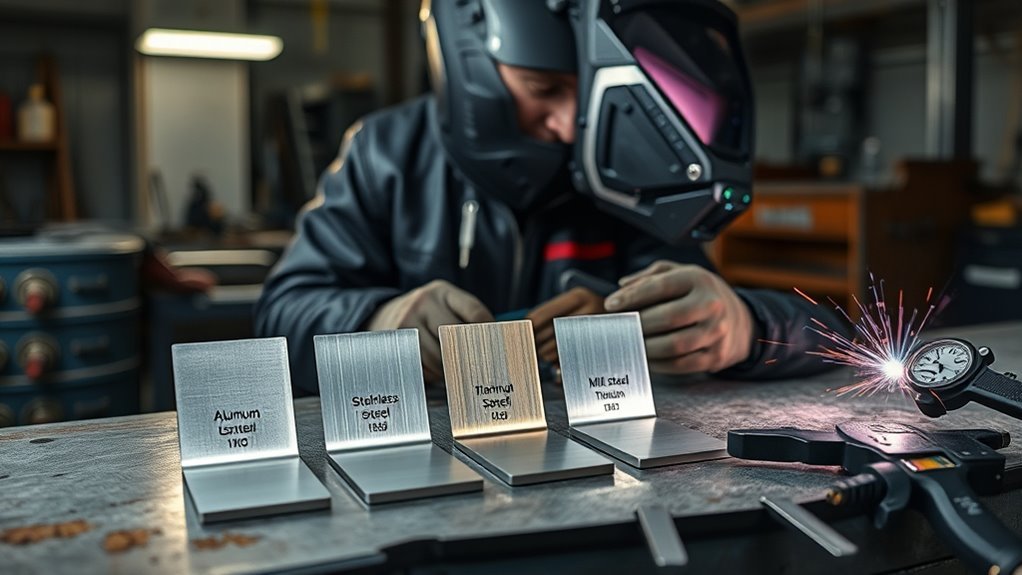
Metal type changes the filler, shielding gas, cleaning method, heat control, and finishing steps. Mild steel is often the most economical option for general fabrication. Stainless steel and aluminum commonly cost more because the material and filler are more expensive and the work may need tighter contamination control or a slower process.
Mild Steel
Mild steel is widely available and works with several common welding processes. It is often a good value for gates, brackets, frames, and repairs when corrosion resistance, weight, or appearance does not require another alloy. Bare steel still needs suitable corrosion protection after welding.
Stainless Steel
Stainless work may require dedicated tools, correct filler selection, controlled heat input, and post-weld cleaning or passivation. Cross-contamination from carbon-steel tools can damage the finish and corrosion performance. These controls can add labor.
Aluminum
Aluminum conducts heat quickly and has a tenacious oxide layer. The welder may need AC TIG equipment, a spool gun or push-pull wire system, careful cleaning, and strong distortion control. Thin or cast aluminum repairs can be difficult to quote until the damaged area is cleaned and inspected.
Coated, Galvanized, and Unknown Metals
Paint, plating, galvanizing, oil, sealants, and unknown coatings can affect weld quality and create hazardous fumes. Identification and safe removal may add time. A spark test, magnet, material marking, drawing, or manufacturer information may help identify the metal, but critical parts may need a more formal material check.
Warning: Do not grind, heat, or weld painted, galvanized, plated, solvent-contaminated, or unknown metal without a safe work plan. OSHA identifies welding fumes, ultraviolet radiation, burns, electrical shock, eye injury, and fire as major hazards. Keep occupants away and use suitable ventilation, PPE, screens, and fire controls.
Estimating Small Repairs and Mobile Welding Fees
Small repairs are often priced by a minimum charge rather than by exact arc time. A contractor may bill one or two labor hours even when the weld itself takes only a few minutes. That minimum covers communication, setup, equipment, cleanup, and the time reserved for the job.
Mobile welding may add a call-out fee, mileage, travel time, generator time, or a higher minimum. Ask whether the quote includes travel both ways and whether the rate changes after a certain distance.
Information to Send for a More Accurate Quote
- Clear photos from several angles, including the full item and close-ups of the damage
- Basic dimensions and metal thickness, when known
- The metal or alloy, if marked or documented
- Whether the item can be taken to a shop
- Access conditions, nearby combustibles, ceiling height, stairs, and working space
- Available electrical service and whether outdoor work is exposed to wind or rain
- The load or use of the part and whether failure could injure someone
- The desired finish, such as an as-welded surface, smooth blend, primer, paint, polish, or passivation
- Your deadline and whether work must occur after hours
Pro Tip: Put a ruler or tape measure in one photo. It gives the welder scale and can reduce back-and-forth before an onsite visit.
Additional Costs That Are Easy to Miss
- Cutting and removal: Failed welds, bent pieces, or rusted sections may need to be removed first.
- Fit-up and fixturing: Parts must be aligned, clamped, and held in position before final welding.
- Machining or formed parts: Replacement components may need drilling, bending, rolling, or machining.
- Surface finish: Grinding a weld flush or polishing stainless can take longer than making the weld.
- Coating repair: Primer, paint, powder coating, galvanizing repair, or passivation may be separate.
- Engineering and drawings: Load-bearing changes may need a design professional.
- Permits and inspection: Requirements depend on the project and local authority.
- Testing: Dye penetrant, magnetic-particle, ultrasonic, radiographic, or other examination may be required for critical work.
- Tax and disposal: Sales tax, shop supplies, and disposal fees may appear as separate lines.
Structural and Safety-Critical Welding
Do not select a welder for a structural or life-safety repair by price alone. Stairs, guardrails, beams, columns, lifting points, trailers, vehicle frames, pressure vessels, piping, and equipment supports can fail with serious consequences.
For structural steel, the AWS D1.1/D1.1M:2025 Structural Welding Code—Steel is the current AWS edition as of July 2026. The code addresses design, fabrication, procedure qualification, welder qualification, and inspection. The version enforced on a project still depends on the contract documents and the code adopted by the local authority.
A critical-work quote may need to identify the drawing revision, base metal, welding process, Welding Procedure Specification (WPS), welder qualification, inspection hold points, acceptance standard, and records to be delivered.

OGX Extra Strength Damage Remedy + Coconut Miracle Hair Oil helps hydrate dry, coarse hair while smoothing frizz and flyaways for a silky finish. This nourishing leave-in treatment blends coconut oil, vanilla bean extract, and tiare essence to add softness, shine, and a pleasant scent. It is paraben-free and designed to support a restorative hair care routine for medium to coarse hair types.

Post-it Super Sticky Easel Pads are designed to keep ideas visible and organized during meetings, training sessions, brainstorming, and project planning. The large premium paper resists marker bleed-through and sticks securely to many surfaces, then repositions without surface damage. A sturdy backcard and portable handle make them easy to move between rooms and use with most easel stands.

Aegend Swim Goggles are designed to help swimmers enjoy a clear, comfortable, and secure fit in the pool. Built for adults and youth, they aim to reduce leaking and provide full eye protection for training, recreation, and water sports. Their versatile design makes them a practical choice for men and women looking for dependable swim eyewear.
Ways to Save on Welding Projects
- Bring portable items to the shop. This can avoid travel and onsite setup charges.
- Send complete information. Photos, dimensions, material details, and a clear finish requirement improve quote accuracy.
- Clear safe access. Move unrelated items and vehicles, but do not disturb structural supports or hazardous coatings.
- Combine small repairs. Several shop repairs completed under one minimum may cost less than separate visits.
- Choose a simple design. Fewer parts, straightforward joints, and standard material sizes can reduce cutting and fit-up.
- Decide the finish in advance. “As welded,” “ground smooth,” and “paint-ready” are different scopes.
- Compare the total, not only the hourly rate. A higher-rate welder may finish sooner and produce less rework.
Do not buy substitute metal or cut parts to final size without the welder’s approval. The wrong alloy, thickness, edge preparation, or fit can increase cost or make the repair unsafe.
Questions to Ask When Getting Welding Estimates
- Is this a fixed price, a time-and-materials estimate, or a not-to-exceed quote?
- What minimum labor, travel, or call-out charge applies?
- What preparation, cutting, fitting, grinding, cleanup, and finish are included?
- Who supplies the base metal, filler, shielding gas, and replacement parts?
- What conditions could change the price after work begins?
- Have you completed similar work on this metal and joint type?
- Does this job require a specific WPS, welder qualification, permit, engineer, or inspection?
- Will you provide proof of applicable licensing and insurance?
- What workmanship warranty, if any, is included in writing?
- What payment schedule and change-order process will be used?
General liability coverage can help protect against property-damage and bodily-injury claims. The U.S. Small Business Administration’s insurance guide explains common business coverage, but requirements and policy limits vary. Ask for a current certificate and confirm that the work and location are covered.
Using a Welding Cost Calculator and Sample Estimates
A useful calculator should not rely on weld length alone. Use this structure:
Estimated total = greater of the minimum charge or labor estimate + base metal and fabricated parts + consumables + travel/site fees + finishing + engineering/permit/inspection + applicable tax.
Estimate labor by listing each task: measure, cut, clean, fit, tack, weld, cool, straighten, grind, inspect, coat, and clean up. Then apply the contractor’s rate. Add a contingency only when the scope contains known uncertainty, such as hidden corrosion or an old repair that must be opened.
Sample Welding Estimates
These examples show the math only. They are not guaranteed market prices.
| Example | Assumptions | Illustrative Total |
|---|---|---|
| Small shop repair | 1.5 hours at $80 + $25 consumables + $20 preparation | $165 |
| Mobile gate repair | 2 hours at $100 + $75 call-out/travel + $40 materials | $315 |
| Precision aluminum TIG repair | 3 hours at $115 + $60 materials/gas + $50 preparation and finishing | $455 |
When Replacement May Cost Less Than Repair
Repair is not always the best value. Replacement may be safer or cheaper when the base metal is deeply rusted, cracked in several places, too thin to support a sound weld, distorted beyond practical alignment, or part of a low-cost mass-produced item.
Ask the welder to compare repair cost with replacement cost and expected service life. For safety-critical items, the decision may require the equipment maker, a qualified engineer, or the authority responsible for inspection.
Frequently Asked Questions
How long does a welded joint typically last?
There is no universal lifespan. A properly designed and made weld can remain serviceable for many years, but life depends on the base metal, joint design, load cycles, corrosion, temperature, impact, workmanship, and maintenance. Inspect cracks, rust, distortion, or loose connections promptly.
Do welders carry insurance for accidental property damage?
Many established welding contractors carry general liability coverage, but coverage is not automatic or identical. Ask for a current certificate of insurance, confirm the policy applies to the work location and scope, and check any licensing or insurance rules in your state or city.
Can welding create health hazards for nearby occupants?
Yes. Fumes, gases, ultraviolet radiation, sparks, hot metal, noise, and fire can affect workers and nearby occupants. The work area may need ventilation, welding screens, removal of combustibles, a fire watch, and restricted access. Never let people watch an arc without proper eye protection.
Are warranties or guarantees included with welding work?
Sometimes. A workmanship warranty is not automatic, and it may exclude corrosion, abuse, overloading, design defects, customer-supplied material, or failure elsewhere in the assembly. Ask for the term, covered defects, exclusions, and remedy in writing before work begins.
Do local permits or codes affect residential welding jobs?
They can. A portable furniture repair may not need a permit, while work on structural members, stairs, guards, buildings, fuel systems, or other regulated equipment may require permits, engineering, or inspection. Check the local building department and the authority responsible for the equipment.
Why can a ten-minute weld still cost more than $100?
The bill includes more than arc time. The welder must communicate with you, reserve time, prepare equipment, travel or receive the item, clean and fit the joint, weld, inspect, grind if needed, and clean up. A one- or two-hour minimum is common for small work.
Should I choose the lowest welding estimate?
Not without comparing scope. Check whether each quote includes preparation, materials, travel, finish, inspection, insurance, and warranty. For critical work, also compare the proposed procedure and the welder’s job-specific qualifications.
Conclusion
For many residential and light-fabrication jobs, use $60 to $125 per hour as a starting range, then add the effects of minimum time, travel, materials, preparation, finishing, and compliance. The most reliable budget comes from a written scope and itemized quotes based on the same information.
Do not trade safety for a lower rate. For structural or other critical work, confirm the applicable drawings, procedure, qualifications, inspection, insurance, and written warranty before the job starts.
Sources
- Angi — How Much Do Welding Projects Cost? (2026 Data) — current consumer hourly range, minimum charges, travel, preparation, and price factors.
- HomeGuide — How Much Does Welding Cost? — residential hourly ranges by welding process and common minimum-fee practices.
- Occupational Safety and Health Administration — Welding, Cutting, and Brazing Hazards and Solutions — fumes, radiation, burns, electrical, eye, and fire hazards.
- American Welding Society — D1.1/D1.1M:2025 Release — current structural-steel code edition and its scope.
- American Welding Society — Certified Welder Program — performance-based, procedure-specific welder qualifications.
- U.S. Small Business Administration — Get Business Insurance — general liability and other common business coverage.

This cordless mini dehumidifier helps keep small spaces dry, fresh, and odor-free without spills, cords, or batteries. Its rechargeable silica gel design is ideal for closets, cabinets, cars, bathrooms, boats, and gun safes, with a moisture indicator that shows when it is ready to recharge. Compact and easy to place or hang, it offers a simple low-maintenance solution for controlling humidity in tight areas.

Nature Made Burp Less Fish Oil provides omega-3 support for heart health in easy-to-take softgels designed to help reduce fish burps. Each serving delivers concentrated EPA and DHA from purified fish oil sourced from wild-caught ocean fish, with no artificial colors, flavors, or preservatives. This gluten-free, dairy-free supplement is a trusted daily option for adults looking to support overall cardiovascular wellness.

This compact Bible study guide helps readers explore Scripture with clarity and confidence. Written by Matt Whitman, it offers a fast, approachable companion for understanding key themes, context, and practical insights from the Bible. Its paperback format makes it easy to carry, reference, and use for personal study or group discussion.
