

You’ll need roughly $2,500–$3,200 monthly to live comfortably in Uruguay, with Montevideo on the lower end and Punta del Este costing more. Rent for a two-bedroom runs $850 in Montevideo and about $1,200 in Punta; smaller beach towns are cheaper. Groceries for two are about $900–$1,000, transport low, utilities modest, and healthcare far cheaper than U.S. private plans. Keep going to see itemized budgets, neighborhood trade-offs and saving tips.
Housing Options and Rental Prices

If you’re comparing coastal and urban options, expect wide variation: in Montevideo a new two‑bedroom unfurnished apartment rents for about $850/month (studios around $530) including gastos comunes, while in Punta del Este furnished two‑bedrooms run near $1,200 and studios about $700.
Smaller seaside towns like Atlántida and Piriápolis offer lower purchase prices ($125k–$180k), and upscale executive homes east of Montevideo sell for $400k–$1M or rent from roughly $3,000/month, with security deposits often equivalent to several months’ rent held by a third‑party bank.
Smaller seaside towns like Atlántida and Piriápolis offer cheaper buys; executive homes east of Montevideo reach $400k–$1M.
You’ll find housing options that reflect lifestyle tradeoffs: urban units balance access and cost, resort properties carry premium rental prices for furniture and location, and smaller coastal towns reduce purchase entry points.
If you plan to rent, factor in third‑party deposit custody and higher short‑term rates in Punta del Este.
If you’re buying, compare coastal resale values to suburban executive markets east of Montevideo to match budget and intended use.
Grocery Costs and Eating Out

While whole foods in Uruguay often cost the same or less than in North America, processed items usually run pricier, so you’ll save most by buying fresh produce—especially at Montevideo’s twice-weekly ferias—where a two-person household can expect monthly grocery bills of roughly $900–$1,000.
Eating out shifts the equation, with breakfasts around $4–$8, lunches $15–$20 and dinners about $30, and the local habit of four meals a day means dining expenses can add up unless you prioritize market shopping and home cooking.
You’ll find grocery costs concentrated in staples: seasonal fruit, vegetables, rice, beans and local dairy tend to be affordable, while imported or branded processed goods push totals up.
When you compare neighborhoods, access to ferias materially reduces your monthly food spend versus relying on supermarkets.
For dining out, treat occasional lunches or dinners as budgeting levers: choosing midday menú del día options or shared plates will cut per-person dining out expenditures without sacrificing the regional cuisine experience.
Transportation and Owning a Car
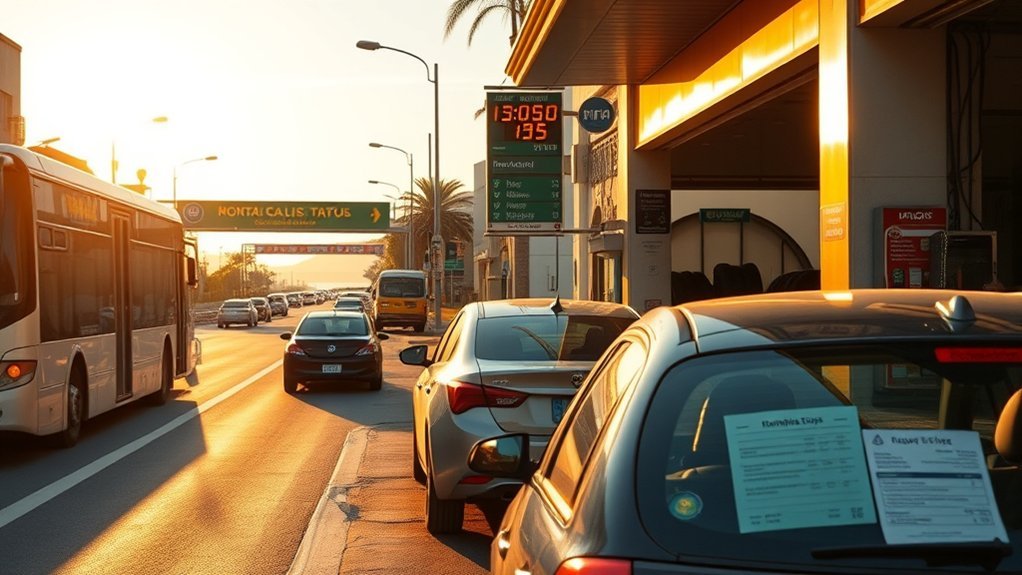
How will you get around Montevideo — and how much will it cost? Many expats skip car ownership: the city’s bus network charges about $1.30 per trip, making daily commuting inexpensive compared with regional norms.
Taxis average roughly $7 for a five-mile ride, convenient for short trips or late nights. Expect an estimated monthly transportation cost of $160 for two people when you combine regular bus use with occasional taxis.
Owning a car raises your cost of living noticeably. Fuel, insurance, and maintenance add recurring and often unpredictable expenses that typically exceed what you’d pay using public transit.
If you do own a vehicle, remember the average monthly electricity for a two-bedroom apartment sits near $85 — separate from any car-related charges like charging, parking, or repairs.
In short, public transport keeps your budget lean; a car gives flexibility but increases regional living costs and financial uncertainty.
Utilities: Power, Internet, and Phone

Because Uruguay keeps basic service prices competitive, you’ll find utilities that are affordable compared with many regional peers: average monthly electricity for a couple in a two-bedroom apartment runs about $85, and overall utilities including other basic services average roughly $38 per month, keeping household bills predictable.
| Service | Typical Monthly Cost | Notes |
|---|---|---|
| Electricity | $85 | Couple, 2‑bed apt |
| Internet (400 Mbps) | $37 | Fiber-optic, reliable |
| Cellphone | $14 | Up to 40 GB data |
These figures show Uruguay’s cost structure is lower than many neighboring countries when you compare similar urban standards. A $37 fiber plan gives fast, stable internet for remote work or streaming, while $14 phone plans cover heavy mobile data needs. When budgeting, combine the $85 electricity with the $37 internet and $14 phone plus the $38 listed utilities subtotal—total utility outlays remain manageable, reinforcing Uruguay’s competitive living costs across the region.
Healthcare and Insurance Expenses

If you compare healthcare costs regionally, you’ll find Uruguay offers high-quality services at comparatively low prices: a typical mutualista membership runs about $70 a month with small copays of $10–$20, while more extensive plans (including emergency coverage) cost around $100 monthly, though some plans impose age limits.
You’ll get broad coverage — doctor visits, specialist consults, hospital stays — at rates significantly lower than U.S. private insurance, which many expats cite when comparing retirement and relocation costs.
Public and private facilities are modern and staffed by trained professionals, so quality rarely lags behind regional peers.
When budgeting, you should factor mutualista fees or modest private premiums into monthly expenses; these predictable costs make healthcare more manageable than in many countries.
If you’re also evaluating real estate in Uruguay, lower ongoing health care costs can offset higher property prices in some coastal areas, improving overall affordability for retirees and long-term residents.
Monthly Budget Examples by Lifestyle
Alongside predictable mutualista fees and modest private premiums, you’ll want to model complete monthly budgets to see how healthcare savings affect overall affordability.
If you’re Living in Uruguay as a single person, plan for roughly $800 monthly (excluding rent). Add Montevideo rent and you’ll hit $1,300–1,500 for a studio or $1,500–1,700 for a one-bedroom.
For a family of four, base non-rent costs run about $2,860; include a two-bedroom rental and you’re approaching $3,500–$4,000 depending on neighborhood.
Compare line items regionally: groceries for two cost $900–$1,000, helped by fresh markets that preserve quality of life without premium prices.
Transport for two averages $160; utilities (electricity ~$138, internet ~$31) total ~$169.
These figures let you model trade-offs—central Montevideo rents raise total budgets, coastal or interior locations lower them.
Use these scenarios to test whether healthcare choices materially change disposable income and perceived quality of life.
Money-Saving Tips and Local Discounts

When you compare typical budgets across Montevideo and smaller cities, small behavioral changes—shopping at twice-weekly ferias, cooking more meals at home, and using buses instead of a car—can cut non-rent monthly costs by several hundred dollars:
You can save on produce by buying whole foods at ferias, where prices are often below supermarket rates and markets run twice weekly in most neighborhoods.
Choose buses over car ownership—single rides cost about $1.30 and a two-person monthly transport budget often comes to about $160 versus much higher car expenses.
Cook at home: groceries for two typically range $900–$1,000 monthly, but emphasis on local whole foods and fewer processed items trims that total.
Join a mutualista for roughly $70/month to lower healthcare copays.
For dining, watch weekday promotions and fixed-price menus; average meals span $15–$30, so using discounts two to three times monthly materially reduces food-away-from-home spend.
These practical, region-aware money-saving tips produce measurable savings.
Best Cities and Neighborhoods to Live In
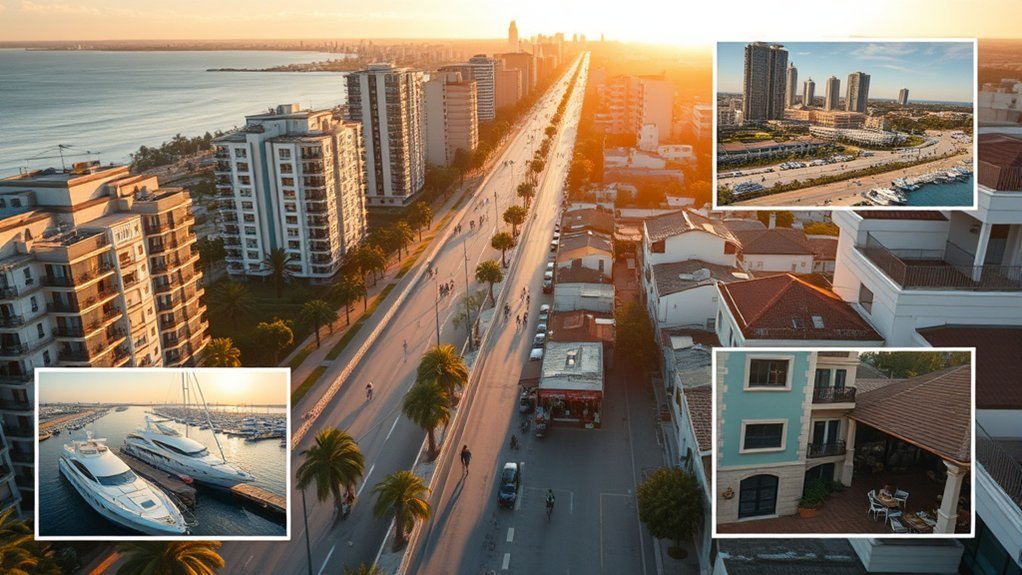
You’ll find Montevideo offers urban neighborhoods like Punta Carretas and Pocitos where studios run about $500–$600 and one-bedrooms $700–$900, balancing city amenities with coastal views.
Punta del Este skews pricier for coastal living, with furnished two-bedrooms near $1,200 and studios around $700, ideal if you prioritize beaches and seasonal rental markets.
If you want lower costs, smaller towns such as Atlántida, Piriápolis, and La Paloma offer homes in the $125k–$180k range and a quieter, more affordable lifestyle.
Montevideo: Urban Neighborhoods
Although Montevideo’s neighborhoods vary widely in character and cost, you’ll find clear patterns that help compare choices: historic Ciudad Vieja offers cultural density and older architecture, Punta Carretas and Pocitos attract expats with modern amenities and coastal access, and rental averages—about $500–$600 for studios and $700–$900 for one-bedrooms—let the city compete favorably with regional capitals.
Add a roughly $1 bus fare and estimated monthly living costs of about $3,100 for two people to gauge neighborhood affordability and lifestyle trade-offs. You’ll weigh trade-offs: central districts save commuting time and favor nightlife, while peripheral barrios cut rent.
If you want a Montevideo studio apartment, expect variable quality and utilities. Compare transit links, safety, and nearby services to match price to daily needs.
Punta Del Este: Coastal Living
If you prefer coastal living with higher-end services and don’t mind paying for it, Punta del Este delivers: furnished two-bedrooms run about $1,200/month and studios near $700/month (both often including common expenses), while luxury homes sell from $400,000 to $1 million and some premium rentals start around $3,000/month.
You’ll find Punta del Este’s market skews upscale compared with Montevideo and inland cities; its beach-resort status drives demand from tourists and expats, pushing dining and entertainment prices above national averages.
Beaches and nightlife create a lifestyle premium you pay for in rent, services, and leisure. If you value proximity to coast, vibrant social options, and high-quality amenities, Punta del Este’s cost profile matches that expectation.
Smaller Towns: Affordable Options
Punta del Este sets a higher-cost benchmark, but many smaller coastal towns give you comparable beach access and community life at much lower prices.
Smaller coastal towns like Atlántida, Piriápolis and La Paloma offer affordable housing options with homes typically priced $125,000–$180,000, making them attractive for budget-conscious buyers.
Rental markets start near $400/month, considerably below tourist hotspots. Your cost of living in these towns drops on groceries, dining and local services versus Montevideo or Punta del Este.
Public transport exists, and many residents live car-free, trimming expenses further. You get vibrant local culture and quality beaches without premium prices, so compare property and rental data to match lifestyle and budget.
- Atlántida: lower rents, commuter links
- Piriápolis: family-friendly, mid-range prices
- La Paloma: surf culture, affordable homes
- Small ports: tight communities, fewer services
- Transit-friendly towns: live car-free
Frequently Asked Questions
Can Americans Live in Uruguay?
Yes — you can live in Uruguay; it’s often about 17% cheaper than the U.S., with affordable housing (~$850 two-bedroom in Montevideo), $70 mutualista healthcare, low transport costs, and stable infrastructure that suits many Americans.
Is It Cheaper to Live in Uruguay or the USA?
Uruguay is generally cheaper than the USA: overall costs run about 17% lower, rents about 66% lower, and a family’s non‑rent monthly expenses average ~$2,860; utilities and fresh food often cost less regionally.
Can US Citizens Buy Homes in Uruguay?
“Where there’s a will, there’s a way.” Yes — you can buy property in Uruguay unrestricted. Closing costs run about 3–4%, you’ll need a passport and RUT, and coastal prices beat inland affordability; use a local agent.
Is Costa Rica or Uruguay Cheaper?
Uruguay’s generally cheaper: you’ll typically spend around 17% less than in the U.S., with lower rents (about 66% down), cheaper transport and similar grocery prices, while Costa Rica can be comparable or slightly pricier.
Conclusion
Living in Uruguay costs more than many Latin American countries but less than major U.S./European cities; expect monthly rents from $300–$900 (inland vs. Montevideo) and groceries about 20–30% cheaper than the U.S. If you value safety, healthcare access, and moderate living, budget $800–1,600 monthly depending on lifestyle. Think of Uruguay as a well-tended garden: expenses vary by neighborhood, but with local bargains and prudent choices you’ll get steady, predictable returns on comfort.
