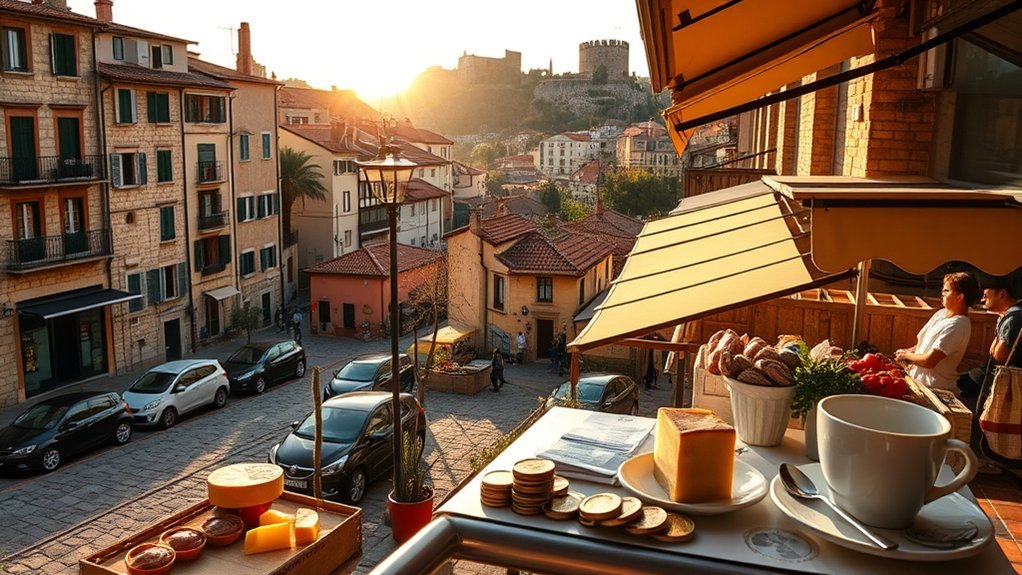
The cost of living in San Marino in 2026 is about €1,600–€1,750 (~$1,790–$1,960) a month for a single person, including a small furnished apartment. A family of four should plan on roughly €3,900–€4,500 (~$4,350–$5,025). These figures use the European Central Bank reference rate of $1.1225 per euro (October 2, 2026). Rent is the biggest cost, and the bigger obstacle is getting the right to live there at all. San Marino uses the euro but is not in the EU, and its residency rules are strict. That is why about 8,900 people who work in the Republic commute from Italy, mostly from the Rimini area. Below you’ll find rents, everyday prices, fuel and transit, taxes, healthcare, residency routes, sample budgets, and a side-by-side look at living in San Marino vs. nearby Italy.
Quick Answer
- Single person: about €1,600–€1,750 (~$1,790–$1,960) a month with rent.
- Family of four: about €3,900–€4,500 (~$4,350–$5,025) a month with rent.
- Rent: furnished two-room apartments listed at €750–€900 (~$840–$1,010) in early October 2026; larger four-room units in Dogana at €1,500 (~$1,685).
- Minimum wage: €1,776.77 a month (~$1,995) since January 1, 2026.
- Inflation: 2.01% a year in April 2026, below Italy’s 3.3% in August 2026.
- Fuel: up to about €0.25 a liter cheaper than in the Rimini area.
- Taxes: no VAT; a 17% single-stage tax on imported goods. Income tax runs from 9% to 35%.
- Residency: limited routes with yearly quotas. The elective residence route starts with a €500,000 property purchase.

Experience J.R.R. Tolkien's legendary Middle-earth saga in a compact hardcover boxed set that brings together The Hobbit and The Lord of the Rings. This deluxe collection is ideal for readers who want a portable, collectible edition of the classic fantasy adventures, making it perfect for gifting, re-reading, and building a treasured library. The boxed presentation adds display appeal while the hardcovers offer lasting durability for years of enjoyment.

Die With Zero offers a fresh perspective on personal finance by encouraging readers to use money intentionally to create memorable life experiences instead of simply accumulating wealth. Written by Bill Perkins, this book combines practical guidance with a motivating philosophy to help readers align spending, saving, and life goals for a more fulfilling future.

This daily devotional helps parents pray purposefully for their children through a full year of Scripture readings, reflections, and guided prayer prompts. Written to encourage faithful family discipleship, it offers practical, biblically grounded support for parents who want to shape their prayers around God's Word. A foreword by Sinclair B. Ferguson adds trusted theological insight and encouragement.
San Marino at a Glance in 2026
San Marino is a microstate surrounded by Italy, between the Emilia-Romagna and Marche regions. According to the San Marino statistics office’s Q2 2026 bulletin, the resident population was 34,167 on June 30, 2026. The main towns are the City of San Marino (the capital on Mount Titano), Borgo Maggiore just below it, and Serravalle, Dogana, and Domagnano in the lower, more commercial part of the country near the Italian border.
A few numbers explain how daily life works:
- Jobs: the same bulletin counts 19,619 private-sector employees and about 4,000 public-sector workers.
- Cross-border workers: 8,939 people commute in from Italy. They make up 45.6% of private-sector employees. The Q4 2025 bulletin showed their number grew 5.7% during 2025.
- Unemployment: 4.62% overall and 2.68% on the strict measure (people immediately available for work).
That last pair of numbers matters for cost of living. Jobs in San Marino are easier to get than homes in San Marino, so many workers live in Italy and drive in.
Inflation, Minimum Wage, and Exchange Rate
Inflation. The April 2026 consumer price release put annual inflation at 2.01%, down from 2.30% in March. Prices rose 0.36% from March to April. The details show where budgets feel pressure:
- Transport: +5.20% a year, with fuels and lubricants up 16.34%
- Housing, utilities, and fuels: +3.06%
- Food and non-alcoholic drinks: +2.11% (fruit +10.50%, coffee +12.14%)
- Restaurants and accommodation: +1.37%
- Healthcare: +1.30%
- Information and communication: -0.87%
Across the border, Italy’s inflation is running higher. ISTAT’s provisional data for August 2026 showed 3.3% a year, up from 2.9% in July.
Minimum wage. The WageIndicator Foundation reports that San Marino’s territorial minimum wage rose on January 1, 2026, from €1,728.38 to €1,776.77 a month, and from €10.64 to €10.93 an hour. At $1.1225 per euro, that is about $1,995 a month. Italy has no general statutory minimum wage.
Exchange rate. All dollar figures here use the ECB reference rate of $1.1225 per euro on October 2, 2026. The rate was $1.1298 a day earlier, so dollar costs can shift a few percent in a short time.
The 2026 minimum wage of €1,776.77 covers a furnished two-room apartment at €750–€900, but not much else on top of it. A single earner on the minimum will find San Marino tight.
Housing: Rent and Property
Rents in San Marino
The rental market is small. Few listings are online at any one time, and no official rent index is published. A snapshot of apartment listings on Italian rental portal Mioaffitto in early October 2026 showed six units across the country:
| Town | Size | Rooms | Monthly Rent | Approx. USD |
|---|---|---|---|---|
| Borgo Maggiore | 50 m² | 2, furnished | €750 | $842 |
| Domagnano | 55 m² | 2, furnished | €800 | $898 |
| City of San Marino | 75 m² | 3, partly furnished | €800 | $898 |
| City of San Marino | 70 m² | 3, furnished | €900 | $1,010 |
| Dogana | 110 m² | 4, furnished | €1,500 | $1,684 |
| Dogana | 120 m² | 4, furnished, terrace | €1,500 | $1,684 |
In Italian listings, “rooms” counts living rooms plus bedrooms, so a two-room unit is a one-bedroom apartment. Serravalle, the largest town, had no apartments listed on the day we checked.
Crowd-sourced averages point the same way: about €700 for a one-bedroom and €900 for a three-bedroom in the center. But those figures come from only four contributors and were last updated in July 2025, so treat them as a rough check, not a benchmark.
Buying Property
San Marino does not publish an official house price index, and we could not find a reliable average price per square meter for 2026. What the law does make clear is the entry ticket for investor residency. Under the coordinated text of Law 118/2010, elective residence requires buying a building for at least €500,000 (~$561,000). Up to €150,000 of completion or renovation costs can count toward it.
For comparison, Rimini city averaged €2,947 per m² in asking prices in August 2026, up 3.4% in a year, according to Immobiliare.it. Its pricier seaside zones, such as Marina Centro and San Giuliano a Mare, averaged €3,499 per m².
Renting Just Across the Border
Rimini has a much deeper rental market. Immobiliare.it put the average asking rent at €12.89 per m² a month in August 2026, up 7.78% in a year. A 60 m² apartment at that rate costs about €775 (~$870). Crowd-sourced averages for Rimini (August 2026) show €725 for a one-bedroom in the center and €580 outside it.
Utilities, Internet, and Phone
Electricity, gas, and water in San Marino come from AASS, the state public services company. AASS also runs the cable car and sells public transport tickets. Households with taxable income of €9,000 or less per person a year can apply for social tariffs, under Delegated Decree 97 of 2025. We could not verify current AASS per-kWh household rates from a published source, so we have not listed them.
Monthly averages from crowd-sourced data:
- Basic utilities (electricity, heating, water, garbage): about €100 in San Marino (thin data, July 2025) and about €221 in Rimini (August 2026).
- Home broadband: about €30 in San Marino and €29 in Rimini.
- Mobile plan: about €20 in San Marino. Rimini’s average is €7, because Italian mobile plans are very cheap.
Italian power bills are climbing this fall. On September 29, 2026, the energy regulator ARERA raised the protected rate for vulnerable customers by 37.3% for the fourth quarter, to €0.4343 per kWh including taxes, Il Fatto Quotidiano reported. That matters if you plan to live in Rimini and work in San Marino.
Food: Groceries and Dining Out
San Marino and Rimini shop from the same regional supply chain, so grocery prices are broadly similar. There is no reliable crowd-sourced grocery data for San Marino itself, so the grocery rows below use Rimini.
| Item | San Marino (Jul 2025) | Rimini (Aug 2026) |
|---|---|---|
| Meal at an inexpensive restaurant | €15.00 (~$16.84) | €18.00 (~$20.21) |
| Three-course dinner for two, mid-range | €50.00 (~$56.13) | €75.00 (~$84.19) |
| Fast-food combo meal | €13.50 (~$15.15) | €12.00 (~$13.47) |
| Cappuccino | €1.57 (~$1.76) | €2.02 (~$2.27) |
| Domestic draft beer (pint) | €5.25 (~$5.89) | €5.00 (~$5.61) |
| Milk (1 liter) | no data | €1.29 (~$1.45) |
| Bread (1 lb loaf) | no data | €2.39 (~$2.68) |
| Eggs (12) | no data | €2.92 (~$3.28) |
| Chicken (1 lb) | no data | €4.83 (~$5.42) |
| Beef (1 lb) | no data | €6.69 (~$7.51) |
| Mid-range bottle of wine | no data | €5.00 (~$5.61) |
All figures are crowd-sourced averages. Rimini’s are based on 152 price entries in the past year. San Marino’s come from just 22 entries, so the gaps between the two columns are not precise.
Price trends are rising in both places. San Marino’s April 2026 index showed fruit up 10.50% and coffee up 12.14% in a year, even as overall food inflation stayed near 2%.
Crowd-sourced data puts everyday costs for one person in Rimini, not counting rent, at about €845 (~$948) a month. For a family of four it is about €2,975 (~$3,339). Those are the best available proxies for San Marino, too.
Transportation, Fuel, and Getting Around
Fuel is one of the few everyday costs where San Marino is clearly cheaper than Italy. Public transport is limited to buses, the on-demand SMUVI service, and the cable car.
| Item | Cost | Notes |
|---|---|---|
| Diesel, Rimini province (July 2026) | €2.099–€2.159 per liter | San Marino pumps were about €0.25 a liter cheaper |
| Gasoline, Rimini province (July 2026) | €1.90–€2.00 per liter | about $8.07–$8.50 per US gallon |
| Rimini bus, single ticket | €2.00 (~$2.25) | valid 60 minutes, up from €1.50 on June 1, 2026 |
| Rimini bus, monthly pass (1 zone) | €38 (~$43) | up from €32 |
| San Marino cable car (Borgo Maggiore–City) | €3 one way / €5 return | 2025 listed fares; runs every 15 minutes |
| SMUVI on-demand bus (San Marino) | free through September 2026 | booked by app or phone; check current fares |
Fuel. Il Resto del Carlino reported on July 26, 2026 that drivers from Rimini were queuing at San Marino stations to save more than €10 a tank. In March 2026, the same paper found diesel just over €1.50 a liter in San Marino, while Rimini was near or above €1.80. Holders of the SMaC card, San Marino’s loyalty and tax card, can get further fuel discounts.
Buses. Start Romagna’s May 2026 fare notice sets the Rimini province fares listed above. The Rimini–San Marino line is run daily by private operators Benedettini and Bonelli Bus, with tickets sold on board or online. Fares for that route were not published in a source we could verify.
Cable car and local buses. The cable car fares come from the University of San Marino’s transport guide. The same university lists SMUVI, an on-demand shared bus inside San Marino, as free through September 2026.
Healthcare and Social Security
San Marino’s public health service is run by the Istituto per la Sicurezza Sociale (ISS). It covers citizens and residents and runs the state hospital, local clinics, medicines, sick pay, family allowances, and pensions in one institution.
If you work in San Marino. Your ISS coverage comes through payroll contributions. Under pension reform Law 157 of 2022, 2026 rates for employees are:
- Pension fund: 6.90% paid by the worker and 17.60% by the employer (24.50% total).
- FONDISS supplementary pension: 2.50% worker and 2.50% employer in 2026, rising to 3% each in 2027.
If you move on an investor or tax residency. Elective and atypical residents cannot claim state benefits and must hold health insurance. For elective residence, the law sets minimum cover of €30,000 a year per person. Price this policy before you commit, because it replaces the free ISS coverage that workers get.
Health spending and tax. From tax year 2026, ISS notes that 18% of dental and prosthetic costs is deductible, up to €1,600 per taxpayer and family member. Psychotherapy costs are 50% deductible up to €1,500.

This hardcover book celebrates the art of gathering with inspiring table settings, thoughtful traditions, and practical ideas for hosting memorable meals. Written by Shea McGee, it offers beautiful design inspiration alongside approachable guidance for creating warm, welcoming spaces for family and friends. It's a charming resource for anyone who loves entertaining, home styling, and making everyday moments feel special.

Come Eat offers 100 approachable recipes designed to make everyday cooking more enjoyable, nourishing, and sustainable. With a focus on flavorful meals and practical preparation, this hardcover cookbook is ideal for home cooks looking for inspiration for salads, sides, and main dishes. Author Melissa Ben-Ishay shares recipes that encourage consistent, feel-good eating without sacrificing taste.

This compact Bible study guide helps readers explore Scripture with clarity and confidence. Written by Matt Whitman, it offers a fast, approachable companion for understanding key themes, context, and practical insights from the Bible. Its paperback format makes it easy to carry, reference, and use for personal study or group discussion.
Taxes: Income Tax and the Import Tax
Income Tax (IGR)
San Marino taxes personal income through the IGR (Imposta Generale sui Redditi). Law 141 of November 12, 2025 rewrote the brackets from tax year 2026:
| Taxable Income (EUR/year) | Rate |
|---|---|
| Up to 10,000 | 9% |
| 10,000–18,000 | 13% |
| 18,000–28,000 | 17% |
| 28,000–38,000 | 21% |
| 38,000–50,000 | 25% |
| 50,000–65,000 | 28% |
| 65,000–80,000 | 31% |
| Over 80,000 | 35% |
The law sets the brackets in its Annex C; the table follows a summary by accounting firm HLB San Marino. Other points from the law:
- Brackets will be indexed to the cost of living every two years, starting in 2028.
- Employees get small family credits: €250 for a dependent spouse and €250 per dependent child.
- Spending recorded on the SMaC card earns a tax benefit of €752.40 to €1,900, depending on income.
For comparison, Italy’s 2026 IRPEF rates are 23% up to €28,000, 33% from €28,000 to €50,000, and 43% above that, before regional and municipal surcharges. The 33% rate was cut from 35% by the 2026 Budget Law.
No VAT: A Single-Stage Import Tax
San Marino has no VAT. Instead it charges a single-stage tax (imposta monofase) on goods when they enter the country, at a standard 17%, and it is not charged again down the supply chain. Italy’s standard VAT is 22%. In practice, shelf prices in San Marino are close to Italian ones, but some goods, especially fuel, come out cheaper.
Cross-Border Workers
If you live in Italy and work in San Marino, IGR is withheld from your pay in San Marino. You then file an Italian return, where the first €10,000 of San Marino income is exempt and a credit offsets IGR already paid. The rules have changed several times, so check with an Italian tax adviser.
Residency Rules and Requirements
San Marino is not in the EU, so an EU passport gives you no automatic right to live there. The Department of Foreign Affairs lists stay permits (3 to 12 months, renewable) and several kinds of residence. The main routes for foreigners are:
| Route | Main Financial Requirement | Tax Treatment | Yearly Cap |
|---|---|---|---|
| Stay permit (work, study, family, etc.) | depends on purpose, e.g. a job offer | normal IGR on San Marino income | — |
| Elective residence | buy a building for €500,000+ or lock €600,000 in a 10-year non-interest deposit (plus a €10,000 tax) | normal IGR | 50 |
| Atypical residence (tax regime) | income produced abroad; no prior tax residence in San Marino | 7% substitute tax, minimum €10,000 and maximum €100,000 a year | 100 |
| Atypical residence for pensioners | €120,000 gross income a year or €500,000 in liquid assets | 6% on foreign pension income | 249 |
Key details:
- Elective residence also requires a €1,000 application fee and health insurance of at least €30,000 a year per person. After 10 years it converts to ordinary residence.
- Pensioner residence is open to nationals of the EU, Switzerland, and designated countries. Delegated Decree 26 of 2025 set the €120,000 income or €500,000 asset test, up from €50,000 or €300,000 before late 2024. Applicants must show a purchase or rental contract, and sharing a home with people outside your family unit is not allowed. Delegated Decree 77 of 2025 set the yearly cap at 249.
- All investor and tax routes bar public-sector jobs and state benefits.
Living in Italy is the realistic choice for most people who want to work in San Marino. A standard Italian lease and Italian residency are far easier to get than San Marino residence.
Sample Monthly Budgets
These budgets add rent to the crowd-sourced estimate of everyday costs other than rent for Rimini, which is the closest reliable proxy. San Marino rents use the October 2026 listings above. Rimini rents use crowd-sourced averages.
| Expense | Single, San Marino | Single, Rimini | Family of Four, San Marino | Family of Four, Rimini |
|---|---|---|---|---|
| Rent | €750–€900 (2-room, furnished) | €580–€725 (1-bed) | €900–€1,500 (3–4 rooms) | €804–€935 (3-bed) |
| Everyday costs without rent | €845 | €845 | €2,975 | €2,975 |
| Total (EUR) | €1,595–€1,745 | €1,425–€1,570 | €3,875–€4,475 | €3,779–€3,910 |
| Total (USD) | $1,790–$1,960 | $1,600–$1,762 | $4,350–$5,025 | $4,242–$4,389 |
What these budgets leave out:
- Private health insurance for elective or atypical residents, which is required and can be a large monthly cost.
- Commuting from Rimini by car or bus. A daily drive up to the City of San Marino adds fuel, wear, and time.
- Schooling. In Rimini, private preschool averages about €454 (~$510) a month, and international primary school about €10,994 (~$12,340) a year, per crowd-sourced data.
- Like-for-like space. The San Marino listings are furnished and often larger than Rimini’s average one-bedroom, which explains part of the rent gap.
Living in San Marino vs. Nearby Italy
The real choice for most people is between a home inside San Marino and a home just across the border in the Rimini area.
| Factor | San Marino | Rimini Area, Italy |
|---|---|---|
| Inflation | 2.01% (April 2026) | 3.3% nationally (August 2026) |
| Sales tax | no VAT; 17% single-stage import tax | 22% standard VAT |
| Income tax | IGR 9%–35% | IRPEF 23%–43% plus local surcharges |
| Rent | €750–€900 for a furnished 2-room unit; very few listings | €12.89 per m² a month average; many listings |
| Diesel | about €0.25 a liter cheaper | €2.099–€2.159 a liter (July 2026) |
| Utilities | about €100 a month (thin data); AASS social tariffs | about €221 a month; protected power rate up 37.3% in Q4 2026 |
| Public healthcare | ISS for workers and ordinary residents; private insurance for investor residents | Italian national health service for registered residents |
| Getting residency | hard; capped routes with high financial bars | EU citizens can register; others need an Italian visa |
Choose San Marino if you qualify for a residency route, want lower inflation and fuel costs, and like the pace of a small hill-town country. The tax regimes for foreign income and pensions can also outweigh the higher rents for wealthier movers.
Choose the Rimini area if you work in San Marino but can’t get residence there, need a wider choice of homes, or want city services, rail links, and the beach on your doorstep. You will pay Italian VAT and higher energy bills, and you will need to manage tax in two countries.
How San Marino Compares With Nearby Countries
San Marino’s day-to-day costs sit close to northern Italy’s, with higher rents and fewer options. For the wider Italian picture, see our guide to the cost of living in Italy. Among Europe’s other small states, the cost of living in Liechtenstein is far higher but comes with much bigger salaries. Andorra is another low-tax microstate with tight residency rules; see whether Andorra is expensive to live in. If you want a Mediterranean EU base with easier residency, compare the cost of living in Malta.
Frequently Asked Questions
How much money do you need to live in San Marino per month?
A single person needs about €1,600–€1,750 (~$1,790–$1,960) a month, including a furnished two-room apartment. A family of four should budget about €3,900–€4,500 (~$4,350–$5,025). Investor and tax residents must add private health insurance.
Can a foreigner live in San Marino?
Yes, but the routes are narrow. Options include stay permits tied to work, study, or family, elective residence through a €500,000 property purchase or a €600,000 10-year deposit, and atypical residence for people with foreign income or pensions. Each investor or tax route has a yearly cap.
Is San Marino cheaper than Italy?
Partly. Fuel is about €0.25 a liter cheaper, there is no VAT, and inflation was 2.01% in April 2026 against Italy’s 3.3% in August 2026. Rents are higher and listings are scarce, so many people who work in San Marino live in the Rimini area instead.
How much is rent in San Marino?
Furnished two-room apartments in Borgo Maggiore, Domagnano, and the City of San Marino were listed at €750–€900 a month in early October 2026. Four-room apartments in Dogana were listed at €1,500.
What is the minimum wage in San Marino in 2026?
The territorial minimum wage is €1,776.77 a month, or €10.93 an hour, since January 1, 2026. That is about $1,995 a month at $1.1225 per euro.
Does San Marino have income tax?
Yes. The IGR runs from 9% on the first €10,000 of taxable income to 35% above €80,000, under brackets that took effect in 2026. San Marino has no VAT but charges a 17% single-stage tax on imported goods.
Conclusion
San Marino is not a budget destination, but it is far from Liechtenstein’s price level. Everyday prices track the Rimini area, fuel is cheaper, inflation is lower, and there is no VAT. A single person should plan on about €1,600–€1,750 a month with rent. The hard part is residency, which comes through a job, family ties, or capped investor and tax routes that start at €120,000 of yearly income or a €500,000 home. If you can’t clear those bars, living in the Rimini area and commuting, as nearly 9,000 workers already do, is the practical way to enjoy San Marino’s jobs and lower fuel costs.
Sources
- UPECEDS Statistics Office – Consumer prices, April 2026
- UPECEDS Statistics Office – Statistical bulletin, Q2 2026
- UPECEDS Statistics Office – Statistical bulletin, Q4 2025
- ISTAT – Consumer prices, provisional data, August 2026
- European Central Bank – EUR/USD reference rate
- WageIndicator Foundation – San Marino minimum wage update, January 2026
- San Marino Department of Foreign Affairs – Stay permits and residence
- Coordinated text of Law 118/2010 on residence
- Delegated Decree 26 of 2025 – pensioner residence
- Delegated Decree 77 of 2025 – pensioner residence quota
- Law 141 of 2025 – IGR income tax reform
- HLB San Marino – Summary of Law 141 of 2025
- Law 157 of 2022 – pension reform and contribution rates
- Delegated Decree 97 of 2025 – AASS social tariffs
- Istituto per la Sicurezza Sociale (ISS) – About ISS
- Il Resto del Carlino – Fuel prices in Rimini vs. San Marino, July 2026
- Il Resto del Carlino – Diesel prices, March 2026
- Start Romagna – Rimini fares from June 1, 2026
- University of San Marino – Transport guide
- Il Fatto Quotidiano – ARERA Q4 2026 electricity rates
- Immobiliare.it – Rimini sale and rental prices, August 2026
- Mioaffitto – San Marino apartment listings, early October 2026
- Crowd-sourced cost-of-living averages for San Marino (July 2025) and Rimini (August 2026)
- Fiscomania (January 2026) and EcNews (January 2026) – cross-border worker taxation and IRPEF 2026 rates

This bestselling Christian devotional by Rick Warren helps readers explore life’s meaning through practical, faith-centered guidance. With thoughtful daily reflections and scripture-based insights, it encourages spiritual growth, purpose, and a deeper relationship with God. Its approachable format makes it a trusted choice for personal devotion or group study.

This hardcover cookbook offers fast, approachable recipes designed for busy days and low-energy nights. Caroline Chambers focuses on simple, flavorful meals that help you get dinner on the table without overthinking it. It's a practical pick for home cooks who want quick weeknight inspiration and minimal-fuss cooking.

Dixie disposable 10-inch paper plates are designed for easy everyday serving at home, parties, picnics, and barbecues. They offer dependable strength with cut resistance, microwaveability, and a soak-proof shield to handle messy meals, sauces, and grease. Made for convenient cleanup, these plates also provide compostable performance except in California.