
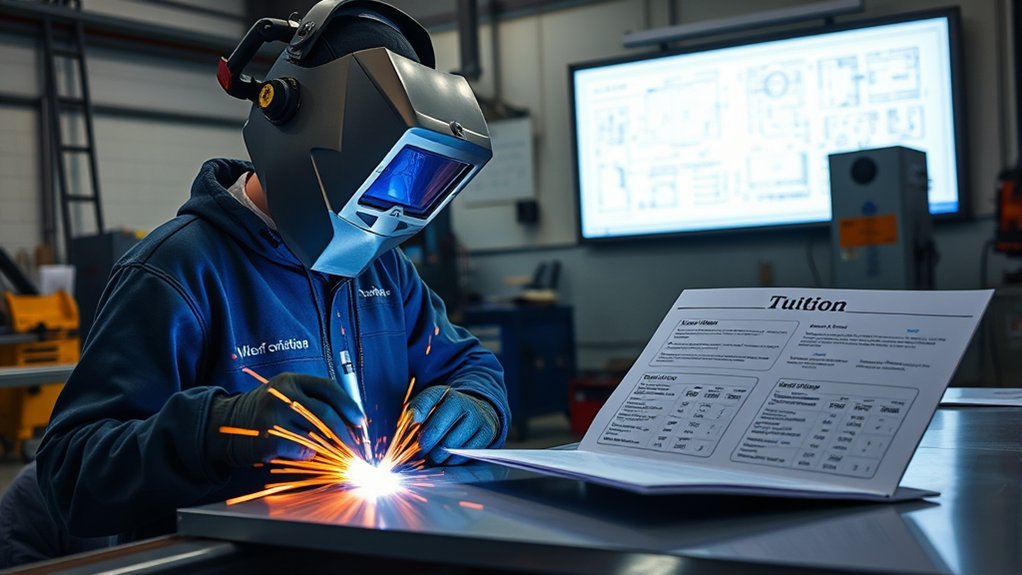
A welding degree or training program can cost a few thousand dollars at a public community college or more than $25,000 at a private career school. The final price depends on the credential, residency, program length, lab fees, tools, certification tests, and living costs. Compare each school’s published program cost and your financial aid offer before enrolling.
Quick Answer
There is no single national welding degree price. Current 2026–27 examples include $2,983 for a public basic certificate, $11,262 for a public welding associate degree, and $25,255 for a private 36-week diploma. Your net cost may be lower after grants and scholarships or higher after housing, transportation, and lost work time.
Key Takeaways
- Public community-college programs are often less expensive than private career-school programs, especially for in-district or in-state students.
- Tuition is only part of the cost. Lab fees, PPE, tools, books, certification tests, transportation, housing, and reduced work hours can change the total.
- A welding certificate, diploma, associate degree, bachelor’s degree, and industry certification are different credentials with different costs and career uses.
- Complete the FAFSA and compare each school’s net price, completion rate, job outcomes, debt, lab time, and employer connections.
Understanding Welding School Costs

The phrase welding school cost can mean several different things. One school may advertise tuition only, while another publishes a full program total that includes fees, books, supplies, and optional certification testing. A third school may show a yearly cost of attendance that also includes housing, food, transportation, and personal expenses.
For a useful comparison, separate these three numbers:
- Sticker price: The published tuition and required school fees before financial aid.
- Program cost: Tuition plus required books, tools, lab fees, equipment, and testing costs.
- Net price: What you are expected to pay after grants and scholarships, but usually before loans are repaid.
Current published examples show why a single national range can be misleading. For the 2026–27 year, Pima Community College lists an estimated $2,983 program total for its Welding Basic Certificate and an estimated $11,262 for its Welding AAS, based on in-state tuition. Universal Technical Institute’s San Antonio catalog lists a $25,255 total for its 36-week Welding Technology diploma for enrollments on or after February 1, 2026.
| Current example | Credential and length | Published program total | Important limitation |
| Pima Community College | Basic certificate | $2,983 | In-state estimate; personal and living costs vary |
| Pima Community College | Associate of Applied Science | $11,262 | In-state estimate; housing and other attendance costs are separate |
| UTI San Antonio | 36-week private diploma | $25,255 | Campus-specific catalog price; housing and transportation are separate |
Note: These figures are real school examples, not a national average or a promise of what you will pay. Residency, transfer credit, aid eligibility, retakes, and required developmental courses can change the total.

Stay organized with a durable 1-subject notebook set designed for school, note-taking, and digital study support. The college ruled pages resist ink bleed, tear out cleanly, and work with the Five Star Study App to create flashcards and sync notes to Google Drive. Tough pockets, a water-resistant cover, and Spiral Lock wire help protect your work throughout the year.

This daily devotional helps parents pray purposefully for their children through a full year of Scripture readings, reflections, and guided prayer prompts. Written to encourage faithful family discipleship, it offers practical, biblically grounded support for parents who want to shape their prayers around God's Word. A foreword by Sinclair B. Ferguson adds trusted theological insight and encouragement.

Post-it Super Sticky Easel Pads are designed to keep ideas visible and organized during meetings, training sessions, brainstorming, and project planning. The large premium paper resists marker bleed-through and sticks securely to many surfaces, then repositions without surface damage. A sturdy backcard and portable handle make them easy to move between rooms and use with most easel stands.
Types of Welding Programs Available
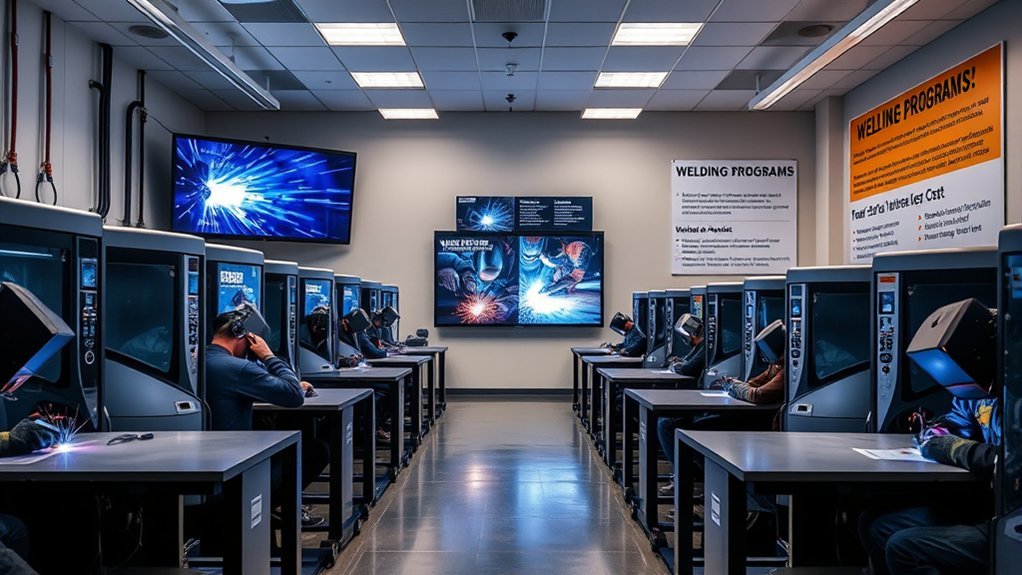
Welding education is offered through short workforce courses, certificates, diplomas, associate degrees, bachelor’s degrees, apprenticeships, and employer training. The right option depends on how quickly you want to work, the jobs you want, and whether you may continue to a higher credential later.
Certificate Programs
A welding certificate usually focuses on practical processes such as shielded metal arc welding, gas metal arc welding, flux-cored arc welding, gas tungsten arc welding, cutting, safety, blueprint reading, and basic fabrication. Some certificates can be completed in one term, while broader certificates may take a year or longer.
Certificates are often the lowest-cost school option, but check whether the credits can be applied to an associate degree. A low-cost noncredit course may not qualify for federal aid or transfer into a degree.
Diploma Programs
Private career schools commonly award diplomas after an intensive program that lasts about nine months to a year. These programs may offer more scheduled lab time and a faster calendar than a community college, but the sticker price can be much higher. Ask for the exact total, refund policy, completion rate, job-placement definition, and average debt before signing an enrollment agreement.
Associate Degree Programs
An Associate of Applied Science in welding or welding technology commonly takes about two academic years. It combines welding labs with courses such as technical math, blueprint reading, metallurgy, fabrication, inspection, communication, and general education. The broader coursework may help with future roles in quality control, supervision, estimating, or further education.
Bachelor’s Degree Programs
Four-year welding-related degrees are less common than certificates and associate degrees. They may focus on welding engineering, welding and fabrication engineering technology, materials, automation, design, quality systems, or manufacturing leadership. For example, Pennsylvania College of Technology’s Welding & Fabrication Engineering Technology B.S. is an eight-semester, 130-credit program.
A bachelor’s degree may fit students who want engineering-technology, management, process-development, or advanced quality roles. Its total cost is usually far higher than a short certificate because it includes four years of tuition, fees, general education, and possible living expenses.
Registered Apprenticeships
An apprenticeship can be a lower-debt alternative because you work and earn wages while completing supervised on-the-job learning and related instruction. The U.S. Department of Labor describes Registered Apprenticeship as a paid pathway with progressive wage increases and a portable credential. Openings vary by employer, union, trade, and location, so search the Apprenticeship.gov Job Finder and compare the training requirements carefully.
The cheapest program is not always the best value. A stronger choice is the lowest net-cost program that provides enough supervised lab time, recognized credentials, acceptable completion outcomes, and a realistic path to the jobs you want.
Duration of Welding Programs
Program length affects both direct and indirect costs. A faster program may reduce housing and commuting months, but an intensive full-time schedule can make it harder to keep a job. A longer program may cost more overall while providing additional lab practice, general education, and advanced topics.
Certificate Program Length
Short introductory certificates may last a few weeks or one semester. Career-ready certificates often take six to twelve months, depending on clock hours, course sequencing, and whether you attend full time. Before comparing two certificates, check the total supervised lab hours rather than relying only on the number of weeks.
A program that teaches several welding processes in fewer weeks may require long daily labs. That can increase transportation, childcare, and lost-income costs even if tuition is lower.
Degree Program Duration
An associate degree generally requires about two years of full-time study, although prerequisites, part-time enrollment, repeated courses, and limited course availability can extend the timeline. A bachelor’s degree generally takes four years and may require 120 to 130 or more credits.
Ask whether welding courses are offered every term. Missing one required lab can delay graduation if that class is available only once per year.
Pro Tip: Request a term-by-term degree plan and ask the school how often each required welding lab is offered. This reveals whether the advertised completion time is realistic for your schedule.
Additional Expenses to Consider

Extra expenses can add hundreds or thousands of dollars to a welding education. The exact amount depends on what the school provides, what you already own, and whether certification testing is included.
Ask for a written list covering:
- Personal protective equipment: Welding helmet, safety glasses, gloves, jacket or sleeves, hearing protection, work boots, and other shop-required clothing.
- Hand tools: Pliers, chipping hammer, wire brush, soapstone, tape measure, clamps, grinders, and tool storage.
- Books and software: Textbooks, code books, online platforms, calculators, and laptop requirements.
- Lab and consumable fees: Plate, pipe, electrodes, wire, shielding gas, grinding discs, and replacement parts.
- Certification testing: Test-facility charges, application fees, destructive or nondestructive testing, retests, and credential maintenance.
- Transportation: Fuel, parking, vehicle maintenance, or relocation to a campus with the required lab.
- Living costs: Housing, food, utilities, childcare, and health insurance.
- Lost income: Reduced work hours during daytime labs, clinical-style shop schedules, or unpaid travel.
Certification costs are not one fixed amount. The AWS 2026 price list shows a $70 Certified Welder application fee and a $105 yearly maintenance subscription, while the hands-on exam price is set by the Accredited Test Facility. Schools may include some testing in tuition, charge separately, or treat it as optional.
Warning: Do not buy a welding machine or expensive tool package until the program gives you its required-equipment list. Many schools provide major shop equipment, and an unapproved machine may not match the processes or electrical service used in class.
Safety should not be treated as an optional expense. Welding can expose students to arc radiation, fumes, gases, burns, fire, noise, and electric shock. OSHA requires appropriate personal protective equipment and ventilation for welding work. A reputable program should teach hazard control, maintain safe labs, and explain which PPE the school supplies and which items you must purchase.
Financial Aid Options for Students
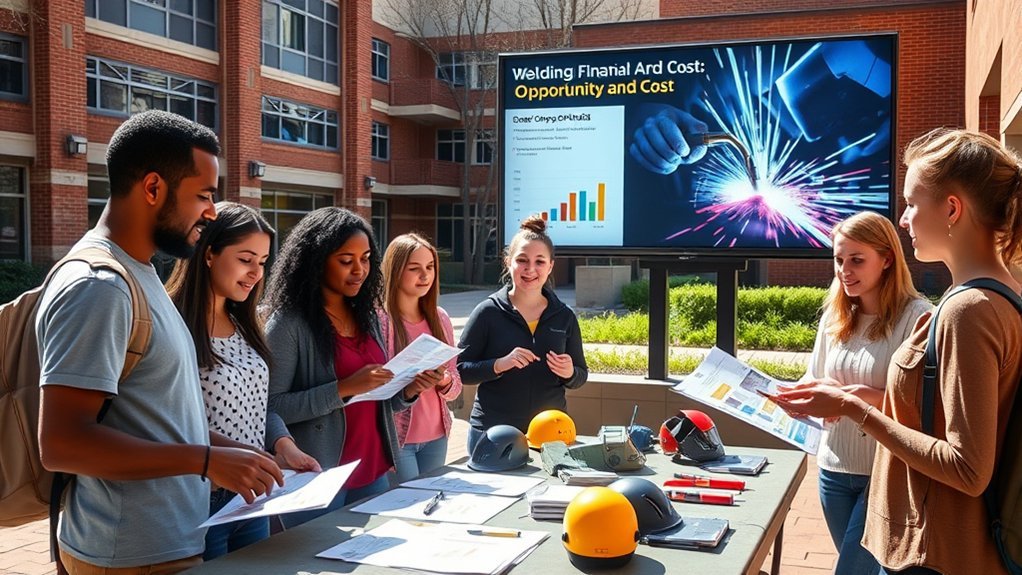
Eligible welding students may receive grants, scholarships, work-study, employer assistance, veterans benefits, or student loans. Aid depends on the school, program, credential length, enrollment level, financial need, and other eligibility rules.
Start with the Free Application for Federal Student Aid. The FAFSA is used for federal grants, work-study, and federal student loans, and many states and schools also use it for their own aid. For the 2026–27 award year, the maximum Federal Pell Grant is $7,395, but your award may be lower and the school or program must be eligible.
Follow this order when financing welding school:
- Apply for grants and scholarships that do not normally require repayment.
- Ask about employer sponsorship, workforce-development funding, union benefits, and state career-training programs.
- Compare school payment plans and part-time schedules.
- Use federal student loans only after reviewing the total debt and estimated monthly payment.
- Treat private loans as a last option because terms and borrower protections may be less favorable.
Veterans, service members, and qualified dependents may be able to use GI Bill benefits for approved college, non-college degree, apprenticeship, licensing, or certification programs. Verify the exact program through the U.S. Department of Veterans Affairs before enrolling.
Note: Loans reduce what you pay today, but they do not reduce the price of the program. Compare grants and scholarships separately from borrowed money when calculating your true net cost.
Scholarships and Grants for Welding Students

Welding students can look for aid from professional associations, schools, employers, unions, community foundations, workforce agencies, manufacturers, and local industry groups.
The AWS Foundation scholarship program supports students at trade schools, community colleges, and four-year universities. AWS lists national, district, section, welder-training, and international opportunities with different award amounts, deadlines, and eligibility rules. Some awards can help with tuition, fees, books, supplies, or required equipment.
Use a simple scholarship system:
- Create a list of awards, deadlines, required documents, and eligibility rules.
- Request transcripts and recommendations early.
- Write one strong personal statement, then tailor it to each award.
- Apply for local awards with smaller applicant pools as well as national scholarships.
- Confirm whether the money is paid to you or directly to the school and what expenses it may cover.
Also ask each school whether it has program-specific scholarships, emergency grants, tool funds, completion grants, or employer-sponsored cohorts. A smaller local award may be easier to win and can cover practical costs that a tuition-only scholarship does not.
The Value of Certification in Welding

A school credential and a welding certification are not the same. A certificate, diploma, or degree shows that you completed an educational program. A performance qualification or industry certification shows that you met a specific standard, process, material, position, or job requirement.
The AWS Certified Welder program is performance-based. It does not require a particular course or degree before testing, but candidates must pass a hands-on test at an AWS Accredited Test Facility. The qualification is tied to the procedure and variables tested, so one credential does not prove ability in every welding process or position.
Enhanced Employment Opportunities
Certification can help document skills that an employer, contractor, code, or project requires. It may be especially useful for structural fabrication, pipe work, construction, manufacturing, energy, and other jobs where welder qualifications are formally recorded.
However, certification does not guarantee employment. Employers may also consider fit-up ability, blueprint reading, safety habits, production speed, weld quality, attendance, drug-testing rules, travel availability, and prior experience.
Increased Earning Potential
It is safer to say that specialized skills and qualifications may improve access to certain roles, not that certification automatically raises pay. Wages vary by location, industry, union status, shift, overtime, travel, experience, and the difficulty of the work.
The latest national BLS wage table reports a median hourly wage of $25.84 for welders, cutters, solderers, and brazers in May 2025. That equals about $53,750 for 2,080 hours of work, before overtime. Individual earnings can be much lower or higher.
Career Opportunities After Graduation

Welding graduates may begin as production welders, fabricators, fitter-welders, structural welders, pipe welders, maintenance welders, or welding-machine operators. The exact entry point depends on the processes practiced, local employers, certifications, and prior work experience.
With added training and experience, possible paths include:
- Welding inspection and quality control
- Non-destructive testing support
- Robotic welding setup and operation
- Fabrication supervision and production leadership
- Estimating, planning, and project coordination
- Welding instruction
- Sales or technical support for welding equipment and consumables
- Welding engineering or engineering technology after further education
- Self-employment or a fabrication business
The Bureau of Labor Statistics projects 2% employment growth for welders, cutters, solderers, and brazers from 2024 to 2034, with about 45,600 openings per year on average, largely from workers changing occupations or leaving the labor force. This means students should judge a program by local employer demand and placement quality, not by broad claims that every welding graduate is guaranteed a high-paying job.

BIC Cristal Xtra Smooth Blue Ball Pens deliver dependable everyday writing with a medium 1.0mm point and fluid Easy-Glide System Ink. Designed to create clear, dark lines, these pens are ideal for notes, lists, journaling, schoolwork, and office tasks. The convenient 10-count pack offers reliable performance for home, work, or classroom use.

The DeLonghi Water Filter helps reduce scale buildup and unwanted impurities that can affect your coffee machine's performance and taste. Its active carbon and ion-exchange technology helps improve brew consistency, maintain flavor, and reduce the need for frequent descaling. Designed as an OEM authorized replacement part, it fits select DeLonghi models for reliable everyday maintenance.

This heartfelt memoir blends laugh-out-loud honesty with tender reflections on love, loneliness, and the unexpected healing power of rescue dogs. Isabel Klee shares her journey fostering pups in the city while navigating dating and self-discovery, offering an intimate, relatable story for readers who enjoy emotional, character-driven narratives. It is a warm, engaging read about opening your heart and finding connection in surprising places.
Comparing Trade Schools and Community Colleges

Trade schools and community colleges can both provide strong welding training, but their price, calendar, credit structure, and student services may differ.
Cost Differences
Public community colleges often charge lower in-district or in-state tuition and may offer Pell Grants, state aid, broad student services, and credits that build toward an associate degree. Out-of-state tuition, differential tuition, lab fees, and extra semesters can raise the total.
Private career schools may charge more but offer frequent start dates, fixed daily schedules, concentrated lab training, and faster completion. Compare the full program price, not the weekly or monthly payment. Also check whether financing charges or private loans increase the amount repaid.
Program Length Options
A career-school diploma may place most training into nine to twelve months. A community-college certificate may take one or two terms, while an associate degree often takes about two years. Part-time and evening options can help you keep working, but they may extend the completion date.
| Compare | Community college | Private trade school |
| Price structure | Usually per credit, with residency-based rates and course fees | Often a fixed program tuition plus registration, lab, or equipment fees |
| Credential | Certificate or associate degree | Usually certificate or diploma; some schools offer degrees |
| Schedule | Semester-based; day, evening, or part-time options may be available | Often intensive, fixed, and designed for faster completion |
| Best question to ask | Will the credits transfer or stack into a higher credential? | What is the total price, average debt, completion rate, and verified placement outcome? |
Factors Influencing the Cost of Welding Education
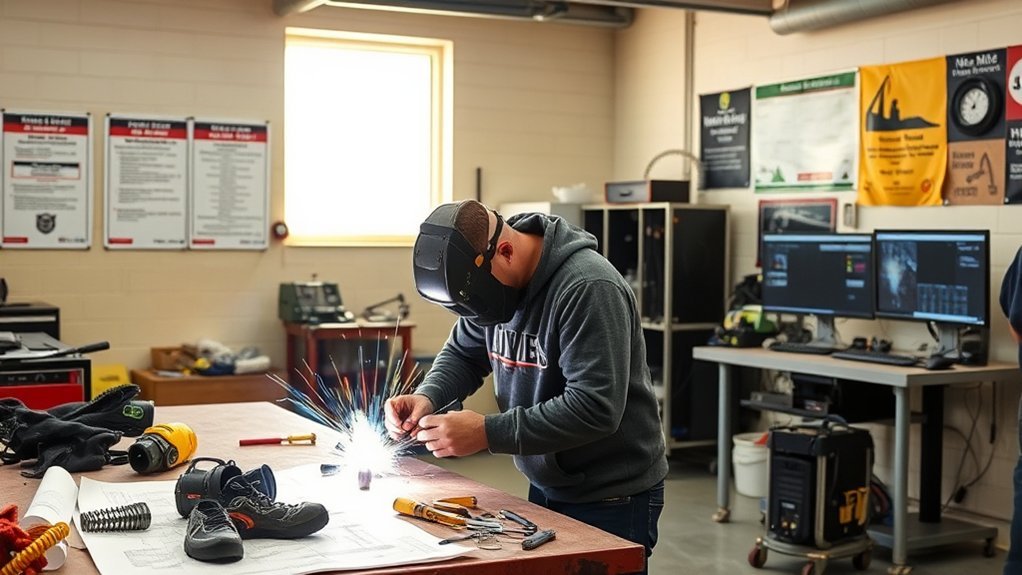
The largest cost drivers are not limited to the type of school. Review each of these before comparing offers:
- Credential level: A short certificate normally requires fewer credits and months than an associate or bachelor’s degree.
- Public or private ownership: Public colleges often receive government support, while private schools may rely more heavily on tuition.
- Residency: In-district and in-state rates can be much lower than out-of-state rates.
- Program intensity: Welding labs require equipment, ventilation, power, consumables, maintenance, and low student-to-instructor ratios.
- Included equipment: Some programs include books, PPE, tools, or test fees; others bill them separately.
- Location: Housing, transportation, wages, and childcare vary by city and campus.
- Time to completion: Failed, dropped, unavailable, or repeated courses can add tuition and delay full-time earnings.
- Financial aid: Grants and scholarships lower net price, while loans only delay payment.
- Transfer credit: Accepted prior learning can reduce time and cost, but noncredit training may not transfer.
- Certification plan: Separate tests, retests, applications, and maintenance can increase the total.
How to Calculate Your Real Welding Degree Cost
Use the same formula for every school so you are comparing equal numbers:
Real program cost = tuition + required fees + books and tools + certification costs + transportation and living costs + lost income − grants and scholarships.
Then complete these steps:
- Download the school’s current tuition sheet, program cost sheet, catalog, and required-tool list.
- Confirm whether the price is per term, per credit, per clock hour, or for the full program.
- Add every mandatory fee, including lab, consumable, technology, registration, testing, and graduation fees.
- Estimate commuting, housing, childcare, and reduced work hours for the full realistic program length.
- Subtract grants and scholarships, but do not subtract loans.
- Compare your result with the school’s completion rate, job outcomes, typical debt, lab hours, and employer partnerships.
Pro Tip: Ask the financial aid office for a written aid offer and ask the welding department for a separate required-cost list. Enrollment staff may discuss tuition, but the department usually knows the real tool, lab, and testing expenses.
Questions to Ask Before Enrolling
- How many supervised welding lab hours will I complete?
- Which processes, materials, positions, and code-based tests are taught?
- Are PPE, tools, consumables, books, and certification tests included?
- Is the program eligible for federal student aid and veterans benefits?
- Will the credits transfer to an associate or bachelor’s degree?
- What percentage of students complete the program on time?
- How does the school define job placement, and is the data independently reported?
- What is the average debt among graduates who borrowed?
- Which local employers hire graduates, and when did they last recruit on campus?
- Can I visit a live lab and speak with current students?
Frequently Asked Questions
Are there prerequisites for enrolling in welding programs?
Requirements vary. Many degree and diploma programs require a high school diploma or equivalent, while some short workforce courses have lower entry requirements. Schools may also use placement tests or require basic reading and math. Ask whether you need prerequisites before the first welding lab.
Can I work while attending welding school?
Yes, especially in an evening, part-time, or apprenticeship program. Full-time welding labs can be physically demanding and may run for several hours, so check the weekly schedule before committing to work hours. Include reduced income and childcare in your cost calculation.
What materials or tools do I need to buy?
Common requirements include a welding helmet, safety glasses, gloves, protective clothing, work boots, pliers, a chipping hammer, a wire brush, measuring tools, and small hand tools. Do not rely on a generic list. Get the school’s current written requirements because major equipment and consumables may be supplied by the lab.
Are online welding programs available?
Online and hybrid courses can teach safety, welding theory, symbols, metallurgy, math, and blueprint reading. Practical welding skill still requires supervised hands-on work with real equipment. Confirm where labs are completed, how many lab hours are included, and whether the online or noncredit program qualifies for financial aid.
Do welding schools offer job placement assistance?
Many schools offer résumé help, interview practice, employer events, apprenticeship leads, and job boards. Assistance is not the same as a guaranteed job. Ask for the school’s written placement methodology, the percentage placed in welding-related work, and the time period covered by the data.
Do I need a welding degree to become a welder?
Not always. The Bureau of Labor Statistics lists a high school diploma or equivalent as the typical entry-level education, followed by technical and on-the-job training. Some employers hire trainees or apprentices, while other jobs prefer school training, documented qualifications, or specific certifications.
Is a welding associate degree worth the extra cost?
It can be worth it when the program adds useful lab depth, metallurgy, inspection, automation, fabrication, communication, and general education at a reasonable net price. It may be less valuable if you already have strong experience and only need a specific qualification. Compare the added cost with the exact jobs and advancement paths you want.
What is the cheapest path into welding?
A paid apprenticeship, employer training, high-school career program, or low-cost public certificate may have the lowest out-of-pocket cost. The best route depends on local availability and whether it provides enough supervised practice and recognized qualifications for the work you want.
Sources
- Pima Community College Welding Basic Certificate Cost Sheet — 2026–27 public certificate cost example.
- Pima Community College Welding AAS Cost Sheet — 2026–27 public associate-degree cost example.
- Universal Technical Institute San Antonio Catalog — 2026 private welding diploma tuition and fee example.
- U.S. Bureau of Labor Statistics Occupational Outlook Handbook — education, work environment, pay, and employment outlook.
- Federal Student Aid FAFSA Guide — federal aid process for college, career school, and trade school.
- AWS Foundation Scholarships — welding scholarship categories and eligible educational expenses.
Conclusion
A welding degree can be a practical investment, but the price varies too much for one broad number to fit every student. Current published examples range from a few thousand dollars for a public certificate to more than $25,000 for a private diploma, while a two-year or four-year degree can add more tuition and living costs.
Compare the full program total, not only advertised tuition. Include tools, PPE, lab fees, tests, transportation, housing, and lost income, then subtract grants and scholarships. The best value is the program that gives you enough hands-on practice, recognized training, realistic completion support, and a clear path to the work you want without taking on more debt than necessary.

This interactive sentence building set helps children practice early reading, writing, and grammar through hands-on play. Color-coded word cards, photo cards, and punctuation pieces make it easy to build simple sentences while reinforcing capitalization, parts of speech, and sentence structure. It is a versatile learning tool for homeschool and classroom use, with included game ideas and teaching suggestions to support multiple skill levels.

These colorful answer buzzers turn lessons, review games, and family activities into lively game-show style challenges that boost participation and make learning more interactive. Each buzzer has a distinct sound to clearly identify who buzzed in first, while the durable, palm-sized design makes them easy for kids and adults to use in classrooms, homeschools, and group settings.

Experience J.R.R. Tolkien's legendary Middle-earth saga in a compact hardcover boxed set that brings together The Hobbit and The Lord of the Rings. This deluxe collection is ideal for readers who want a portable, collectible edition of the classic fantasy adventures, making it perfect for gifting, re-reading, and building a treasured library. The boxed presentation adds display appeal while the hardcovers offer lasting durability for years of enjoyment.
