
Welding machine prices vary widely because a compact home-repair welder and an industrial production system are built for very different jobs. As of July 28, 2026, an entry-level machine may cost about $120 to $300, a capable home-shop welder often costs $500 to $1,700, and specialized industrial equipment can exceed $10,000. Your complete setup may also require safety gear, gas, consumables, accessories, and electrical work.
Quick Answer
A welding machine generally costs about $120 to more than $10,000. Basic stick and flux-core units are cheapest, while capable MIG, TIG, and multiprocess machines commonly cost $500 to $2,500. Industrial TIG, engine-driven, and high-output systems may cost several thousand dollars more. These figures normally exclude PPE, gas, consumables, and electrical upgrades.
Key Takeaways
- Entry-level flux-core, stick, and limited multiprocess machines may cost about $120 to $300.
- A capable gas MIG, AC/DC TIG, or full-featured multiprocess welder commonly costs about $500 to $2,500.
- Industrial TIG systems, diesel engine-driven welders, and production equipment can exceed $10,000.
- Check input voltage, amperage, duty cycle, metal type, thickness range, warranty, and included accessories before comparing prices.
- The machine is only part of the budget. PPE, gas, wire or electrodes, clamps, a cart, ventilation, and electrical work can raise the total significantly.
Note: The price ranges in this guide are planning estimates based on U.S. retail examples checked on July 28, 2026. Promotions, packages, local taxes, freight, regional availability, and included accessories can change the final price.
Overview of Welding Equipment Types

Welding machines are designed around different processes, power levels, materials, and working conditions. Choosing the process first will usually save more money than buying a machine based only on its maximum amperage or sale price.

The DeLonghi Water Filter helps reduce scale buildup and unwanted impurities that can affect your coffee machine's performance and taste. Its active carbon and ion-exchange technology helps improve brew consistency, maintain flavor, and reduce the need for frequent descaling. Designed as an OEM authorized replacement part, it fits select DeLonghi models for reliable everyday maintenance.

LIQUI MOLY Cera Tec is a ceramic-based engine oil additive designed to reduce friction and wear in petrol and diesel engines. It mixes easily with compatible motor oils, helps protect against metal-to-metal contact, and can improve smoother engine performance while supporting lower fuel consumption. Suitable for engines, transmissions, pumps, and compressors, it is built to handle extreme temperatures and long service intervals.

This daily devotional helps parents pray purposefully for their children through a full year of Scripture readings, reflections, and guided prayer prompts. Written to encourage faithful family discipleship, it offers practical, biblically grounded support for parents who want to shape their prayers around God's Word. A foreword by Sinclair B. Ferguson adds trusted theological insight and encouragement.
Flux-Core Wire Welders
A compact flux-core welder feeds tubular wire through a gun and normally does not require an external shielding-gas cylinder when self-shielded wire is used. These machines are popular for small repairs, light fabrication, and outdoor work.
Low-cost models may be advertised beside MIG welders, but a flux-core-only machine is not necessarily a true gas-capable MIG welder. Check whether the machine includes a gas valve, regulator connection, and the correct polarity options before buying.
MIG Welders
MIG, also called gas metal arc welding or GMAW, uses continuously fed wire and usually an external shielding gas. It is one of the easiest processes for beginners to learn and is well suited to automotive work, general fabrication, furniture, brackets, and repairs.
A true MIG setup may require a gas cylinder, regulator, hose, contact tips, nozzles, drive rolls, and welding wire. Some machines can also run self-shielded flux-core wire when outdoor conditions make shielding gas impractical.
TIG Welders
TIG, also called gas tungsten arc welding or GTAW, uses a non-consumable tungsten electrode and a separate filler rod when filler metal is needed. It offers excellent heat control and clean weld appearance, but it normally takes longer to learn and can require more accessories.
DC TIG machines are commonly used for steel and stainless steel. Welding aluminum normally requires an AC-capable TIG machine, so buyers should not assume that every machine marked “TIG” can weld aluminum.
Stick Welders
Stick welding, also called shielded metal arc welding or SMAW, uses coated electrodes and does not require a wire feeder or shielding-gas cylinder. Stick machines are valued for their simple setup, portability, outdoor performance, and ability to handle repair work on thicker steel.
They are less convenient for very thin sheet metal, and the process creates slag that must be removed after welding.
Multiprocess Welders
A multiprocess welder combines two or more processes in one power source. Most common portable models offer MIG or flux-core, DC TIG, and stick. Some higher-end machines add pulsed MIG, pulsed TIG, AC TIG, synergic controls, or saved programs.
Plasma cutting is not a welding process and is not standard on most multiprocess welders. Some combination machines include a separate plasma-cutting function, but buyers should verify that capability instead of assuming it is included.
Engine-Driven Welders
Engine-driven welders produce welding output without relying on utility power and often provide generator power for grinders, lights, and other job-site tools. They are used for field repair, pipelines, farms, construction, mobile service, and remote work.
The engine, generator capacity, fuel system, output, trailer, leads, and weather protection make these machines much more expensive and maintenance-intensive than a small plug-in welder.
Cost Breakdown and Comparison of Different Types of Welders
The following ranges describe commonly seen new-machine prices rather than guaranteed quotes. A low-priced model may have limited output, a short duty cycle, fewer included parts, or no gas capability. Professional and industrial machines cost more because they are designed for higher output, longer operating periods, advanced controls, service support, or demanding environments.
| Machine Type | Typical New Price | Best Fit | Important Limitation |
|---|---|---|---|
| Flux-core-only | About $120 to $350 | Small repairs, learning, light outdoor work | May not support shielding gas or thin, appearance-sensitive work |
| Stick | About $120 to $600 for common portable units | Farm repair, structural work, outdoor use, thicker steel | Slower on repeated production work and difficult on thin sheet |
| MIG | About $300 to $1,700+ for portable shop machines | Beginners, automotive work, general fabrication, faster production | Gas setups cost more and shielding gas is vulnerable to wind |
| TIG | About $225 to $2,500 for many portable units; industrial systems can exceed $10,000 | Precise work, stainless steel, aluminum with AC, thin materials | Slower learning curve and more accessories may be needed |
| Multiprocess | About $120 to $1,500 for light and portable units; industrial models cost more | Users who need several processes without buying separate power sources | Low-cost models may offer only basic lift TIG or omit required accessories |
| Engine-driven | About $1,800 to $7,000 for many compact gasoline models; industrial diesel systems cost more | Remote work, construction, farms, pipelines, mobile service | Fuel, engine service, weight, noise, transport, and storage add cost |
The cheapest machine is not always the least expensive setup. A welder that needs a separate torch, pedal, spool gun, gas cylinder, 240-volt circuit, or upgraded leads can cost much more than its advertised machine-only price.
What Different Budgets Usually Buy
- $120 to $300: Entry stick, flux-core, or limited multiprocess equipment for light repairs and occasional home use.
- $300 to $700: Better portable stick machines, gas-capable MIG welders, DC TIG units, and light multiprocess models.
- $700 to $1,500: Dual-voltage MIG, AC/DC TIG, and more complete multiprocess machines with better controls and output.
- $1,500 to $3,000: Premium portable machines, stronger duty cycles, advanced wave controls, pulsed processes, or more complete packages.
- More than $3,000: Engine-driven equipment, high-output shop machines, industrial TIG systems, production welders, and specialized packages.
Machine-Only Price Versus Complete Setup Price
Before comparing two welders, read the “included items” list carefully. One package may include a torch, gun, regulator, work clamp, electrode holder, sample consumables, and voltage adapters. Another may contain only the power source.
A complete first setup may also require:
- An approved welding helmet with the correct lens shade
- Leather gloves, flame-resistant clothing, boots, and hearing protection
- A shielding-gas cylinder, deposit or lease, regulator, and hose
- Wire, electrodes, filler rods, tungsten, contact tips, cups, and nozzles
- A welding cart, cylinder restraint, clamps, magnets, pliers, brushes, and chipping tools
- A spool gun for aluminum MIG or a foot pedal and TIG torch for some TIG setups
- Local exhaust ventilation or other fume controls
- A suitable receptacle, breaker, wiring, or professionally installed 240-volt circuit
Pro Tip: Compare the cost of a ready-to-weld package, not just the power source. A slightly more expensive package can be better value when it includes the correct gun or torch, regulator, leads, adapters, and consumables.
Factors Affecting Welding Equipment Costs
Price is influenced by much more than the welding-process label. Two 200-amp machines may differ greatly in usable output, duty cycle, included equipment, controls, certification, repair support, and power requirements.
| Factor | How It Affects Cost | What to Check |
|---|---|---|
| Output and thickness range | Higher usable amperage and a wider thickness range usually cost more. | Rated output, minimum amperage, and the manufacturer’s thickness chart |
| Duty cycle | A stronger duty cycle supports longer welding periods before cooling. | The stated amperage and voltage at which the duty cycle was measured |
| Input power | Dual-voltage and industrial three-phase machines may cost more. | 120V, 240V, three-phase, breaker, receptacle, and generator requirements |
| Processes | More processes and advanced modes increase component and control costs. | MIG, flux-core, DC TIG, AC TIG, stick, pulsed modes, and accessory requirements |
| Controls and automation | Digital displays, synergic settings, memory, pulse, and automatic setup add cost. | Whether the feature improves your actual work or only adds complexity |
| Included accessories | Complete packages may cost more upfront but reduce setup expenses. | Torch, gun, pedal, regulator, hose, leads, adapter plugs, drive rolls, and cart |
| Support and warranty | Service networks, parts support, training, and warranty coverage may raise the purchase price. | Covered components, exclusions, labor, authorized service locations, and claim process |
Why Duty Cycle Matters
Duty cycle states how many minutes a welder can operate within a 10-minute test period at a specified output before it must cool. A 30% duty cycle at a stated amperage generally represents three minutes of welding followed by seven minutes of cooling under the test conditions.
Do not compare duty-cycle percentages without also comparing the amperage and input voltage. A machine advertising a high percentage at low output may provide less real production capacity than a different model rated at a lower percentage but much higher amperage.
120V Versus 240V
A 120-volt welder is convenient for light work because it can use a suitable household circuit. However, available output and duty cycle may be limited, especially on thicker material.
A 240-volt machine can usually deliver more output and weld thicker material more comfortably, but you need the correct circuit, breaker, receptacle, wiring, and plug. Never assume an existing dryer or range outlet is suitable without checking the machine manual and having the installation evaluated when necessary.
Metal Type and Thickness
The maximum amperage number alone does not prove that a machine is right for your material. Check the manufacturer’s recommended thickness range for the exact process, wire or electrode, input voltage, joint design, and metal.
For aluminum MIG, you may need a compatible spool gun or push-pull system. For aluminum TIG, you normally need an AC-capable TIG machine. Thin sheet also requires good low-amperage control, while thick steel may require more power, joint preparation, and multiple passes.
Ongoing Costs and Considerations When Purchasing Welding Equipment
The machine purchase is only the beginning of the ownership cost. The amount you spend later depends on how often you weld, the process you use, the material, the size of the work, and whether you operate at home or in a production shop.
Consumables by Process
- MIG and flux-core: Wire, contact tips, nozzles, liners, drive rolls, gun parts, and shielding gas when gas is used.
- TIG: Shielding gas, filler rods, tungsten electrodes, cups, collets, collet bodies, back caps, torch parts, and coolant for some water-cooled systems.
- Stick: Electrodes, electrode storage, work leads, holders, chipping tools, and brushes.
- Engine-driven equipment: Fuel, engine oil, filters, batteries, belts, coolant where applicable, and generator or engine service parts.
No welding process is automatically the cheapest in every situation. MIG may deposit metal quickly, TIG may reduce spatter and cleanup on precision work, and stick may avoid shielding-gas costs. The most economical process is the one that produces an acceptable weld with the least total labor, rework, preparation, and waste.
Maintenance and Repair
There is no universal rule requiring every welding machine to receive full service every six months or 100 hours. Follow the exact owner’s manual for your model. Inspect the power cord, work lead, electrode holder, torch or gun, gas connections, cooling openings, and damaged insulation regularly.
Manufacturer maintenance guidance recommends keeping guns, nozzles, tips, drive systems, and equipment clean and referring to the owner’s manual for complete procedures. Dusty or heavy-service conditions may require more frequent inspection and cleaning.
Disconnect input power and follow the manufacturer’s lockout, discharge, and service instructions before opening or servicing equipment. Internal components may retain hazardous voltage even after the power switch is turned off.
Warranty and Service Support
Warranty length varies by manufacturer, machine, and component. Some portable machines advertise three-year coverage, while accessories, torches, engines, batteries, and wear items may have different terms.
Read the complete warranty before buying. Confirm whether it covers parts, labor, shipping, and commercial use. Also check the distance to an authorized repair center and whether common consumables and replacement parts are available locally.
Miller’s warranty page, for example, directs owners to its product-specific True Blue warranty terms and notes that engines in engine-driven welders may be covered separately by the engine manufacturer.
Warning: Welding can expose you to electric shock, fire, hot metal, ultraviolet and infrared radiation, fumes, gases, noise, and compressed-cylinder hazards. Read the machine manual, use suitable PPE, control fumes with appropriate ventilation, remove or protect combustible materials, secure gas cylinders, and follow applicable OSHA welding, cutting, and brazing standards. Do not weld on a container, tank, coated surface, or confined space unless the hazards have been properly evaluated and controlled.
Popular Welding Machines and Accessories
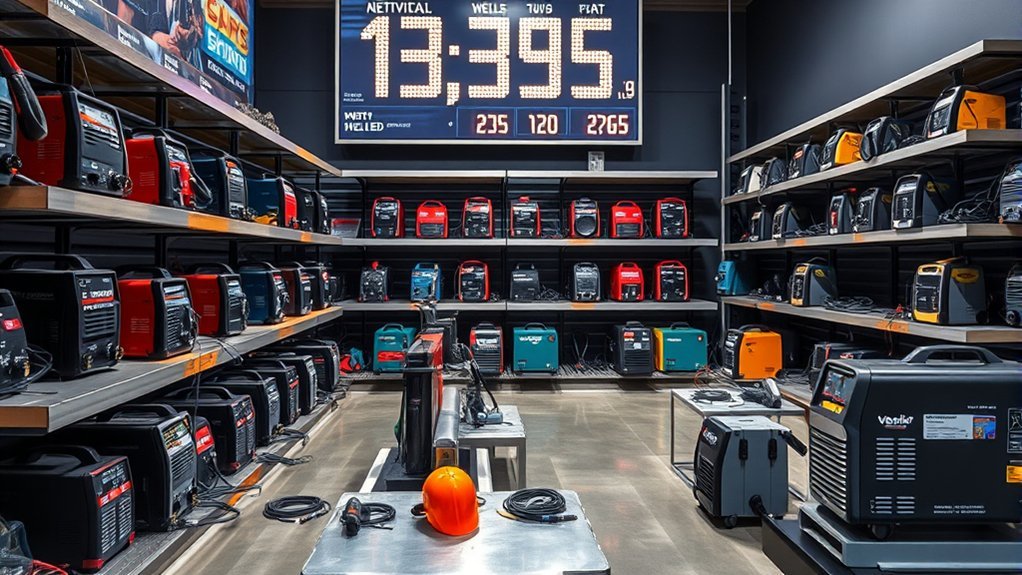
Specific models and prices change, so use named machines as examples of capability rather than permanent price benchmarks.
The current Miller Millermatic 211 PRO is an example of a premium portable MIG welder. Miller lists 120/240-volt input, a 30-to-230-amp range, a 60% rated duty cycle at specified outputs, and the ability to weld steel and aluminum up to 3/8 inch under the listed conditions.
The Razorweld Multi 160 illustrates a compact multiprocess machine offering MIG, DC lift TIG, and stick. Its manufacturer lists 115/230-volt input, process-specific duty-cycle ratings, spool-gun compatibility, and a three-year machine warranty. The TIG function is DC lift TIG, so it should not be treated as a full AC/DC aluminum TIG machine.

The Armor All AA255W wet/dry utility vac delivers strong 2 peak HP suction in a compact, portable design for quick cleanup of wet and dry messes. Its 2.5-gallon tank, wheel base, top handle, and built-in storage make it easy to move, organize, and use around the garage, car, or jobsite. It also converts to a blower and comes with multiple accessories for versatile cleaning tasks.

These Stanley MaxSteel straight aviation snips are built for clean, controlled cutting through sheet metal and other tough materials. Serrated cutting edges help prevent slippage for more accurate results, while the double pivot action delivers increased cutting power with less effort. Designed for dependable performance, they are a practical choice for metalworking, HVAC tasks, and general workshop use.

Post-it Super Sticky Easel Pads are designed to keep ideas visible and organized during meetings, training sessions, brainstorming, and project planning. The large premium paper resists marker bleed-through and sticks securely to many surfaces, then repositions without surface damage. A sturdy backcard and portable handle make them easy to move between rooms and use with most easel stands.
Accessories That Can Change the Real Price
- Spool gun: May be required for convenient aluminum MIG welding.
- TIG torch and foot control: Some multiprocess machines support TIG but do not include the full TIG package.
- Gas regulator and hose: Verify whether they are included and compatible with the gas you plan to use.
- Running gear or cart: Helps support the machine and secure the gas cylinder.
- Longer leads or gun: Useful for large workpieces but must match the machine’s output and connection type.
- Water cooler: Common on higher-amperage TIG packages and adds substantial cost.
- Fume extraction: May range from a small local-exhaust solution to a professional mobile or fixed extraction system.
How to Choose a Welding Machine Without Overspending
A practical buying decision begins with the work, not the brand or display panel. The Miller first-welder guide recommends considering amperage needs, available input power, material thickness, and duty cycle.
- List the metals you will weld. Separate mild steel, stainless steel, aluminum, cast iron, and specialty alloys.
- Measure the thinnest and thickest material. Choose a machine with enough maximum output and stable low-end control.
- Choose the main process. MIG is convenient for general shop use, TIG favors control and appearance, stick suits outdoor repair, and multiprocess equipment offers flexibility.
- Check available power. Confirm the receptacle, voltage, breaker, wiring, and generator requirements in the manual.
- Compare rated output and duty cycle. Do not compare maximum amperage alone.
- Review everything included. Price the missing torch, gun, pedal, regulator, spool gun, leads, cart, and adapters.
- Check local support. Confirm warranty terms, repair options, consumables, and replacement-part availability.
- Add the full setup cost. Include PPE, ventilation, gas, consumables, electrical work, tax, shipping, and training.
Best General Starting Points
- Occasional small repairs: A compact flux-core or stick machine may be enough if its material range matches the work.
- Home garage and automotive work: A gas-capable 120/240-volt MIG machine offers a useful balance of speed and flexibility.
- Stainless and appearance-sensitive fabrication: A suitable TIG machine provides greater control.
- Aluminum projects: Choose AC TIG or a MIG machine that supports the correct spool gun or push-pull system.
- Farm and outdoor repair: Stick or self-shielded flux-core avoids shielding-gas problems in wind.
- Mobile professional work: An engine-driven system may be justified when utility power is unavailable and generator output is valuable.
New, Used, or Rental Welding Machine
Buying New
A new welder normally provides the clearest warranty, current safety documentation, known history, and access to manufacturer support. It is the safer choice for buyers who cannot inspect or test electronic welding equipment.
Buying Used
A used machine can reduce the purchase price, especially for durable transformer-based equipment. However, older machines may be heavy, inefficient, out of warranty, incompatible with current accessories, or difficult to repair.
Before buying used, inspect or test:
- The serial number, model plate, manual, and input-voltage requirements
- Power cord, plug, case, fan, switches, displays, connectors, and damaged insulation
- Wire-feed operation, drive rolls, liner, gun, torch, work clamp, and gas valve
- Arc starting and output at several settings using the intended process
- Unusual noise, overheating, fault codes, burning smell, or evidence of moisture and metal dust
- Availability and cost of replacement boards, guns, torches, leads, and consumables
Do not energize damaged equipment. Have uncertain equipment inspected by a qualified welding-equipment technician or electrician.
Renting
Renting can make sense for a one-time repair, a short project, an unusually large job, or a process you want to test before buying. Ask whether the rental includes leads, a gun or torch, regulator, gas cylinder, consumables, PPE, damage waiver, and cleaning charges.
Daily and weekly rental prices vary by location and machine type, so compare the complete rental cost with the cost of hiring a qualified welder or buying a suitable used machine.
Frequently Asked Questions
What is the average lifespan of a welding machine?
There is no dependable universal lifespan. A lightly used, well-maintained machine may remain serviceable for many years, while a machine exposed to heavy production, dust, moisture, poor power quality, blocked cooling, or physical damage may fail much sooner. Parts availability and repair cost also determine its practical service life.
Can I finance my welding machine purchase?
Many manufacturers, distributors, retailers, and equipment-finance companies offer installment plans, promotional financing, leasing, or business-equipment loans. Approval, interest, fees, insurance, and tax treatment vary. Compare the total amount payable rather than focusing only on the monthly payment.
Are warranties available for welding machines?
Yes. New welding machines commonly include limited manufacturer coverage, but the duration and covered components vary. Engines, torches, guns, accessories, batteries, labor, shipping, and wear parts may have separate terms or exclusions. Read the warranty for the exact model before purchasing.
How often should I service my welding machine?
Use the maintenance schedule in the machine’s owner’s manual. Inspect cables, connections, the gun or torch, gas fittings, cooling openings, and damaged insulation regularly. Dusty, humid, outdoor, or high-use conditions may require more frequent cleaning and inspection than occasional home use.
Can I rent a welding machine instead of buying?
Yes. Renting is practical for short projects, temporary production needs, field repairs, or testing a process before buying. Confirm the rental period, deposit, damage terms, required power, included leads and accessories, gas arrangements, consumables, and transportation costs.
How much should a beginner spend on a welder?
A beginner may spend about $150 to $700 on the machine, depending on the process and project. A compact flux-core or stick unit can handle occasional repairs, while a gas-capable MIG machine usually costs more but is easier to use for many home-shop and automotive projects. Budget separately for PPE and accessories.
Is a 120V or 240V welder better?
A 120V welder is convenient for light work and portability. A 240V machine normally provides more usable output and better performance on thicker material. A dual-voltage machine offers flexibility, but you must use the correct plug, circuit, breaker, wiring, and extension arrangement specified by the manufacturer.
How much does a complete welding setup cost?
A basic home setup may cost several hundred dollars beyond the machine after adding a proper helmet, gloves, clothing, clamps, consumables, and tools. Gas welding processes may also require a cylinder, regulator, and refills. A 240V circuit, spool gun, TIG pedal, cart, or fume extraction can raise the total further.
Conclusion
A welding machine can cost about $120 for a basic light-duty unit or more than $10,000 for specialized industrial equipment. For many home shops, repair jobs, and small fabrication projects, the practical machine budget falls between about $500 and $1,700.
Choose the process and capacity that match your metal, thickness, power supply, duty cycle, and working conditions. Then compare the complete ready-to-weld cost, including PPE, gas, consumables, accessories, ventilation, electrical work, warranty coverage, and service support. Paying for useful capacity and dependable support is better than paying for features you will not use.
Sources
- Occupational Safety and Health Administration: Welding, Cutting, and Brazing Standards — workplace safety, PPE, fire prevention, and ventilation requirements.
- Miller: Buying Your First Welder — input power, amperage, material thickness, and duty-cycle selection.
- Miller Welding Equipment Maintenance Checklists — inspection, cleaning, and manual-based maintenance guidance.
- Miller True Blue Warranty — warranty and engine-coverage considerations.
- Harbor Freight Welder Listings — current examples of entry and portable welder price tiers checked July 28, 2026.
- Cyberweld Miller Dynasty 400 Listing — current example showing the price of a high-output industrial TIG power source.

Coghlan's Magnetic Bear Bell helps alert bears and other wildlife to your presence while hiking, walking, or exploring outdoors. The built-in magnetic silencer lets you quiet the bell when it is not needed, and the hook-and-loop closure makes it easy to attach to clothing, boots, hats, packs, or pet collars. It is a simple safety accessory designed to add peace of mind on the trail.

The DEWALT TSTAK Mobile Storage unit delivers a spacious, stackable solution for organizing and transporting tools with ease. Its telescopic handle, durable 7-inch wheels, and bi-material top handle make moving loads more comfortable, while rust-resistant metal latches and side latches support secure stacking with other TSTAK units. Built for convenience and mobility, it is ideal for professionals and DIY users who need dependable on-the-go storage.

The TENS 7000 Digital TENS Unit delivers drug-free pain relief with multiple therapy modes designed to help ease back, neck, shoulder, sciatica, elbow, and nerve pain. This consumer-favorite electrotherapy device doubles as a muscle stimulator and massager, making it a versatile option for recovery and everyday pain management. It includes the essentials to get started right away, along with a portable carrying case for convenient use at home or on the go.
