Last updated: September 7, 2026 · Pricing and policy references checked against the cited sources.
The average cost of a 2-star hotel in the USA is about $128 per night, while the current median is $98, based on a nationwide dataset of 35,011 two-star properties. These are base-price planning benchmarks before taxes and fees, not guaranteed quotes. Your final total depends on the destination, dates, room type, cancellation policy, local events, and included amenities.
Quick Answer
A 2-star hotel in the USA averages about $128 per night in a current dataset of 35,011 properties, while the median is $98. These are planning figures before taxes and some fees. Expect higher totals in major cities, resort areas, and destinations hosting holidays, festivals, games, or conventions.
Key Takeaways
- A current nationwide dataset lists an average two-star base rate of $128 and a median of $98 per night.
- The median may be more useful for budgeting because expensive outliers can pull the average upward.
- Free breakfast, parking, a pool, a refrigerator, and pet access are common at some properties but are never guaranteed by the two-star label.
- Compare the same room, occupancy, cancellation policy, included amenities, and final total on every booking site.
- Major events, holidays, resort locations, and limited local supply can push a basic hotel far above the national benchmark.
What to Expect From a 2-Star Hotel in the USA
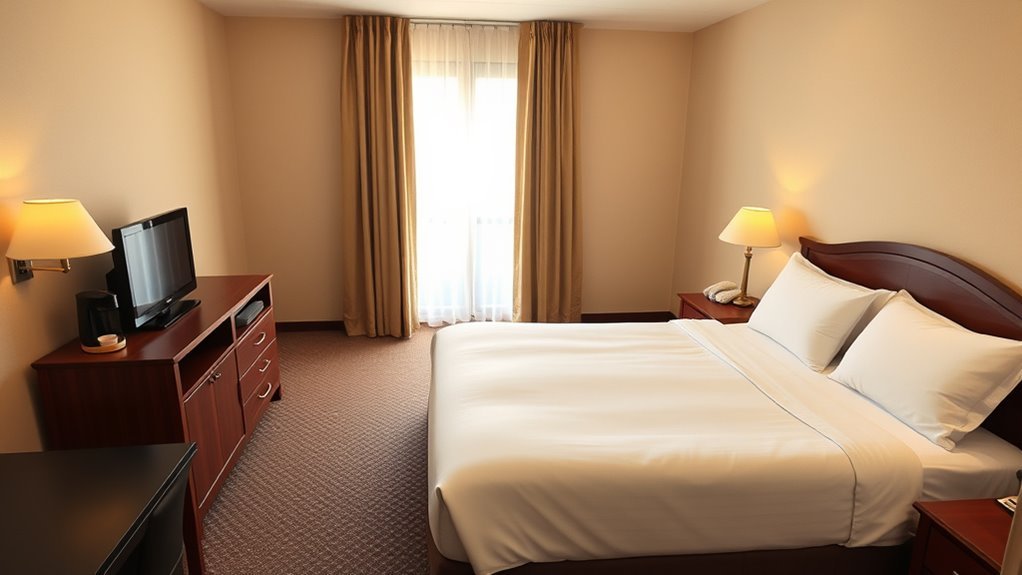
A 2-star hotel generally focuses on a clean place to sleep, a private room, and essential services rather than upscale design, full-service dining, or personalized attention. Many are limited-service chain hotels, roadside motels, airport properties, or independently operated accommodations.
However, a two-star label is not a nationwide guarantee. The United States does not use one mandatory federal star-classification system. Google says its hotel class ratings draw on third-party partners, direct research, hotelier feedback, and machine-learning analysis of property attributes. Organizations such as AAA use a separate inspection-based Diamond program. A hotel’s class should also not be confused with its guest-review score.
Note: A “2-star hotel” describes a property category or service level. A guest score such as 8.2/10 reflects reviews from previous customers. Always examine both before booking.
Common features may include:
- A private room and bathroom
- A television and basic climate control
- Wi-Fi in the room or public areas
- Basic toiletries, towels, and linens
- Regular housekeeping or towel service
- A front desk, self-check-in system, or limited reception hours
Some two-star hotels also provide breakfast, free parking, a swimming pool, a fitness room, laundry facilities, a refrigerator, or a microwave. Verify each feature on the individual property page because none of these extras is universal.
What Is the Average Cost of a 2-Star Hotel in the USA?
Checked September 7, 2026, Budget Your Trip’s analysis of 35,011 two-star hotels reports an average price of $128 and a median of $98 per night. The underlying prices are described as base prices reported by Kayak and are listed before taxes and fees.
That dataset is useful for national planning, but it is not a live checkout quote. Current booking displays for U.S. short-term lodging are subject to the FTC pricing rule described below, so compare the benchmark with the actual total shown for your selected room and dates.
A current dataset of 35,011 two-star U.S. hotels shows an average base price of $128 and a median of $98 per night.
| Pricing Measure | Current Benchmark | How to Use It |
|---|---|---|
| Average | $128 per night | Useful for a broad national estimate, but higher-priced destinations can pull it upward. |
| Median | $98 per night | Half of the sampled properties were priced below this amount and half above it. |
| Three-night average | About $384 | A base-rate estimate before taxes, deposits, parking, and selected extras. |
| Three-night median | About $294 | A more conservative starting point for lower-cost destinations and dates. |
There is no dependable single national “peak-season” or “low-season” price for every two-star hotel. Ski towns, beach destinations, national-park gateways, college towns, and major cities follow different demand calendars. Search your exact destination and dates before setting a final budget.
Is a 2-Star Hotel the Same as a Budget Hotel?
No. “Two-star” describes a hotel class, while “budget hotel” is a price-based category. In the same Budget Your Trip dataset, the broad budget category averages $96 per night with a $95 median, compared with $128 and $98 for two-star hotels. The categories overlap, but they are not interchangeable.
Understanding the Advertised Price
Since May 12, 2025, the Federal Trade Commission’s Fees Rule has required businesses advertising short-term lodging to display the total price upfront with mandatory charges they know and can calculate. Government charges and optional add-ons may initially be excluded, but the final amount of payment must be shown clearly before the business asks you to pay.
Your checkout total may therefore include:
- State and local lodging taxes
- Optional parking or valet charges
- Pet fees
- Optional breakfast or meal packages
- Rollaway-bed or extra-person charges
- Trip protection selected during booking
- A refundable security deposit or temporary incidental hold
A deposit or card hold may not be part of the room cost, but it can temporarily reduce your available credit or bank balance. Check the amount and release timeline before arrival.
What Should You Include in a Real Hotel Budget?
Use a five-number check before you book: (1) the room rate for all nights, (2) mandatory fees already included in the displayed total, (3) government taxes, (4) optional extras you choose, and (5) any refundable deposit or incidental hold. The first four determine what the stay costs; the fifth affects available cash or credit even when it is later released.
For a three-night stay at the $128 national two-star average, the room-rate benchmark is about $384 before government taxes and optional extras. At the $98 median, the same three nights are about $294. Use those figures only as planning anchors, then replace them with the live total for your exact room and dates.
What Amenities to Expect in 2-Star Hotels
A two-star hotel should provide the basics needed for a short stay, but the exact package varies considerably. Treat every amenity as property-specific until it appears in the room description or written hotel policy.
| Often Available | Must Be Verified |
|---|---|
| Private room and bathroom | Free or paid parking |
| Television and climate control | Complimentary breakfast |
| Basic linens, towels, and toiletries | Refrigerator, microwave, or coffee maker |
| Wi-Fi at many properties | Pool, gym, laundry, or business center |
| Some form of reception or guest support | Twenty-four-hour front desk service |
| Basic housekeeping or towel service | Daily full-room cleaning |
A two-star label does not promise free breakfast, parking, a pool, or a particular guest-review score.
Also check accessibility details rather than relying on a general “accessible” filter. Confirm doorway width, bathroom layout, elevator access, bed height, parking, and communication features directly with the hotel when those details are important to your stay.
How 2-Star Hotel Prices Compare to Other Options

Using the same nationwide pricing dataset provides a more useful comparison than mixing figures from unrelated sources. It currently reports an average of $128 for two-star hotels and $214 for three-star hotels. For a deeper breakdown of the next class up, see this 3-star hotel cost guide.
| Category | Average Base Price | Median Base Price | Important Context |
|---|---|---|---|
| Budget hotel category | $96 | $95 | A broad price-based category that can include hostels, guesthouses, motels, and hotels of different classes. |
| Two-star hotel | $128 | $98 | Basic or limited-service lodging with property-specific amenities. |
| Three-star hotel | $214 | $162 | Often provides more facilities, upgraded rooms, or a broader service package. |
| Four-star hotel | $268 | $223 | Generally positioned as upscale lodging, though classification standards still vary. |
At the averages above, choosing a two-star instead of a three-star hotel saves about $86 per night, or roughly $258 over three nights, before taxes and extras. The cheapest room is not automatically the best value, however. A slightly higher rate may be worthwhile when it includes breakfast, parking, a better location, or a flexible cancellation policy.
Top Strategies for Scoring Affordable 2-Star Hotel Deals
The most reliable savings come from flexible dates, accurate comparisons, and understanding what is included. No single website, weekday, or booking window produces the lowest price in every destination.
Book During Off-Peak Seasons
Start by checking the destination’s actual demand calendar. A beach town, ski area, college town, convention city, and national-park gateway can have completely different high seasons.
Use a flexible-date calendar to compare:
- Weekdays against weekends
- The week before and after a holiday
- Dates immediately before and after a festival, game, graduation, or convention
- Central locations against nearby suburbs
- Peak season against the destination’s shoulder season
Moving a stay by one or two nights can help, but it can also raise the price in markets where weekday business travel is stronger than weekend demand. Always test the exact dates rather than following a universal “cheapest day” rule.
Utilize Discount Travel Websites
Use at least one comparison tool and then check the hotel’s official website. Compare the exact same:
- Hotel and room type
- Bed configuration
- Number and ages of guests
- Included breakfast or parking
- Refund and cancellation rules
- Payment timing
- Total stay price rather than only the nightly figure
A lower-looking room may become more expensive when it lacks breakfast, charges for parking, or requires full nonrefundable payment. Third-party reservations may also have different change procedures from direct bookings.
Pro Tip: Take a screenshot of the room description, included amenities, cancellation deadline, and total price before paying. It gives you a clear record if the listing changes or a promised inclusion is missing.
Join Loyalty Programs Today
Free hotel loyalty programs can provide member-only rates, points, or booking benefits, but the savings vary. For example, Choice Privileges advertises savings of 10% or more. Current Wyndham Rewards member-rate terms say non-cardholder members receive at least 5% off the Standard Rate or at least 2% off a Standard Promotional Rate or Hotel Special Rate, depending on which comparison applies; cardholder minimum discounts are higher.
Before booking, compare the loyalty rate with:
- The publicly available refundable rate
- A prepaid or nonrefundable offer
- AAA, AARP, military, government, corporate, or senior rates when eligible
- Third-party prices with the same conditions
- Packages that include parking or breakfast
A member rate is not automatically the lowest available offer. Also check whether booking through a third party prevents you from earning points or receiving program benefits.
Seasonal Trends for 2-Star Hotel Costs
Two-star hotel prices move with local demand, room supply, labor costs, events, weather, and travel patterns. National averages cannot predict the cost of a specific room on a specific night.
Seasonal Price Variations
Rates commonly rise when a destination has more visitors than available rooms. This can happen during summer vacations, ski season, fall foliage, spring break, cruise departures, sports tournaments, conventions, graduations, festivals, and major concerts.
Less expensive periods may include:
- Shoulder-season weeks between the main high and low seasons
- Dates immediately after a major holiday
- Periods with fewer local events
- Stays outside a city center or resort district
- Flexible dates when more standard rooms remain available
Do not assume that winter is always cheaper or that rural locations always cost less. A small ski town or national-park gateway can be more expensive than a large city when local inventory is limited.
Holiday Impact on Rates
Holiday pricing depends on the destination. Leisure markets may become expensive around Memorial Day, Independence Day, Labor Day, Thanksgiving, Christmas, and New Year’s Eve. Business-oriented districts may become quieter during some of those periods.
Check both price and availability early when your dates overlap with a holiday or local event. Recheck refundable reservations as the trip approaches because hotels may lower rates when expected demand does not materialize.
Warning: A prepaid rate can save money, but it may provide no refund if your plans change. Read the full cancellation deadline in the hotel’s local time zone before paying.
Best Websites for Booking 2-Star Hotels
No booking website is consistently cheapest for every hotel. A practical search process is more useful than choosing one permanent favorite.
- Start with a broad comparison: Search Google Hotels, Kayak, Trivago, Expedia, Booking.com, or another established comparison platform.
- Open the full rate details: Confirm room type, occupancy, payment timing, cancellation rules, and included amenities.
- Check the hotel directly: Compare the official website’s public and member rates.
- Review the final total: Confirm mandatory fees, taxes, parking, pet charges, and optional extras.
- Review support options: Decide whether you prefer dealing with the hotel or a third-party platform if the reservation must be changed.
Price-comparison results can display rates with different conditions side by side. A nonrefundable room should not be compared directly with a flexible room as though they were identical products.
What Do Guests Think About 2-Star Hotels?
Guest experiences vary too widely for a single national review score to describe all two-star hotels. A basic property can earn excellent reviews when it is clean, quiet, accurately described, and well managed. Another hotel with similar facilities may receive poor reviews because of maintenance, noise, safety concerns, or weak customer service.
Prioritize recent reviews that discuss:
- Room and bathroom cleanliness
- Bed comfort and noise
- Air-conditioning and heating performance
- Hot-water pressure and plumbing
- Parking availability and lighting
- Front-desk responsiveness
- Wi-Fi reliability
- Pest, odor, or maintenance complaints
- Whether listing photos still match the property
Sort by newest reviews and read several positive, average, and negative reports. Repeated recent complaints are more useful than one unusually angry or enthusiastic review.
Location also affects satisfaction. A lower rate may be poor value when it requires expensive parking, long rides to attractions, or an uncomfortable late-night route. Use a map and street-level images before booking an unfamiliar area.
Will 2-Star Hotel Prices Rise After 2026?
No reliable national source supports a blanket prediction that every two-star hotel will rise by 5% to 10% or reach a particular high-season price. Local demand and supply will continue to produce very different results.
In its newer August 6, 2026 update, CoStar and Tourism Economics upgraded their broader 2026–27 U.S. hotel forecast. For 2026, projected gains in average daily rate (ADR) and revenue per available room (RevPAR) were raised by 1.1 and 1.6 percentage points, respectively, and projected occupancy was lifted to 63.1%. Those are industry-wide projections, not a forecast specifically for two-star hotels.
For travelers, the practical outlook is:
- National room prices may continue to increase gradually.
- Economy and select-service properties may perform differently from luxury hotels.
- Major events can cause short-lived local spikes.
- New hotel supply can reduce pricing pressure in some markets.
- Flexible dates and refundable rebooking will remain useful.
Use $128 as a current planning benchmark, not a permanent future price.
How Much Do 2-Star Hotel Prices Vary by Region?
Location can affect a two-star hotel’s price more than its star classification. Land costs, wages, taxes, parking, tourism, room supply, and nearby events all contribute to the final rate. For a broader trip-cost framework, use this guide to budget for hotel costs on a U.S. vacation.
Regional Price Differences
Prices are often above the national benchmark in:
- Major city centers
- Beach and resort destinations
- National-park gateway towns
- Areas near stadiums and convention centers
- Markets hosting graduations, festivals, tournaments, or large concerts
- Locations with few competing hotels
Lower rates are more common in ordinary suburban corridors, highway markets, and small towns with sufficient room supply. However, rural does not automatically mean inexpensive. Limited inventory can make a remote market costly during its busy season.
Urban vs. Rural Rates
| Location Type | Typical Pricing Pattern | What to Check |
|---|---|---|
| Large urban center | Often above the national benchmark | Parking, destination fees, neighborhood, transit access, and weekday business demand |
| Suburban corridor | Frequently lower than downtown | Driving time, tolls, parking, and public transportation |
| Airport area | Highly variable | Shuttle hours, parking charges, flight disruptions, and sound insulation |
| Small town or highway market | Often below the benchmark | Recent reviews, reception hours, food access, and local events |
| Resort or park gateway | Can be expensive despite a rural setting | Seasonal closures, minimum stays, limited supply, and distance from attractions |
Seasonal Price Fluctuations
Regional pricing changes when local demand changes. A hotel near a beach may peak in summer, while a desert destination may be more expensive in winter. Ski areas may peak during snow season, and college towns may spike around home games and graduation.
Before choosing a nonrefundable rate, search the destination’s tourism calendar, convention schedule, stadium events, school calendar, and major holidays. This can explain why an ordinary room is unusually expensive and may reveal cheaper nearby dates.
Frequently Asked Questions
What is the average cost of a 2-star hotel in the USA?
A current nationwide dataset of 35,011 two-star hotels reports an average base price of about $128 per night and a median of $98. The figures are before taxes and some fees, and your actual rate can vary substantially by destination and date.
What should I expect from a 2-star hotel?
Expect basic, limited-service accommodation rather than luxury facilities. A private room, bathroom, television, climate control, linens, and some form of guest support are common. Breakfast, parking, a pool, a refrigerator, daily housekeeping, and a 24-hour front desk must be checked separately.
Does the nightly hotel price include taxes and fees?
Not always. Calculable mandatory lodging fees must generally be included in the displayed total under the FTC Fees Rule, but government taxes and optional services may be shown separately. Review the final amount before payment and check for parking, pet, breakfast, and extra-person charges.
Is a 2-star hotel rating the same as a two-star guest review?
No. Hotel stars usually describe the property’s class, facilities, or service level according to a platform or rating organization. A guest-review score reflects customer feedback. A two-star hotel can have excellent guest reviews, and a higher-class property can receive poor reviews.
When should I book a 2-star hotel for the lowest rate?
There is no universal best booking day. Compare flexible dates, avoid high-demand events when possible, and reserve a refundable rate when prices are reasonable. You can then recheck the same room and dates and rebook if a lower equivalent rate appears before the cancellation deadline.
Is a 2-star hotel cheaper than a 3-star hotel?
In the current nationwide dataset used in this guide, yes on average: two-star hotels average $128 per night versus $214 for three-star hotels, a difference of about $86. The medians are $98 and $162, respectively. Individual properties can still reverse that pattern on specific dates.
Does a 2-star rating mean a hotel is unsafe or unclean?
No. A star or class rating mainly describes the property’s service level and amenities, not neighborhood safety or a universal cleanliness score. Check recent guest reviews, the property’s current photos, parking and access details, and any inspection or rating information available for that specific hotel.
Conclusion
For a 2026 U.S. trip, use $128 per night as a broad two-star hotel average and $98 as the current median benchmark, before taxes and some fees. Then price your exact destination and dates rather than relying on a national high- or low-season figure.
The best value comes from comparing identical rooms by final total, location, cancellation terms, parking, breakfast, and recent reviews. A carefully selected two-star hotel can provide a clean and comfortable stay, but the star label alone does not guarantee specific amenities or service quality. Before paying, run the five-number budget check above and confirm the live total for your exact dates.
Sources
- Budget Your Trip: Hotel Prices for the USA — current two-star sample size, average, median, comparison categories, and base-price methodology.
- Federal Trade Commission: Rule on Unfair or Deceptive Fees FAQ — mandatory lodging-fee display and final-price requirements.
- CoStar and Tourism Economics: August 2026 U.S. Hotel Forecast — current national hotel-demand and rate outlook.
- Google Business Profile Help: Hotel Class Ratings — explains how Google distinguishes hotel class ratings from guest-review ratings and the inputs used for class ratings.
- AAA Diamond Program — inspection-based hotel classification and cleanliness standards.
- Choice Privileges Benefits — example of a hotel loyalty program advertising member-only savings.
- Wyndham Rewards Member Rate Terms — current eligibility and minimum member-rate discount terms.