
Last updated: August 10, 2026
Argon refill cost in New Orleans is usually quote-based rather than one fixed citywide price. For budgeting, current national retail benchmarks checked August 10, 2026 are $57.99 for 40 CF of 100% argon contents at Northern Tool and $67.99–$69.99 for 80 CF of contents at Northern Tool and Tractor Supply. Those prices cover the gas, not a new cylinder. Your New Orleans-area total can change with cylinder ownership, gas grade, exchange policy, delivery, handling or hazmat fees, and tax.
Quick Answer
No universal published New Orleans walk-in argon refill rate was identified. As current national contents-only benchmarks, budget about $58 for a 40-CF exchange and about $68–$70 for an 80-CF exchange before local fees and tax. Get a direct quote for 125-CF and larger cylinders, leased bottles, delivery, or specialty grades, and confirm whether each quoted price is for gas contents, the cylinder, or both.
Key Takeaways
- A refill or exchange price can cover only the argon contents; buying a cylinder is a separate purchase and can add several hundred dollars.
- Current national retail examples put 40-CF argon contents near $58–$60 and 80-CF contents near $68–$70, but New Orleans branch pricing can differ.
- Local distributors often use branch-, account-, or service-specific pricing instead of publishing one New Orleans walk-in rate.
- Welding-grade argon is suitable for most TIG welding and appropriate nonferrous MIG work; UHP argon is mainly for applications with stricter impurity limits.
- An 80-CF cylinder provides about four ideal arc-on hours at 20 CFH before allowing for purging, post-flow, leaks, and residual pressure.
- Check cylinder ownership, valve type, condition, and the requalification stamp before buying a used bottle.
Note: The retail prices below are dated planning benchmarks, not guaranteed New Orleans tariffs. Industrial-gas distributors may quote different rates for walk-in customers, commercial accounts, leased cylinders, and delivered orders.
How Much Does an Argon Refill Cost in New Orleans?
The first step is to determine whether a quoted price covers only the argon contents or includes a cylinder. Those are separate purchases. A contents-only exchange requires an eligible bottle, while a cylinder listing covers the reusable pressure vessel and may or may not include gas.
Never compare a contents-only exchange price with the price of a cylinder. They are two different purchases.
As of August 10, 2026, Northern Tool lists 40-CF 100% argon contents at $57.99 and 80-CF contents at $67.99. Tractor Supply lists 80-CF argon contents at $69.99. These are national retail benchmarks, not guaranteed New Orleans branch prices, and availability, exchange eligibility, tax, and local fees can change the final amount.
| Cylinder Size | Current Pricing Benchmark | Best Fit |
|---|---|---|
| 40 CF | $57.99 contents-only at Northern Tool; Tractor Supply also lists 40-CF contents around $60. Local rates may differ. | Occasional repairs and portable hobby use |
| 80 CF | $67.99 contents-only at Northern Tool and $69.99 at Tractor Supply; cylinder purchase is separate | Home shops and regular light fabrication |
| 125 CF | Current contents-only price varies by retailer and branch; request a local exchange quote | Frequent hobby use and small commercial shops |
| 250–330 CF | Distributor quote normally required; rental or lease programs are common | Production work and high annual gas use |
Before choosing a size, compare the refill price per cubic foot, how often the cylinder must be transported, its full weight, and whether your preferred supplier will exchange that ownership class.
What Affects Argon Cylinder Cost in New Orleans?
Two customers can receive different totals for the same nominal cylinder size. The biggest variables are:
- Cylinder ownership: A customer-owned bottle, leased bottle, and supplier-owned exchange cylinder can have different gas and handling rates.
- Gas grade: Welding-grade argon normally costs less than certified specialty or ultra-high-purity gas.
- Cylinder size: Larger bottles can lower the gas cost per cubic foot but are heavier and may only be available through a lease or supplier program.
- Walk-in versus delivered service: Delivery, route, minimum-order, fuel, and handling charges may apply.
- Commercial account terms: Volume, contract length, cylinder inventory, and delivery frequency can affect pricing.
- Cylinder condition: An expired requalification date, damaged valve, heavy corrosion, or unclear ownership marking can cause rejection or extra service charges.
Ask for an itemized quote that identifies the gas contents, cylinder rent or deposit, delivery, hazmat or environmental fees, fuel surcharge, minimum order, and sales tax. Record the quote date because industrial-gas pricing and surcharges can change.
Pro Tip: Give every supplier the same request: cylinder capacity, 100% argon grade, owner or lease status, pickup or delivery, expected exchanges per year, and your ZIP code. For example: “I need the out-the-door pickup price to exchange one customer-owned 80-CF cylinder for 100% welding argon. Please include gas, exchange or handling fees, hazmat charges, and tax.” Standardized requests make local quotes much easier to compare.
Do You Need Welding-Grade or UHP Argon?
Argon grade names and specifications vary by supplier, so compare the stated purity and impurity limits rather than assuming every “industrial” grade is identical. As one current U.S. example, Airgas ARCAL Prime welding argon is 99.998% Ar, while Airgas UHP argon is listed at 99.999% purity.
Most routine TIG welding and appropriate nonferrous MIG applications do not require UHP gas. Choose the grade specified by the welding procedure, customer contract, equipment manufacturer, or laboratory method. Buying a higher purity than the process requires usually raises cost without improving an otherwise correct welding setup.
| Grade | Typical Specification | Common Uses | Pricing |
|---|---|---|---|
| Welding grade | Supplier-defined; Airgas ARCAL Prime is one 99.998% Ar welding-gas example | TIG welding, aluminum and copper-alloy MIG, root shielding, and fabrication | Usually lower than specialty UHP gas; branch or account quote may apply |
| High purity | Supplier-defined purity and impurity limits | Specialized processing, testing, and controlled atmospheres | Typically higher than ordinary welding gas |
| UHP | 99.999% in the cited Airgas UHP example | Chromatography, glove boxes, analytical work, purging, and specified high-precision processes | Specialty quote; certification and tighter impurity limits can add cost |
Products Worth Considering

APPLICATION: The ARCCAPTAIN gas pressure regulator can be used with argon, helium, and carbon dioxide gas tanks.
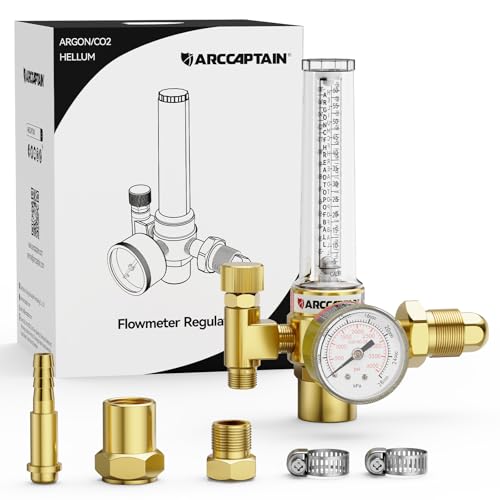
APPLICATION: The ARCCAPTAIN gas pressure regulator can be used with argon, helium, and carbon dioxide gas tanks.
Should You Buy, Rent or Lease an Argon Cylinder?
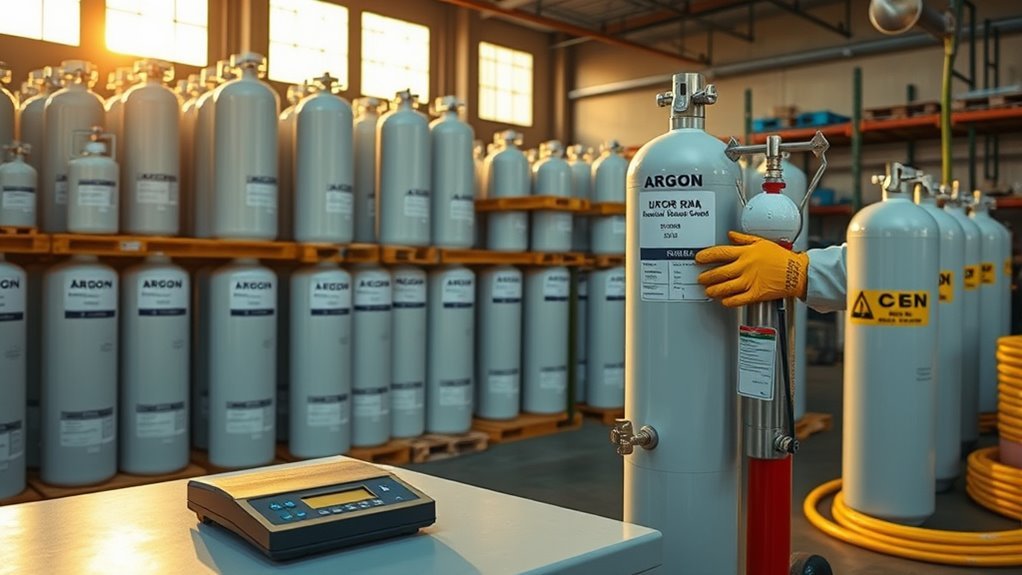
Owning a smaller cylinder can make sense for a hobbyist or small shop that wants to avoid recurring bottle rent. Leasing is often more practical for large cylinders, frequent exchanges, multiple gases, or businesses that want the supplier to manage cylinder inspection and inventory.
Buying may be better when:
- You use a portable 40-, 80-, or 125-CF bottle.
- Your supplier accepts that owner-cylinder size and brand for exchange.
- You expect to keep using argon for several years.
- You can transport and store the cylinder safely.
Leasing may be better when:
- You need a 250- to 330-CF shop cylinder.
- You exchange bottles frequently.
- You need delivery, inventory management, or several cylinders.
- You do not want responsibility for long-term cylinder ownership and requalification.
Lease terminology differs. A supplier may charge annual rent, monthly rent, daily demurrage after a free period, a refundable deposit, or a cylinder-maintenance fee. Ask what happens if the account closes, a bottle is lost, or the cylinder remains unused for months.
For a fair comparison, use these formulas:
- Annual ownership cost: purchase price divided by expected ownership years, plus gas exchanges, inspection-related costs, and transportation.
- Annual lease cost: rent or demurrage, plus gas exchanges, delivery, handling, and account fees.
Warning: Do not buy a used cylinder until your preferred supplier confirms that it will refill or exchange that bottle. A cylinder may be rejected because of supplier ownership markings, an expired requalification date, valve incompatibility, corrosion, fire damage, dents, or unauthorized repairs.
Products Worth Considering
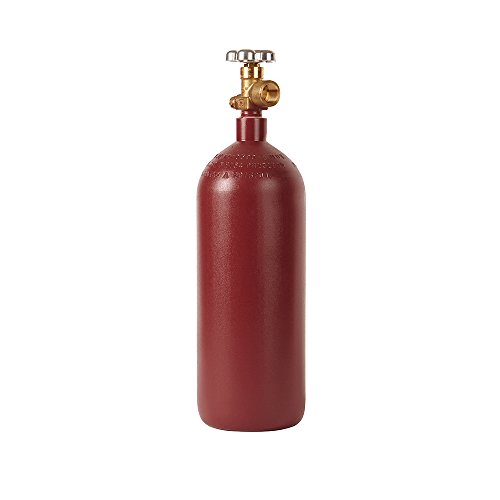
20 CU FT ARGON CYLINDER - Compact steel argon tank perfect for TIG welding, MIG welding, and hobby/small shop fabrication. 2015 PSI service pressure. Ultra-portable with 5.25" diameter x 18" height, 13.67 lb tare weight. Ideal for mobile welders, small shops, automotive repair, and DIY metalworking projects

All HP cylinders come with a 10 year hydrotest date stamped.
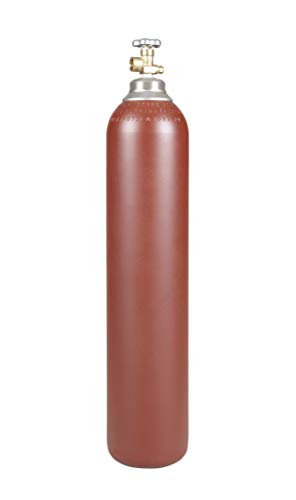
80 CU FT INERT GAS CYLINDER - Mid-size steel cylinder for professional welding, HVAC, beverage, and industrial applications. 2015 PSI service pressure. 7" diameter x 31" height, 47 lb tare weight. Letter designation: Q. Ideal balance of capacity and portability for commercial operations and serious hobbyists
How Long Does an Argon Cylinder Last?
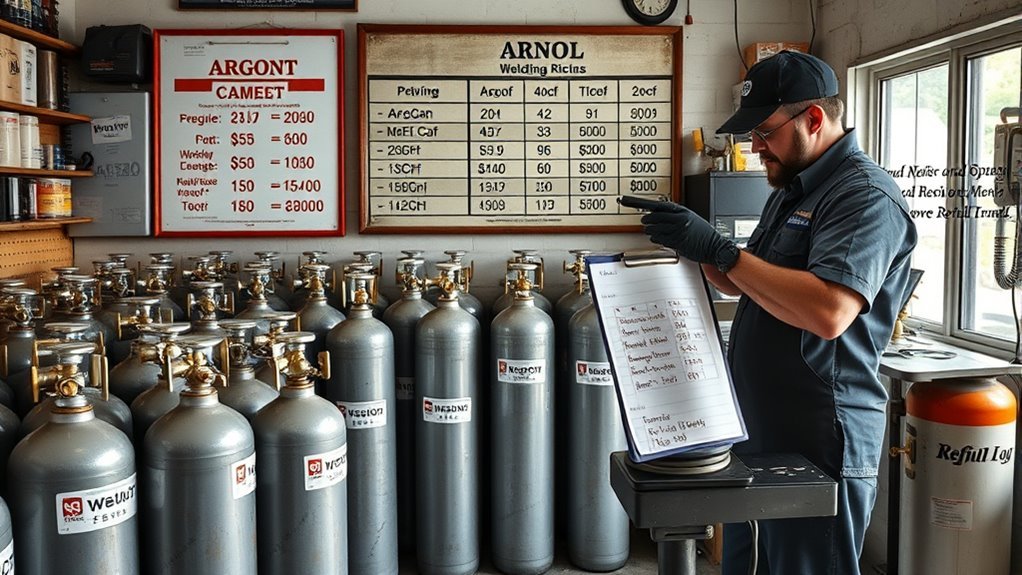
A cylinder’s ideal runtime is its rated gas capacity divided by the flow rate in cubic feet per hour. Real runtime will be shorter because of pre-flow, post-flow, purging, leaks, regulator losses, and gas left in the bottle when pressure becomes too low for stable operation.
| Cylinder | Ideal Runtime at 15 CFH | Ideal Runtime at 20 CFH | Ideal Runtime at 30 CFH |
|---|---|---|---|
| 40 CF | 2.7 hours | 2 hours | 1.3 hours |
| 80 CF | 5.3 hours | 4 hours | 2.7 hours |
| 125 CF | 8.3 hours | 6.25 hours | 4.2 hours |
| 300 CF | 20 hours | 15 hours | 10 hours |
Miller notes that TIG flow commonly ranges from about 10 to 35 CFH depending on consumables and atmospheric conditions. Many routine TIG setups operate within that range, so cylinder life can vary substantially with cup size, drafts, purge needs, and actual arc-on time.
An 80-CF cylinder at 20 CFH provides about four ideal arc-on hours. If the refill costs $70, the recurring gas cost is about $17.50 per ideal arc-on hour—not the price of the entire reusable cylinder.
What Fees Can Be Added to an Argon Refill Quote?
Delivery and account fees can turn a low gas price into a higher invoice. There is no dependable universal New Orleans percentage because distributors use different fee structures and may negotiate commercial-account terms.
Request a written quote showing:
- Argon grade and cylinder capacity.
- Gas contents or exchange charge.
- Cylinder rent, lease, demurrage, or deposit.
- Hazmat, environmental, handling, or facility fee.
- Fuel or route surcharge.
- Delivery charge and minimum order.
- Hydrostatic-test or inspection charge, if applicable.
- Sales tax and final out-the-door total.
For delivery, ask whether the driver provides dock, curbside, or inside placement and whether your site needs a loading area, cylinder cart, or scheduled delivery window. Small users may save money by picking up an exchange cylinder, but only when they can transport it safely.
How Do You Calculate the Real Cost of Argon?
Use the refill or exchange price—not the full cylinder purchase price—to calculate recurring gas cost.
Cost per cubic foot:
Refill price ÷ cylinder capacity
Example: $70 ÷ 80 CF = $0.875 per cubic foot.
Ideal cylinder runtime:
Cylinder capacity ÷ flow rate
Example: 80 CF ÷ 20 CFH = 4 ideal arc-on hours.
Recurring gas cost per ideal arc-on hour:
Refill price ÷ ideal runtime
Example: $70 ÷ 4 hours = $17.50 per ideal arc-on hour.
Amortized cylinder cost:
Cylinder purchase price ÷ expected ownership years
Example: A $500 cylinder kept for 10 years represents $50 per year before testing, transportation, loss, or repair costs.
For a shop-level comparison, add rent, delivery, fees, lost production time, and the labor required to collect a replacement cylinder. A slightly higher exchange price may still be cheaper if the supplier prevents several hours of downtime.
For broader national pricing and cylinder-selection guidance, see our welding gas tank cost guide and welding gas cylinder cost guide.
Alternatives to Argon for MIG and TIG Welding
The correct alternative depends on the process and base metal. Pure argon is a standard choice for TIG welding and nonferrous MIG applications such as aluminum. It is usually not the best choice for ordinary short-circuit MIG welding on mild steel, where a 75% argon and 25% carbon-dioxide blend is common.
| Process and Material | Common Gas Choice | Important Note |
|---|---|---|
| TIG, steel or stainless steel | 100% argon | Use the procedure and equipment manufacturer’s recommended flow. |
| TIG, aluminum | 100% argon; argon/helium for some thick sections | Helium increases heat input but normally increases gas cost. |
| MIG, mild steel | 75% argon/25% CO₂ is common | Other blends may be specified for spray transfer or production requirements. |
| MIG, aluminum | 100% argon | Helium-containing blends may be used for heavier material or specialized procedures. |
| Self-shielded flux-core, carbon steel | No external shielding gas | Useful outdoors, but creates slag and often more spatter. |
Self-Shielded Flux-Core
Self-shielded flux-cored wire eliminates the external gas cylinder and performs better than gas-shielded solid wire in windy field conditions. It is a practical option for many carbon-steel repairs, structural applications, farm work, and outdoor fabrication when the selected wire is approved for the joint and required mechanical properties.
The trade-offs include slag removal, smoke, spatter, wire cost, and a different finished appearance. It is not automatically cheaper once cleanup labor and consumable cost are included. Stainless steel requires a consumable specifically classified for the alloy and application; do not assume a general carbon-steel self-shielded wire is suitable.
- No external shielding-gas cylinder is required.
- Wind resistance is better than gas-shielded MIG.
- Slag and cleanup time must be included in the cost comparison.
Helium-Argon Blends
Argon/helium blends can add heat and improve travel speed on thick aluminum, copper alloys, and other applications where pure argon produces insufficient heat input. Miller notes that common TIG blends can contain roughly 25% to 75% helium, depending on the work.
Helium is lighter than argon and may require a different flow setting to maintain shielding. The gas normally costs more, so the blend should be justified by faster travel, reduced preheating, improved penetration, or another measurable production benefit.
Test the blend on representative material and compare total cost per completed weld rather than gas price alone.
How Should You Transport, Store and Inspect an Argon Cylinder?
Argon is nonflammable, but it can displace oxygen in an enclosed space. A leaking cylinder can therefore create a serious asphyxiation hazard without producing smoke, flame, or a strong warning odor.
- Keep cylinders upright and secured with a chain, strap, rack, or approved cylinder cart during storage and use.
- Close the valve before moving the bottle and whenever welding is finished.
- Remove the regulator and install the protective valve cap when the cylinder is transported, when the cylinder design permits a cap.
- Use a regulator and fittings intended for argon and the cylinder’s connection, commonly CGA 580 on many U.S. welding-argon cylinders.
- Store the bottle in a dry, protected, well-ventilated location away from impact, excessive heat, and unauthorized handling.
- Secure the cylinder against movement during vehicle transport and follow the supplier’s transport instructions and applicable rules.
- Inspect the valve, cap, body, regulator, and hose before use.
- Check the stamped requalification date before buying or presenting an owner cylinder for filling.
OSHA 29 CFR 1926.350 contains compressed-gas cylinder requirements for construction workplaces, including securing cylinders, closing valves, and using valve-protection caps in specified circumstances. OSHA has separately clarified that §1926.350(a)(9) is a construction-site requirement rather than a universal rule for welding-gas manufacturers and distributors. For home shops and nonconstruction workplaces, also follow the cylinder supplier’s instructions and the safety rules that apply to that setting.
DOT-covered cylinders are subject to continuing qualification requirements under Title 49, with the applicable test or requalification interval determined by cylinder specification, markings, and governing rules. A filler may refuse a cylinder that is overdue, damaged, improperly marked, or outside its exchange system.
Warning: Never use makeshift adapters, damaged regulators, or unauthorized cylinder repairs. If a valve leaks, close it only when this can be done safely, ventilate the area, keep people away, and contact the supplier or emergency services as the situation requires.
Products Worth Considering

All HP cylinders come with a 10 year hydrotest date stamped.
All HP cylinders come with a 10 year hydrotest date stamped.

60 CU FT ARGON CAPACITY - Mid-size cylinder for welding, metal fabrication, and more. Balances generous capacity with portability at 29 lbs for professional welders, fabrication shops, and mobile repair
Where Can You Buy or Refill Argon Near New Orleans?
Verified New Orleans-area options include Airgas, Gas and Supply, and Linde. Their official location pages confirm nearby industrial-gas or welding-gas service, but they do not publish one universal New Orleans argon refill price for every cylinder and customer type.
Call before driving to a branch. Confirm that the location has your cylinder size, accepts your bottle for exchange, carries the required gas grade, and can serve your customer/account type.
- Airgas Kenner: The official branch page lists argon and welding supplies. View the Airgas Kenner branch.
- Airgas Harvey: The branch lists argon, cylinder returns, tank exchanges, regulators, and welding equipment. View the Airgas Harvey branch.
- Airgas Slidell: The official Slidell branch is another regional industrial-gas and welding-supply option. View the Airgas Slidell branch.
- Gas and Supply: The company lists its New Orleans location at 111 Buras Drive in Belle Chasse and its N.O. Service Center at 1452 4th Street in Harvey. View Gas and Supply locations.
- Linde Belle Chasse: Linde operates a Welding Gas & Equipment Center at 1903 Engineers Road in Belle Chasse, and its local page says welding and cutting gases including argon are available. View the Linde Belle Chasse location.
Ask each supplier whether it performs an on-site fill or a cylinder exchange for your bottle type. Exchange programs are faster, but you normally receive a different inspected cylinder rather than the exact bottle you brought in.
How Can You Lower Your Argon Costs?
The safest savings come from using the right cylinder, eliminating waste, and comparing complete invoices.
- Use the lowest correct flow: Excessive flow can create turbulence and pull surrounding air into the shielding zone.
- Check for leaks: Inspect the regulator connection, hose, fittings, torch, and valve area with an approved leak-detection method.
- Close the cylinder valve: Shut it when the equipment is unattended or the welding session is finished.
- Reduce unnecessary purge time: Follow the procedure instead of allowing gas to flow longer than needed.
- Choose the right bottle size: Frequent users can reduce exchange trips and may lower cost per cubic foot with a larger cylinder, provided transport and rent remain practical.
- Compare complete invoices: Include gas, cylinder fees, delivery, fuel, hazmat, environmental charges, and tax.
- Request commercial pricing: Businesses with predictable volume may qualify for contracted delivery or cylinder rates.
- Avoid unnecessary UHP gas: Use the purity required by the process rather than automatically buying the highest grade.
- Keep a spare cylinder when downtime is costly: A second bottle can cost less than stopping a production job during supplier hours.
Track the date, cylinder size, invoice total, estimated arc-on hours, and remaining pressure for several exchanges. Your own records will reveal whether a larger bottle, different supplier, or repaired leak produces the biggest saving.
Sources
- Northern Tool 40-CF Argon Contents — current contents-only retail benchmark.
- Northern Tool 80-CF Argon Contents — current contents-only exchange benchmark.
- Tractor Supply 80-CF Argon Contents — current contents-only retail benchmark.
- Airgas Kenner branch — confirms local argon and welding-gas availability.
- Airgas Harvey branch — confirms local argon, cylinder returns, and tank exchanges.
- Gas and Supply locations — confirms Belle Chasse and Harvey New Orleans-area locations.
- Linde Belle Chasse Welding Gas & Equipment Center — confirms another New Orleans-area welding-gas location.
- Airgas ARCAL Shielding Gases — welding-argon purity and process guidance.
- Airgas UHP Argon — UHP purity and applications.
- Miller TIG Shielding-Gas Best Practices — TIG flow ranges, turbulence, and argon/helium blend guidance.
- OSHA 29 CFR 1926.350 — construction-workplace cylinder-handling requirements.
- OSHA Directive STD 03-08-002 — clarifies the construction-site scope of §1926.350(a)(9).
- 49 CFR 180.205 — compressed-gas cylinder requalification requirements.
Frequently Asked Questions
How much does an 80-CF argon refill or exchange cost?
As of August 10, 2026, current national contents-only examples are $67.99 at Northern Tool and $69.99 at Tractor Supply for an 80-CF 100% argon cylinder. Those figures do not include buying a new cylinder, and New Orleans branch prices, fees, tax, and exchange eligibility can differ.
How long does an 80-CF argon cylinder last?
At a 20-CFH flow rate, an 80-CF cylinder provides about four ideal arc-on hours because 80 ÷ 20 = 4. Actual usable time is lower after allowing for pre-flow, post-flow, purging, leaks, and gas left in the cylinder.
Is it cheaper to refill or exchange an argon cylinder?
It depends on the supplier. An exchange can reduce waiting time because you receive another inspected cylinder, while a true refill lets you keep the same bottle. Compare the complete out-the-door price, turnaround time, ownership policy, and any inspection or handling fees rather than assuming one method is always cheaper.
Do I need UHP argon for TIG welding?
Usually not for routine welding. Supplier specifications vary, but Airgas ARCAL Prime is a 99.998% argon product intended for TIG welding and other welding applications, while its 99.999% UHP argon is aimed at applications with tighter impurity requirements. Use the gas grade specified by your welding procedure, customer, or equipment requirements.
Why might a supplier refuse to refill or exchange my cylinder?
Common reasons include an expired requalification date, severe corrosion, dents, heat or fire damage, an incompatible valve, unclear ownership, supplier markings, unauthorized repairs, or a cylinder size outside the branch’s exchange program. Send the supplier photographs of the neck markings and test stamp before buying a used bottle.
Can I use pure argon for mild-steel MIG welding?
Pure argon is generally not the preferred shielding gas for ordinary short-circuit MIG welding on mild steel. A 75% argon and 25% CO₂ blend is common because it provides more suitable arc behavior and penetration. Pure argon is widely used for TIG and for MIG welding aluminum and other nonferrous metals. Follow the wire and welder manufacturer’s recommendations.
Where can I buy or exchange argon near New Orleans?
Verified New Orleans-area options include Airgas branches in Kenner and Harvey, Gas and Supply locations in Belle Chasse and Harvey, and the Linde Welding Gas & Equipment Center in Belle Chasse. Airgas also has a Slidell branch. Call first to confirm your cylinder size, gas grade, owner-cylinder policy, walk-in availability, and current out-the-door price.
Conclusion
There is no single published New Orleans argon refill price that applies to every cylinder and customer. Current national benchmarks put 40-CF argon contents near $58–$60 and 80-CF contents near $68–$70, while larger cylinders, specialty grades, rentals, and delivery normally require a direct quote. For the best local comparison, call at least two New Orleans-area suppliers with the same cylinder size, ownership status, gas grade, and pickup or delivery request. Compare the final out-the-door price and cost per cubic foot—not a cylinder purchase price against a gas-only exchange.
