

If you’re planning to get welding certified, you’ll want a clear budget and timeline before you start. Costs vary by program length and institution, since short certificates cost less than two-year degrees. You’ll also need to factor in tuition, equipment, PPE, and certification tests. Some employers or apprenticeships cover fees, while community colleges and trade schools offer very different price points. Keep reading for specific numbers and what each cost actually covers.
Quick Answer
- Certification tests typically cost $460–$520, with retests running $120–$250 per position.
- Certificate programs run $3,000–$10,000; diploma programs $5,000–$15,000; associate degrees $10,000–$25,000.
- Equipment and PPE add roughly $100–$2,500 depending on what you already own.
- Financial aid, scholarships, and apprenticeships can significantly cut your out-of-pocket costs.
- Living expenses near a training program add about $5,000–$15,000 per academic year in most regions.
Typical Tuition Ranges for Welding Programs
Welding program tuition varies widely, generally falling between $5,000 and $30,000 depending on the type and length of the program.
Certificate tracks often cost $3,000–$10,000 for focused, short-duration training. Diploma programs typically run $5,000–$15,000 and include more hands-on hours. Associate degrees take about two years and usually range $10,000–$25,000, adding general education requirements on top of the technical coursework.
Community colleges average around $5,000 for two-year welding courses that combine academics with hands-on practice, making them a good fit for budget-conscious students.
Trade schools focus on vocational skill and charge roughly $5,000–$20,000, which reflects intensive lab time and equipment use.
When comparing options, look at total cost, program duration, and contact hours side by side. Choose the program that fits your timeline, budget, and credential goals.
Types of Schools and How They Affect Cost
Choosing between a trade school and a community college comes down to cost versus instructional focus. Trade schools prioritize hands-on skill training and often charge $5,000–$20,000. Colleges combine theory and general education at lower average rates, around $5,000 for a two-year program.
Program format matters too. Certificate courses run weeks to months and cost $3,000–$10,000. One-year diplomas run $5,000–$15,000. Two-year associate degrees range $10,000–$25,000. Duration and curriculum depth drive tuition at every level.
Also consider class size and lab time. Programs with more hands-on instruction typically cost more per credit hour.
Products Worth Considering


Trade School vs. College
Both routes lead to welding careers, but the choice between trade school and community college affects cost, time, and what you actually study.
Trade schools focus on hands-on, vocational training with certificate and diploma options. Fees run roughly $3,000–$20,000 and programs range from a few weeks to a year. Community colleges offer two-year associate programs that mix technical instruction with general education, with tuition roughly $5,000–$25,000 depending on the program and transfer opportunities.
Trade school advantages include concentrated practical hours, faster time-to-certification, and predictable costs: $3k–$10k for certificates and $5k–$15k for diplomas. Community college benefits include accredited associate degrees ($10k–$25k), transferable credits, and a broader academic foundation.
Choose based on the credential you need, your budget, and your long-term career goals.
Program Length & Format
Program length directly affects contact hours, coursework scope, and cost. Factor that in before you choose a school.
Certificate programs run weeks to months, cost $3,000–$10,000, and deliver focused shop hours for immediate entry-level work. Diploma programs span about one year, cost $5,000–$15,000, and blend practical skills with targeted theory.
Trade schools favor shorter, intensive formats with typical costs of $5,000–$20,000. Community colleges offer longer programs, often two-year associate degrees, averaging around $5,000 for two years or $10,000–$25,000 where advanced specialization is included.
Match the format and duration to the skills you actually need to avoid paying for coursework that doesn’t move your career forward.
Program Lengths: Certificate, Diploma, and Degree Prices

If you want a fast path to entry-level welding, certificate programs run a few weeks to several months and typically cost $3,000–$10,000. Diploma programs extend to about one year with fees of $5,000–$15,000. Associate degrees take roughly two years and range $10,000–$25,000. Four-year bachelor’s tracks that add business or engineering courses commonly exceed $20,000.
Choose based on the credential you need, the depth of training required, and your long-term goals. Compare program length against curriculum scope and expected tuition to find the right fit for your time and money.
- Certificate: shortest program, focused skills, lowest tuition.
- Diploma: one-year trade-focused curriculum, moderate tuition, broader practice.
- Associate: two-year technical degree, includes general education, higher tuition.
- Bachelor’s: four-year professional pathway with business or engineering, highest tuition.
Also check whether the school issues completion certificates and note that additional certification testing costs are separate from tuition.
Products Worth Considering

🧲 Sticks to Toolboxes & Welders – Heavy-duty magnetic welding chart adheres to metal surfaces like your welding table, toolbox, or wall for instant reference while working.

Richard Finch, Welder's Handbook: A Complete Guide to MIG, TIG, Arc & Oxyacetylene Welding, "Completely Revised and Updated Edition!" paperback

Used Book in Good Condition
Equipment, Materials, and Personal Safety Gear Expenses
When budgeting for welding certification, keep equipment, consumables, and PPE as separate line items. These costs can add up quickly: materials and PPE typically run $100–$500, welding machines $500–$2,000, and textbooks and supplies another $100–$500.
For equipment, the main cost driver is the welding machine. Stick, MIG, and TIG machines typically range $500–$2,000. Leads, clamps, and torches add a smaller amount on top. Filler metals, electrodes, and shielding gas are recurring consumables within the $100–$500 range.
For PPE, budget separately for a welding helmet (auto-darkening costs more than passive), leather gloves, a welding jacket, and boots. Add another $100–$500 for textbooks and course supplies.
Keep your one-time startup costs (machine, high-end PPE) separate from recurring consumables so you can accurately forecast cash flow throughout your program.
Products Worth Considering

WITH LED WELDING LIGHT: This welding helmet comes equipped with a USB-powered LED light on top, offering two brightness levels. You can weld easily, even in dark environments, without worrying about not being able to see the details of the weld. It is ideal for assisting with welding in various scenarios. NOTE: Welding light comes uninstalled; easy to attach.

【FASTER AUTO-DARKENING】Features high-end auto-darkening lenses with 4 premium arc sensors, switching from light to dark in 1/25000 sec. Easily adjust the shade and sensitivity of the lenses for different working environments, perfect for TIG/MIG/ARC welding. Dark state level: 4/9-13.

Wide Application Range: Shade 3.5/9-13 supports TIG, MIG, MMA/ARC and Grind, and the helmet accommodates magnifying lenses for close-up and detailed work.
Certification and Testing Fees Explained
Once you’ve budgeted for gear and consumables, add a separate line for certification and testing fees to get a complete picture of your total cost.
After budgeting gear and consumables, add a separate line for certification and testing fees to complete your cost picture.
Most certification tests through the American Welding Society (AWS D1.1, ASME IX) cost $460–$520. An ATF Upgrade plus AWS registry enrollment adds about $155–$165. If you need to retest, plan for $120–$250 per position.
Tests are typically scheduled on set days (often Tuesdays and Thursdays at 8:00 AM, depending on the testing center). Bring a photo ID and all required safety equipment, since missing documents or PPE can delay your test and add extra charges.
- Base test fee: $460–$520 depending on code and level.
- ATF Upgrade/registry: +$155–$165 to enroll in the AWS certified welder registry.
- Retest per position: $120–$250. If you need multiple positions, plan for higher total cost.
- Scheduling/logistics: confirm test days and bring all required documents and PPE to avoid delays.
Also track renewal timelines for your certification. Planning ahead for renewal can help you avoid unnecessary repeat testing costs.
Financial Aid, Scholarships, and Loan Options
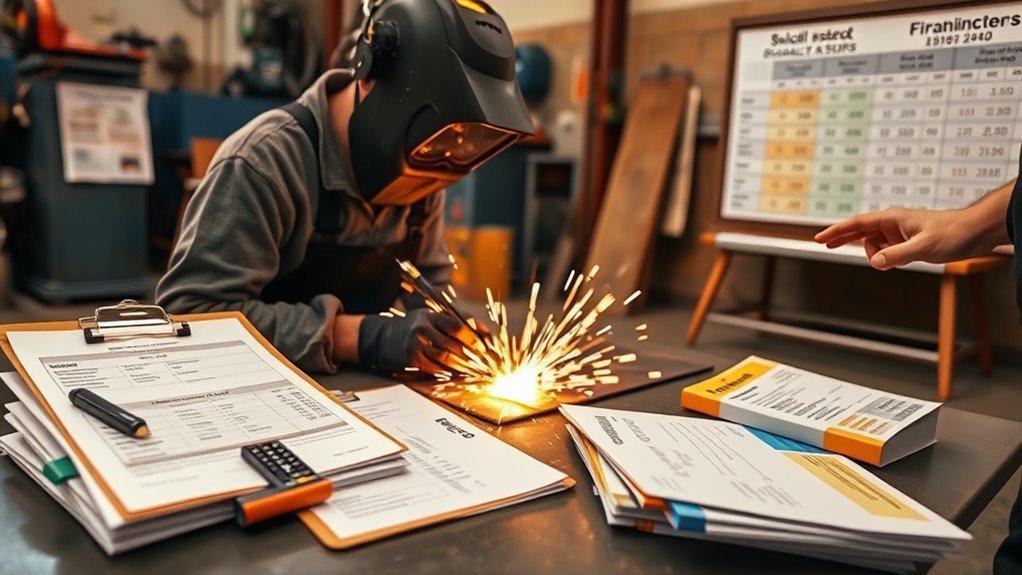
Certification programs can look expensive upfront, but combining federal aid, scholarships, and low-interest loans can significantly cut what you pay out of pocket.
Start by completing the FAFSA to find out if you qualify for federal grants or subsidized loans. Make sure your school participates in federal aid programs before you enroll. If you’re a veteran or a dependent family member, look into GI Bill eligibility early so those benefits can be layered with other aid.
At the same time, apply for scholarships. Target professional associations like the American Welding Society, school-specific awards, and competition-based grants. Keep track of deadlines, required documents, and selection criteria for each one. Applying to multiple programs gives you a better shot at stacking funding and reducing what you borrow.
If you do need a loan, prioritize federal or school-arranged plans with low interest rates. Calculate your total repayment using expected wages from certified welding roles to make sure the numbers work. A simple spreadsheet tracking award amounts, expiration dates, and conditions will help you make a clear-headed funding decision.
Apprenticeships and Employer-Sponsored Training Costs

When looking at apprenticeships or employer-sponsored training, weigh the employer-paid benefits against any costs you’d still cover yourself.
Most apprentices earn roughly half a journeyman’s pay while training. Some programs also provide $500–$2,000 for tools and $100–$500 for materials or PPE. Factor in any service agreements or contractual commitments that could affect your future earnings if you leave early.
Employer-Paid Training Benefits
In an employer-run apprenticeship or sponsored training program, the company typically covers most certification and schooling costs. Those costs otherwise range from about $460 to over $1,000 for individual welding tests and $5,000 to $30,000 for formal school tuition.
Typical benefits include covered exam fees, reduced out-of-pocket expenses, and paid access to equipment and PPE. Employers often fund materials ($100–$500), guarantee job placement after completion, and maintain standards over the training curriculum.
Before enrolling, review the program scope, duration, which certifications are covered, and any service-commitment clauses carefully.
- Cost coverage: exams, tuition, materials.
- Equipment and PPE supplied or reimbursed.
- Direct pathways to certified roles.
- Employer-controlled curriculum and standards.
Apprenticeship Stipends and Wages
Beyond covering tuition and gear, employers also pay apprentices during training. Welding apprenticeships typically mix on-the-job and classroom instruction over 1–4 years, and apprentices usually earn 30%–50% of a journeyman’s pay.
Pay follows a structured progression tied to completed levels and certifications. Starting hourly rates often fall between $15–$25 and increase as you hit milestones. Many employer-sponsored programs also include health insurance, retirement contributions, and paid time off, which lowers your overall cost of training.
When comparing offers, look at the base stipend, scheduled pay increases, and the dollar value of any benefits to get a true sense of total compensation during the program.
Costs Tied to Commitments
Apprenticeships and employer-sponsored programs come with defined timelines and milestones, so it’s worth mapping out both your expected earnings and any out-of-pocket costs across the full 1–4 year term.
Apprentices typically earn a fraction of journeyman pay while spending $100–$500 on tools and materials. Employer programs may cover $460–$2,000 or more in tuition and exam fees, but retest costs (for example, $250 for an AWS D1.1 retest) usually fall on you.
- Calculate net income across the full commitment, including staged wage increases.
- List all direct costs: tools, materials, tuition, exam fees, and retests.
- Confirm employer reimbursement timelines and any clawback clauses.
- Model your worst-case out-of-pocket exposure if training ends early.
Regional Cost Differences and Living Expenses

Certification fees and training costs vary by location. Expect test prices to range roughly $460–$685 and total living expenses near a welding program to add about $5,000–$15,000 per academic year.
In high-demand regions, course and exam fees tend to be higher. On the plus side, you’ll usually find more frequent testing windows and stronger employer partnerships. Materials, equipment, and safety gear also cost more in high cost-of-living areas, typically $100–$2,000, along with higher housing and transportation expenses.
Lower-demand, lower-cost regions can cut your immediate costs, but may also limit local job placement options after you certify.
Before choosing a training location, add up fixed costs (tuition, exam fees, gear) and variable costs (rent, commute, consumables) for each region. Then compare program schedules and local job markets side by side to find the balance that works for your budget and career goals.
Calculating Return on Investment for Welding Training

Once you know your regional costs and living expenses, compare your total program outlay against projected earnings to see how quickly training pays off.
Add up tuition, fees, ATF upgrade ($460–$685 range), and living expenses. Then model your earnings using median wage data and a certification premium. According to the Bureau of Labor Statistics, the May 2023 median wage for welders was $48,940. A 20% wage premium over non-certified workers is a reasonable baseline for certified welders. Specialized certifications (underwater, aerospace) can push earnings well above that.
Calculate total program cost (tuition, fees, ATF upgrade $460–$685, living) and model earnings uplift from a 20% certification premium.
- Add up all upfront costs, subtract financial aid, and calculate your net outlay and payback period.
- Project annual earnings: median wage times (1 + certification premium), with specialty adjustments where applicable.
- Compute simple ROI = (cumulative additional earnings minus net outlay) / net outlay over your target timeframe.
- Test different scenarios (regional wage variance, job placement rates, scholarship impact) to pressure-check your numbers before committing.
Frequently Asked Questions
Can I Transfer Welding Credits Between Schools or Programs?
Yes, you can often transfer welding credits, but you’ll need to confirm credit transfer policies and accreditation details with both schools. They’ll review course equivalency, syllabi, contact hours, and certification alignment before approving any transfers.
Are Online Welding Courses Accepted by Employers for Certification?
Online course credibility varies. Most employers want proof of hands-on skills and accredited program completion, so make sure any online coursework is backed by documented weld tests and recognized certifications that align with employer requirements.
How Often Must I Renew or Requalify My Welding Certification?
Renewal frequency depends on your employer, the applicable code, and the certifying body. Certification validity often ranges from 1 to 5 years. You’ll requalify through retesting or documented continuous practice under ASME, AWS, or your company’s specific procedures.
Do Different Welding Processes Require Separate Certifications?
Yes, different welding processes typically require separate certifications. Each one has its own requirements, and you’ll need to demonstrate distinct techniques per process, including specific materials, positions, and parameters.
What Insurance or Liability Costs Should I Expect as a Welder?
Expect to budget for general liability, professional liability, and commercial auto insurance. Costs vary by location, experience level, and revenue. If you employ others, you’ll also need workers’ comp. Equipment insurance is worth adding too. Budget anywhere from a few hundred to several thousand dollars annually depending on your situation.
Conclusion
Most welders spend $460–$685 for initial certification plus $120–$250 per retest, and about $5,000 on average for a two-year community college welding program. Add $100–$2,500 for tools and PPE. For a real-world example, Maria paid $5,200 in tuition, $850 in gear, and $525 for tests, totaling $6,575. Plan your costs by program length and region, compare apprenticeships and aid options, and calculate your payback time based on expected wages before you decide.
