
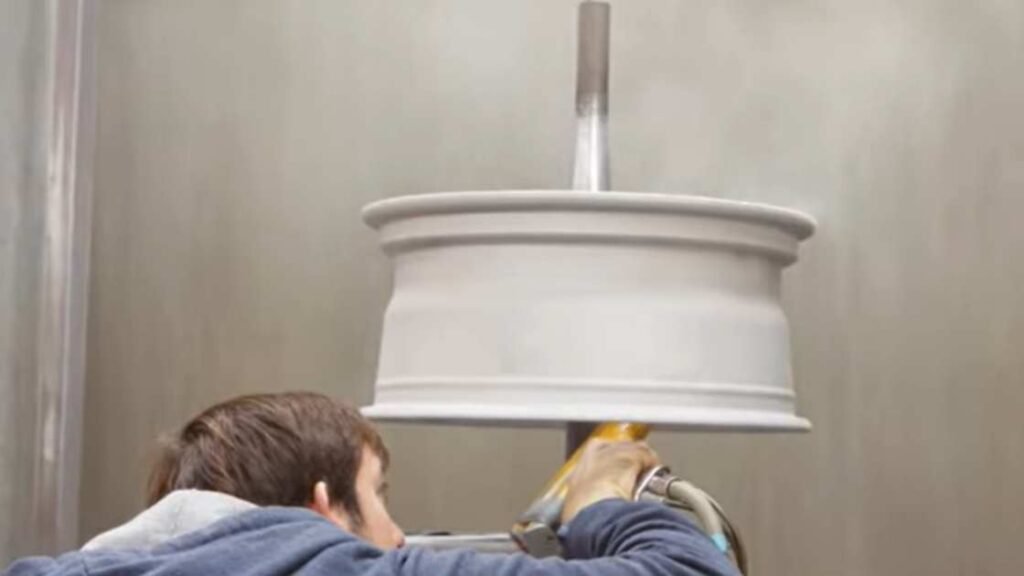
Powder coating four rims in the U.S. usually costs about $400 to $1,000 for a standard single-color job. Current posted prices checked in August 2026 start around $340 for four 17-inch loose wheels and reach $1,000 or more for full-service vehicle drop-off. Large wheels, curb-rash repair, multi-stage colors, and premium-market labor can raise the total to about $1,800 or more.
Powder coating is a dry finishing process that uses electrostatically charged powder and heat curing to form a hard, decorative layer on metal. It is generally more durable than ordinary liquid paint when the wheel is prepared and cured correctly, but the coating cannot make a bent, cracked, or badly corroded wheel safe.
Last updated: August 10, 2026. The published shop prices and cited policies on this page were rechecked on this date.
Disclosure: This page contains affiliate product links. If you buy through one, we may earn a commission at no extra cost to you.
Quick Answer
Budget $400–$1,000 for a typical set of four car rims in a standard color. Current posted examples range from about $340 for four 17-inch loose wheels to $1,000+ for full-service vehicle drop-off. Repairs, oversized wheels, multi-stage finishes, premium colors, and high-cost markets can push the bill toward $1,800+. Compare itemized quotes because shops include different services.
Key Takeaways
- Loose-wheel pricing is usually lowest: removing the wheels and tires before drop-off can reduce labor charges.
- Prep drives quality and cost: stripping, blasting, cleaning, damage repair, masking, and proper curing matter more than the powder itself.
- Ask what is included: tire service, balancing, TPMS handling, curb-rash repair, clear coat, and taxes may be separate.
- Do not coat an unsafe wheel: cracks, major bends, and serious corrosion require professional inspection before refinishing.
- Check the wheel warranty first: aftermarket refinishing can void some manufacturers’ structural or finish coverage.
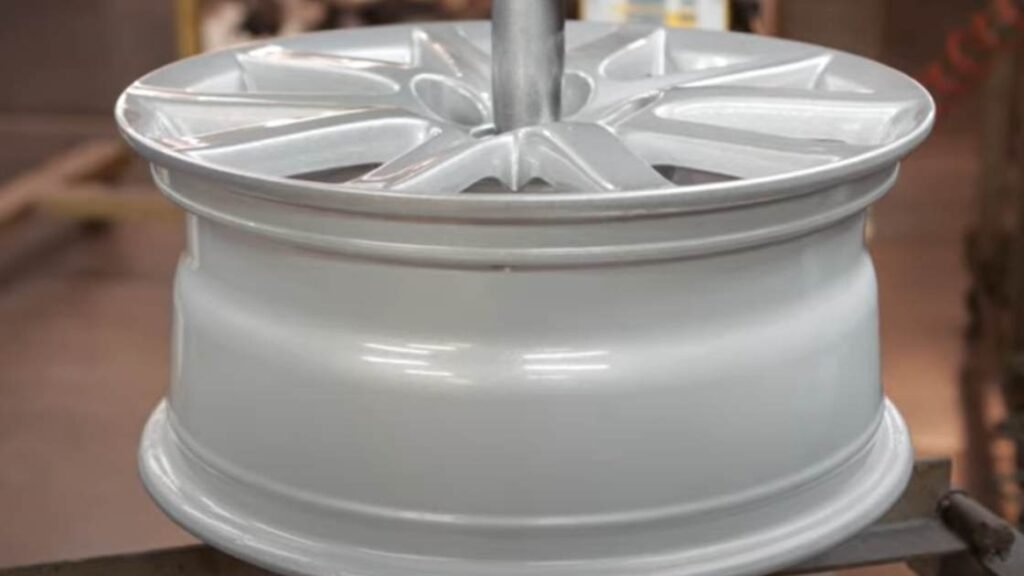
How Much Does It Cost to Powder Coat 4 Rims in 2026?
There is no single national price for wheel powder coating, and published shop rates vary widely by location and service level. The ranges below are practical planning figures based on current U.S. shop price pages, not guaranteed quotes.
How these ranges were built: We compared publicly posted prices from the five U.S. shops listed below, then separated loose-wheel coating from full-service vehicle drop-off so unlike quotes are not averaged together.
| Job Type | Typical Planning Range for 4 | Usually Includes |
|---|---|---|
| Loose wheels, standard color | $340–$800 | Coating, curing, and inspection; stripping/blasting may be included or extra; tires are already removed |
| Vehicle drop-off, standard finish | $440–$1,300 | Wheel removal, tire dismount, preparation, coating, remounting, balancing, and reinstalling |
| Large, damaged, or custom wheels | $800–$1,800+ | Heavy prep, repairs, oversized wheels, multi-stage colors, detailed masking, or premium market labor |
Note: “Rim” is commonly used to mean the whole wheel, although the rim is technically the outer portion that holds the tire. Most coating shops price the complete wheel.

Meguiar’s Ultimate Compound is designed to remove stubborn stains, bird dropping marks, oxidation, light scratches, and swirl marks from automotive paint. Its advanced abrasive technology helps restore a smoother, clearer finish without scouring clear coats, making it a reliable choice for paint correction before waxing. Use it by hand or with a dual action polisher to prepare your vehicle for a brilliant final shine.

This silky, lightweight K-beauty face primer visibly smooths skin and minimizes the appearance of pores for a refined, velvety look. Its soft-matte finish helps reduce shine and creates a smooth base that supports longer-lasting makeup wear without feeling heavy. Suitable for all skin types, it works well under powder, liquid, or cream foundation and is designed to glide on evenly for a flawless finish.

This practical guide brings together traditional skills and self-sufficiency knowledge in one accessible reference. It helps readers learn time-tested home, craft, and survival techniques with clear guidance suited for beginners and hobbyists alike. Ideal for anyone interested in homesteading, DIY living, or preserving old-fashioned know-how.
Current Published Shop Price Examples
These examples were checked on August 10, 2026 and show why a single national average can be misleading:
- Pop Shop Garage lists standard wheels from $85 each for 14–17 inches and $95 each for 18–20 inches, with specialty finishes and heavy prep priced separately.
- Black Rim Powder Coating lists $340 for four 17-inch wheels, $360 for 18-inch wheels, and $400 for 20-inch wheels when tires are already removed; tire service is extra.
- Proper Motion advertises a starting price of $440 for four wheels 18 inches and under, including mounting, balancing, and minor curb-rash repair.
- ColorWerks lists loose-wheel service from $800 per set and same-day vehicle drop-off from $1,000 per set.
- Hussle Customz in Los Angeles lists full-service sedan and coupe jobs from $1,000 to $1,300, with larger vehicles priced higher.
The most useful quote is not the lowest number. It is the quote that clearly states what preparation, tire work, repairs, finish layers, warranty, and taxes are included.
The Basics of Powder Coating
Powder coating is a dry finishing method. A spray gun gives fine polymer powder an electrical charge, attracting it to a grounded metal wheel. The coated wheel then enters a curing oven, where the powder flows and chemically cross-links into a continuous film.
The finished layer can resist chips, abrasion, moisture, fading, and corrosion better than many ordinary liquid-paint systems. Performance still depends on the powder type, wheel material, surface preparation, film thickness, and correct cure time and metal temperature.
The Professional Process in a Nutshell
- Inspection: The shop checks for cracks, bends, heavy corrosion, previous repairs, and materials or inserts that may not tolerate stripping or curing.
- Disassembly: Tires, valve stems, TPMS hardware, wheel weights, center caps, and removable trim are taken off as required.
- Stripping and cleaning: Old paint, clear coat, grease, brake dust, oxidation, and contaminants are removed by chemical stripping, media blasting, or both.
- Repair and preparation: Approved cosmetic damage is smoothed, the surface is cleaned again, and porous cast aluminum may be pre-baked to reduce outgassing defects.
- Masking: The hub-mounting face, lug-seat contact areas, center bore, valve-stem opening, and other tight-tolerance surfaces are protected where required.
- Application: Electrically charged powder is sprayed onto the grounded wheel in one or more coats.
- Curing: The wheel is heated for the powder manufacturer’s specified time and metal temperature. Oven air temperature alone does not prove a complete cure.
- Cooling and inspection: The finish is checked for thin spots, contamination, orange peel, pinholes, color variation, and masking quality.
- Reassembly: Tires and TPMS parts are installed, the wheel-and-tire assemblies are balanced, and the wheels are torqued to the vehicle manufacturer’s specification.
Benefits Over Traditional Painting
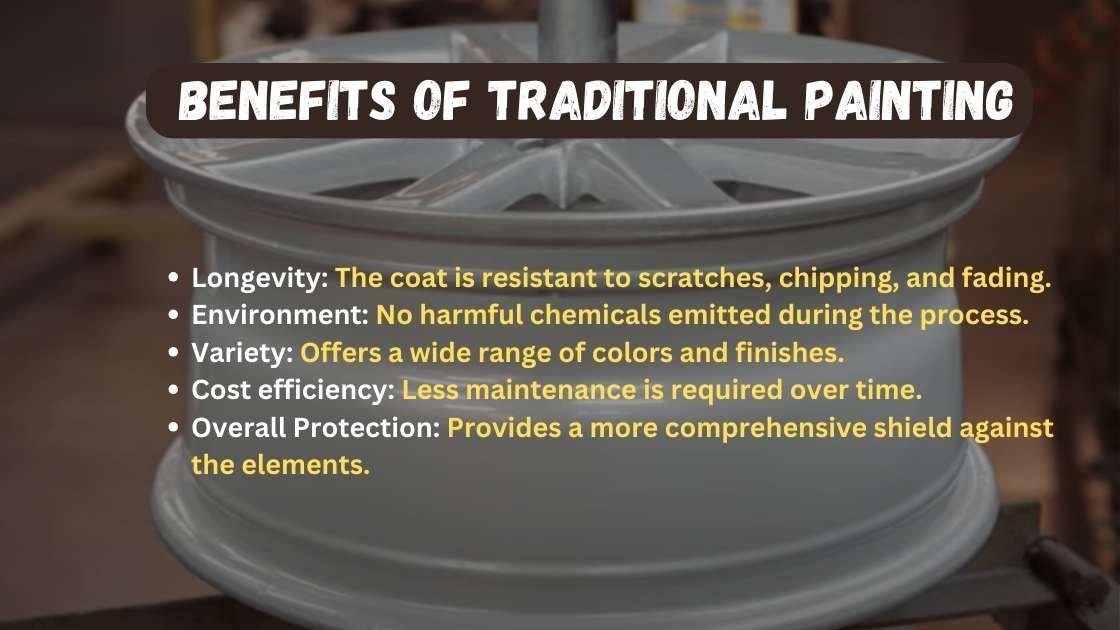
- Durability: A correctly prepared and cured powder finish generally resists abrasion, moisture, chemicals, UV exposure, chipping, and fading better than ordinary single-stage paint.
- Even coverage: Electrostatic application helps powder wrap around spokes and complex shapes, although recessed areas still require skilled technique.
- Color and texture choices: Gloss, satin, matte, textured, metallic, candy, and clear finishes are available.
- Lower solvent emissions: The U.S. Environmental Protection Agency lists powder coatings among low- or no-VOC/HAP coating options. Some formulations may still release volatile material during curing.
- Long-term value: A durable finish can reduce the need for frequent cosmetic repainting when the wheel is maintained and not damaged by impacts.
Powder coating protects and refreshes the wheel surface. It does not add structural strength, erase fatigue damage, or make an unsafe wheel roadworthy.
Warning: Powder dust, electrostatic equipment, blasting, chemical stripping, and curing ovens create fire, electrical, inhalation, and burn hazards. OSHA requires controls for powder accumulation, ignition sources, ventilation, electrostatic equipment, and curing systems. Wheel-size DIY work needs dedicated equipment and a properly designed workspace.
Wheel-material caution: Do not assume every alloy wheel is suitable for aftermarket powder coating. BBS USA says BBS Motorsport products should never be powder coated because curing heat can affect the original heat treatment and structural integrity. Check the wheel maker’s instructions before authorizing refinishing.
Factors Influencing the Cost
Several variables determine what you will pay to powder coat four rims. Ask each shop to separate the base coating price from optional work so you can compare quotes fairly.
Rim Size and Design Complexity
- Larger wheels use more rack and oven space and usually require more material and handling time.
- Deep barrels, tight spokes, and complex shapes take longer to clean, mask, spray, and inspect.
- Two-piece and three-piece wheels may require specialist disassembly, new hardware or seals, and careful reassembly.
- Two-tone or machined-look designs require additional masking, coating stages, or machining.
Choice of Powder and Finish
The powder system and appearance you choose directly affect labor and material costs.
- Standard single-stage colors, such as gloss black, satin black, silver, or common bronze, are usually the least expensive.
- Metallic, candy, pearl, chrome-effect, transparent, or textured finishes may need special powder, a base coat, or a clear top coat.
- Custom color matching and two-tone work add setup, masking, spraying, and curing time.
- Exterior-grade powders should be selected for UV exposure and road use; the cheapest available powder is not always the best value.
Preparation and Labor Expenses
| Preparation Step | Labor Level | Cost Effect |
|---|---|---|
| Removing paint, clear coat, chrome-like finishes, or failed powder | Moderate to high | Often included in premium quotes; extra in low base-price quotes |
| Media blasting, degreasing, and pretreatment | Moderate | Essential quality work; should not be skipped |
| Curb-rash correction or corrosion cleanup | Moderate to high | Common per-wheel add-on unless included |
| Detailed masking or multi-stage finish | High | Can add substantially to the total |
Good preparation is what makes the coating adhere and last. A low quote that excludes stripping, blasting, or repair may cost more after add-ons or may produce a weaker finish.
Price Range for Powder Coating Rims
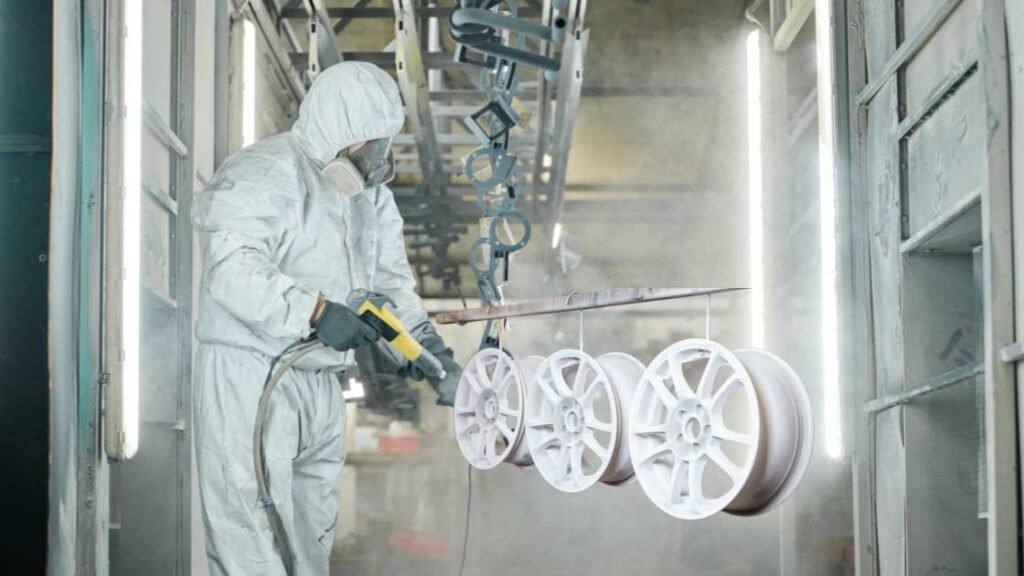
For budgeting, expect a standard set of four passenger-vehicle wheels to fall around $400 to $1,000. The low end generally assumes loose wheels, a common one-stage color, and limited repairs. Full-service vehicle drop-off and premium finishes can cost considerably more.
Planning Cost by Wheel Size
| Wheel Size | Loose-Wheel Planning Range | Why It Varies |
|---|---|---|
| 14–17 inches | About $85–$150 per wheel | Simple designs and standard colors are lowest; stripping and repairs raise the price |
| 18–20 inches | About $95–$200 per wheel | More surface area, larger tire equipment, and common premium finishes |
| 21 inches and larger | About $110–$250+ per wheel | Oven capacity, handling risk, tire type, and finish complexity |
These are planning ranges, not national averages. Your material, wheel construction, local labor market, finish, damage, and included services determine the actual quote. If damage is part of the decision, see our guide to bent rim repair costs before paying for cosmetic refinishing.
What Is Usually Included?
A complete professional quote may include:
- Removal of the old finish
- Degreasing and media blasting
- Minor surface correction
- Masking of critical areas
- Primer when required
- One powder color and oven curing
- Final quality inspection
- Tire dismounting, remounting, balancing, and wheel installation
Do not assume every item is included. Some shops quote only the coating of loose, ready-to-process wheels.
Simple Cost Estimator
Use this formula before requesting quotes:
Total project cost = base coating for four wheels + stripping/prep + repairs + specialty finish + tire/TPMS service + transport or rush fees + tax.
| Example | Illustrative Calculation | Estimated Total |
|---|---|---|
| 18-inch loose wheels, standard color | $95 × 4 + $80 additional prep | $460 |
| 20-inch full-service custom finish | $150 × 4 + $160 tire service + $200 specialty finish + $120 cosmetic repair | $1,080 |
The examples show how add-ons change the bill; they are not shop quotes.
DIY Versus Professional Service
A basic powder gun is only one part of a wheel-capable setup. Four rims also require a large dedicated curing oven, safe powder containment and ventilation, grounding equipment, stripping or blasting equipment, high-temperature masking supplies, suitable PPE, and enough experience to control film thickness and cure.
- DIY: Can make sense for an experienced hobbyist who already has a dedicated, compliant workspace and wheel-size equipment.
- Professional: Usually gives more consistent preparation, coating thickness, curing, masking, tire handling, and warranty support.
Warning: Never use a curing oven for food afterward. Follow the powder and equipment manufacturers’ safety instructions, and do not improvise around combustible dust, open flames, poor ventilation, or high-voltage electrostatic equipment.
Additional Costs to Consider
The coating price may be only part of the total expense. Ask for an itemized estimate that covers every step from vehicle drop-off to final installation.
Tire Removal, Mounting, and Balancing
Tires normally must come off for full stripping, coating, and curing. Current posted examples checked in August 2026 put basic dismounting, remounting, and balancing at about $120 to $175 per set of four when it is not included in the coating price. Larger, low-profile, run-flat, or heavy-duty tires may cost more.
Balancing should be performed after the tires are refitted. Continental recommends rebalancing when a tire is refitted to a wheel to help prevent vibration and uneven wear.
Repairs and Preparation
| Possible Add-On | Common Pricing Method | What to Confirm |
|---|---|---|
| Heavy stripping or blasting | Per wheel or included in a premium package | Whether failed powder, chrome-like finishes, or heavy corrosion cost extra |
| Curb-rash repair | Included in some full-service packages; otherwise quoted per wheel, with posted stand-alone cosmetic repair examples around $120–$250 | Whether the damage is cosmetic or structural |
| Bend or crack evaluation | Inspection and individual quote | Whether repair is approved for that wheel and use; replacement may be safer |
| Specialty or two-tone finish | Per-wheel or per-stage surcharge | Number of coats, clear coat, masking, and color-match fees |
| Valve stems or TPMS service | Parts and labor | Whether seals, service kits, or damaged sensors need replacement |
Transportation and Vehicle Downtime
There is no reliable national transportation fee. Your cost depends on whether you deliver loose wheels, leave the vehicle, use pickup and delivery, ship the wheels, or need temporary wheels. Also ask how long your vehicle will be unavailable.
Turnaround varies widely. Some specialists advertise same-day service, while others quote about three to five business days for the full process. Heavy repair, custom colors, powder ordering, or a busy schedule can extend the wait.
Powder Coating Versus Painting Rims
| Factor | Powder Coating | Liquid Paint |
|---|---|---|
| Upfront cost | Usually higher | Usually lower for a basic cosmetic refinish |
| Durability | Strong abrasion and weather resistance when prepared and cured correctly | Varies widely by paint system and preparation |
| Touch-up repair | Harder to blend invisibly; full refinishing may be needed | Often easier to spot-repair and blend |
| Equipment | Electrostatic gun, booth or containment, and curing oven | Spray equipment and controlled drying area; no powder cure oven |
| Best fit | Complete, durable wheel refinishing | Lower-cost cosmetic changes or easier future touch-ups |
Cost-Saving Tips
Powder coating does not have to stretch your budget. The safest savings come from reducing avoidable labor, choosing a simpler finish, and comparing equivalent itemized quotes.

BioSilk Hydrating Therapy Pure Moisture Leave-In Spray helps replenish moisture in dry, coarse hair for a softer, smoother feel. This daily styling spray also helps control frizz, boost shine, and improve manageability while supporting hair against environmental stressors. Formulated with silk and maracuja oil, it is suitable for all hair types, including color-treated hair.

See You Later, Alligator is a charming children's picture book that blends playful rhyme with colorful animal storytelling. Written by Sally Hopgood and illustrated by Emma Levey, it makes read-aloud time fun and engaging while helping young readers enjoy rhythm, repetition, and early language development.

This deep repairing hair treatment is designed to help restore damaged, over-processed hair with a quick in-home care routine. Formulated with ceramide and collagen ingredients, it works in minutes to support smoother, healthier-looking hair and is suitable for all hair types. It is especially recommended for hair stressed by heat styling or sun exposure.
Choose a Standard Color
Common stocked colors usually cost less than custom matches, candy colors, metallic systems, two-tone designs, or finishes that need a clear coat.
Bring Loose Wheels When Practical
If you already have a safe way to remove, transport, and store the wheels and tires, loose-wheel service can be cheaper than leaving the vehicle. Do not remove tires yourself without proper tire equipment.
Ask About Seasonal Promotions and Group Rates
- Subscribe to local shop newsletters or social accounts for promotions.
- Ask whether a standard-color batch, off-peak appointment, or four-wheel package costs less.
- Coordinate with a car club only when every customer receives a clear individual work order and warranty.
Compare Like-for-Like Quotes
A $400 coating-only quote is not cheaper than a $700 full-service quote if you later pay separately for tire work, stripping, repair, balancing, and transport. Compare the final out-the-door total.
Pro Tip: Send each shop the same photos and details: wheel diameter and width, material, current finish, damage, desired color, whether tires are mounted, and whether you are dropping off the vehicle or loose wheels.
Finding the Right Supplier

Picking the right shop matters as much as picking the right finish. You want safe wheel handling, thorough preparation, repeatable curing, careful masking, and a clear written warranty.
Reputation and Reviews
Check recent reviews and completed-wheel photos. Look for repeated comments about:
- Finish consistency across the face, spokes, barrel, and back side
- Careful tire and TPMS handling
- Accurate turnaround estimates
- How the shop handles defects or warranty claims
- Experience with your wheel material and construction
Damage Inspection and Wheel Safety
Ask the shop to inspect the wheels before stripping. Cracks, severe bends, missing material, elongated lug holes, heavy corrosion, or questionable previous welds may make replacement safer than refinishing. Cosmetic coating should never hide a structural concern.
Also check the original wheel manufacturer’s policy. Some manufacturers, including Vorsteiner, state that refinishing or powder coating makes a wheel ineligible for warranty coverage. Policies vary, so confirm before authorizing work.
Warranty and After-Service
A useful warranty clearly states:
- How long coverage lasts
- Whether it covers peeling, bubbling, corrosion under the coating, fading, or color mismatch
- Which damage is excluded, such as curb impact, stone chips, harsh chemicals, racing, or improper cleaning
- Who pays for tire removal, balancing, transport, and reinstallation during a claim
- Whether repairs are refinished individually or the full set is color-matched
A longer warranty is helpful only when the coverage and claim process are clear.
What to Ask Before You Book
- Does the quote include stripping, blasting, cleaning, and pretreatment? A coating-only quote may exclude the most labor-intensive work.
- Are tire dismounting, remounting, balancing, valve service, TPMS handling, and wheel installation included?
- What damage is included in the price? Ask about curb rash, corrosion, bends, cracks, and previous repairs.
- Which areas do you mask? The hub-mounting face and wheel-nut contact surfaces must remain suitable for correct seating and torque.
- What powder system will you use? Confirm the color, gloss level, texture, primer, clear coat, and exterior suitability.
- How do you verify cure? Proper cure depends on the powder manufacturer’s specified metal temperature and time.
- Can I see recent examples of the same finish? Metallic, candy, matte, and textured finishes can look different under sunlight and shop lighting.
- What is the written warranty? Ask what is covered, excluded, and required for a claim.
- What is the turnaround time? Confirm whether it is same-day, one to three business days, or longer for repair and special-order powder.
- What is the final price including tax? Get every add-on in writing before work begins.
How to Care for Powder-Coated Rims
Correct care helps preserve the finish and makes it easier to spot damage before corrosion spreads under a chip.
- Let the wheels cool before washing.
- Use clean water, a mild or pH-neutral detergent, and a soft wash mitt or brush.
- Avoid strong acids, strong alkalis, unknown wheel cleaners, abrasive pads, and aggressive solvents unless the coating supplier approves them.
- Rinse away brake dust, road salt, and cleaner residue thoroughly.
- Dry with a soft microfiber towel to reduce spotting.
- Inspect for chips, lifting edges, bubbles, cracks, air leaks, or new vibration.
Note: A coating defect is cosmetic until it exposes or hides a safety problem. Stop driving and have the wheel inspected if you notice a crack, bend, repeated air loss, loose hardware, or new vibration.
Frequently Asked Questions
How much should powder coating four rims cost?
A standard single-color job commonly costs about $400 to $1,000 for four passenger-vehicle wheels. Loose wheels in simple condition can cost less, while vehicle drop-off, large wheels, custom colors, repairs, and high-cost markets can push the total above $1,000.
How much powder coat do I need for four wheels?
There is no reliable fixed amount. Powder use depends on wheel surface area, spoke design, specific gravity, target film thickness, transfer efficiency, overspray recovery, primer, clear coat, and the number of finish layers. Use the powder manufacturer’s coverage calculator or data sheet rather than assuming two pounds will always be enough.
Is it worth powder coating rims?
It can be worthwhile when the wheels are structurally sound and you want a durable full refinish. It may not be the best value when the wheels have serious damage, replacement wheels cost about the same, you need an easy spot repair, or refinishing would void valuable manufacturer coverage.
How long does it take to powder coat four rims?
The hands-on preparation, coating, and curing work can be completed in a day, but shop scheduling varies. Current posted examples range from same-day service to about three to five business days for a full-service job. Repairs, corrosion, special-order powder, multi-stage finishes, and workload can extend the turnaround.
Can aluminum and steel wheels be powder coated safely?
Many steel wheels and some aluminum-alloy wheels are powder coated successfully, but aftermarket recoating is not approved for every wheel. The shop must use material-appropriate preparation and curing, and the wheel manufacturer’s instructions come first. BBS USA, for example, says BBS Motorsport products should never be powder coated because curing heat can affect their original heat treatment and structural integrity. Magnesium wheels, multi-piece wheels, chrome-plated surfaces, plastic inserts, and wheels with unknown repairs need specialist evaluation.
How long does powder coating last on wheels?
There is no universal wheel-specific lifespan. Durability depends on surface preparation, powder chemistry, film thickness, cure, UV exposure, road salt, brake dust, impacts, and cleaning products. The Powder Coating Institute describes properly applied powder as more durable than many liquid-paint finishes, but a chip, curb strike, corrosion, or poor preparation can shorten service life.
How much does it cost to powder coat 20-inch rims?
For loose 20-inch wheels, current posted examples checked in August 2026 start around $95 per wheel at Pop Shop Garage and $400 for a set of four at Black Rim Powder Coating. Full-service vehicle drop-off, repairs, custom colors, and multi-stage finishes can cost much more, so treat those numbers as shop examples rather than a national average.
Will powder coating void my wheel warranty?
It can. Some wheel manufacturers exclude refinished, repainted, heated, repaired, or powder-coated wheels from warranty coverage. Read the warranty or contact the manufacturer before changing the original finish.
Is painting rims cheaper than powder coating?
Basic liquid painting is usually cheaper and easier to touch up. Powder coating normally costs more because it requires complete preparation, electrostatic application, and oven curing, but it often provides a tougher full-wheel finish.
Can a cracked or bent wheel be powder coated?
Do not use coating to conceal structural damage. A qualified wheel specialist should inspect a cracked, bent, heavily corroded, or previously welded wheel before refinishing. Depending on the wheel, damage, vehicle, and intended use, replacement may be safer than repair.
Conclusion
Powder coating four rims usually costs $400 to $1,000 for a standard U.S. job, but the final bill depends on wheel size, condition, finish, local labor, and which services are included. Full-service vehicle drop-off, large wheels, repairs, and custom finishes can raise the total to $1,000 to $1,800 or more.
Get two or three itemized quotes, confirm the wheels are structurally safe, check the original warranty, and choose the shop that explains its preparation, masking, cure control, tire handling, and workmanship warranty. That approach gives you a better chance of receiving a durable finish without surprise charges.
Sources
- Powder Coating Institute: What Is Powder Coating? — application process, curing, finish properties, and durability.
- U.S. Environmental Protection Agency: Low/No-VOC/HAP Coatings — environmental context for powder coatings.
- OSHA Standard 1910.107 — powder-coating, electrostatic, ventilation, dust, and curing-system safety requirements.
- Continental: Balancing Tires — why a tire should be rebalanced after it is refitted to a wheel.
- BBS USA: Frequently Asked Questions — BBS Motorsport warning against powder coating and coating mounting surfaces.
- Vorsteiner: Wheel Warranty — warranty exclusion for refinished, repainted, or powder-coated wheels.
- Pop Shop Garage: Powder Coating Prices — current per-wheel starting prices and finish/prep add-ons.
- Black Rim Powder Coating: Pricing — current loose-wheel and tire-service price examples.
- Proper Motion: Wheel Powder Coating — current full-service starting price, included services, and same-day option.
- ColorWerks: Wheel Powder Coating — current loose-wheel and full-service price examples.
- Hussle Customz: Los Angeles Wheel Powder Coating Pricing — current full-service pricing by vehicle type.
- Kwicksilver Wheel Repair of Sacramento: Powder Coat Sale — posted full-service tire handling add-on.
- Westchester Wheel Repair: Automotive Pricing — current tire service, repair, and multi-stage finish add-ons.

This heartfelt children's book brings Dolly Parton's beloved story to life with warm, colorful illustrations by Brooke Boynton-Hughes. It celebrates family, kindness, and the power of imagination while offering a meaningful read-aloud experience for young readers and caregivers alike.

OGX Extra Strength Damage Remedy + Coconut Miracle Hair Oil helps hydrate dry, coarse hair while smoothing frizz and flyaways for a silky finish. This nourishing leave-in treatment blends coconut oil, vanilla bean extract, and tiare essence to add softness, shine, and a pleasant scent. It is paraben-free and designed to support a restorative hair care routine for medium to coarse hair types.

This cordless mini dehumidifier helps keep small spaces dry, fresh, and odor-free without spills, cords, or batteries. Its rechargeable silica gel design is ideal for closets, cabinets, cars, bathrooms, boats, and gun safes, with a moisture indicator that shows when it is ready to recharge. Compact and easy to place or hang, it offers a simple low-maintenance solution for controlling humidity in tight areas.

2 thoughts on “How Much Does It Cost to Powder Coat 4 Rims? (2026 Price Guide)”
Pingback: How Much Does It Cost To Regear A Jeep? Expert Solution
Pingback: How Much Does It Cost To Ceramic Coat A Car? Expert Guide