As an Amazon Associate I earn from qualifying purchases. This article may contain affiliate links, at no extra cost to you.
A soft, fading brake pedal under heavy braking is one of the fastest ways to lose confidence on a mountain descent, towing haul, or track day. Because brake fluid is hygroscopic—meaning it absorbs moisture over time—old or underspecified fluid boils earlier, turns into compressible vapor, and undermines hydraulic stopping power right when you need it most.
Below, we compare five proven brake fluids across motorsport-grade DOT 4 racing formulas and dependable DOT 3 street maintenance options so you can buy the right bottle on the first try. Always check your owner’s manual or reservoir cap first and match the required DOT specification and fluid chemistry before comparing boiling points.
Quick Verdict: Best Brake Fluid by Driving Style
#1 Best Track-Day Pick — Motul RBF600: The go-to 100% synthetic DOT 4 racing fluid for HPDE drivers, canyons, and performance motorcycles, pairing a 312°C (594°F) dry boiling point with wide compatibility across non-silicone hydraulic brake and clutch systems.
Best Premium Motorsport Pick — Castrol SRF Racing: Choose SRF for severe endurance or competition braking where its 325°C dry and 260°C+ wet boiling performance deliver unmatched fade resistance. Looking for a track-day alternative? Compare Ravenol R325+ (327°C dry).
Best Daily Street DOT 3 Picks: Stick with Prestone AS401 for routine commuter maintenance or Lucas Oil #10826 (1-Quart) when you need extra volume for a full DIY flush on a DOT 3 vehicle.
Top Picks Compared at a Glance
| Award | Product | Spec & Boiling Point | Best For | Check Price |
|---|---|---|---|---|
| 🏆 Best High-Temp Track Pick | Motul RBF600 | DOT 4 Synthetic · 312°C (594°F) dry | Track days & spirited driving | Check Price → |
| ⭐ Best Premium Motorsport | Castrol SRF Racing | DOT 3/4 · 325°C dry / 260°C+ wet | Severe racing & endurance heat | Check Price → |
| 🚀 Best Track Alternative | Ravenol R325+ | Racing · 327°C dry / 202°C wet | Dedicated track & motorsport use | Check Price → |
| 💰 Best Daily DOT 3 Pick | Prestone AS401 | DOT 3 Synthetic · Exceeds DOT 3 min | Routine street maintenance | Check Price → |
| 🔰 Best Value Quart | Lucas Oil #10826 | DOT 3 Synthetic · 401°F+ min dry (1 qt) | Full DIY DOT 3 flushes | Check Price → |
1. Motul RBF600 — Best High-Temp Track Pick

Motul RBF600 is a 100% synthetic DOT 4 racing brake fluid engineered for hydraulic brake and clutch systems that see far more heat than a standard commute produces. With a manufacturer-published dry boiling point of 312°C (594°F), it provides a substantial thermal safety margin against vapor lock during repeated hard braking zones.
Best For: HPDE participants, weekend track-day cars, canyon drivers, and performance motorcycles whose brake systems call for a non-silicone synthetic DOT 4 fluid.
Real-World Strengths
- High thermal headroom: The 312°C (594°F) published dry boiling point helps preserve a firm, consistent pedal across repeated laps.
- Dual brake and clutch utility: Formulated for compatible non-silicone hydraulic brake and hydraulic clutch systems.
- Practical track-prep choice: Delivers genuine motorsport heat resistance without stepping all the way up to specialist endurance-race fluid.
Before You Buy (Honest Trade-Offs)
- Overkill for plain commuting: If you only drive a standard commuter car on city streets, racing-grade fluid offers little benefit over a fresh OEM-spec fluid.
- Requires disciplined flush intervals: High-performance racing fluids are meant to be kept fresh and sealed; plan on bleeding more frequently if you track the car.
Verified Key Specs
- Specification: 100% Synthetic DOT 4 racing fluid (non-silicone)
- Dry Boiling Point: 312°C (594°F) manufacturer-published
- Applications: Compatible hydraulic brake and clutch systems
2. Castrol SRF Racing — Best Premium Motorsport Pick

Castrol React SRF Racing is built for drivers who refuse to compromise on pedal feel under extreme, sustained brake heat. While many racing fluids focus primarily on dry boiling numbers, Castrol publishes both a 325°C dry boiling point and a wet boiling point above 260°C in regional technical data—a standout margin that keeps fluid resisting vapor lock even after moisture begins entering the system.
Best For: Competitive racers, heavy track-day cars, rally builds, and serious enthusiasts running aggressive pads and sticky tires where repeated severe braking is routine.
Real-World Strengths
- Exceptional wet boiling margin: Staying above 260°C wet helps maintain consistent braking performance longer between full flushes than typical racing fluids.
- Broad glycol-ether compatibility: Meets or exceeds DOT 3 and DOT 4 performance requirements and is compatible with conventional glycol-ether brake fluids per Castrol.
- Proven competition pedigree: Engineered specifically for severe motorsport duty rather than light street upgrades.
Before You Buy (Honest Trade-Offs)
- Chemistry clarification: Castrol SRF uses silicon ester technology—it is not DOT 5 silicone brake fluid and must never be used where a vehicle requires DOT 5 silicone or mineral-oil hydraulic fluid.
- Unnecessary for normal street cars: Everyday commuters rarely generate the caliper temperatures needed to justify a specialist motorsport fluid.
Verified Key Specs
- Specification: Meets or exceeds DOT 3 and DOT 4 requirements (silicon ester technology)
- Dry Boiling Point: 325°C manufacturer-published
- Wet Boiling Point: Above 260°C (Castrol regional technical data)
- Compatibility: Compatible with conventional glycol-ether brake fluids (not DOT 5 silicone)
3. Ravenol R325+ — Best Track Alternative

Ravenol R325+ is a dedicated motorsport brake fluid that delivers serious dry-heat resistance in a convenient 500 ml bottle. Ravenol publishes a 327°C dry boiling point alongside a 202°C wet boiling point, giving track-day buyers transparent, verifiable numbers to compare directly against Motul and Castrol.
Best For: Track-day car and motorcycle owners who want a high-dry-boiling racing fluid in fresh 500 ml containers for pre-event bleeds.
Real-World Strengths
- Top dry boiling figure in this lineup: Published at 327°C for strong resistance to brake fade during intense track sessions.
- Fresh 500 ml packaging: Smaller sealed bottles help minimize leftover opened fluid sitting on a garage shelf absorbing moisture.
- Clear wet/dry ratings: Both 327°C dry and 202°C wet figures are published upfront by Ravenol.
Before You Buy (Honest Trade-Offs)
- Lower wet boiling point than Castrol SRF: At 202°C wet versus SRF’s 260°C+, plan on staying proactive with pre-track flushes.
- Check quantity for full flushes: A single 500 ml bottle may only cover a partial bleed or motorcycle service—order multiple bottles if flushing a full car system.
Verified Key Specs
- Dry Boiling Point: 327°C manufacturer-published
- Wet Boiling Point: 202°C manufacturer-published
- Container Size: 500 ml
- Intended Use: Dedicated motorsport and high-temperature track braking
4. Prestone AS401 — Best Daily DOT 3 Pick

Prestone AS401 is a straightforward synthetic DOT 3 brake fluid built for everyday cars, SUVs, and trucks whose manuals call for DOT 3. Prestone formulates its current DOT 3 line to exceed federal DOT 3 minimum boiling requirements while adding corrosion protection for internal braking-system metals.
Best For: Daily-driver owners performing routine top-offs, caliper replacements, or scheduled street brake flushes on vehicles specifying DOT 3.
Real-World Strengths
- Exceeds DOT 3 minimums: Provides extra margin against moisture-related performance drop compared with basic minimum-spec fluid.
- Internal corrosion protection: Designed to protect metal lines, calipers, and master-cylinder components over normal street service intervals.
- Smart street choice: Gives commuters reliable OEM-appropriate performance without paying for track-only racing specs.
Before You Buy (Honest Trade-Offs)
- DOT 3 vehicles only: Do not substitute DOT 3 in vehicles that strictly require DOT 4, DOT 4 LV, DOT 5 silicone, or mineral oil.
- Follow your car’s schedule: Even though Prestone markets its current DOT 3 formula for extended life, always follow your automaker’s inspection and flush intervals.
Verified Key Specs
- Specification: Synthetic DOT 3 brake fluid
- Performance: Exceeds DOT 3 minimum boiling requirements per Prestone
- Protection: Corrosion-protection additive package for braking-system metals
5. Lucas Oil #10826 — Best Value 1-Quart DOT 3
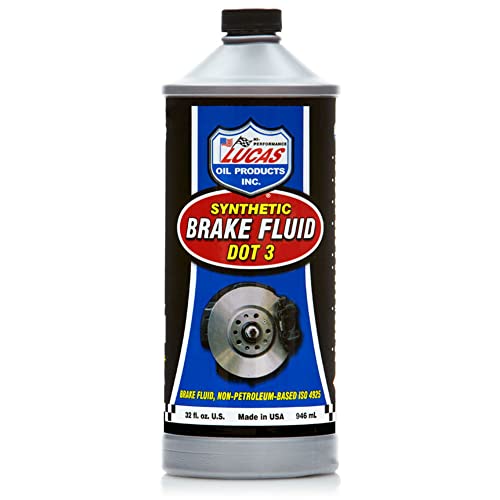
Lucas Oil #10826 gives DIYers a full 1-quart bottle of synthetic DOT 3 brake fluid blended from polyethylene glycol ethers and protective additives. According to Lucas, it meets or exceeds the 401°F DOT 3 minimum dry boiling point and works across compatible disc, drum, and hydraulic clutch systems.
Best For: Home mechanics flushing a full four-wheel brake system or servicing trucks and older vehicles that specify DOT 3 and need more than a small pint bottle.
Real-World Strengths
- Full 1-quart volume: Convenient single-container size for complete DIY flushes so you do not run short mid-bleed.
- Broad DOT 3 system coverage: Suitable for compatible disc brakes, drum brakes, and hydraulic clutches.
- Dependable conventional formula: Meets or exceeds federal DOT 3 minimum dry boiling specifications for reliable daily driving.
Before You Buy (Honest Trade-Offs)
- Do not buy by bottle size alone: Confirm your vehicle specifically calls for DOT 3 before ordering.
- Store tightly or use promptly: Because a 1-quart jug holds more fluid, keep any leftover tightly capped and avoid using long-opened fluid that may have absorbed moisture.
Verified Key Specs
- Product Number: Lucas Oil #10826
- Specification: DOT 3 synthetic polyethylene glycol ether blend
- Dry Boiling Point: Meets or exceeds 401°F DOT 3 minimum
- Container Size: 1 quart (32 oz)
Brake Fluid Buying Guide: 4 Rules That Prevent Costly Mistakes
- Match your vehicle’s exact DOT spec first: Check the owner’s manual or master-cylinder cap before shopping. Never confuse DOT 5 (silicone-based) with DOT 5.1 (glycol-based)—they are chemically incompatible and must never be mixed.
- Look at both dry and wet boiling points: Dry boiling point measures brand-new fluid straight from a sealed bottle; wet boiling point reflects how well the fluid resists fade after absorbing moisture over time. For track use, both figures matter.
- Buy the right container size for the job: A quick caliper bleed may only take a small bottle, while a full four-wheel flush can easily use a quart or more. Always start with a freshly sealed container.
- Handle and dispose of fluid safely: Brake fluid strips automotive paint quickly and is hazardous waste. Keep it off bodywork, seal used fluid in a labeled container, and drop it off at a local automotive-waste or hazardous-waste collection center. For complete caliper and hardware maintenance, pair your flush with proper brake-system service lubricants, and have a qualified technician handle the bleed if you are unsure of the procedure.
Full Specification Comparison
| Product | Best For | Verified Spec / Boiling Point | Primary Use Cases | Check Price |
|---|---|---|---|---|
| Motul RBF600 DOT 4 | High-temp track days | DOT 4 synthetic; 312°C (594°F) dry | HPDE, track days, performance cars & bikes | Check Price → |
| Castrol SRF Racing | Premium motorsport | Meets/exceeds DOT 3 & 4; 325°C dry / 260°C+ wet | Competition racing, rally, severe repeated braking | Check Price → |
| RAVENOL R325+ Racing | Track-day alternative | Racing; 327°C dry / 202°C wet (500 ml) | Motorsport, track events, heavy braking | Check Price → |
| Prestone AS401 DOT 3 | Daily DOT 3 street cars | DOT 3; exceeds DOT 3 minimum spec | Commuter maintenance, routine bleeding & flushes | Check Price → |
| Lucas Oil #10826 DOT 3 | Value 1-quart DIY flush | DOT 3; 401°F+ min dry (1 quart) | Full DIY flushes on disc, drum & clutch systems | Check Price → |
Frequently Asked Questions
Can I mix different brake fluids?
Avoid mixing brake fluids whenever possible. While conventional glycol-based DOT 3 and DOT 4 fluids are generally chemically compatible, mixing dilutes the higher boiling point of a performance fluid. Never mix DOT 5 silicone brake fluid with glycol-based DOT 3, DOT 4, or DOT 5.1 fluids.
Is Castrol SRF silicone brake fluid?
No. Castrol React SRF Racing uses silicon ester technology, not DOT 5 silicone. Castrol lists SRF as meeting or exceeding DOT 3 and DOT 4 performance requirements and confirms it is compatible with conventional glycol-ether brake fluids.
How often should I change my brake fluid?
Follow the interval in your vehicle’s maintenance schedule for street driving. Vehicles driven on track or in severe towing conditions typically require much more frequent inspection and fluid flushes because high heat and moisture absorption degrade pedal feel faster.
How should I dispose of used brake fluid?
Pour drained fluid into a sealed, clearly labeled container and take it to a local automotive recycling or household hazardous-waste facility. Never dump brake fluid into storm drains, household sinks, or onto the ground.