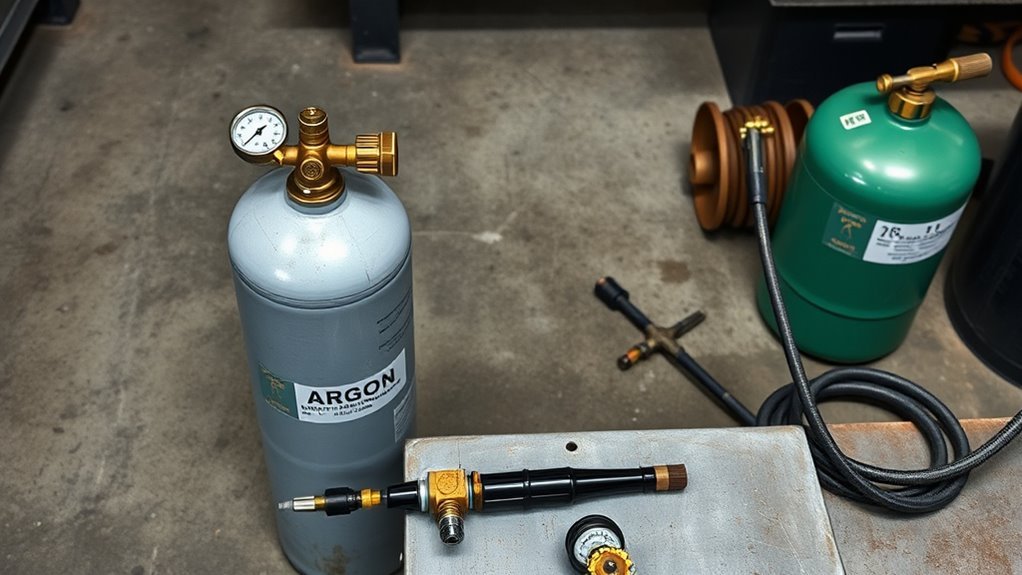
For MIG welding mild steel, a 75/25 argon-CO₂ blend, commonly called C25, is usually the best balance of arc quality, bead appearance, and cleanup. That does not mean it always has the lowest cylinder price. Pure CO₂ often costs less upfront, while the price difference between C25 and pure argon varies by supplier, cylinder size, location, and account terms.
Quick Answer
For MIG welding mild steel, 75/25 argon-CO₂ (C25) is usually the best-value choice, not necessarily the cheapest cylinder. 100% CO₂ often costs less upfront. Pure argon may be cheaper or more expensive locally, but it is generally the wrong shielding gas for ordinary solid-wire MIG on mild steel.
Key Takeaways
- C25 is the best all-purpose choice for many mild-steel MIG jobs because it offers a stable arc, low spatter, good bead shape, and useful control on thin steel.
- 100% CO₂ often has the lowest upfront gas cost, but it normally produces more spatter and a rougher arc and bead than C25.
- Pure argon is generally a poor choice for ordinary solid-wire MIG welding mild steel, although argon is widely used for TIG welding and aluminum MIG welding.
- Changing from C25 to straight CO₂ may affect equipment cost because the cylinder connection or regulator requirements can differ.
- Compare equal cylinder sizes and total ownership costs, including rental, exchange, delivery, fees, cleanup time, gas consumption, equipment compatibility, and rework.
Which Is Cheaper: Argon or 75/25?
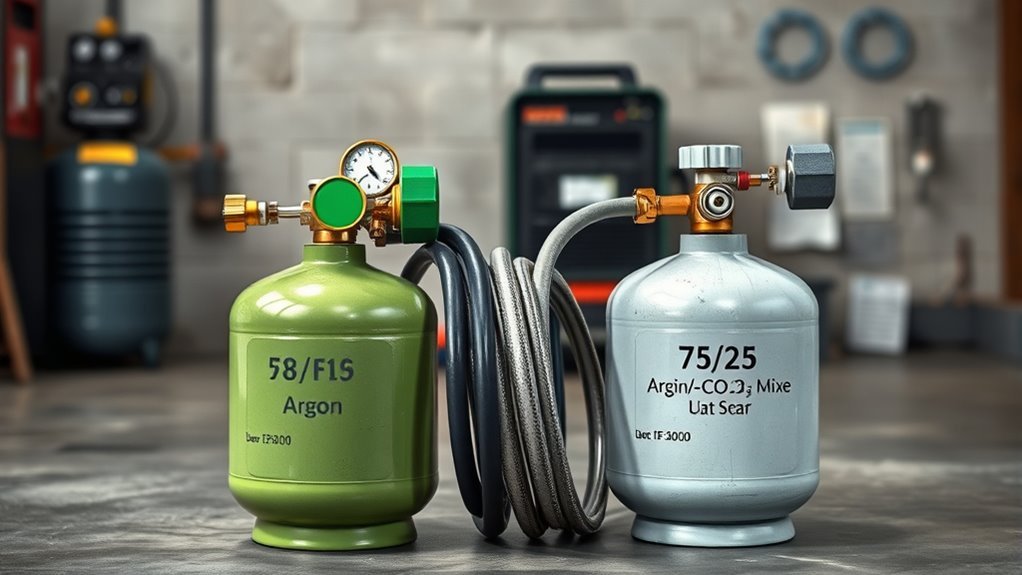
There is no dependable nationwide rule saying an equal-size cylinder of pure argon will always cost more or less than an equal-size cylinder of C25. Industrial-gas suppliers commonly set prices by location, cylinder size, account, supply agreement, cylinder ownership, service method, and availability. For example, Airgas lists a 125-size C25 cylinder but requires a delivery ZIP code or account login before showing current price and availability.
For mild-steel MIG welding, the more useful cost comparison is usually C25 versus 100% CO₂. Miller describes straight CO₂ as a cost-effective alternative to C25. C25 generally produces less spatter, a smoother arc, and a better-looking bead, while CO₂ normally gives deeper penetration and more spatter.
Pure argon should not be selected for ordinary solid-wire MIG welding mild steel merely because a local refill happens to be inexpensive. Carbon-steel MIG procedures normally use CO₂ or an argon blend containing an active component such as CO₂ or oxygen. Pure argon is more appropriate for processes such as TIG welding and many aluminum MIG applications.
The lowest cylinder price is not automatically the lowest welding cost. Compare the gas, cylinder, regulator requirements, fees, usable volume, cleanup time, and potential rework.
Argon, C25, and CO₂ Compared
| Gas | Best Use | Main Advantages | Main Limitations | Cost Position |
| 75% argon / 25% CO₂ | General solid-wire MIG welding on mild and carbon steel, especially short-circuit work | Stable arc, low spatter, good bead shape, and good control on thin and medium-gauge steel | Usually costs more than straight CO₂; not the preferred mixture for every spray-transfer or specialty-wire procedure | Often the best total-value choice, but local cylinder prices vary |
| 100% CO₂ | Budget-focused mild-steel MIG when the welder, wire, and gas equipment support C100 | Often lower gas cost and generally deeper penetration | More spatter, a harsher or less stable arc, and a rougher bead than C25 | Often cheapest upfront among common mild-steel shielding-gas choices |
| 100% argon | TIG welding and many aluminum MIG applications | Inert shielding with arc characteristics suited to several TIG and non-ferrous applications | Generally unsuitable for ordinary solid-wire MIG welding mild steel because a stable, properly wetting carbon-steel MIG arc normally requires an appropriate active-gas addition | No reliable nationwide price ranking versus C25; supplier and market determine the price |
How to Compare Shielding Gas Costs Fairly
Do not compare only the amount printed on two receipts. Ask each supplier for a quote using the same cylinder size, service type, and pickup or delivery method.
- Match the cylinder volume. Compare 80 cubic feet with 80 cubic feet or 125 cubic feet with 125 cubic feet whenever possible.
- Confirm whether the quote is a refill or exchange. Exchange programs may include handling or cylinder-maintenance costs.
- Separate gas from cylinder cost. A first purchase may include the cylinder, while later exchanges mainly cover gas and service.
- Include rental or lease charges. Some suppliers charge monthly or annual cylinder rent.
- Include all fees. Ask about delivery, hazmat, environmental, energy, account, and inspection charges.
- Check equipment compatibility. Changing from an argon/CO₂ cylinder to straight CO₂ can require a compatible cylinder connection, regulator, flowmeter, or approved adapter.
- Check ownership restrictions. Some suppliers will not fill or exchange an unfamiliar customer-owned cylinder.
- Ask whether the quoted volume is nominal. Cylinder labels and supplier descriptions may use nominal capacity rather than a guaranteed exact delivered volume.
Use these formulas for a fair comparison:
- Gas cost per cubic foot = total refill or exchange cost ÷ usable cylinder volume
- Theoretical gas-flow time = cylinder volume ÷ flow rate in cubic feet per hour
- Total job cost = gas + cylinder/rental + equipment + wire + electricity + consumables + cleanup labor + rework
For example, a 125-cubic-foot cylinder flowing continuously at 25 CFH provides about five hours of theoretical gas-flow time. An 80-cubic-foot cylinder at the same flow provides about 3.2 hours. Actual usable time may be lower because of purging, preflow or postflow, leaks, regulator losses, and gas left in the cylinder.
Pro Tip: Take a photo of each supplier’s written quote and record the cylinder size, gas mixture, date, fees, connection type, and whether the price is for a refill, exchange, rental, or new cylinder. That prevents an apples-to-oranges comparison.
Will Switching From C25 to CO₂ Require Different Equipment?
Possibly. Do not assume a regulator that physically fits one cylinder will automatically fit or be approved for another gas. The exact connection depends on the cylinder, regulator, country, and supplier.
As a U.S. example, the Airgas 125-size C25 cylinder uses a CGA-580 connection. Miller also sells CO₂ flow-gauge equipment with a CGA-320 connection. That difference can matter when calculating the real cost of switching from C25 to straight CO₂.
Some regulators or kits are designed for more than one shielding-gas service when used with the correct approved connections. Others are gas-specific. Check the regulator label, cylinder valve, welder manual, and gas supplier before connecting anything.
Warning: Never force mismatched cylinder fittings, modify a regulator connection, or improvise an adapter. Use equipment specifically rated and approved for the cylinder pressure, gas service, and connection.
Argon Vs 75/25 MIG Weld Quality
Pure argon and C25 behave differently because they are intended for different welding conditions. Pure argon is commonly used for TIG welding and many aluminum MIG applications. It should not be treated as an interchangeable substitute for C25 when using solid steel wire on mild steel.
For carbon-steel MIG welding, the CO₂ portion of C25 helps support the arc, penetration, and bead wetting. The argon portion helps produce smoother arc characteristics and reduce spatter compared with straight CO₂. The result is a controllable, general-purpose blend that works well for many home, automotive, fabrication, and repair jobs.
According to Miller’s mild-steel MIG guidance, C25 provides low spatter, good bead appearance, and useful control on thinner steel. The same guidance notes that 100% CO₂ provides deeper penetration but creates more spatter and a rougher bead.
Lincoln Electric’s GMAW guidance likewise lists 75% argon/25% CO₂ as a common short-circuit shielding-gas blend for carbon steel and states that it reduces spatter and improves bead appearance.
C25 is not automatically the ideal choice for every thick-steel procedure. Higher-argon mixtures such as 90% argon and 10% CO₂ may be used for spray transfer, pulsed MIG, or higher-production work. Follow the parameter chart for your welder, the filler-wire data sheet, and any applicable welding procedure specification rather than choosing a gas solely by price.
When 75/25 Saves More Money
C25 can save money when its smoother arc and lower spatter reduce work after welding. That advantage matters most when appearance, fit-up, painted finishes, repeated parts, or labor time are important.
Its possible savings include:
- Less grinding and wire brushing around the joint
- Fewer interruptions to clean spatter from the nozzle
- More consistent bead appearance
- Better control on thin sheet where burn-through is a concern
- Less time correcting rough welds caused by unsuitable gas or incorrect settings
However, C25 does not guarantee a lower total cost. A skilled operator using a modern machine set correctly for 100% CO₂ may produce acceptable work at a lower gas price. The best choice depends on labor rates, finish requirements, material thickness, transfer mode, machine capability, regulator compatibility, and how much post-weld cleanup the job allows.
Note: Gas selection cannot correct poor polarity, dirty steel, excessive wire stickout, weak work-clamp contact, incorrect voltage, or improper wire-feed speed. Fix the setup before blaming the shielding gas.
How Mild Steel Changes the Gas Choice
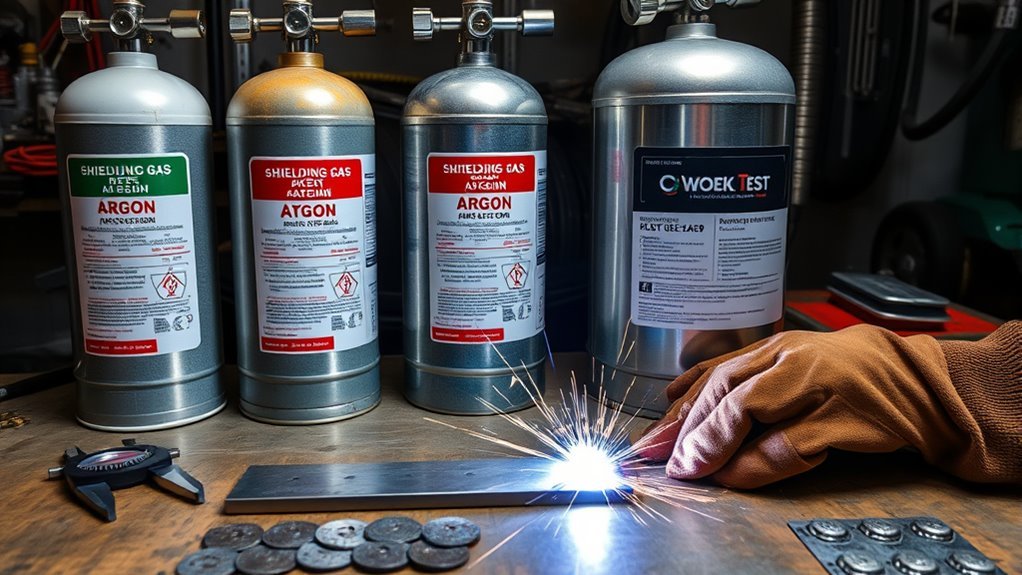
Mild steel usually points home and small-shop welders toward C25 because it provides an effective balance of arc stability, bead shape, penetration, and cleanup. The gas should still match the wire, machine, transfer mode, material thickness, welding position, and required procedure.
- Choose C25 for general-purpose solid-wire MIG. It is a dependable starting point for short-circuit welding on thin and medium-gauge carbon steel.
- Choose 100% CO₂ when upfront gas cost matters most. Confirm that the welder, regulator, flow equipment, and parameter chart support it, and expect more spatter.
- Do not choose pure argon for ordinary mild-steel solid-wire MIG. Carbon-steel MIG normally requires an appropriate active-gas component rather than straight argon.
- Consider a higher-argon blend when the procedure calls for spray transfer. Thick plate and production welding may call for C10 or another manufacturer-approved mixture.
- Match the filler wire. ER70S-6 is a common solid wire for mild steel and contains more deoxidizers than ER70S-3, making it more tolerant of some surface contamination. The joint should still be cleaned properly.
Also check polarity. Most solid-wire mild-steel MIG procedures use direct-current electrode positive (DCEP, also called DC+ or reverse polarity). Many self-shielded flux-cored wires use different polarity requirements and do not need an external gas cylinder. Always follow the wire manufacturer’s instructions.
Hidden Costs of Spatter and Cleanup
One reason pure CO₂ can cost more than expected is the additional finishing work it may create. Compared with C25, straight CO₂ generally produces more spatter and a rougher bead. The exact difference depends on voltage, wire-feed speed, stickout, gun angle, travel speed, surface condition, transfer mode, and the machine’s arc characteristics.
Spatter can collect around the gas nozzle and interfere with shielding-gas coverage if it is not removed. It can also require grinding or brushing on the workpiece, especially before paint, powder coating, or cosmetic finishing.
CO₂ often lowers the gas bill but can increase spatter cleanup. C25 often raises the gas bill but can reduce finishing work.
Avoid assuming that CO₂ automatically destroys contact tips or nozzles faster. Poor settings, excessive stickout, feeding problems, an unstable arc, and accumulated spatter can all contribute to consumable trouble. Track actual tip, nozzle, and cleanup use in your own shop instead of relying on a universal estimate.
Which Gas Works Best for DIY MIG Welding?
For most DIY solid-wire MIG welding on mild steel, C25 is the easiest general-purpose choice. It offers forgiving arc behavior, manageable spatter, and good bead control on common repair and fabrication projects.
- Choose C25 for automotive panels, brackets, furniture, gates, general repairs, and projects where bead appearance matters.
- Choose 100% CO₂ when your machine and gas equipment support it, the lower local gas price matters, and extra spatter is acceptable.
- Choose pure argon for an appropriate TIG or aluminum MIG application, not as a substitute for C25 on mild steel.
- Choose self-shielded flux-cored wire for outdoor work where wind can blow away externally supplied MIG shielding gas.
Set the gas flow according to the welder’s manual, door chart, filler-wire instructions, or approved procedure. Miller’s current basic mild-steel MIG setup recommends 20–25 CFH. Lincoln Electric’s GMAW procedure tables list 25–35 CFH for several specific short-circuit carbon-steel procedures. These are examples, not universal settings.
More flow is not automatically better. A flow rate that is too low can leave the weld pool inadequately shielded, while excessive flow wastes gas and can create turbulence that draws surrounding air into the shielding stream and contributes to porosity.
Warning: Shielding gases can displace oxygen. Secure cylinders upright, protect the valve, use gas in a properly ventilated area, keep cylinders away from heat and physical damage, and follow the cylinder SDS, welder manual, fire precautions, and local codes. Welding in a confined space requires the appropriate ventilation, atmospheric controls, supervision, and rescue procedures.
Common Shielding-Gas Problems
Porosity in the Weld
Check for an empty cylinder, closed valve, flow set too low or too high, a leaking hose, loose fittings, a blocked nozzle, drafts, excessive gun distance, or contamination such as paint, oil, rust, moisture, or mill scale. Use an approved leak-detection method on gas fittings rather than a flame.
Excessive Spatter
Confirm the gas type, polarity, voltage, wire-feed speed, contact-tip-to-work distance, gun angle, and work-clamp connection. Some additional spatter is normal with 100% CO₂ compared with C25, but severely excessive spatter often indicates a setup or technique problem.
The Cylinder Empties Too Fast
Check the flowmeter while gas is actually flowing, not only while the system is idle. Inspect the hose, solenoid, fittings, regulator, and gun connection for leaks. Close the cylinder valve after use, release system pressure according to the equipment instructions, and avoid setting the flow higher than the procedure requires.
Unstable or Wandering Arc
Make sure the gas matches the base metal, wire, and transfer mode. Pure argon is not an appropriate substitute for a carbon-steel MIG mixture simply because the cylinder is already available. Also inspect the contact tip, drive-roll tension, liner, work clamp, wire condition, polarity, and parameter settings.
Frequently Asked Questions
What is 75/25 argon used for?
A 75% argon and 25% CO₂ blend is commonly used for solid-wire MIG welding mild and carbon steel. It provides a stable short-circuit arc, relatively low spatter, good bead shape, and useful control on thin and medium-gauge material.
Which shielding gas is the cheapest?
For common mild-steel MIG options, 100% CO₂ often has the lowest upfront gas cost. Local prices vary, and its additional spatter can increase cleanup time. Compare equal cylinder sizes, fees, rental terms, equipment requirements, gas use, and labor before deciding which option is cheapest overall.
Is CO₂ cheaper than 75/25 for MIG welding?
Often, yes. Manufacturers describe straight CO₂ as a lower-cost or cost-effective alternative to argon-rich shielding gases. However, local refill prices, cylinder arrangements, regulator requirements, extra spatter, and cleanup labor can change the total cost.
Is argon the cheapest shielding gas?
No universal rule makes argon the cheapest. Pure argon, C25, and CO₂ prices vary by supplier, cylinder size, location, and contract. More importantly, pure argon is generally unsuitable for ordinary solid-wire MIG welding mild steel even when its local refill price looks attractive.
Which gas is known as the lazy gas?
Argon is associated with the term “lazy gas.” According to the Royal Society of Chemistry, its name comes from the Greek word argos, meaning lazy or inactive, referring to argon’s very low chemical reactivity. CO₂ is an active shielding gas, not the gas behind that nickname.
Can I use 100% argon for MIG welding mild steel?
It is not recommended for ordinary solid-wire mild-steel MIG welding. Carbon-steel MIG normally uses straight CO₂ or an argon mixture containing an appropriate active-gas component. Use the gas specified by the welder and filler-wire manufacturer.
Do I need a different regulator for 100% CO₂?
You may. Cylinder connections and regulator requirements can differ. For example, common U.S. C25/argon equipment may use CGA-580, while dedicated CO₂ equipment may use CGA-320. Check the actual cylinder valve and regulator specifications and use only approved gas-rated equipment.
What gas flow should I use for 75/25 MIG welding?
There is no single setting for every welder. Miller gives 20–25 CFH in its basic mild-steel MIG setup, while Lincoln Electric lists 25–35 CFH for some specific short-circuit procedures. Use the setting specified by your welder, wire, or approved procedure and adjust only within the manufacturer’s guidance.
How long does a 125-cubic-foot C25 cylinder last?
At a continuous flow of 25 CFH, the theoretical gas-flow time is about five hours. Real usable time may be lower because of purging, leaks, regulator losses, preflow or postflow, and gas remaining in the cylinder. Calendar life depends on how much trigger-on welding time you perform.
Sources
- Miller — Understanding the Basics of MIG Welding for Mild Steel — supports C25 and CO₂ selection, DCEP polarity, ER70S wire guidance, mild-steel preparation, and the 20–25 CFH basic setup.
- Miller — What Type of Gas Is Best for MIG Welding in DIY Applications? — supports the C25, C100, and higher-argon comparison and explains problems caused by incorrect gas flow.
- Lincoln Electric — Gas Metal Arc Welding Guidelines — supports carbon-steel shielding-gas selection, C25 short-circuit use, DC+ polarity, spatter differences, and procedure-specific 25–35 CFH flow guidance.
- Airgas — 25% CO₂, Balance Argon Industrial Mix — supports C25 composition, a CGA-580 cylinder example, local price/availability variation, and cylinder safety guidance.
- OSHA — Welding, Cutting, and Brazing General Requirements — supports PPE, ventilation, fire prevention, and confined-space precautions.
- Royal Society of Chemistry — Argon — supports the origin of argon’s name from the Greek word meaning lazy or inactive.
Conclusion
For most DIY and general-shop MIG welding on mild steel, 75/25 argon-CO₂ is the practical all-purpose choice. It usually gives a smoother arc, less spatter, and a cleaner-looking bead than 100% CO₂. Straight CO₂ may still be the lowest-cost option when upfront gas price matters most and extra cleanup is acceptable.
Pure argon is not a budget substitute for C25 on mild steel simply because a local cylinder quote looks favorable. Compare equal cylinder sizes, calculate gas cost fairly, include rental and supplier fees, check regulator and cylinder compatibility, and account for cleanup labor. Most importantly, use the shielding gas and settings approved for your welder, filler wire, and welding procedure.