If you need a short-term Georgia fishing permit, residents pay $7 for a 3-day license and nonresidents pay $30. The resident price breaks down as $5 for day one and $1 for each extra day. Nonresidents pay a flat three-day fee. All licenses must comply with state rules, and some anglers need add-ons like a trout stamp or the free Saltwater Information Permit. Keep your proof of purchase handy.
Quick Answer
- Residents pay $7 for a 3-day fishing license ($5 for day one, $1 per additional day).
- Nonresidents pay a flat $30 for a 3-day license.
- Anyone over 16 must carry a valid license while fishing in Georgia.
- Saltwater anglers also need the free Saltwater Information Permit (SIP).
- Trout fishing requires a separate trout license ($10 residents, $25 nonresidents).
- Buy online 24/7 at Go Outdoors Georgia or at retailers and state park kiosks.
Who Needs a Multi-Day Fishing License in Georgia
You need a multi-day fishing license in Georgia if you are over 16 and plan to fish more than one day but less than a full year.
State fishing regulations require anyone older than 16 to hold a valid license. Multi-day options meet that requirement while offering flexibility for short trips and a lower per-day cost compared to buying repeated one-day licenses.
Anyone over 16 must carry a valid fishing license; multi-day passes offer flexibility and lower per-day costs.
Residents can get a 3-day license for $5 on day one plus $1 for each additional day. Nonresidents pay $10 for day one and $3.50 for each day after that.
Saltwater anglers must also obtain the free Saltwater Information Permit (SIP), so factor that into your planning. A multi-day pass is the right call when you want predictable costs and compliance for a short outing without committing to an annual license.
Pricing Breakdown: One-Day, Three-Day and Additional Day Rates

There is a clear split between resident and nonresident rates. Nonresidents pay $10 for a single day; residents pay $5. Residents can also buy a three-day license for $15.
For multi-day trips, per-day add-on charges matter. Residents pay $1 per extra day and nonresidents pay $3.50 per extra day after the initial one-day purchase.
One-Day and Three-Day Rates
The simplest way to compare short-term fishing access is to look at the actual numbers. Residents pay $5 for a one-day license and can extend it at $1 per day (totaling $7 for three days). Nonresidents pay $10 for the first day and $3.50 for each additional day.
These differences reflect state policy balancing local access with revenue. Under current fishing regulations, residents get a much lower per-day cost. A resident pays roughly $2.33 per day over three days; a nonresident pays about $5.67.
When planning trips, factor in your residency status, trip length, and the rules around purchase timing and proof of residency.
Additional Per-Day Pricing
Per-day charges depend on your residency and how many days you need. Residents pay $5 for a one-day license and can add days at $1 each. Nonresidents pay $10 for day one and $3.50 per extra day.
Your effective daily cost drops substantially if you qualify as a resident or buy a multi-day pass. For residents, three days at $15 works out to $5 per day. Adding individual days at $1 makes longer trips inexpensive.
Nonresidents face $10 on day one and $3.50 after that, so multi-day planning matters for budgeting.
Licenses are required for anyone over 16.
How the 3-Day Fee Is Calculated
Georgia uses separate formulas for residents and nonresidents. Residents pay $5 for day one and $1 for each extra day, totaling $7 for three days. Nonresidents pay a flat $10 that covers all three days.
The resident formula applies a small per-day charge after an initial base rate. The nonresident price is a single bundled fee that simplifies budgeting but removes per-day savings.
When estimating costs, use the resident incremental model for varied trip lengths. One-day and three-day costs scale predictably at $5 and $7 respectively.
Keep in mind that specialty permits like a trout license add to your total and are governed separately by state policy. Always confirm the full cost before heading out.
Resident Vs Nonresident Multi-Day Costs
The gap between resident and nonresident pricing is significant. Residents cover three days for $5 plus $1 per extra day. Nonresidents pay a flat $30 for the full 3-day term.
Residents get a low base fee and cheap extensions. Nonresidents face substantially higher per-day costs if they fish beyond the standard period.
Everyone over 16 must hold a valid Georgia fishing license regardless of which rate applies. You can verify current fees directly through the Georgia Department of Natural Resources.
Resident 3-Day Pricing
For a short Georgia trip, residents pay $5 for a 3-day fishing license versus $10 for nonresidents. Residents can extend their stay at $1 per additional day; nonresidents pay $3.50 per extra day. Both licenses cover fresh and saltwater fishing, though some activities still require separate permits.
As a resident, you get the lowest base rate and the most affordable extensions. That matters if your plans change mid-trip. Note that youth licenses are available: residents aged 12 to 15 can buy a youth fishing license for $10. Nonresidents do not have access to this rate.
Follow current fishing regulations on size limits, bag limits, and seasons. Confirm any specialty permits (such as tournament or saltwater recreational permits) before fishing to avoid penalties.
Nonresident 3-Day Rates
If you are a nonresident planning a short Georgia fishing trip, the 3-day license costs $30. That is six times the resident 3-day rate of $5, but it beats buying a $10 one-day nonresident license three times over if you plan to fish multiple days.
You get standard fishing privileges for fresh and saltwater. You must also obtain the free Saltwater Information Permit (SIP), valid for 365 days, to fish in saltwater.
- Cost comparison: $30 (3-day nonresident) vs $10 (1-day nonresident). Choose the 3-day pass if you plan to fish three or more days.
- Resident gap: The $5 resident 3-day rate highlights the nonresident premium.
- Privileges: Covers basic fresh and saltwater access. Follow species and season regulations.
- Compliance: Carry your license and SIP. Adhere to bag and size limits and any reporting rules.
Additional Day Fees
Georgia’s additional-day pricing creates a clear residency gap. Residents pay $5 for day one and just $1 for each extra day, bringing a 3-day total to $7. Nonresidents pay $10 up front plus $3.50 per additional day, for a 3-day total of $17.
The lower marginal cost for residents after a short residency requirement (three months) is intentional. It encourages local access. This affects budgeting, compliance with fishing regulations, and decisions about license timing.
| Buyer Type | 3-Day Cost |
|---|---|
| Resident | $7 |
| Nonresident | $17 |
| Note | Residents need 3 months’ registration to qualify |
Where to Purchase a 3-Day Fishing License

You can buy a 3-day fishing license online 24/7 through the Georgia Department of Natural Resources website. You will need a valid Social Security number to complete the application.
If you prefer to buy in person or by phone, several options are available.
- WRD/CRD offices and state park kiosks accept short-term sales and verify ID on the spot.
- Major retailers and bait shops are convenient walk-up options. Hours and inventory vary by location.
- Phone orders are available by calling 800-366-2661. A Social Security number is required.
- Pricing note: the nonresident 3-day fee is $10 at point of sale. Residents pay $5 for day one and $1 per additional day.
All channels enforce the same documentation and fee policies.
What the 3-Day License Permits You to Do
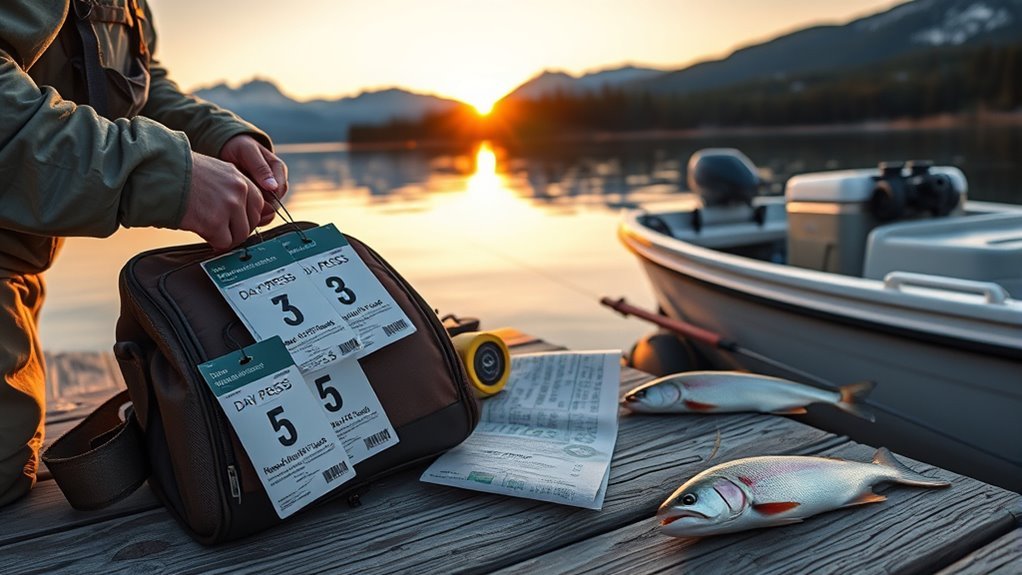
A 3-day Georgia fishing license gives you three consecutive days of legal fishing in both fresh and saltwater. Residents pay $5; nonresidents pay $10. If you are 16 or older, you must carry the license while fishing.
You can catch a range of species within state size and bag limits. This license is a good fit for visitors or casual anglers who need flexible, short-term access without buying an annual pass.
| Feature | Scope | Limitation |
|---|---|---|
| Duration | 3 consecutive days | Starts at purchase |
| Waters | Freshwater & saltwater | Within Georgia boundaries |
| Eligibility | Anglers 16+ must carry license | Trout requires extra permit |
Follow all fishing regulations, including seasons, size limits, bag limits, and gear rules. The 3-day pass does not replace specialty permits like a trout endorsement.
Special Permits and Add-Ons (Trout, Saltwater, Youth)

A short-term license does not cover every situation. Depending on where and what you fish, you may need add-ons or separate permits.
Trout fishing requires a separate trout license ($10 for residents, $25 for nonresidents) on top of your basic license. Saltwater anglers must also get the free Saltwater Information Permit (valid 365 days). Resident youth ages 12 to 15 can buy a youth fishing license for $10.
Penalties apply for fishing without the right permits.
- Trout license: Required in addition to a basic license. $10 for residents, $25 for nonresidents. Check species and season-specific rules.
- Saltwater Information Permit (SIP): Free, valid for 365 days. Required alongside any saltwater fishing license.
- Youth licensing: Resident youth ages 12 to 15 pay $10. Verify age documentation before purchasing.
- Other special permits: Some waters or species require extra permits. Confirm agency policy before you fish.
Discounts, Exemptions and Lifetime Options

If you are 100% disabled or blind, you may qualify for substantial discounts or exemptions on fishing licenses. Contact the issuing agency to verify the documentation required.
Residents also benefit from flexible short-term pricing. A one-day license costs $5, and each extra day adds just $1. That lets you match your cost precisely to your trip length.
Lifetime options are available for residents. An adult lifetime sportsman’s license costs $750. There is no lifetime option for youth, but residents ages 12 to 15 can buy a recurring youth license for $10 each year. Nonresidents cannot access resident lifetime options.
These provisions balance access and revenue. Targeted discounts lower barriers for disabled and youth residents. Lifetime options provide long-term convenience for frequent resident anglers.
Managing and Reprinting Your Multi-Day License

Once you have your license, manage it proactively to stay compliant. You can access your permits online at any time through Go Outdoors Georgia to view purchases, add days, or prepare for renewal. Free reprints are available if you lose a permit, so keep a digital copy on your phone and a printed backup in your gear bag.
- Use Go Outdoors Georgia to reprint your license and confirm your multi-day coverage period.
- Check your expiration date. If plans change, add short-term days at $1 each to avoid a violation.
- Keep purchase receipts handy for any enforcement checks. A digital or printed copy both work.
- Set a calendar reminder based on your purchase date so your coverage does not lapse.
Frequently Asked Questions
Can I Transfer My 3-Day License to Someone Else?
No. Fishing licenses are generally nontransferable. Regulations prohibit reassigning license ownership. Check your state agency’s policies for any narrow exceptions, but expect short-term permits to be issued to one person only.
Are Multi-Day Licenses Refundable or Cancellable?
Generally, no. Most agencies deny refunds or limit cancellations to administrative errors. Check the specific state’s terms, contact the issuing office promptly, and document any requests in writing.
Does the 3-Day Pass Cover Fishing From Private Docks?
Yes, in most cases. The 3-day pass covers fishing from private docks, but verify private dock regulations in your area and make sure you have the property owner’s permission. Agencies often require you to carry your permit while fishing from any location.
Are There Daily Catch Limits Specifically for 3-Day License Holders?
No. Catch limits apply to all anglers regardless of license type. Your 3-day permit does not change daily possession or size rules. Follow the same limits set by the state agency for all anglers.
Can I Buy a 3-Day License as a Gift for Someone?
Yes, in most cases. Check local policy for gift purchasing options and required recipient details. You will usually need the recipient’s ID and a specified start date, so confirm the rules before completing the purchase.
Conclusion
A multi-day Georgia fishing license is the right choice when you need short-term access without committing to an annual pass. Three-day options balance cost and convenience for occasional anglers. Plan your days upfront, add a trout or saltwater endorsement if needed, and compare resident versus nonresident fees before buying. Purchase online or at a local agent, and keep a digital copy of your license handy. Check exemptions and lifetime options to find the most cost-effective path for your situation.