
California does not sell a special fishing license just for children. Anglers younger than 16 may fish without a sport fishing license, while anyone age 16 or older generally needs a valid license unless a narrow exception applies. Report cards, seasons, bag limits, gear rules, and local closures can still apply to young anglers.
Quick Answer
In California, anglers under 16 do not need a sport fishing license. At age 16, they pay the standard adult fee: $64.54 for a resident 365-day license in 2026. One-day and two-day licenses cost $21.09 and $32.40. Species-specific report cards may be required at any age.
Key Takeaways
- Under age 16: No California sport fishing license is required.
- Age 16 or older: A license is normally required, and California does not offer a separate teen discount.
- Report cards: Steelhead, sturgeon, North Coast salmon, and spiny lobster rules can apply even when no license is required.
- 2026 short-term fees: $21.09 for one day and $32.40 for two consecutive days.
- Free Fishing Days: July 4 and September 5, 2026, but all other regulations remain in force.
At a Glance
| Angler Under 16 | No sport fishing license; report cards may still be required |
| Resident Age 16+ | $64.54 for a 365-day license in 2026 |
| Nonresident Age 16+ | $174.14 for a 365-day license in 2026 |
| Short-Term Options | One day: $21.09; two consecutive days: $32.40 |
| Where to Buy | CDFW online sales, license agents, CDFW sales offices, or telephone sales |
Who Needs a Youth Fishing License in California?
California bases its sport fishing license requirement on age. Under CDFW rules, anyone age 16 or older must generally carry a valid sport fishing license when attempting to take fish, shellfish, amphibians, reptiles, or other covered species.
Children younger than 16 may fish without a sport fishing license. That exemption does not depend on whether a licensed adult is standing beside them. Parents should still supervise children closely and check any site-specific age or safety rules.
Young anglers must follow the same seasons, size limits, bag limits, gear restrictions, fishing hours, and closures that apply to everyone else. A required report card must also be in the angler’s possession before fishing for the covered species.
The key age is 16: younger anglers are license-exempt, while anglers 16 and older normally need the same license sold to adults.
Warning: California fishing rules can change during the year. Check the current CDFW fishing regulations for the exact water, species, season, and gear before every trip. Children under 13 on a moving recreational vessel must wear a properly fitted, U.S. Coast Guard-approved life jacket under California law.

This kid-friendly cookbook helps young chefs build confidence in the kitchen with more than 100 recipes designed for fun, learning, and delicious results. Created by America's Test Kitchen Kids, it offers approachable instructions, helpful guidance, and a wide range of dishes that make cooking and eating an engaging family activity.

This heartfelt memoir blends laugh-out-loud honesty with tender reflections on love, loneliness, and the unexpected healing power of rescue dogs. Isabel Klee shares her journey fostering pups in the city while navigating dating and self-discovery, offering an intimate, relatable story for readers who enjoy emotional, character-driven narratives. It is a warm, engaging read about opening your heart and finding connection in surprising places.

These Rawlings practice baseballs are built for young players ages 8 and under, offering an easy grip and consistent feel for recreational play. Each ball features a synthetic leather cover with a solid cork and rubber center, plus official size and weight for reliable training. The set includes a durable bucket for convenient storage and transport, making it a smart choice for coaches, parents, and teams.
2026 California Fishing License Prices for Teens and Families
There is no separate California “youth fishing license” price. A child under 16 pays nothing for the sport fishing license itself. Once the angler turns 16, the standard resident, nonresident, or short-term fee applies.
| License Type | 2026 Fee | Who It Fits |
|---|---|---|
| Under 16 | No license fee | Young anglers statewide; required report cards may cost extra |
| Resident 365-Day License | $64.54 | California residents age 16 or older |
| Nonresident 365-Day License | $174.14 | Nonresidents age 16 or older |
| One-Day License | $21.09 | Residents or nonresidents age 16 or older fishing one specified day |
| Two-Day License | $32.40 | Residents or nonresidents age 16 or older fishing two consecutive days |
| Ten-Day Nonresident License | $64.54 | Nonresidents age 16 or older fishing up to 10 consecutive days |
CDFW adjusts many license and report-card fees each year, so prices from an older article may no longer be correct. The figures above are from the official 2026 fee table.
Lifetime Fishing License for Children
California residents may buy a lifetime fishing license for a child. The 2026 price for ages 0–9 is $709.00. This is optional; it does not change the rule that children under 16 may fish without a standard sport fishing license. A lifetime license can make sense for a family that expects the child to fish regularly after turning 16.
Note: A 365-day license is valid for 365 days from the purchase date, not only through December 31. Report cards follow their own seasons and reporting deadlines.
Short-Term Fishing Licenses for Teens and Visiting Families
One-day and two-day licenses are not youth-only products. They are useful for anglers age 16 or older who will fish for a brief trip. A child under 16 does not need either license.
One-Day Fishing License
The 2026 one-day sport fishing license costs $21.09 and is available to residents and nonresidents. It covers one specified day. It is also exempt from the Ocean Enhancement Validation normally required to fish in ocean waters south of Point Arguello.
This option is often the lowest-cost choice for a 16- or 17-year-old who plans to fish only once during a family vacation.
Two-Day Fishing License
The two-day license costs $32.40 in 2026 and covers two consecutive days. Residents and nonresidents may buy it, and it is also exempt from the Ocean Enhancement Validation.
For a weekend trip, compare the two-day fee with the resident 365-day fee. A California resident who expects to fish more than one weekend may get better value from the 365-day license.
When Does a Teen Need a Short-Term License?
- Age: The angler must be 16 or older for the license requirement to apply.
- Trip length: Choose one day for a single outing or two days for consecutive fishing days.
- Species: Buy any required report card separately before fishing for steelhead, sturgeon, North Coast salmon, or spiny lobster.
- Possession: Keep the license and required report card in immediate possession while fishing.
Pro Tip: Do not buy a one-day or two-day license for a child under 16. Check whether the child needs a species report card instead.
Annual Fishing License Costs for Anglers Age 16 and Older
A teen who has reached age 16 pays the same standard fee as an adult. In 2026, a resident 365-day sport fishing license costs $64.54, and a nonresident 365-day license costs $174.14. California does not list a separate reduced rate based only on being 16 or 17.
The license starts on the purchase date and remains valid for 365 days. Validations, such as the Second-Rod Validation and Ocean Enhancement Validation, may be needed depending on the location and fishing method.
One important exception applies to public fishing piers in ocean waters. Anglers, including those age 16 or older, may fish from a qualifying public ocean pier without a sport fishing license. Report cards and all other fishing rules still apply.
Free and Reduced-Fee License Eligibility
California does not offer a general reduced-fee license simply because an angler is a teenager. However, a person age 16 or older may qualify for a free or reduced-fee license under another eligibility category.
- Free disability-based licenses: CDFW provides free licenses for qualifying people who are blind, developmentally disabled, or severely mobility impaired. Certification is required for the first license.
- Disabled veterans: Qualifying veterans with a service-connected disability rating of at least 50% may receive a reduced-fee license after prequalification.
- Recovering service members: Eligible service members may qualify for a reduced-fee license with supporting documentation.
- Low-income Native Americans: California residents who meet CDFW’s eligibility rules may qualify for a free license.
- Low-income seniors: This reduced-fee program is for qualifying California residents age 65 or older, not youth.
A child under 16 does not need to apply for a free disability-based sport fishing license to use the ordinary age exemption. The family may still need to purchase report cards or other required items.
How to Buy a License or Report Card
Families can buy sport fishing licenses and most report cards through CDFW Online License Sales and Services, an independent license agent, a CDFW sales office, or telephone sales at (800) 565-1458.
- Confirm the angler’s age: Under 16 means no sport fishing license; age 16 or older normally means a license is required.
- Choose the license period: Select a 365-day, one-day, two-day, or eligible nonresident option.
- Check report-card rules: Purchase the correct card before targeting a covered species.
- Create or retrieve the customer record: The online system uses identifying information such as name, address, date of birth, an accepted identity type, and physical descriptors. Existing customers can use their GO ID or other identification on file.
- Review the purchase: Confirm the angler’s name, dates, license type, and report cards before completing payment.
- Carry the documents: The angler must keep the license and required report cards in immediate possession while fishing.
CDFW’s purchase instructions do not require the purchasing adult to hold a fishing license. An adult who also fishes must meet the licensing rules that apply to that adult.
Benefits of Getting the Correct License or Report Card
For anglers age 16 or older, buying the correct license provides legal access to California fishing opportunities for the license period. For younger children, obtaining any required report card allows them to fish for covered species while helping CDFW collect catch and effort data.
- Legal compliance: The angler has the required document before fishing.
- Conservation data: Report cards help biologists track fishing effort and catches for species such as steelhead and sturgeon.
- Program support: License and report-card revenue supports fishery management, monitoring, and habitat work.
- Better habits: Learning to record fishing activity teaches young anglers to check rules and handle resources responsibly.
The real goal is not to buy a “youth license” that a child does not need. It is to match the angler’s age, location, species, and trip length with the correct legal documents.

This daily devotional helps parents pray purposefully for their children through a full year of Scripture readings, reflections, and guided prayer prompts. Written to encourage faithful family discipleship, it offers practical, biblically grounded support for parents who want to shape their prayers around God's Word. A foreword by Sinclair B. Ferguson adds trusted theological insight and encouragement.

SET is a fast-paced family card game that challenges players to spot patterns and make matches by color, shape, shading, or number. Easy to learn yet mentally engaging, it works well for solo play, group game nights, travel, and classroom fun. Its quick rounds and educational value make it a favorite for kids, teens, and adults alike.

These colorful answer buzzers turn lessons, review games, and family activities into lively game-show style challenges that boost participation and make learning more interactive. Each buzzer has a distinct sound to clearly identify who buzzed in first, while the durable, palm-sized design makes them easy for kids and adults to use in classrooms, homeschools, and group settings.
Where to Purchase California Fishing Licenses
Most families will find online purchasing fastest, but in-person help can be useful when creating a child’s first customer record or applying for a special free license.
| Purchase Method | Best For |
|---|---|
| CDFW Online Sales | 365-day and short-term licenses, validations, and most report cards |
| Independent License Agent | In-person purchases at participating tackle shops, sporting-goods stores, and other agents |
| CDFW License Sales Office | First-time special-license applications, lifetime licenses, and complex account help |
| Telephone Sales | Purchasing by phone at (800) 565-1458 |
CDFW license counters do not accept cash. They accept checks, money orders, and Visa- or Mastercard-branded debit or credit cards. Payment options can vary at independent license agents.
Required Report Cards for Young Anglers
A report card is separate from a fishing license. Every angler must carry the correct report card when fishing for a covered species, including children under 16, people fishing on a Free Fishing Day, and anglers using the public-pier license exception.
2026 Report Card Costs and Uses
| Report Card | 2026 Fee | When Required |
|---|---|---|
| Steelhead Report Card | $10.29 | Fishing for steelhead in inland waters |
| North Coast Salmon Report Card | $9.21 | Fishing for salmon in the Smith, Klamath, or Trinity river systems |
| Spiny Lobster Report Card | $12.70 | Fishing for or taking spiny lobster in California ocean waters |
| Sturgeon Fishing Report Card | $8.13 for 2026–2027 | Fishing for sturgeon, including catch-and-release fishing; the 2026–2027 card is scheduled for sale beginning August 15, 2026 |
| Abalone Report Card | Not available | The recreational abalone fishery is closed |
Reporting Deadlines and Non-Return Fees
Steelhead and North Coast salmon report cards generally must be reported by January 31 of the following year. Spiny lobster cards must be reported online or returned by April 30 after the season, even if the angler did not fish or catch a lobster. Missing the lobster deadline can trigger a $21.60 non-return fee when buying a card for the next season.
Sturgeon now follows a seasonal card. The card covers the October 1 through June 30 season, and CDFW says the completed card or online report is due by July 31 after it expires. White sturgeon fishing is catch-and-release only under the current rules.
Follow the instructions printed on each report card. Some cards require entries before fishing begins, when the angler changes locations, or immediately after a catch or release.
Warning: A report card is required for the act of fishing for certain species, not only when a fish is kept. Do not wait until after a catch to buy or fill out the card.
Free Fishing Opportunities for Youth
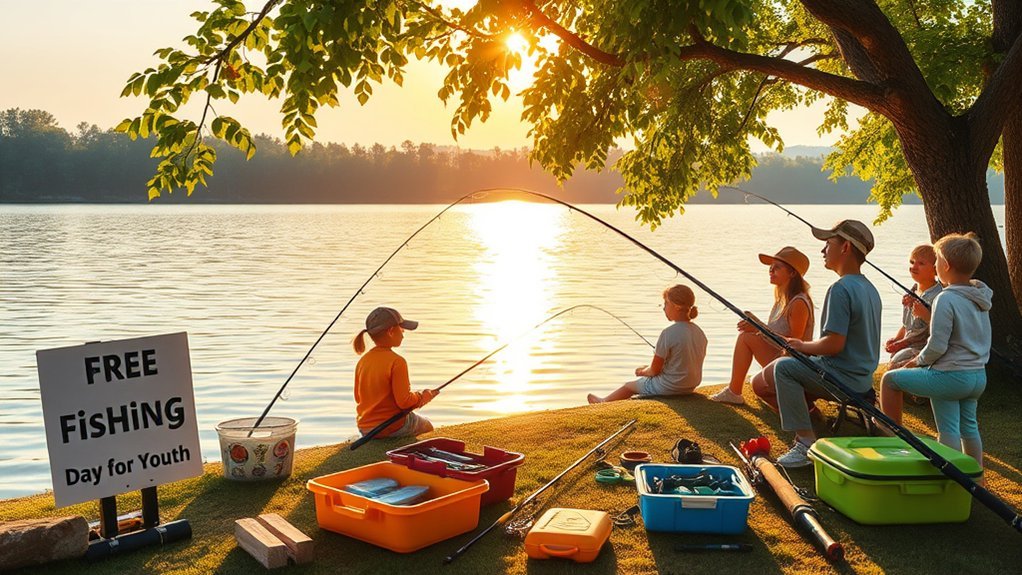
Children under 16 already fish without a sport fishing license, but California also offers opportunities that can reduce costs for older family members and help beginners learn.
- 2026 Free Fishing Days: California’s dates are Saturday, July 4, and Saturday, September 5. Anyone may fish without a sport fishing license on those days.
- Fishing in the City: CDFW runs urban fishing clinics and beginner programs in several regions. Some youth clinics provide instruction and fishing equipment.
- Public ocean piers: A sport fishing license is not required when angling from a qualifying public pier in ocean waters, although report cards and other rules still apply.
- Local youth events: Hatcheries, parks, cities, and fishing groups may hold free clinics or derbies with their own registration and supervision rules.
Free does not mean rule-free. Bag limits, size limits, seasons, closures, gear restrictions, and report-card requirements remain in effect on Free Fishing Days and at public piers.
Frequently Asked Questions
Can a child fish without a license if no licensed adult is present?
Yes. California’s sport fishing license exemption is based on the child’s age, not on whether a licensed adult is present. A child under 16 does not need a sport fishing license, but supervision, report-card rules, and all fishing regulations still matter.
At what age does a California fishing license become required?
The general requirement begins at age 16. A 16- or 17-year-old pays the standard fee because California does not offer a separate teen license rate.
Does a California annual fishing license expire at the end of the year?
No. A standard resident or nonresident sport fishing license is valid for 365 days from the purchase date. Report cards have separate seasons and deadlines.
Can fishing licenses or report cards be transferred between siblings?
No. Licenses and report cards are issued to an individual angler and should not be shared. Each sibling who needs a document must have the correct item issued in that person’s name.
What identification is needed for an online license purchase?
CDFW’s online system asks a new customer for personal information, an accepted identity type, date of birth, and physical descriptors. An existing customer can retrieve the record with identifying information already on file, such as a GO ID. A birth certificate or school ID is not listed by CDFW as a universal requirement.
Does a child need a report card on a Free Fishing Day?
Yes, when fishing for a species covered by a report-card requirement. Free Fishing Days waive the sport fishing license, not report cards or other fishing regulations.
Can a child under 16 use two rods in inland waters?
CDFW says a child under 16 may generally fish with two rods in inland waters without buying a Second-Rod Validation. The exception is water where only artificial lures or barbless hooks may be used.
Conclusion
California keeps the basic rule simple: children under 16 do not need a sport fishing license, while anglers 16 and older normally do. The harder part is checking report cards, local regulations, and special exceptions. Use the current CDFW fee page before buying, carry every required document, and review the rules for the exact water and species before the family heads out.
Sources
- California Department of Fish and Wildlife: Sport Fishing Licenses and Report Cards — 2026 fees, age requirements, public-pier rules, validations, report cards, and purchase methods
- California Department of Fish and Wildlife: Free Fishing Days — 2026 dates and rules that remain in effect
- California Department of Fish and Wildlife: White Sturgeon — catch-and-release status, seasonal report card, fee, and July 31 reporting deadline
- California Department of Fish and Wildlife: Recreational Lobster Fishing — report-card possession, recording, and April 30 return requirements
- California Department of Fish and Wildlife: Fishing Regulations — current freshwater and ocean regulation resources
- California State Parks Division of Boating and Waterways: Life Jackets — California life-jacket law for children under 13 on moving recreational vessels

The Little Tikes First Slide is a beginner-friendly playset designed for toddlers and young children to enjoy safe sliding fun indoors or outdoors. Its compact, foldable design makes setup, storage, and moving simple, while the sturdy build supports active play that helps promote balance and coordination.

The Crayola Inspiration Art Case is a complete 140-piece creative set designed to spark imagination in young artists. It includes crayons, washable markers, colored pencils, and drawing sheets neatly organized in a durable space-themed carrying case with compartments, locking latches, and a handle for easy portability. Safe, nontoxic, and ideal for beginners, this art kit supports school projects, crafts, and creative play at home or on the go.

The Eastpak Tranverz S is a compact wheeled suitcase designed to keep short trips and weekend travel organized with two main compartments and a convenient front pocket. Its dual-wheel system and telescopic handle make rolling smooth and stable, while the TSA-approved lock and compression straps help keep your belongings secure and in place. Built from a durable, water-resistant fabric blend, it offers dependable protection for travel on the go.
