

A TIG welder can cost less than $500 for a basic DC machine or more than $24,000 for a high-output industrial system. Most home users who want to weld both steel and aluminum will spend about $550–$2,500 on the machine, then add shielding gas, safety equipment, electrical preparation, and any accessories not included in the package.
Quick Answer
Basic DC TIG welders start near $449, while entry-level AC/DC machines commonly cost about $550–$1,200. Well-equipped workshop units run roughly $1,500–$4,500, and professional systems can cost $5,000–$15,000 or more. A complete first setup usually costs several hundred to several thousand dollars beyond the bare machine.
Key Takeaways
- A low-cost DC TIG welder can handle steel and stainless, but you normally need AC/DC output for conventional TIG welding on aluminum and magnesium.
- Confirm whether the price includes a torch, foot pedal, regulator, work lead, gas hose, starter consumables, cart, or water cooler.
- Your first-year cost can be much higher than the machine price after adding argon, PPE, ventilation, filler rod, a cylinder arrangement, and possible electrical work.
- Duty cycle, low-amperage control, arc starting, warranty support, and replacement-part availability often matter more than maximum advertised amperage.
- Shielding-gas cost depends on local supplier policies and actual usage, so there is no reliable universal annual figure.
At a Glance
| Time Required | About 1–3 hours to compare specifications, package contents, gas options, and electrical requirements |
| Difficulty | Moderate; model names and maximum amperage alone do not reveal aluminum capability, duty cycle, or included equipment |
| Tools Needed | Material and thickness list, machine manual, circuit information, local gas quote, and package checklist |
| Cost | About $449 for a basic DC machine to $24,000+ for industrial equipment; complete home setups commonly require hundreds or thousands more |
What Is a TIG Welder and How Does It Work?
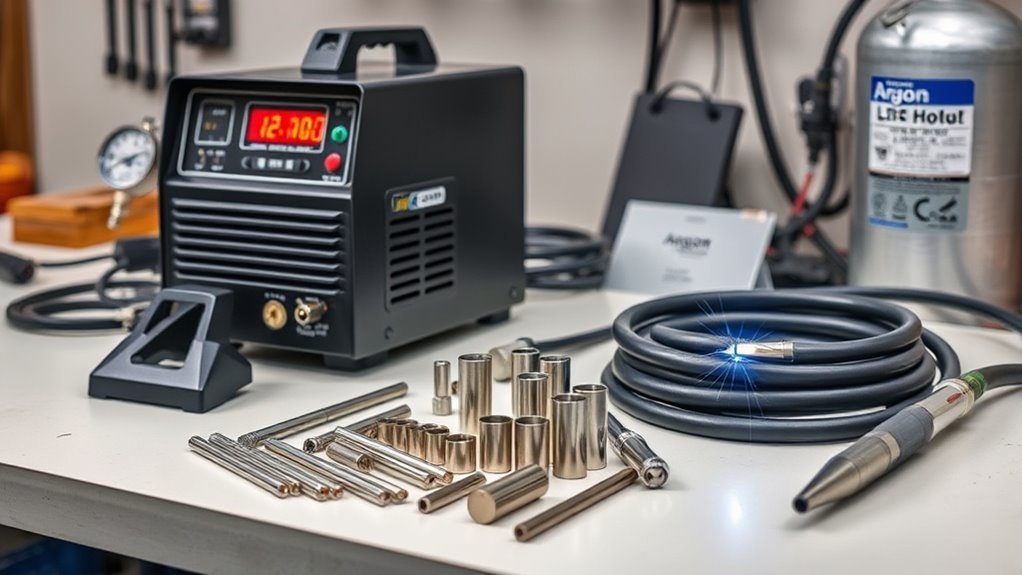
A TIG welder, also called a gas tungsten arc welding or GTAW machine, uses a non-consumable tungsten electrode to create an arc between the torch and the workpiece. A separate shielding gas, most often argon, protects the hot tungsten and weld pool from contamination. Filler metal can be added by hand when the joint requires it.
This process gives you precise control over heat and filler placement. It can produce clean, low-spatter welds on thin material, visible joints, tubing, stainless steel, aluminum, and specialty alloys. The trade-off is that TIG welding is slower and normally requires more coordination than MIG welding.
For a detailed process overview, see Miller’s guide to TIG welding basics.
AC Versus DC TIG
DC TIG is commonly used for carbon steel, stainless steel, titanium, nickel alloys, and many copper applications. A lower-cost DC TIG or TIG/stick machine can be a sensible choice when you do not plan to TIG weld aluminum.
AC TIG is the conventional choice for aluminum and magnesium because the alternating-current cycle helps break up the surface oxide while providing penetration. An AC/DC machine therefore costs more but covers a wider range of materials.
Shielding Gas and Arc Starting
TIG welding commonly uses 100% argon. Argon-helium blends may be used for selected applications that need more heat input. Do not assume a MIG argon/CO2 mixture will work for TIG; active gas in the mixture can contaminate the tungsten and weld.
Machines may use scratch start, lift start, or high-frequency start. High-frequency start lets you establish the arc without touching the tungsten to the work and is especially useful for clean, controlled TIG work. It is normally expected on a capable AC/DC aluminum machine.
Pro Tip: Write down the metals and maximum thicknesses you expect to weld before comparing machines. Paying for AC controls, high output, or a water cooler makes little sense if you only repair thin steel a few times each month.
TIG Welder Price Ranges

The price of a TIG welder depends heavily on whether it is DC-only or AC/DC, how much equipment comes in the package, and whether it is designed for occasional projects or production work. The ranges below are planning figures rather than guaranteed selling prices.
Pricing examples were checked in July 2026. Manufacturer prices, rebates, packages, and stock can change without notice.
| Machine category | Typical machine price | Best fit | Current examples |
|---|---|---|---|
| Basic DC TIG/stick | About $300–$800 | Steel, stainless, learning, light repair, and portable work without conventional AC aluminum TIG | PrimeWeld TIG200-DC: $449 |
| Budget AC/DC TIG | About $550–$1,200 | Home shops, hobby fabrication, automotive projects, aluminum, steel, and stainless | YESWELDER TIG-200P AC/DC; PrimeWeld TIG225X: $849; Vulcan ProTIG 205 |
| Mid-range workshop AC/DC | About $1,500–$4,500 | Frequent fabrication, stronger duty cycle, better controls, multiprocess capability, or established service networks | Forney 220 AC/DC: $2,399.99; Miller Multimatic 220 AC/DC: $4,285 list price |
| Professional TIG | About $5,000–$15,000 | Production shops, critical work, advanced program control, repeatability, multiple input voltages, and stronger support | Lincoln Aspect 230 AC/DC: $6,250.39 MSRP; Miller Dynasty 300: $10,816 list price |
| High-output industrial | About $15,000–$25,000+ | Heavy aluminum, high-amperage work, demanding duty cycles, automation, or specialized production | Miller Dynasty 800: $24,888 list price |
A $449 DC TIG machine and a $24,888 industrial AC/DC power source can both be called TIG welders. Material capability, output, duty cycle, controls, package contents, support, and production demands explain much of the price difference.
Products Worth Considering

【Born for Aluminum Welding】AC TIG mode is perfect for dealing with Aluminum and Aluminium alloy.

Large LED Display: Features a large LED screen for enhanced visibility and a clear display of welding parameters and settings. Its intuitive interface ensures effortless operation, enabling precise welding of diverse metals

POWERFUL 7-IN-1 TIG WELDER AC/DC: The Welder is capable of welding with DC TIG / DC Pulse TIG / AC TIG / AC Pulse TIG / AC Pulse TIG Square / AC Pulse TIG Triangular / STICK /SPOT TIG Methods. AC TIG is used in finesse welding various aluminum alloys, magnesium alloys, and other non-ferrous metals. DC TIG provides low-temperature control. You need precise welding for various types of steel: stainless steel, carbon steel, copper.
What Makes One TIG Welder Cost More?
- AC/DC capability: AC circuitry and aluminum controls raise the cost compared with a basic DC machine.
- Maximum output: Higher amperage supports thicker material but may also require a larger circuit, torch, or cooler.
- Duty cycle: Duty cycle states how many minutes within a 10-minute period the machine can operate at a specified output before cooling. A 40% rating at a given amperage means four minutes of welding and six minutes of cooling under the manufacturer’s test conditions. See Miller’s duty-cycle explanation.
- Low-amperage performance: A stable arc at very low output helps when welding thin sheet, tubing, and delicate edges.
- Arc starting: High-frequency start normally offers cleaner, more controlled starts than scratch start.
- Pulse and AC controls: Pulse frequency, AC balance, AC frequency, and waveform options give experienced welders more control over heat, cleaning action, penetration, and bead shape.
- Cooling system: Air-cooled torches are less expensive. Water-cooled systems add a cooler, hoses, coolant, and maintenance but improve comfort during high-amperage or long-duration work.
- Power flexibility: Dual-voltage machines are convenient for mobile and home use. Industrial machines may accept several single- and three-phase input voltages.
- Warranty and service: Dealer support, repair parts, loaner options, firmware support, and warranty coverage can justify a higher purchase price for a working shop.
Machine-Only Price Versus Ready-to-Weld Price
A low advertised price may cover only the power source. Before comparing two machines, check whether each package includes:
- TIG torch and torch consumables
- Foot pedal or fingertip amperage control
- Regulator or flowmeter and gas hose
- Work lead and clamp
- Stick electrode holder, if applicable
- 120V and 240V adapters
- Starter tungsten and cups
- Cart and cylinder rack
- Water cooler and water-cooled torch
- Power cord or plug
Note: A professional power source may cost more than $10,000 and still exclude the torch, pedal, work lead, cart, cooler, and cylinder. Compare the complete package rather than the front-page machine price.
Estimated First-Year TIG Setup Cost
| Setup | Machine | Likely complete first-year budget | Main additions |
|---|---|---|---|
| Basic DC hobby setup | $300–$800 | About $800–$1,800 | Gas arrangement, regulator, PPE, filler rod, tungsten, workbench protection, and ventilation |
| Budget AC/DC home shop | $550–$1,200 | About $1,200–$2,500 | Foot control if missing, gas, cylinder arrangement, aluminum consumables, PPE, cart, and possible 240V work |
| Regular workshop setup | $1,500–$4,500 | About $2,500–$7,000 | Larger cylinder, better PPE, cart, multiple filler alloys, electrical circuit, fume control, and spare torch parts |
| Professional system | $5,000–$15,000+ | About $8,000–$20,000+ | Cooler, water-cooled torch, cart, remote control, industrial gas supply, power installation, extraction, calibration, and production spares |
These are planning ranges, not quotes. Your result can be lower when the machine includes a complete accessory kit or much higher when you need a new electrical circuit, professional ventilation, premium PPE, or a water-cooled package.
Consumables and Recurring Costs to Expect
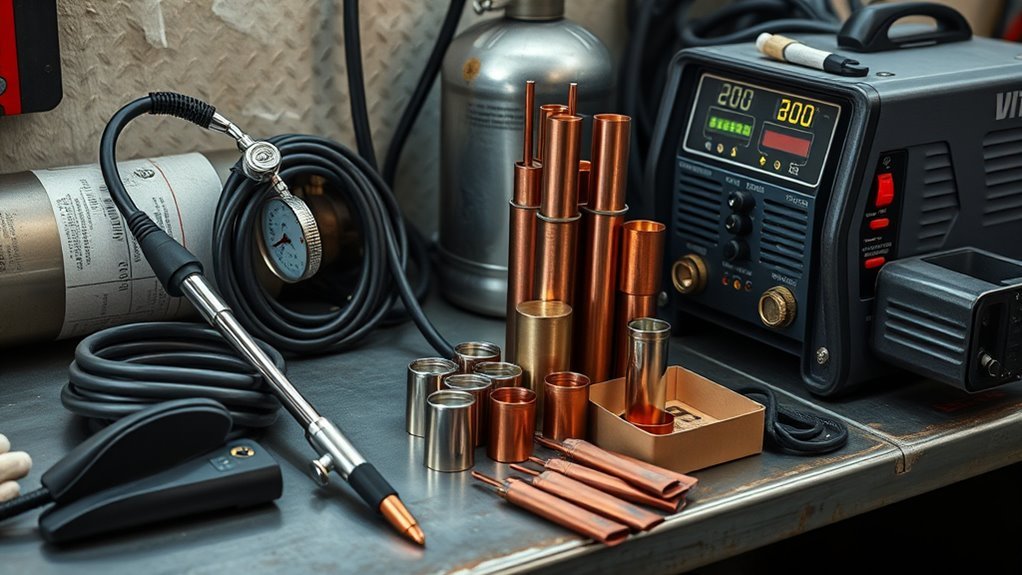
TIG does not continuously feed an electrode wire through the torch, but it still has recurring costs. Common replacements include tungsten electrodes, ceramic cups, gas lenses, collets, collet bodies, O-rings, filler rod, torch parts, coolant, and shielding gas.
The largest variable is usually gas. Your supplier may use cylinder ownership, lease, rental, deposit, or exchange programs. The amount paid to obtain a cylinder is not the same as the price of refilling or exchanging it.
Products Worth Considering

Set includes:3pcs Back cup, 6pcs collet body, 5pcs Alumina gas cup/ nozzle, 3pcs Zirconiated WhiteTungsten Electrodes
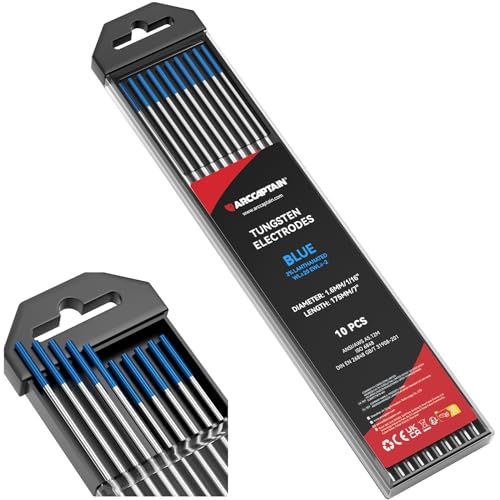
TOP QUALITY: This 10-pack of 2% Lanthanated tig tungsten electrodes 1/16"x7"(Blue, WL20/EWLa-2) adhere to Standard AWS A5.12M/A5.12:2009 and DIN EN 26848 GB/T 31908-201. All our tungsten has 100% traceability.
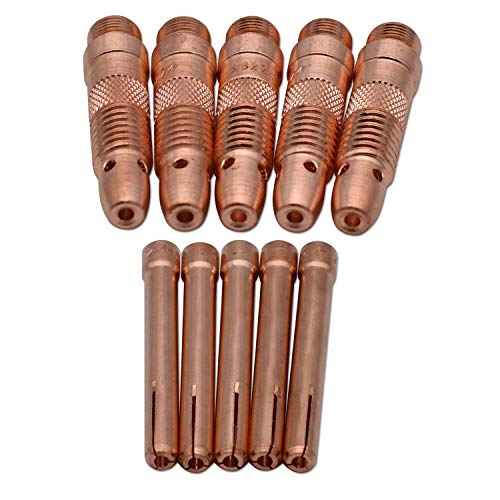
5Pcs 10N24 3/32" ( 2.4mm ) Collet
How to Estimate Annual Argon Cost
Use this simple formula:
Annual shielding-gas cost = number of fills or exchanges per year × your local supplier’s price per fill or exchange
Estimate usage from your normal flow setting, arc time, pre-flow, post-flow, purging, and any leaks. Frequent stainless back-purging or long post-flow settings can use much more gas than occasional bench welding.
| Cost category | What affects the cost | When to replace or pay |
|---|---|---|
| Argon or argon-helium gas | Cylinder size, local supplier program, flow rate, arc time, purging, pre-flow, post-flow, and leaks | Each refill, exchange, rental period, or lease renewal |
| Tungsten electrodes | Diameter, alloy, brand, contamination, sharpening loss, and amperage | When too short, cracked, contaminated, or unsuitable for the job |
| Cups, collets, gas lenses, and seals | Torch series, accidental damage, heat, cross-threading, and project variety | As cracked, distorted, leaking, worn, or needed in another size |
| Filler metal | Alloy, diameter, package size, waste, and storage quality | By project volume and alloy requirements |
| Torch or cooler service | Heat load, hose wear, coolant condition, duty cycle, and accidental damage | At the manufacturer’s service interval or when performance declines |
| Electricity and maintenance | Output, arc time, machine efficiency, fan or cooler operation, shop labor, and parts | Through utility bills and scheduled or corrective service |
A light hobby user may be able to plan for a few hundred dollars per year after the initial setup. Regular fabrication, stainless purging, high-amperage aluminum work, or production use can increase annual costs substantially. Use your own gas quote and expected arc hours instead of treating $200–$500 as a fixed rule.
Pro Tip: Gas leaks can quietly become one of the most expensive ownership problems. Check fittings with an approved leak-detection solution, close the cylinder valve after use, and inspect damaged hoses or O-rings instead of compensating with a higher flow setting.
Accessories and Safety Gear That Add to the Investment
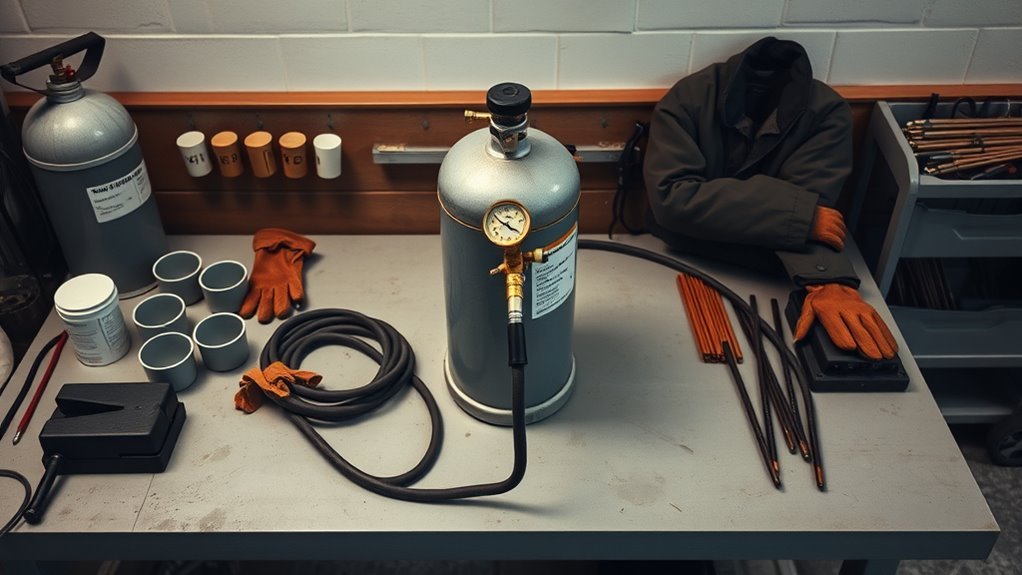
The TIG welder is only the center of the setup. Depending on what the manufacturer includes, accessories and safety equipment can add several hundred dollars to a hobby purchase or several thousand dollars to a professional installation.
| Item | Planning range | Buying note |
|---|---|---|
| Welding helmet | About $50–$400+ | Choose a suitable shade range, optical clarity, coverage, sensitivity, and low-amperage TIG performance. |
| Gloves, sleeves, and flame-resistant clothing | About $30–$150+ | TIG gloves should allow control while protecting your hands. Clothing should cover exposed skin. |
| Regulator or flowmeter | About $50–$250 | Confirm the gas connection and whether a regulator and hose already come with the machine. |
| Foot pedal or fingertip control | About $100–$350+ | Check connector compatibility. Some low-cost machines include a pedal; others sell it separately. |
| Gas cylinder arrangement | Varies by supplier | Ask separately about purchase, deposit, lease, rental, fill, exchange, and certification policies. |
| Cart and cylinder rack | About $100–$500+ | The rack must hold the cylinder securely and keep hoses and cables away from damage. |
| Water cooler and cooled torch | Several hundred to several thousand dollars | Most useful for frequent high-amperage welding or long production runs. |
| Ventilation and fire protection | Varies widely | A small bench setup and an industrial extraction system have very different costs and requirements. |
Warning: TIG welding can expose you and nearby people to ultraviolet and infrared radiation, burns, electrical shock, hot metal, fire, fumes, and compressed-gas hazards. Wear suitable eye, face, hand, body, and foot protection; provide adequate ventilation; remove or shield combustibles; protect bystanders with welding screens; and secure gas cylinders upright. Follow the machine manual and applicable workplace rules. Review OSHA’s welding hazards and solutions before setting up a work area.
Products Worth Considering

🔥 Flame-Resistant Safety: Made in USA 100% Cotton flame-resistant. Exactly what you needed, our Handmade welding caps for men and women offer essential protection for welders working in intense heat. Perfect for TIG, MIG, Stick, or Plasma welding


Compressed-Gas Cylinder Safety
Keep the cylinder upright and secured with a suitable chain or strap. Protect it from sparks, heat, impact, and electrical contact. Move it with its protective cap installed when the supplier’s cylinder design uses one, and never lift a cylinder by the valve or cap. OSHA’s gas-cylinder welding requirements provide additional workplace guidance.
Ventilation and Fume Control
TIG may appear cleaner than flux-cored or stick welding, but it can still produce hazardous fumes and gases from the base metal, filler, coatings, cleaning residue, and shielding process. Use suitable ventilation or local exhaust, especially on stainless steel, coated metal, confined areas, or unfamiliar alloys. Respiratory protection may be needed when ventilation and work practices cannot control exposure.
Electrical Requirements and Possible Wiring Costs
A TIG welder does not automatically require a new home circuit. Many portable machines can operate from 120 volts, but their maximum output and duty cycle are usually lower on 120V than on 240V. A higher-output AC/DC machine may require a 240V receptacle and a circuit sized according to the manufacturer’s input-current specifications.
Before buying, check:
- Required input voltage and phase
- Rated input current at the output you plan to use
- Recommended breaker or fuse
- Plug and receptacle type
- Required conductor and extension-cord size
- Grounding instructions
- Generator requirements, if applicable
Do not choose a breaker or wire size from the welder’s maximum output amperage. Welding output amperage and supply-circuit amperage are different measurements. Follow the exact manual and local electrical requirements.
Note: A dual-voltage label does not mean the machine delivers identical performance on both voltages. Forney, for example, lists different output and duty-cycle ratings for its 120V and 240V operation. Have a licensed electrician evaluate the installation when you need a new receptacle, circuit, disconnect, or panel work.
Choosing the Right TIG Welder for Your Budget and Projects
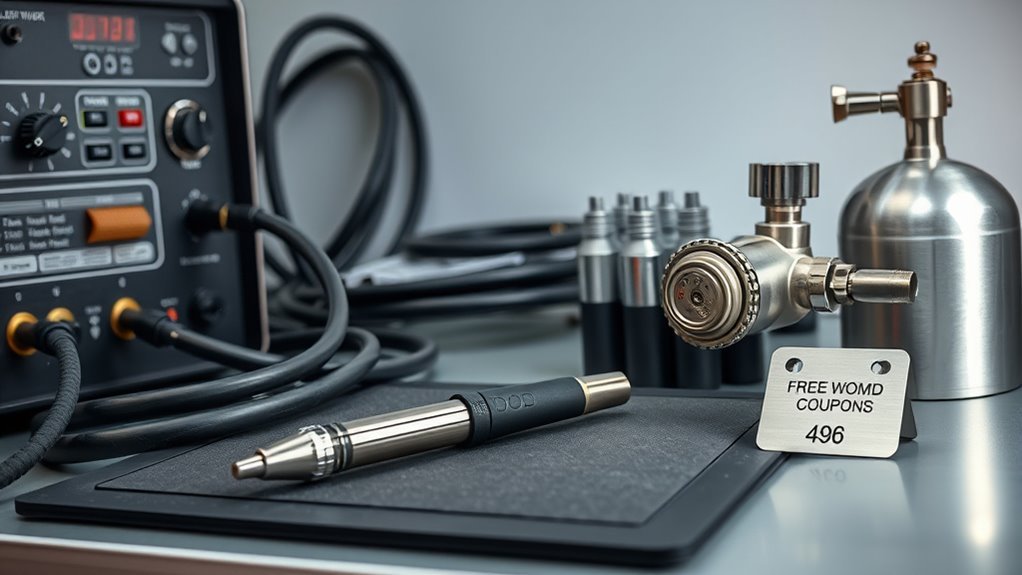
Start with your actual projects rather than a brand name or maximum amperage figure. List the metals, thickness range, joint types, expected weekly use, available power, portability needs, and whether you need another process such as stick or MIG.
Choose DC or AC/DC
- Choose DC TIG when you mainly weld carbon steel, stainless steel, titanium, and compatible specialty alloys.
- Choose AC/DC TIG when conventional TIG welding on aluminum or magnesium is part of your plan.
- Choose a multiprocess machine when you genuinely need TIG plus MIG or stick and accept any TIG limitations listed by the manufacturer.
Do not assume every machine advertised as “TIG capable” can perform high-frequency AC TIG. Some multiprocess welders provide only DC lift-arc TIG and may exclude the torch, pedal, or gas controls.
Match Output to Material Thickness
Thin material needs stable low-amperage control as much as thick material needs maximum output. A machine that starts smoothly at 5 amps may be more useful for thin stainless tubing than a higher-amperage machine with poor low-end control.
For thicker aluminum, you may need more amperage, stronger duty cycle, a larger torch, and possibly water cooling. Manufacturer thickness claims usually assume specific joint preparation, technique, pass count, and material conditions, so treat them as guidance rather than a guarantee.
Check Duty Cycle at the Amperage You Will Use
A machine may advertise 200 or 225 amps but allow that output for only a limited part of each 10-minute period. Compare duty cycle at realistic welding amperages, not just the highest number on the front panel.
Evaluate Controls Without Overbuying
Useful controls may include pre-flow, post-flow, start current, end current, upslope, downslope, pulse frequency, AC balance, AC frequency, waveform selection, spot timing, and stored programs. These features can improve repeatability, but they do not replace cleaning, fit-up, torch control, gas coverage, and practice.
Consider Warranty and Repair Support
Compare warranty length, shipping responsibility, service-center access, parts availability, torch compatibility, pedal availability, and whether the company publishes manuals and parts diagrams. For a business, downtime and service access can matter more than saving a few hundred dollars on the purchase.
Pro Tip: Download the manual before buying. Confirm input power, duty cycle, included equipment, torch connection, remote-control compatibility, gas requirements, warranty terms, and replacement-part numbers while you can still compare alternatives.
Buying a Used TIG Welder
A used professional machine can provide strong value, but repair costs can erase the savings. Whenever possible, test the welder under load rather than accepting a demonstration in which it only powers on.
Used TIG Welder Inspection Checklist
- Confirm the serial number, model revision, input voltage, and phase.
- Check that the machine is not configured only for an industrial voltage unavailable in your shop.
- Test DC TIG, AC TIG, high-frequency start, stick mode, pulse, remote control, and panel controls when applicable.
- Listen for unstable fans, coolant-pump noise, electrical arcing, or unusual vibration.
- Inspect the torch, hoses, power cord, work lead, connectors, pedal cable, and gas fittings.
- Look for burned terminals, coolant leaks, damaged displays, cracked housings, corrosion, and heavy conductive dust.
- Verify that replacement boards, torches, connectors, pedals, manuals, and service support remain available.
- Ask whether the unit has been repaired, dropped, used outdoors, stored in moisture, or operated from a generator.
- Price missing accessories before making an offer.
A low used price is less attractive when the machine needs a proprietary pedal, torch adapter, cooler, or control board that is difficult to obtain.
Should You Rent Instead?
Rental can make sense for one large project, a temporary production increase, or a job that requires more output than your normal work. Compare the rental charge, deposit, consumables, gas, damage terms, delivery, and required electrical connection with the cost of buying and later reselling a machine.
When Is a TIG Welder Worth the Cost?
TIG is worth the added equipment and training cost when appearance, heat control, thin material, precise filler placement, clean welds, or specialty-alloy work matters. It is often chosen for stainless tubing, aluminum fabrication, motorsports, bicycle frames, food-service equipment, aerospace work, art, and visible joints.
A less expensive or faster process may be more practical for long production welds, outdoor repair, dirty steel, or projects where appearance and precise heat control are not priorities. MIG and flux-cored welding generally offer faster deposition, while stick welding handles wind and field conditions better than gas-shielded TIG.
Maintenance and Common Cost-Saving Checks
Routine inspection helps protect the machine and prevents wasted gas, tungsten, and material.
- Before welding: Inspect the power cord, torch, hoses, work lead, connectors, regulator, cylinder restraint, and cooling system.
- Check gas coverage: Confirm the correct gas, sensible flow, leak-free fittings, suitable cup size, torch angle, and adequate post-flow.
- Prepare tungsten correctly: Use the appropriate diameter and preparation for the machine, polarity, amperage, and material.
- Keep the work clean: Remove oil, moisture, oxide, paint, and unsuitable cleaning residue using a method appropriate for the alloy.
- Protect ventilation openings: Keep the welder away from grinding dust and clean it only as the manufacturer directs.
- Maintain water cooling: Use approved coolant and inspect hoses, fittings, flow, and the cooler at the recommended interval.
- Close the cylinder: Shut the valve after use and release pressure according to the equipment instructions.
A dull, porous, gray, or contaminated weld often points to the wrong gas, insufficient coverage, a leak, excessive torch angle, dirty material, or contaminated tungsten. Miller’s common TIG welding problems guide covers several of these checks.
Frequently Asked Questions
Are TIG welders suitable for outdoor windy conditions?
TIG welding is difficult in wind because moving air can displace the shielding gas and contaminate the weld. Use a suitable wind barrier or enclosure and follow the recommended gas setting. Simply increasing gas flow can create turbulence and may not solve the problem. For exposed field repairs, stick or self-shielded flux-cored welding may be more practical.
Can I TIG weld without prior welding certification?
You can practice TIG welding and complete many personal hobby projects without holding a welding certification. Paid, structural, pressure, aerospace, workplace, or code-governed work may require training, a qualified welder, an approved welding procedure, inspection, and project-specific documentation. Passing a qualification test does not guarantee every future weld.
How long do TIG welders last with regular use?
There is no fixed lifespan for every TIG welder. Workload, duty cycle, cooling, dust, moisture, storage, component quality, maintenance, repair support, and parts availability all affect service life. A clean, correctly powered, repairable machine may remain useful for many years, while severe production use or poor storage can shorten its economical life.
Do TIG welders require special electrical wiring at home?
Not always. Some portable TIG welders can operate from a properly rated 120V receptacle, although maximum output may be reduced. Full output on larger machines often requires 240V. Use the manual’s input-current, breaker, receptacle, grounding, and conductor requirements. Have a licensed electrician install or evaluate a new circuit.
Can I use a TIG welder on non-metal materials such as plastic?
No. Arc TIG welding is intended for electrically conductive metals and compatible alloys. Plastic joining uses processes such as hot-air welding, hot-plate welding, extrusion welding, solvent bonding, adhesive bonding, vibration welding, or ultrasonic welding, depending on the material and product.
Is a cheap TIG welder good enough for a beginner?
A lower-cost machine can be suitable when it supports your materials, available power, amperage range, and preferred arc-starting method. Check low-amperage stability, duty cycle, included torch and pedal, warranty support, manual quality, and parts availability. Choose AC/DC rather than DC-only when aluminum TIG is an important goal.
How much should I budget beyond the TIG welder itself?
A complete home setup can add roughly $500–$1,500 or more beyond the machine after accounting for a gas-cylinder arrangement, fill or exchange, regulator, helmet, gloves, protective clothing, filler rod, tungsten, cups, cart, ventilation, and possible electrical work. Professional cooling and extraction can add much more.
What size argon cylinder should I buy?
Choose a cylinder that balances run time, storage space, portability, supplier availability, and refill or exchange policy. Small cylinders are easier to move but require more frequent fills. Larger cylinders reduce refill trips but are heavier and need secure storage. Ask your local supplier which sizes it will refill or exchange before purchasing a cylinder.
Conclusion
A TIG welder can cost about $449 for a basic DC machine, roughly $550–$4,500 for many home and workshop AC/DC options, or more than $10,000 for advanced professional equipment. The advertised machine price is only part of the investment.
Before buying, add the cost of shielding gas, cylinder arrangements, a torch and pedal if excluded, PPE, filler metal, consumables, ventilation, electrical work, and maintenance. Choose according to material, thickness, low-amperage control, duty cycle, available power, package contents, warranty, and service support. A machine that fits those needs is usually a better value than the cheapest or most powerful model on the page.
Sources
- Miller Electric — Guide to TIG Welding Basics — TIG process, tungsten electrode, shielding gas, and common applications.
- Miller Electric — Duty Cycle: What It Is and Why It Is Important — duty-cycle definition and buying considerations.
- Occupational Safety and Health Administration — Welding Hazards and Solutions — radiation, fumes, burns, electrical shock, and workplace controls.
- OSHA 1926.350 — Gas Welding and Cutting — compressed-gas cylinder handling and protection.
- Forney Industries — Forney 220 AC/DC TIG Welder — current package price, input power, processes, output, and duty-cycle specifications.
- Miller Electric — Dynasty 300 — professional AC/DC TIG pricing, package contents, input voltages, controls, and capacity.
