

Welding school can cost a few thousand dollars at a public technical college or more than $20,000 at some private career schools. The amount you actually pay depends on program length, residency, required tools, testing fees, housing, transportation, and financial aid. Compare each school’s full cost of attendance and likely net price—not tuition alone—before enrolling.
Quick Answer
A practical planning range for welding training is about $3,000 to $30,000 or more in tuition and required fees. Short public programs are often cheaper, while private career schools and degree programs can cost more. Add tools, PPE, books, testing, transportation, and living expenses before comparing your real out-of-pocket cost.
Key Takeaways
- Published price is not net price: grants, scholarships, employer aid, and veteran benefits may reduce what you pay.
- Extra costs matter: tools, PPE, books, lab fees, certification testing, transportation, and housing can add thousands of dollars.
- Certification is separate from graduation: a school certificate shows program completion, while a welder qualification proves you passed a specific performance test.
- Compare outcomes: review hands-on shop hours, processes taught, completion rates, job-placement disclosures, employer relationships, and graduate debt.
- Borrow last: complete the FAFSA, check scholarships, apprenticeships, WIOA funding, employer programs, and GI Bill® eligibility before taking private loans.
At a Glance
| Time Required | Several weeks to about one year for many certificates and diplomas; about two years for an associate degree |
| Difficulty | Moderate to high; training is hands-on, safety-focused, and physically demanding |
| Tools Needed | Helmet, gloves, protective clothing, boots, safety glasses, and basic hand tools; schools usually supply welding machines |
| Cost | Roughly $3,000–$30,000+ for tuition and required fees, plus tools, testing, transportation, and living costs; actual prices vary by school |
Average Tuition Costs for Welding Programs
There is no single national price for welding school. Published costs vary by school type, location, residency, program length, and what the quoted price includes. A short noncredit course may cost only a few thousand dollars, while a longer private program or degree can cost far more.
For example, the Florida State College at Jacksonville lists approximate in-state tuition of $3,066 for its welding career certificate. The East Central Technical College lists a 2026–2027 estimated direct cost of $7,433.20 for its 36-week welding program. These examples show the spread, but they are not national averages and may not include every living or personal expense.
The best comparison number is the amount you must pay after grants and scholarships, plus the income and living costs you give up while training.
Use a school’s current catalog, enrollment agreement, cost-of-attendance page, and net price calculator. Ask for the full price in writing before you sign anything.

This daily devotional helps parents pray purposefully for their children through a full year of Scripture readings, reflections, and guided prayer prompts. Written to encourage faithful family discipleship, it offers practical, biblically grounded support for parents who want to shape their prayers around God's Word. A foreword by Sinclair B. Ferguson adds trusted theological insight and encouragement.

This hardcover cookbook offers fast, approachable recipes designed for busy days and low-energy nights. Caroline Chambers focuses on simple, flavorful meals that help you get dinner on the table without overthinking it. It's a practical pick for home cooks who want quick weeknight inspiration and minimal-fuss cooking.

Stay organized with a durable 1-subject notebook set designed for school, note-taking, and digital study support. The college ruled pages resist ink bleed, tear out cleanly, and work with the Five Star Study App to create flashcards and sync notes to Google Drive. Tough pockets, a water-resistant cover, and Spiral Lock wire help protect your work throughout the year.
Typical Planning Ranges by Program
| Program Type | Common Length | Planning Range |
|---|---|---|
| Short course or single-process training | Several weeks to a few months | Often $1,000–$10,000 |
| Certificate or diploma | A few months to about one year | Often $3,000–$20,000+ |
| Associate degree | About two years | Often $5,000–$25,000+ depending on residency and school type |
| Bachelor’s or welding-engineering path | About four years | Varies like other four-year degrees and can exceed $40,000 |
Note: These are broad planning ranges, not official national averages. In-district tuition, state grants, union training, and apprenticeships can make the final price much lower.
Types of Schools and How They Affect Price
The school type affects tuition, program structure, financial-aid eligibility, and the credential you receive.
Public Technical Schools and Community Colleges
Public schools often have the lowest tuition for local residents. They may offer short certificates, diplomas, or associate degrees. Degree programs usually include general education courses, which add time but may make it easier to continue into another college program.
Private Career and Trade Schools
Private schools may offer faster schedules, more start dates, and concentrated shop training. They can also charge more. Compare total tuition and fees, refund rules, financing terms, and outcomes—not the monthly payment shown during enrollment.
Union and Registered Apprenticeships
A Registered Apprenticeship combines paid work, progressive wage increases, classroom instruction, mentoring, and a portable credential. Openings can be competitive, and the curriculum may focus on the sponsoring trade or employer rather than every welding process.
High School and Adult-Education Programs
Career and technical education programs may let high school students begin welding at little or no tuition cost. Adult-education and workforce programs can also provide lower-cost training, but some noncredit courses are not eligible for federal student aid.
Program Lengths and Their Cost Differences
Shorter programs usually cost less and get you into entry-level work sooner. Longer programs add shop time, general education, or advanced topics such as pipe welding, fabrication, metallurgy, robotics, inspection, and quality control.
Certificate vs. Degree
A certificate or diploma is usually the fastest school-based route. It focuses on practical welding, cutting, blueprint reading, fit-up, and safety. An associate degree often adds math, communication, technical theory, and broader manufacturing coursework.
A bachelor’s degree is not normally required for production welding. Four-year paths are more relevant to welding engineering, engineering technology, management, education, or design roles.
Short vs. Long Programs
Choose a short program when you already know the process and job market you are targeting. Choose a longer program when local employers expect several processes, pipe positions, code work, or broader fabrication skills.
Ask how many hours are spent welding in the booth. A program can be long on the calendar but light on hands-on practice. Also ask whether make-up lab time, practice metal, consumables, and qualification testing are included.
What Is Included in Welding School Tuition?
Two schools with the same tuition can have very different total costs. Request an itemized list that separates tuition from mandatory fees and optional purchases.
- Instruction and lab access: classroom hours, booth time, instructor supervision, and machine use.
- Consumables: plate, pipe, electrodes, wire, shielding gas, grinding discs, and cutting tips.
- Books and software: textbooks, code books, online platforms, and technology fees.
- PPE and tools: helmet, gloves, jacket, boots, safety glasses, pliers, chipping hammer, soapstone, and measuring tools.
- Testing: school practical exams, third-party performance qualification tests, test coupons, inspection, and application fees.
- Administrative costs: registration, background checks, drug screening, insurance, graduation, and transcript fees.
Pro Tip: Ask the school for a sample first-term supply list and the maximum likely cost—not only the minimum kit price. Consumables and replacement PPE can raise the total later.
Required Tools, Gear, and Supply Expenses
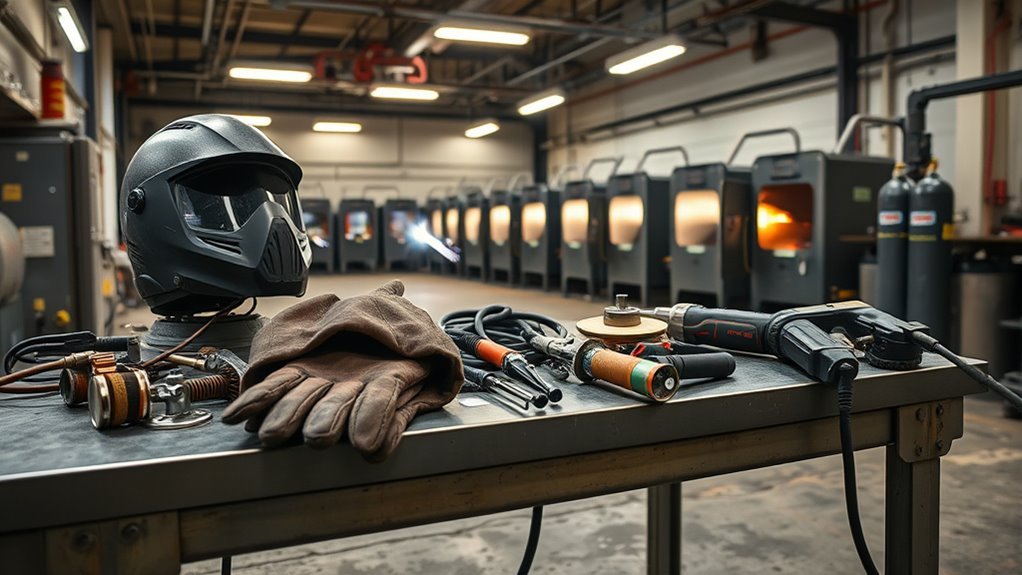
A reasonable planning budget for personal tools and safety gear is about $500–$1,500, but your school’s list controls the real amount. Some programs include a kit, while others require students to buy everything separately.
Common items include an auto-darkening or passive helmet, safety glasses, leather gloves, flame-resistant jacket or sleeves, leather work boots, hearing protection, welding pliers, chipping hammer, wire brush, soapstone, tape measure, square, and grinder accessories.
You normally do not need to buy a welding machine for school. Schools supply machines for lab use. A personal machine may cost several hundred to several thousand dollars, but it should be treated as an optional home-practice purchase unless the program specifically requires it.
Warning: Do not buy used helmets, respirators, electrical leads, or damaged protective clothing without a careful safety inspection. Welding exposes students to intense light, hot metal, electrical hazards, fumes, and fire risks. Follow the school’s PPE and ventilation rules and the applicable OSHA welding safety guidance.
Certification and Testing Fees to Budget For

Certification costs are not one flat price. They depend on the credential, test facility, welding process, code, position, material, coupon, inspection method, and retest policy.
School Certificate vs. Welder Certification
A school certificate or diploma confirms that you completed a training program. A welder performance qualification confirms that you passed a hands-on test for a specific process, material, position, thickness range, and code or procedure. Employers may still require a company-specific test even when you hold another credential.
Certification Exam Costs
The AWS Certified Welder Program is performance-based and has no formal education or experience prerequisite. Candidates test at an AWS Accredited Test Facility. AWS lists a $70 Certified Welder application fee for 2026, but the testing facility sets the practical test price. Contact the facility for the full amount, including coupon preparation, inspection, and retesting.
- Ask which qualification tests are included in tuition.
- Confirm the exact code, process, position, and material covered by each test.
- Ask whether destructive or nondestructive examination is included.
- Get the retest fee and waiting policy in writing.
- Verify whether the credential is portable or limited to one employer’s procedure.
Recertification and Retests
AWS Certified Welder status does not simply expire every few years. AWS states that it remains valid as long as continuity is maintained and documentation is submitted every six months. Under the 2026 AWS price list, Certified Welder maintenance uses a $105 yearly subscription for unlimited renewals. Missing continuity can require requalification.
Other credentials, including inspection, educator, robotic, and specialty certifications, have different renewal cycles and fees. Check the issuing body’s current rules instead of assuming every welding credential follows the same schedule.
Living, Travel, and Miscellaneous Costs During Training
Living costs can exceed tuition, especially if you move for school or attend full time. Build a monthly budget for housing, utilities, food, transportation, insurance, phone service, medical needs, and personal expenses.
Also include the value of work hours you may lose while attending class. This opportunity cost matters when comparing a fast full-time program with a slower evening program.
- Housing and utilities: rent, deposits, electricity, internet, and renters insurance.
- Transportation: fuel, parking, transit, vehicle repairs, or temporary lodging for off-site testing.
- Food and personal items: groceries, laundry, and basic household costs.
- Equipment upkeep: replacement gloves, lenses, batteries, grinding discs, and damaged tools.
- Lost income: reduced work hours during class, study, and lab practice.
How to Calculate Your Total Welding School Cost
Use this formula for each school:
Total education cost = tuition + mandatory fees + books + tools/PPE + testing + transportation + living costs + lost income − grants and scholarships.
Then calculate what you must borrow and the expected monthly payment. Do not count a loan as a discount; it lowers the amount due today but increases the total you repay.
Note: A school’s “cost of attendance” is a budgeting figure. Your bill may be lower, but your real living and transportation costs may be higher or lower than the school’s allowance.

Ticonderoga wood-cased pencils deliver smooth, reliable writing with an exclusive #2 graphite formula that produces consistent, bold lines. Made with premium wood for easy sharpening and minimal breakage, these pre-sharpened pencils also feature a latex-free eraser that removes marks cleanly. Trusted by teachers and suitable for kids, they offer dependable performance for school, office, and everyday writing tasks.

This interactive sentence building set helps children practice early reading, writing, and grammar through hands-on play. Color-coded word cards, photo cards, and punctuation pieces make it easy to build simple sentences while reinforcing capitalization, parts of speech, and sentence structure. It is a versatile learning tool for homeschool and classroom use, with included game ideas and teaching suggestions to support multiple skill levels.

These colorful answer buzzers turn lessons, review games, and family activities into lively game-show style challenges that boost participation and make learning more interactive. Each buzzer has a distinct sound to clearly identify who buzzed in first, while the durable, palm-sized design makes them easy for kids and adults to use in classrooms, homeschools, and group settings.
Financial Aid, Grants, and Scholarship Options
Start with aid that does not normally need to be repaid, then use work-based funding, and borrow only for the remaining gap.
Federal Grants Available
Complete the Free Application for Federal Student Aid to be considered for federal grants, work-study, and federal loans at eligible programs. The maximum Federal Pell Grant for the 2026–2027 award year is $7,395, although the actual award depends on eligibility, enrollment, and the school’s cost of attendance.
Federal aid is not available at every welding program. Confirm that the specific campus and program participate in Title IV aid by checking the school’s federal code and asking the financial-aid office.
Trade School Scholarships
Search for awards from the school, local manufacturers, unions, community foundations, workforce boards, and professional groups such as the AWS Foundation. Apply early because many awards have limited funds and firm deadlines.
| Source | Typical Requirement | Repayment |
|---|---|---|
| Federal or state grant | Financial eligibility and an eligible program | Usually none, except in limited circumstances |
| School scholarship | Enrollment, merit, need, or a separate application | None if conditions are met |
| Industry or association award | Career goals, academics, need, or local membership | None if conditions are met |
| Employer reimbursement | Employment, grades, and possible service commitment | May require repayment if you leave early |
Employer & Union Aid
Employers and unions may offer tuition reimbursement, paid apprenticeships, tool allowances, or training partnerships. Read the agreement carefully. Some programs require you to remain employed for a set period or repay benefits if you leave early.
- Ask current and prospective employers about paid training and reimbursement.
- Search local union and Registered Apprenticeship openings.
- Contact an American Job Center about WIOA-funded training and your state’s Eligible Training Provider List.
- Combine employer support with grants or veteran benefits when program rules allow it.
Payment Plans, Loans, and Veteran Benefits
Payment plans spread a bill over time but do not reduce the price. Ask about enrollment fees, late fees, automatic withdrawals, and what happens if you withdraw.
Federal student loans usually offer more borrower protections than private education loans. Review the interest rate, origination fee, repayment start date, estimated monthly payment, and total repaid before borrowing.
Veterans, service members, and eligible family members should use the GI Bill Comparison Tool to confirm that the school and exact program are approved and to estimate how benefits may apply. Approval and benefit levels can differ by campus and program.
How to Compare Welding Schools Before Enrolling
Price matters, but a cheap program is not a bargain if it provides too little booth time or weak job preparation. Compare the same facts for every school.
- Verify the school: check state authorization and institutional accreditation in the U.S. Department of Education accreditation database.
- Confirm aid eligibility: accreditation alone does not guarantee that the school or program participates in federal student aid.
- Review the curriculum: look for the processes local employers request, such as SMAW, GMAW, FCAW, and GTAW.
- Count hands-on hours: ask for scheduled booth hours, student-to-instructor ratios, and make-up lab access.
- Check equipment: tour the shop and ask whether machines, booths, ventilation, and consumables are current and available in sufficient numbers.
- Request outcomes: ask for completion, placement, job-title, wage, and graduate-debt disclosures with the reporting period and methodology.
- Read the contract: review cancellation, refund, leave-of-absence, attendance, satisfactory-progress, and complaint policies.
- Talk to employers: ask local fabrication shops, contractors, unions, shipyards, and manufacturers which programs they hire from.
Warning: Be cautious when a school guarantees a job, promises unusually high starting pay, pressures you to sign immediately, or focuses on a small monthly payment instead of total debt. Ask for every claim and cost in writing.
Comparing Return on Investment by Industry and Location
CareerOneStop, using May 2025 U.S. Bureau of Labor Statistics wage data, lists a national median annual wage of $53,750 for welders, cutters, solderers, and brazers. Pay varies by industry, location, experience, overtime, and specialty.
A high advertised wage does not prove that a program will deliver that result. Compare local entry-level openings, required qualifications, normal hours, travel, and overtime.
Do not assume one state automatically produces the best return. A higher wage may come with higher housing costs, seasonal work, travel, union requirements, or more experience. Use current local job postings and BLS or CareerOneStop wage data for the area where you plan to work.
Simple ROI Check
- Estimate your total out-of-pocket education cost.
- Add interest on any loans and income lost during training.
- Estimate a conservative first-year wage from local entry-level jobs.
- Subtract commuting, relocation, tools, dues, and travel costs.
- Compare the result with a paid apprenticeship or lower-cost public program.
Tips to Lower Your Welding School Expenses
You can lower welding school costs without cutting essential training or safety.
| Strategy | Why It Helps | Action |
|---|---|---|
| Compare public programs first | In-district tuition may be lower | Price at least three nearby schools |
| Complete the FAFSA early | Opens access to federal and school aid | Submit before school and state priority dates |
| Apply for several scholarships | Small awards can cover tools or testing | Use school, industry, union, and local sources |
| Consider paid apprenticeship | Lets you earn while learning | Search Apprenticeship.gov and local unions |
| Buy noncritical tools carefully | Reduces kit expense | Use student discounts; avoid unsafe damaged PPE |
| Live at home or attend evenings | May reduce housing and lost income | Compare total cost, not only program length |
| Borrow only the remaining gap | Limits interest and repayment risk | Review total repayment before signing |
Frequently Asked Questions
Can I work part-time while attending welding school?
Yes. Evening, weekend, and part-time programs can make work easier to manage. Check the real weekly schedule because lab practice, commuting, homework, and make-up sessions may take more time than the catalog hours suggest.
Are online welding courses accepted by employers?
Online lessons can teach safety, symbols, metallurgy, and theory, but welding performance must be developed and tested hands-on. A hybrid program can be useful when it includes supervised lab work and documented practical skills.
Do welding schools provide job-placement assistance?
Many provide résumé help, interview practice, employer visits, job leads, or career fairs. Placement assistance is not a job guarantee. Ask for the school’s written placement definition, reporting period, job titles, and number of graduates included.
What safety certifications are required before enrollment?
Most beginner programs teach required shop safety after enrollment, but policies vary. An OSHA 10- or 30-hour card is a voluntary course-completion card, not an OSHA certification or license, although a state, employer, union, or jobsite may require it.
Are tool discounts available for students through schools?
Often. Schools may negotiate kit prices, vendor discounts, bookstore packages, or employer-sponsored tool programs. Compare the kit with individual retail prices and confirm whether every item is required.
Can FAFSA pay for welding school?
Federal aid may help when the school and specific program are eligible. Completing the FAFSA does not guarantee an award, and short noncredit courses may not qualify. Confirm eligibility with the financial-aid office before enrolling.
Do I need welding school to become AWS certified?
No. AWS states that its Certified Welder program has no formal education or experience prerequisite. You must have enough skill to pass the required performance qualification test at an AWS Accredited Test Facility.
Is welding school worth the cost?
It can be when the program provides substantial hands-on practice, teaches skills local employers need, has a reasonable net price, and does not require excessive debt. Compare it with apprenticeships, public colleges, and employer-paid training before deciding.
Conclusion
Welding school prices vary too much for one number to tell the whole story. Start with the current tuition and mandatory fees, then add tools, PPE, testing, transportation, living costs, and lost income. Subtract grants and scholarships to find your likely net price. The best-value program is the one that delivers enough hands-on training, credible outcomes, and relevant job skills without forcing you into unmanageable debt.
Sources
- CareerOneStop: National Welding Wages — May 2025 Bureau of Labor Statistics wage estimates for welders, cutters, solderers, and brazers.
- Federal Student Aid: Pell Grants — 2026–2027 maximum award and basic eligibility information.
- American Welding Society: Certified Welder Program — testing pathway, prerequisites, facility pricing, and continuity requirements.
- American Welding Society: 2026 Certification and Education Price List — application and maintenance fees.
- Occupational Safety and Health Administration: Welding Hazards and Solutions — welding health and safety hazards and controls.
- Apprenticeship.gov: Registered Apprenticeship Program — paid work experience, wage progression, classroom instruction, and credentials.

Coghlan's Magnetic Bear Bell helps alert bears and other wildlife to your presence while hiking, walking, or exploring outdoors. The built-in magnetic silencer lets you quiet the bell when it is not needed, and the hook-and-loop closure makes it easy to attach to clothing, boots, hats, packs, or pet collars. It is a simple safety accessory designed to add peace of mind on the trail.

These Rawlings practice baseballs are built for young players ages 8 and under, offering an easy grip and consistent feel for recreational play. Each ball features a synthetic leather cover with a solid cork and rubber center, plus official size and weight for reliable training. The set includes a durable bucket for convenient storage and transport, making it a smart choice for coaches, parents, and teams.

Debrox Ear Wax Removal Kit helps gently soften and loosen excess ear wax with microfoaming ear drops, making at-home ear care simple and effective. The included bulb syringe helps rinse away loosened wax, and the formula is designed for safe use by adults and children over 12. This convenient kit supports relief from clogged ears caused by earbuds, hearing aids, and other everyday ear wear.
