
California does not sell or require a separate Trout Conservation Stamp in 2026. Most anglers age 16 or older need a valid California sport fishing license to fish for trout. A separate Steelhead Report Card is required only when fishing for steelhead in applicable inland or anadromous waters. Because other states do sell trout stamps or permits, always check the rules for the state and water you plan to fish.
Quick Answer
California’s trout stamp costs $0 because the state does not require a separate trout stamp. In 2026, an annual sport fishing license costs $64.54 for residents and $174.14 for nonresidents. A $10.29 Steelhead Report Card is required when fishing for steelhead in applicable inland waters.
Key Takeaways
- California has no separate trout stamp or trout validation in 2026.
- Most anglers age 16 or older need a California sport fishing license.
- The 2026 annual license costs $64.54 for residents and $174.14 for nonresidents.
- A $10.29 Steelhead Report Card is required for anyone fishing for steelhead in applicable inland waters, including anglers who are otherwise license-exempt.
- License validity, trout seasons, bag limits, gear rules, and report-card requirements are separate issues.
- Other states may require a trout stamp or permit, so never apply California rules to an out-of-state trip.
At a Glance
| Time Required | About 5–10 minutes to check the rules and buy a license online |
| Difficulty | Easy, once you know whether you are targeting ordinary trout or steelhead |
| Tools Needed | CDFW customer record, payment method, current regulations, and a phone or printed license |
| Cost | No trout-stamp fee; 2026 annual license is $64.54 resident or $174.14 nonresident, with a $10.29 Steelhead Report Card when required |
What California Trout Conservation Funding Actually Covers
California manages trout through broader fisheries programs rather than a dedicated statewide trout stamp. The official CDFW sport fishing license and fee list includes sport fishing licenses, validations, and species-specific report cards, but it does not include a Trout Conservation Stamp.
California’s Heritage and Wild Trout Program works to protect native trout, improve habitat, manage designated wild-trout waters, and provide high-quality fishing opportunities. CDFW also operates hatchery, stocking, monitoring, restoration, and angler-education programs.
The closest California product to the stamp described in the original article is the Steelhead Report and Restoration Card. Revenue from that card is dedicated to steelhead-fishery management, monitoring, and habitat-restoration work. Steelhead are the ocean-going form of rainbow trout, but the card is not required for ordinary trout fishing in lakes and non-anadromous streams.
Note: Buying a California sport fishing license and buying a Steelhead Report Card are different transactions. Do not buy the steelhead card unless your target species and fishing location require it.

This daily devotional helps parents pray purposefully for their children through a full year of Scripture readings, reflections, and guided prayer prompts. Written to encourage faithful family discipleship, it offers practical, biblically grounded support for parents who want to shape their prayers around God's Word. A foreword by Sinclair B. Ferguson adds trusted theological insight and encouragement.

This bright white cardstock delivers smooth, professional-quality printing for projects at home, school, or the office. Its sturdy 65 lb weight adds durability for covers, signs, table tents, and other creative uses, while acid-free construction helps preserve your work over time. Compatible with inkjet, laser, copier, and offset printing, it provides reliable results across a wide range of applications.

These colorful answer buzzers turn lessons, review games, and family activities into lively game-show style challenges that boost participation and make learning more interactive. Each buzzer has a distinct sound to clearly identify who buzzed in first, while the durable, palm-sized design makes them easy for kids and adults to use in classrooms, homeschools, and group settings.
Who Needs a California Fishing License for Trout
There is no California trout stamp to buy. Instead, most anglers age 16 or older need a valid sport fishing license before attempting to take trout or other fish in California waters.
The license requirement applies to residents and nonresidents, although the prices differ. Additional validations or report cards are required only for certain fishing methods, species, or locations.
Age and Residency Requirements
The following table shows the main 2026 California license options. Fees can change annually, so confirm the price on the CDFW website before purchasing.
| Angler or License Type | 2026 Requirement or Fee |
|---|---|
| California resident, age 16 or older | Resident 365-day sport fishing license: $64.54 |
| Nonresident, age 16 or older | Nonresident 365-day sport fishing license: $174.14 |
| Angler under age 16 | No sport fishing license for ordinary trout fishing; all seasons, limits, gear rules, and applicable report-card requirements still apply |
| One-day sport fishing license | $21.09 for a resident or nonresident |
| Two-day sport fishing license | $32.40 for two consecutive days |
| Ten-day nonresident license | $64.54 for ten consecutive days |
| Steelhead Report Card | $10.29 when fishing for steelhead in applicable inland waters |
Residency affects the annual license price, but it does not create a resident-only trout stamp. Both resident and nonresident anglers must follow the same water-specific trout regulations.
Special Exemptions and Waivers
California offers several license exemptions or reduced-fee programs, but none is a trout-stamp waiver because the state has no separate trout stamp.
- Anglers under 16: A sport fishing license is generally not required, although a report card is still required when fishing for steelhead or another report-card species.
- Free Fishing Days: CDFW lists July 4 and September 5 as its 2026 Free Fishing Days. The sport fishing license requirement is waived, but bag limits, seasons, gear restrictions, closures, and applicable report-card requirements remain in effect.
- Qualifying public piers: A sport fishing license is not required when fishing from a qualifying public pier in ocean or bay waters. This exception does not apply to ordinary inland trout fishing.
- Reduced-fee or free licenses: Certain disabled veterans, recovering service members, low-income seniors, low-income Native Americans, and qualifying people with disabilities may be eligible.
Warning: A license exemption does not automatically remove a report-card requirement. Anyone fishing for steelhead must carry the required Steelhead Report Card, including children under 16 and anglers fishing on a Free Fishing Day.
Trout Stamp Prices by State
Trout-stamp rules vary widely. Some states include trout in a general fishing license, while others require a separate stamp or permit for designated trout waters.
The following examples use official state-agency prices available on July 29, 2026. Fees and rules can change, so verify them before traveling.
Annual Stamp Fees
| State | 2026 Trout Fee | How the Rule Works |
|---|---|---|
| California | No separate trout stamp | A general sport fishing license is normally required for anglers 16 and older; a Steelhead Report Card applies when fishing for steelhead |
| Pennsylvania | $14.97 Trout Permit | Required in addition to a fishing license when an angler age 16 or older fishes for trout |
| Maryland | $20 resident; $30 nonresident | Required for anglers age 16 or older who catch, attempt to catch, or possess trout from Maryland non-tidal waters |
| Virginia | $23 resident or nonresident trout license | Required in addition to the appropriate fishing license in designated stocked trout waters from October 1 through June 15 |
| Illinois | $6.50 Inland Trout Stamp | Applies to licensed anglers in inland waters other than Lake Michigan, subject to program and site rules |
Resident Vs Nonresident
Some states charge residents and nonresidents the same trout-permit fee, while others charge more for nonresidents. The trout permit is often only one part of the total cost because the angler may also need a resident or nonresident fishing license.
For example, Maryland charges $20 for a resident trout stamp and $30 for a nonresident stamp. Virginia currently charges both residents and nonresidents $23 for its designated-stocked-water trout license, but each angler must also hold the appropriate underlying fishing license.
California takes a different approach. It has no separate trout stamp, but the 365-day nonresident sport fishing license is substantially more expensive than the resident license.
Discounted and Lifetime Options
Discounts and lifetime privileges also vary by state:
- California: Offers lifetime sport fishing licenses to residents, but there is no lifetime trout stamp. Some lifetime packages include a Steelhead Report Card privilege that must be claimed or issued under current program rules.
- Pennsylvania: Offers multi-year trout permits in addition to its annual permit.
- Virginia: Offers annual and lifetime trout-license options for designated stocked waters.
- Maryland: Its senior consolidated license no longer automatically includes the trout stamp, so eligible seniors who want to fish for trout must obtain it separately.
Note: Never assume a lifetime fishing license includes every trout permit, report card, endorsement, or access permit. Read the current privilege description before relying on it.
How to Purchase the California License or Card You Actually Need
You cannot select a California trout stamp because no such license product is offered. Use the following process to buy the correct item:
- Identify your target fish. Decide whether you are fishing for ordinary resident trout or for steelhead in an anadromous water.
- Check the water-specific regulations. Review the current CDFW freshwater regulations for season dates, closures, gear restrictions, and bag limits.
- Select a sport fishing license. Choose a 365-day, one-day, two-day, or eligible nonresident ten-day license.
- Add required items only when applicable. Purchase a Steelhead Report Card if you will fish for steelhead. Add a Second-Rod Validation only when two rods are legal and desired.
- Complete the purchase. California licenses can be purchased through the CDFW online sales system, by telephone, from an authorized license agent, or from a participating CDFW license office.
- Carry valid proof. Carry the paper license or display it through the official CDFW License App. Carry any required physical report card.
The CDFW License App can display eligible sport fishing licenses and validations. A screenshot or ordinary photograph of the license is not valid. The app stores refreshed licenses for offline display, but your device must be working and able to show the license.
Proof of a report-card purchase inside the app does not replace the physical report card. If you are fishing for steelhead, keep the physical card in your immediate possession and complete it as required.
Pro Tip: Refresh the CDFW License App while you still have internet access, charge your phone, and carry a paper license as backup when fishing in remote areas.
Exemptions and Reduced-Rate Licenses
California’s assistance programs apply to the sport fishing license rather than to a trout stamp. Eligibility, documentation, and purchase locations vary.
| Category | 2026 License Benefit | Key Qualification |
|---|---|---|
| Disabled veteran | $10.04 at a CDFW office or $10.54 from a license agent | Honorably discharged veteran with a service-connected disability rating of at least 50% |
| Recovering service member | $10.04 at a CDFW office or $10.54 from a license agent | Must meet CDFW’s recovering-service-member requirements and prequalify |
| Low-income senior | $10.04 | California resident age 65 or older who receives SSI or CAPI |
| Low-income Native American | No-fee sport fishing license | California residency, financial eligibility, and required tribal documentation |
| Mobility impaired, blind, or developmentally disabled | No-fee sport fishing license for qualifying applicants | Must satisfy the applicable statutory and documentation requirements |
First-time applicants may need to apply through the CDFW License and Revenue Branch or a designated CDFW office. After approval, later renewals may be available through additional sales channels.
These programs do not automatically waive a Steelhead Report Card or another species-specific report card. Check each required item separately.
License Validity Periods and Renewal Rules
California’s 365-day sport fishing licenses are valid for 365 consecutive days from the date of purchase. They do not automatically expire on December 31.
For example, a license purchased on July 29, 2026, would normally remain valid through July 28, 2027. Eligible validations, including the Second-Rod Validation and Ocean Enhancement Validation, also follow a 365-day period.
Report cards operate differently. They follow their own seasons and reporting cycles rather than the 365-day license period. A Steelhead Report Card must be reported or returned by January 31 following the year for which the card was issued.
- Sport fishing license: Valid for 365 days from purchase.
- Eligible validations: Generally valid for 365 days from purchase.
- Species report cards: Follow program-specific seasons, possession rules, and reporting deadlines.
- Trout season: Determined by the regulations for the water being fished, not by the expiration date on the license.
California’s 2026 statewide general trout opener was April 25. Most lakes, rivers, and streams covered by the general rule have a five-trout daily limit and a ten-trout possession limit, but many waters have different seasons, size limits, bag limits, or gear restrictions. Review CDFW’s 2026 trout-season guidance and current regulations for your exact destination.
Warning: A valid 365-day license does not mean every trout water is open. Seasonal closures, special tackle rules, zero-retention waters, and emergency changes can still apply.

The DeLonghi Water Filter helps reduce scale buildup and unwanted impurities that can affect your coffee machine's performance and taste. Its active carbon and ion-exchange technology helps improve brew consistency, maintain flavor, and reduce the need for frequent descaling. Designed as an OEM authorized replacement part, it fits select DeLonghi models for reliable everyday maintenance.

The LG LT1000P is a genuine replacement refrigerator water filter designed to deliver cleaner, fresher-tasting water and ice for your household. Certified to meet NSF standards, it helps reduce a wide range of contaminants while ensuring a proper fit and reliable performance in compatible LG refrigerators. With a recommended replacement cycle of several months and support for substantial water volume, it offers dependable filtration and peace of mind.

This heartfelt memoir blends laugh-out-loud honesty with tender reflections on love, loneliness, and the unexpected healing power of rescue dogs. Isabel Klee shares her journey fostering pups in the city while navigating dating and self-discovery, offering an intimate, relatable story for readers who enjoy emotional, character-driven narratives. It is a warm, engaging read about opening your heart and finding connection in surprising places.
Reporting and Compliance Requirements
California does not require a statewide report card for ordinary trout fishing. You do not need to submit a mandatory report every time you fish for rainbow, brown, brook, golden, or other resident trout.
Steelhead fishing is different. A Steelhead Report Card is required for anyone fishing for steelhead in applicable inland or anadromous waters. This requirement applies even when the angler is under 16, is fishing on a Free Fishing Day, or otherwise does not need a sport fishing license.
Steelhead cardholders must follow the card instructions, including:
- Recording the date and location code before beginning to fish
- Making a new entry when moving to a different location code
- Recording retained hatchery steelhead immediately
- Recording released steelhead and fishing hours when finishing or changing locations
- Reporting the card by January 31 of the following year, even if the holder did not fish
Failure to return or report a required card can restrict the holder from obtaining the same card later or result in an additional issuance fee. Those consequences apply to the report-card program and should not be presented as a general late fee for ordinary trout anglers.
Ordinary California trout fishing does not require a statewide report card, but steelhead fishing does—and the steelhead card must be carried, completed, and reported correctly.
CDFW also operates the California Inland Recreational Angler Survey, which allows anglers to share voluntary trip and catch information. That survey can help fisheries managers and other anglers, but it is not a replacement for a mandatory Steelhead Report Card.
How California Supports Trout Habitat Restoration
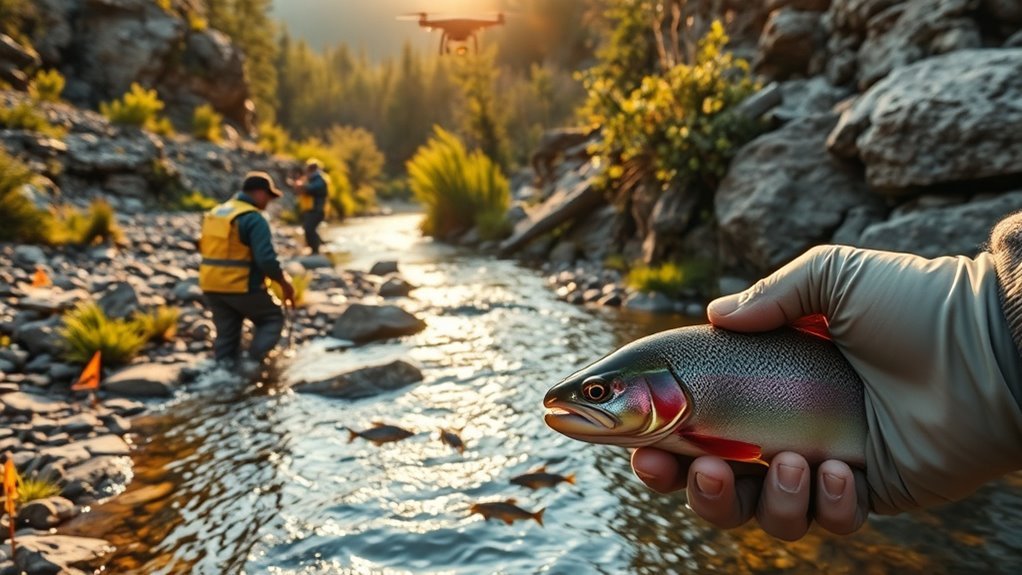
California’s trout and steelhead conservation work is real, but it is not financed through the statewide Trout Conservation Stamp described in the original article.
CDFW supports cold-water fisheries through several distinct programs:
- Heritage and Wild Trout Program: Protects native trout, manages designated wild and heritage trout waters, supports habitat work, and promotes responsible angling.
- Steelhead Report and Restoration Card: Generates angler data and dedicated revenue for steelhead-fishery management, monitoring, and habitat restoration.
- Fisheries Restoration Grant Program: Provides competitive grants for salmon and steelhead habitat projects in partnership with tribes, public agencies, nonprofit organizations, landowners, and other groups.
- Hatchery and stocking programs: Produce and distribute fish for recreational and conservation purposes according to management goals and ecological considerations.
- Monitoring and angler surveys: Supply information used to evaluate fish populations, fishing pressure, habitat conditions, and management results.
In states that sell a true trout stamp, the law or program rules may dedicate that revenue to stocking, hatcheries, access, research, or habitat work. The exact use differs by state. Maryland, for example, states that its trout-stocking program receives funding from non-tidal fishing licenses, trout stamps, and federal Sport Fish Restoration funds.
Note: Check the issuing state’s official description before assuming that every dollar from a trout permit is legally earmarked for one specific project or grant program.
Frequently Asked Questions
Does California require a trout stamp?
No. California does not require or sell a separate trout stamp in 2026. Most anglers age 16 or older need a sport fishing license. A separate Steelhead Report Card is required when fishing for steelhead in applicable inland waters.
Are trout stamps transferable between anglers?
California has no trout stamp to transfer. Sport fishing licenses and report cards are issued to individual anglers and cannot be shared. A person may buy a California gift voucher for someone else to redeem for a license, but the resulting license belongs to the named holder.
Can a nonresident buy a California fishing license online?
Yes. Residents and nonresidents can purchase eligible California sport fishing licenses through CDFW’s online sales system. Buyers must create or retrieve a CDFW customer record and provide the information required by the licensing system.
Do trout-stamp fees fund fish stocking?
They can in states that sell trout stamps, but the answer depends on state law and program rules. California has no statewide trout stamp. Its stocking, wild-trout, steelhead, and habitat programs use other funding sources and program-specific revenue.
Are digital and printed California fishing licenses both valid?
Yes. You may carry a valid paper license or display an eligible license through the official CDFW License App. A screenshot or ordinary photo is not valid. Physical report cards must still be carried when required.
Do children need a Steelhead Report Card?
Yes, when they are fishing for steelhead in waters where the card is required. The report-card rule applies even to anglers under 16 who do not need a sport fishing license.
Does the public-pier exemption apply to inland trout fishing?
No. California’s public-pier license exemption applies to qualifying piers in ocean or bay waters. It does not create a license exemption for fishing from the bank, shore, dock, lake, river, or stream in inland waters.
Can trout-related fees be used for research grants?
That depends on the law and budget rules governing the specific state program. California has no statewide trout stamp, but Steelhead Report Card revenue supports steelhead management and restoration, and California also administers separate fisheries-restoration grant programs.
Conclusion
California’s separate trout-stamp cost is $0 because the state does not require a Trout Conservation Stamp. In 2026, most anglers age 16 or older need a valid sport fishing license, which costs $64.54 for residents or $174.14 for nonresidents. Anglers fishing for steelhead in applicable inland waters must also obtain the $10.29 Steelhead Report Card.
Before each trip, check the regulations for the exact lake, river, or stream. Confirm the season, bag limit, possession limit, gear rules, closures, and any steelhead requirements. Carry a valid paper license or display it in the official CDFW License App, and keep every required physical report card with you.
Sources
- California Department of Fish and Wildlife — Sport Fishing Licenses and Report Cards — 2026 license, validation, report-card, reduced-fee, and validity information
- California Department of Fish and Wildlife — 2026 Trout Season Guidance — general opener, common limits, license requirement, and water-specific exceptions
- California Department of Fish and Wildlife — Steelhead Report and Restoration Card — card requirements, recording instructions, reporting deadlines, and funding uses
- California Department of Fish and Wildlife — License App — electronic display, offline access, screenshot restrictions, and physical report-card rules
- Pennsylvania Fish and Boat Commission — Fishing Licenses and Permits — 2026 Pennsylvania trout-permit fee and requirements
- Maryland Department of Natural Resources — Sport Fishing Licenses — resident and nonresident trout-stamp prices and eligibility

The Beurer BM27 is a dependable home blood pressure monitor designed for easy, accurate tracking of heart health. It features an adjustable upper-arm cuff, irregular heartbeat detection, and a color-coded risk indicator to make readings simple to understand. With memory storage for multiple users and app synchronization to major health platforms, it helps families keep a clear digital record of measurements.

This ROCKBROS bicycle front frame bag gives riders convenient storage and easy phone access on every ride. It features a high-sensitivity TPU touchscreen window, waterproof construction, reflective details, and a secure multi-strap fit to help keep essentials organized and visible while cycling. Designed for phones up to 7 inches with slim cases, it also includes a hidden earphone hole and quick-release installation for everyday commuting and long-distance riding.

This Ultra PRO bundle provides layered protection for standard trading cards with clear rigid toploaders and soft inner sleeves. It helps guard against bending, scratches, and dust while keeping cards visible for display, storage, shipping, and everyday handling. Ideal for collectors who want a reliable way to protect and organize valuable cards.
