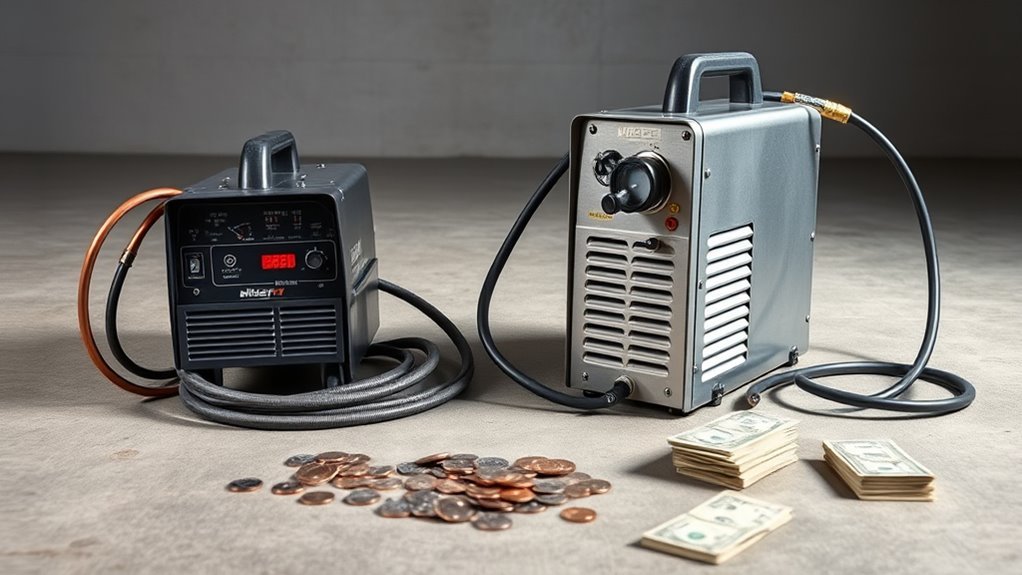
If you compare upfront cost, a regular welder usually costs less than a spot welder. You can get entry MIG or stick welders for about $100 to $2,000, while spot welders often start near $7,000 and can reach $28,000 for automated systems. Spot welders cost more because they deliver precision, speed, and repeatability for thin metal jobs. Your application matters, and the details below show where each machine makes sense.
Spot Welder vs Regular Welder: Which One Costs More?
When you compare upfront cost, regular welders are usually cheaper than spot welders. You can buy entry MIG or TIG units for about $200, while robust multiprocess systems can climb past $10,000.
By contrast, spot welders typically start around $7,000 and reach $28,000 for automated industrial setups. That gap reflects specialization: you’re paying for tight control, repeatable joints, and speed on battery packs or automotive parts.
If you need broad material options and flexible techniques, regular welder versatility gives you more freedom at a lower entry point. But if your workflow centers on production efficiency, the spot welder advantages can justify the higher cost through precision and reduced labor.
How Spot Welder Prices Vary
Spot welder prices vary widely because capability and automation rise with the workload you need to handle. You’ll usually see a clear ladder:
- Around $7,000, entry-level units suit small jobs and hardware parts;
- Near $14,000, mid-range machines support small to medium batch production;
- About $28,000, high-end systems deliver advanced precision and automation;
- Higher-priced models add stability and lower failure risk.
When you compare spot welder features, price tracks welding precision, duty cycle, and control depth. Basic machines can free you for simple tasks, but they’re less resilient.
Mid-range options balance throughput and cost, giving you more autonomy in repetitive work. Premium systems maximize automation benefits, which matters when you need consistent results at scale.
For your workflow, the real question isn’t just cost; it’s whether the machine matches your production logic. Spot welders stay cost-effective when you buy only the capability you’ll actually use.
Regular Welder Costs by Type
Regular welders fall into a clear price spectrum that reflects process complexity, material range, and output quality. You’ll see MIG welder pricing from $200 to $2,000, and that spread tracks ease of use, wire-feed convenience, and broad material compatibility across steel and aluminum.
TIG welder features push costs higher, typically $500 to $5,000 or more, because you’re paying for tighter control, cleaner welds, and stronger performance on thin aluminum and stainless steel.
Stick welder advantages keep entry costs low, from $100 to $1,000, while still giving you rugged output for outdoor and heavy-duty work on thick metal.
If you need more freedom, multiprocess welder applications justify $1,000 to $10,000 or more by combining MIG, TIG, and Stick in one unit. Each category prices in capability, so you’re choosing the tool that matches your technical demands, not just the lowest sticker.
Which Welder Fits Your Project?
Choosing between a spot welder and a regular welder comes down to the job’s materials, thickness, and production scale.
You should match tool choice to application suitability and material compatibility, not price alone. Spot welders, usually $7,000 to $28,000, deliver fast, precise joins on thin metal sheets and battery tabs. Regular welders, from $100 to over $10,000, cover a wider range of metals and thicknesses, so they fit mixed fabrication better.
- Thin sheet metal: choose spot welding for speed.
- Batteries or electronics: choose spot welding to limit heat spread.
- Mixed materials and thicknesses: choose MIG, TIG, or Stick.
- Small custom work versus large runs: scale your tool accordingly.
If you want clean, repeatable joints and minimal distortion, a spot welder gives you focused control.
If you need broader material coverage and flexible joining, a regular welder frees you to handle more project types.
Accessories, Power, and Maintenance Costs
When you compare ownership costs, the gap between spot welders and regular welders goes beyond the purchase price.
You’ll usually need fewer accessory essentials for spot welding: basic power, electrode tips, and occasional replacements. Regular welders often pull in gas tanks, hoses, and process-specific parts, raising startup and replacement costs.
Power efficiency also tilts the scale. Many spot welders run on standard household outlets, so you avoid the higher voltage and amperage demands that can push utility bills up.
Many spot welders run on standard outlets, keeping power demands and utility costs refreshingly low.
Regular welders, by contrast, often need heavier electrical service.
Maintenance longevity favors spot welders too. Their simpler design and fewer moving parts usually mean lower service costs and fewer breakdowns.
Regular welders can demand more repairs, especially in heavy-duty use.
If you want operational simplicity and lower lifetime expense, spot welding gives you a leaner, more liberated path.
Frequently Asked Questions
Is It Cheaper to Rent or Buy a Spot Welder?
You’ll usually save with buying if you weld often; Rental Costs add up fast, while Purchase Benefits include instant access and customization. Rent only when your use is rare and the total stays below ownership costs.
Why Do Welders Not Live Long?
You wear welders out through heat, duty cycles, and poor maintenance; like a marathoner sprinting, one shop’s cheap unit died in six months. Better cooling, welding safety, and lower health risks extend life.
Which Type of Welding Is the Cheapest?
Stick welding is usually the cheapest welding technique. In your cost analysis, you’ll see basic stick machines start near $100, beating MIG, TIG, spot, and multiprocess options while still handling rugged welding techniques.
Can Welders Make $100,000 a Year?
Yes—you can, though it’s not the default. In welding careers, salary expectations vary by specialty, certs, and location; you’ll hit $100,000 through high-demand, overtime-heavy, or contract work, not just basic shop labor.
Conclusion
So, when you compare a spot welder and a regular welder, you’re really weighing upfront price against versatility. A basic spot welder can start around $200, while regular welders often range from $300 to well over $1,000, depending on type. I once saw a shop owner buy a cheap MIG, then add gas, wire, and accessories—the “bargain” grew fast. Think of it like buying a car: the sticker price matters, but total operating cost tells the real story.