
Arizona does not issue a saltwater fishing license because the state has no ocean coastline or marine fishing waters. Arizona anglers use freshwater fishing or combination licenses for public lakes, rivers, reservoirs, streams, and community waters. The right credential depends on your age, residency, destination, and whether the water is public, private, or on tribal land.
Quick Answer
No. Arizona does not issue a saltwater fishing license because it has no marine waters. For public accessible inland waters, anglers age 10 or older generally need an Arizona fishing or combination license. The annual general license costs $37 for residents and $55 for nonresidents; youth, short-term, private-water, tribal, and travel rules differ.
Key Takeaways
- Arizona has no saltwater-specific license; its standard fishing licenses cover legal aquatic wildlife in inland waters.
- The annual general fishing license is $37 for residents and $55 for nonresidents.
- A $5 youth combination license is available for ages 10–17; children under 10 do not need a state fishing license.
- No Arizona state license is required on qualifying private waters, tanks, or ponds when the property owner gives permission.
- Tribal waters and coastal destinations use their own permits, rules, seasons, and limits.
Note: Fees and regulations can change. Arizona’s 2025–2026 fishing booklet was amended in January 2026, so check the current official rules and the special-regulation map before each trip.
Why Arizona Has No Saltwater Fishing License
Arizona is landlocked. It has reservoirs, rivers, lakes, streams, stock tanks, and community ponds, but it does not manage ocean or tidal fisheries. That is why the Arizona Game and Fish Department lists general fishing, combination hunt-and-fish, youth combination, and short-term combination licenses rather than a saltwater license.
The absence of a saltwater license does not mean fishing is unregulated. Arizona sets statewide and water-specific rules for licenses, legal methods, bait, seasons, protected native fish, size limits, and daily bag limits. Regulations can differ from one lake or stream to another.
Arizona has no marine fishing license. The practical question is which Arizona inland-water license—or which separate tribal, coastal-state, or Mexican permit—your trip requires.
Arizona licenses also include several privileges that older articles may describe as separate stamps. A current fishing or combination license includes trout privileges, simultaneous fishing with up to two poles or lines, and qualifying privileges on Arizona’s Colorado River boundary waters. Those are freshwater boundary-water privileges, not saltwater access.
Arizona Fishing License Types and Fees
The Arizona Game and Fish Department’s current license page lists four main choices for ordinary anglers. The annual general fishing license is the simplest option when you only plan to fish.
| License | Who It Fits | Resident | Nonresident |
|---|---|---|---|
| General Fishing | Fishing statewide, including Community Fishing waters | $37 | $55 |
| Combination Hunt and Fish | Fishing plus listed hunting privileges | $57 | $160 |
| Youth Combination Hunt and Fish | Ages 10–17 | $5 | $5 |
| Short-Term Combination Hunt and Fish | One or more selected fishing days | $15 per day | $20 per day |
Annual licenses are valid for one year from the purchase date. A short-term license is valid only on the date or dates selected during purchase; multiple dates do not have to be consecutive. Licenses are nontransferable and generally nonrefundable.
Products Worth Considering

ARIZONA STATE FLAG DESIGN: Features the bold red, yellow, and blue of the Arizona state flag with full embossed detail.

DECORATIVE LICENSE PLATE – Signs 4 Fun License Plates give personality to any vehicle. These license plates do not intend to cover or block any existing license plate on a vehicle. Our decorative license plates can be hung on walls as well as decoration in man caves, garages, or other displays.

High-Quality Material: Our car front license plate is made of high-quality aluminum, which provides long-lasting protection against corrosion, rust, and aging, durable and waterproof for long-lasting performance under most weather conditions
Resident vs. Nonresident Fees
Resident pricing requires more than simply owning property or staying in Arizona for part of the year. Arizona generally treats a person as a resident for license purposes when Arizona has been the person’s domicile for the six months immediately before applying and the person does not claim resident privileges elsewhere.
Active-duty military members and their spouses may qualify for resident pricing when the member is stationed in Arizona or lists Arizona as the member’s home of record. Confirm your status in the licensing portal before paying.
Resident and nonresident general fishing licenses provide the same listed statewide fishing privileges. The main difference is price.
Special and Youth Licenses
- Ages 10–17: The youth combination hunt-and-fish license costs $5 for residents and nonresidents.
- Under age 10: No Arizona state fishing license is required.
- Blind Arizona residents: No state fishing license is required.
- Pioneer license: A complimentary license may be available to a person age 70 or older who has been an Arizona resident for at least 25 consecutive years immediately before applying.
- Disabled veteran license: A complimentary combination license may be available to an Arizona resident of at least one year who has a permanent, service-connected disability rated 100% disabling and meets the department’s documentation rules.
- Lifetime licenses: Arizona offers resident-only lifetime options with fees based on age and license type.
There is no current $24 Community Fishing license in the standard fee table. The general fishing and combination licenses already include Community Fishing waters.
How to Buy an Arizona Fishing License Online
You can buy a license through the official AZGFD licensing portal, at an Arizona Game and Fish Department office, or from an authorized license dealer.
- Open the official portal. Sign in to an existing account or create a customer account.
- Enter accurate identity information. The system asks for contact details, date of birth, physical description, identification, and residency information.
- Select the correct license. Choose general fishing, combination hunt-and-fish, youth combination, or short-term combination.
- Choose dates when required. For a short-term license, select each valid fishing day before checkout.
- Pay and save proof. Print the license, save an electronic copy, or view it in the Arizona E-Tag app.
All required licenses must be in your possession while fishing. The E-Tag app can keep a license available even where cellular service is limited, and licenses bought online can be reprinted.
Pro Tip: Before checkout, confirm whether the water is state-managed, private, tribal, or across a state or national border. Buying the wrong jurisdiction’s license will not make the trip legal.
Products Worth Considering

Material:License Plate made of Stainless steel. Non-blocking and street legal, that won't block the upper and lower status and year labels, never having to worry about getting a ticket and wasting time

✅FULL SIZE HIGH-QUALITY ALUMINUM MATERIAL - Crafted from top-grade aircraft aluminum, this custom designed novelty plate resists rust and corrosion, ensuring it withstands harsh weather, Will maintain its appearance for years to come.

Comes with pre-drilled holes for easy installation
Age, Exemptions, and Special Licenses in Arizona
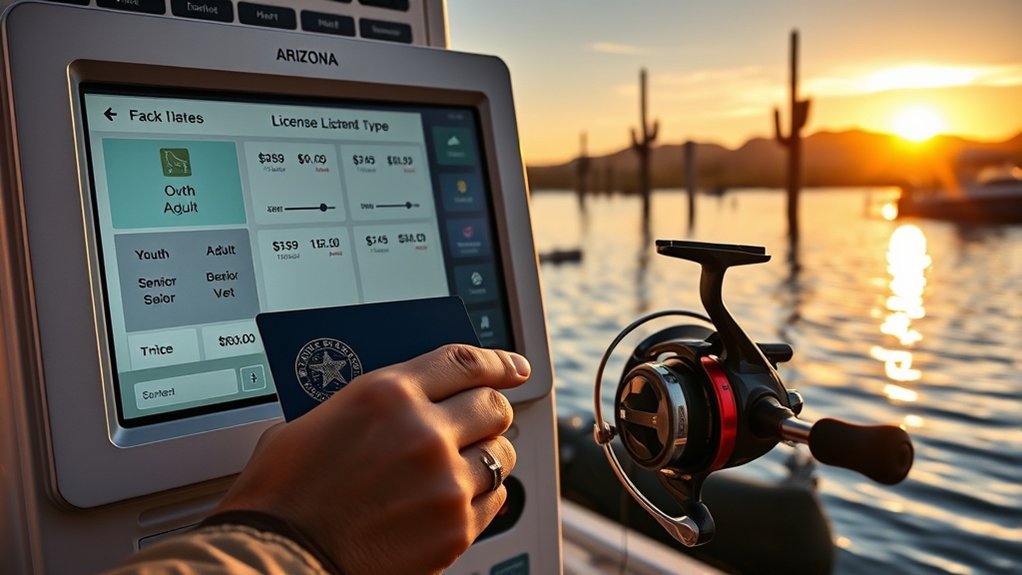
The usual rule is simple: residents and nonresidents age 10 or older need a valid Arizona fishing or combination license when fishing any public accessible water in the state. The exceptions are narrower than the original article suggested.
| Public accessible water, age 10+ | Arizona fishing or combination license required. |
| Child under 10 | No state fishing license required. |
| Blind Arizona resident | No state fishing license required. |
| Private water, tank, or pond | No state license required when the property owner gives permission. |
| Arizona Free Fishing Day | No state license on participating public waters for that designated day; bag limits and other regulations still apply. |
| Tribal water | The tribe’s permit and rules control; an Arizona state license may not replace the tribal permit. |
Warning: Do not assume an Arizona state license covers tribal waters. For example, the Navajo Nation requires a fishing permit for waters under its jurisdiction, and the White Mountain Apache Tribe states that its own permit—not an Arizona state permit—is required on the Fort Apache Indian Reservation.
Special licenses have exact eligibility standards. Review the AZGFD special-license instructions and submit the required proof rather than relying on a broad label such as “senior,” “disabled,” or “military.”
Fishing on Private Property and License Requirements
Private-property access and fishing-license requirements are two separate questions. You always need legal permission to enter private land. Whether you need an Arizona fishing license depends on the legal status of the water.
Products Worth Considering

Arizona License Plate Design: Featuring an accurate replica of an Arizona license plate in a compact 1.75 by 3.5-inch size.

ARIZONA DESERT DECOR: Features a grayscale Arizona-inspired star and sun ray design, creating a clean regional accent for garages, cabins, bedrooms, offices, RV spaces, travel rooms, and wall displays.

Fun Fact: Did You Know that only 10% of novelty license plates are actually placed on vehicles. Most of them are used as signs. Hang them on the wall of your man cave, bedroom, den, college dorm, home office or theater. The possibilities are absolutely endless.
Private Land Permission
Ask the owner before entering, parking, crossing the property, launching a boat, or fishing. Follow all posted conditions, access hours, parking rules, and fees. Written permission is the safest choice when ownership or access terms could be disputed.
License Necessity Exceptions
Arizona’s current regulations state that a fishing license is not required when fishing private waters, tanks, or ponds with the property owner’s permission. This is the opposite of the original article’s broad claim that a state license is normally required on private water.
The exemption does not automatically apply merely because you stand on private land. If the water itself is public accessible water, anglers age 10 or older generally still need the appropriate state license.
Property Boundary Clarification
- Confirm who owns the land and who controls the water.
- Ask whether the water is a private pond or part of a public river, lake, reservoir, or canal system.
- Check for city, county, federal, tribal, or site-specific access rules.
- Carry your license and permission documents when they are required.
When the status is unclear, contact the landowner and the agency that manages the water before fishing.
What to Do When Fishing in Coastal States
An Arizona fishing license does not become a saltwater license when you leave the state. Buy the credential required by the place where you will actually fish.
- Check the destination fish and wildlife agency. Look for resident, nonresident, annual, short-term, pier, shore, charter, or combination options.
- Read the current marine regulations. Check open seasons, size and bag limits, marine protected areas, gear rules, report cards, and species-specific permits.
- Verify charter coverage. Some licensed vessels cover passengers in some jurisdictions, while others do not. Ask the operator and confirm the rule with the agency.
- Check federal requirements. A state saltwater license often satisfies the National Saltwater Angler Registry requirement, but the registry is not a substitute for a state license. Some species and federal fisheries require added permits.
- Check boating rules separately. Kayak registration, boater education, lighting, flotation devices, and motor rules depend on the jurisdiction and whether the kayak is powered.
- For Mexico, obtain a Mexican permit. An Arizona license has no authority in Mexican waters; use the official CONAPESCA sport-fishing permit system.
Warning: There is no nationwide recreational fishing license that automatically covers every coastal state or Mexico. Boundary-water agreements and charter exemptions are limited exceptions, not a general rule.
For U.S. saltwater trips, start with NOAA Fisheries’ National Saltwater Angler Registry guidance and then follow the destination state’s rules. For Mexican waters, use the official CONAPESCA permit portal.
How Fishing Licenses Support Conservation
Arizona says every license purchased online contributes directly to on-the-ground conservation. License revenue helps support fisheries management, habitat protection, fishing education, enforcement, hatcheries, and stocking programs.
Arizona’s hatchery and sport-fish stocking work also receives support through the federal Sport Fish Restoration program. Together, state license revenue and federal restoration funds help maintain fishing opportunities and aquatic habitat.
- Fish hatchery operation and sport-fish stocking
- Habitat restoration and fisheries surveys
- Fishing access, education, and public information
- Enforcement of seasons, limits, and protected-species rules
- Aquatic invasive-species prevention and decontamination work
Note: Arizona’s invasive-species concern is aquatic—not “saltwater”—invasive species. Report concerns through the AZGFD Aquatic Invasive Species program, and clean, drain, and dry boats and fishing gear before moving between waters.
Frequently Asked Questions
Can I use an Arizona license to fish in Mexico waters?
No. Arizona licenses apply only where Arizona privileges are recognized. Recreational fishing in Mexican waters requires the applicable Mexican permit and compliance with Mexican species, gear, and vessel rules.
Do I need a boating license to saltwater fish from a kayak?
A fishing license and a boating credential are separate requirements. The answer depends on the state, the operator’s age, and whether the kayak is unpowered or motorized. Check registration, boater-education, flotation-device, lighting, and fishing-license rules for the exact water.
Are special permits required for commercial saltwater fishing?
Yes, in most commercial fisheries. Commercial operators may need state licenses, federal vessel or species permits, landing privileges, reporting accounts, quotas, and approved gear. Recreational licenses do not authorize commercial harvest or sale.
Can I obtain one multi-state fishing license for coastal trips?
There is no single nationwide recreational license for every coastal state. You may need a separate license for each state you fish from or in. Limited reciprocity and boundary-water agreements exist, but they apply only where the governing agencies specifically recognize them.
How do I report an invasive aquatic species in Arizona?
Use the Arizona Game and Fish Department’s Aquatic Invasive Species resources or contact the program directly. Record the location, date, photos, and identifying details. Do not transport the organism or move contaminated water, bait, boats, or gear to another water.
Does an Arizona fishing license cover Lake Mead, Lake Mohave, or Lake Havasu?
Arizona’s current fishing and combination licenses include privileges from shore or boat on portions of the Colorado River and impounded waters that form mutual boundaries with California or Nevada, including qualifying portions of Lake Mead, Lake Mohave, and Lake Havasu. Always check the exact boundary and special regulations.
Do I need a separate Community Fishing license in Arizona?
No. The current general fishing, combination hunt-and-fish, youth combination, and short-term combination licenses include fishing at Arizona Community Fishing waters. The older separate community-license price should not be used.
Sources
- Arizona Game and Fish Department — Licenses and Regulations and 2025 & 2026 Fishing Regulations — current fees, age rules, exemptions, private-water requirements, boundary-water privileges, and purchase options.
- Arizona Game and Fish Department — Special Licenses — Pioneer, disabled-veteran, lifetime, and other special-license eligibility.
- AZGFD Fisheries Management and Aquatic Invasive Species Program — stocking, hatcheries, conservation funding, and invasive-species prevention.
- Navajo Nation Parks and Recreation and White Mountain Apache Tribe Game and Fish — examples of separate tribal fishing-permit requirements.
- NOAA National Saltwater Angler Registry and Federal Fishing Permits — state saltwater-license, federal registration, and fishery-permit guidance.
- CONAPESCA — Recreational Sport-Fishing Permits — official Mexican recreational fishing permit portal.
Conclusion
Arizona has no saltwater fishing license because it has no marine waters. For Arizona public waters, choose the current general, combination, youth, or short-term license that fits your trip. Then verify the exact water’s regulations, private or tribal status, and access rules. When traveling to a coast or Mexico, buy the destination’s permit instead of relying on your Arizona license.
