
California fishing license prices changed for 2026, so older fee lists can leave anglers budgeting the wrong amount. The standard 365-day sport fishing license now costs $64.54 for a California resident and $174.14 for a nonresident. The right license depends on your age, residency, trip length, fishing location, and target species.
Quick Answer
In 2026, a California 365-day sport fishing license costs $64.54 for residents and $174.14 for nonresidents. A one-day license is $21.09, a two-day license is $32.40, and a 10-day nonresident license is $64.54. Extra validations or report cards may be required.
Key Takeaways
- Most people age 16 or older need a California sport fishing license to take fish, shellfish, reptiles, or amphibians.
- The resident and nonresident 365-day licenses are valid for 365 days from the purchase date, not just through December 31.
- Children under 16, anglers on qualifying ocean public piers, and everyone on California Free Fishing Days may fish without a sport fishing license, but other rules still apply.
- Species-specific report cards and area or gear validations can add to the total cost.
- California fees and fishing regulations can change, so check the California Department of Fish and Wildlife before each trip.
Note: The fees in this guide were checked against the official 2026 California Department of Fish and Wildlife fee table on July 28, 2026. Most listed fees already include the applicable application and license-agent handling charges.
Who Needs a Sport Fishing License in California?
Under California law, a person who is 16 years of age or older generally needs a valid sport fishing license before attempting to take fish, mollusks, crustaceans, other invertebrates, reptiles, or amphibians in California inland or ocean waters. The requirement applies to residents and visitors, including people fishing from a private boat, charter boat, or guided trip.
For licensing purposes, the California Department of Fish and Wildlife (CDFW) generally treats someone as a resident after that person has continuously lived in California for at least six months immediately before applying. Certain active-duty military personnel and Job Corps participants also qualify under the state definition.

The LG LT1000P is a genuine replacement refrigerator water filter designed to deliver cleaner, fresher-tasting water and ice for your household. Certified to meet NSF standards, it helps reduce a wide range of contaminants while ensuring a proper fit and reliable performance in compatible LG refrigerators. With a recommended replacement cycle of several months and support for substantial water volume, it offers dependable filtration and peace of mind.

This daily devotional helps parents pray purposefully for their children through a full year of Scripture readings, reflections, and guided prayer prompts. Written to encourage faithful family discipleship, it offers practical, biblically grounded support for parents who want to shape their prayers around God's Word. A foreword by Sinclair B. Ferguson adds trusted theological insight and encouragement.

This retractable car window shade helps block UVA and UVB rays to make rides more comfortable and protected for passengers. It includes a White Hot heat alert that turns white when the car is too hot, plus dual installation options for a secure fit in many vehicles. The safe-view mesh supports visibility while helping reduce glare, and the easy one-push retraction makes it simple to use when needed.
When You May Fish Without a Sport Fishing License
- Anglers under age 16: A child younger than 16 does not need a sport fishing license, although a report card may still be required for certain species.
- Qualifying public piers: No sport fishing license is required when angling for noncommercial purposes from a qualifying public pier in California ocean or bay waters. The structure must meet California’s legal definition of a public pier.
- Free Fishing Days: Anyone may fish without buying a sport fishing license on California’s designated Free Fishing Days. In 2026, those dates are July 4 and September 5.
- Eligible free-license applicants: Certain blind, mobility-impaired, developmentally disabled, and qualifying low-income Native American applicants may receive a free license after approval.
- Narrow private-water or aquaculture exceptions: State law includes limited exceptions for qualifying offstream ponds wholly enclosed on private property and for angling at a properly registered aquaculture facility. Do not assume an ordinary private lake, fee-fishing site, or farm pond qualifies without checking the legal conditions.
Warning: A beach, seawall, marina dock, jetty, or breakwater is not automatically a license-free public pier. Confirm the location on CDFW’s public pier and beach-fishing guide. Bag limits, size limits, seasons, gear rules, and report-card requirements still apply even when no license is required.
How Much Is a Fishing License in California?
The standard 2026 California sport fishing license costs depend on residency and the length of the license. These are the main options shown in the official CDFW fee table:
| License type | 2026 fee | Best for |
|---|---|---|
| Resident 365-day sport fishing license | $64.54 | California residents age 16 or older who expect to fish more than a few days |
| Nonresident 365-day sport fishing license | $174.14 | Frequent visitors or longer stays |
| One-day sport fishing license | $21.09 | A single specified fishing day for a resident or nonresident |
| Two-day sport fishing license | $32.40 | Two consecutive days for a resident or nonresident |
| 10-day nonresident sport fishing license | $64.54 | A nonresident fishing trip lasting up to 10 consecutive days |
A 2026 resident 365-day California sport fishing license costs $64.54 and remains valid for 365 days from the purchase date.
The one-day and two-day licenses are exempt from the Ocean Enhancement Validation requirement. A 10-day license is available only to nonresidents. License purchases are generally nonrefundable once issued.
How to Choose the Most Cost-Effective License
- Choose a one-day license for a single charter, guided trip, or day outing.
- Choose a two-day license for a weekend or two consecutive fishing days.
- Choose a 10-day nonresident license for a visiting angler fishing several days within one trip.
- Choose a 365-day license when you expect repeat trips during the next year.
2026 Lifetime Fishing License Prices
California lifetime fishing licenses are available to California residents. The license must be claimed or renewed for each 365-day period, but there is no annual license charge after the original lifetime purchase.
| Age at purchase | 2026 fee |
|---|---|
| Ages 0-9 | $709.00 |
| Ages 10-39 | $1,160.25 |
| Ages 40-61 | $1,045.00 |
| Ages 62 and older | $709.00 |
| Lifetime Fishing Privilege Package | $478.75 |
The optional privilege package includes lifetime Second-Rod and Ocean Enhancement validations plus annual North Coast Salmon and Steelhead report-card privileges. New future requirements may not be included. Review the CDFW lifetime license information before buying.
Reduced-Fee and Free Fishing Licenses
California offers reduced-fee and free sport fishing licenses to applicants who meet specific eligibility rules. Approval may require identity documents, benefit verification, medical certification, military records, or tribal documentation.
| License | 2026 fee | Main eligibility rule |
|---|---|---|
| Disabled veteran reduced-fee license | $10.04 at CDFW offices; $10.54 from license agents | Honorably discharged veteran with a service-connected disability rating of at least 50% |
| Recovering service member reduced-fee license | $10.04 at CDFW offices; $10.54 from license agents | Qualifying U.S. military service member receiving outpatient treatment, recuperation, or therapy for a service-related serious injury or illness |
| Low-income senior reduced-fee license | $10.04 | California resident age 65 or older who receives SSI or CAPI benefits; annual verification is required |
| Free disability license | No fee | Qualifying blindness, permanent mobility impairment, or developmental disability with required certification |
| Free low-income Native American license | No fee | California resident Native American who is financially unable to pay and provides acceptable tribal documentation |
Disabled veterans and recovering service members must prequalify before purchasing the reduced-fee license through normal sales channels. Low-income senior licenses requiring SSI or CAPI verification must be renewed through a CDFW license sales office. First-time free-license applications are reviewed by CDFW and may take up to 15 business days.
Note: A free or reduced-fee sport fishing license does not automatically include every validation or report card. Required add-ons for the species, gear, or area generally must still be obtained separately.
Additional Requirements: Report Cards and Validations
A basic sport fishing license does not cover every fishing activity. Depending on the location, gear, and species, you may also need a validation or report card.
| Item | 2026 fee | When it is required |
|---|---|---|
| Ocean Enhancement Validation | $7.30 | Fishing in ocean waters south of Point Arguello, except under a one-day or two-day license |
| Second-Rod Validation | $20.26 | Using two rods or lines in eligible inland waters; it does not override waters restricted to artificial lures or barbless hooks |
| Recreational Crab Trap Validation | $2.98 | Taking crabs with qualifying crab traps; not required for hoop nets or crab loop traps |
| Sturgeon Fishing Report Card | $8.13 | Any person fishing for sturgeon; white sturgeon fishing is catch-and-release only under the current rules |
| North Coast Salmon Report Card | $9.21 | Fishing for salmon in the Smith River or Klamath-Trinity river systems |
| Steelhead Report Card | $10.29 | Fishing for steelhead in inland waters |
| Spiny Lobster Report Card | $12.70 | Any person taking spiny lobster during the applicable season |
| Abalone Report Card | Not available | The recreational abalone fishery is currently closed |
Warning: Report cards can be required even when a sport fishing license is not required. This includes anglers under 16, people fishing from a qualifying public pier, and anglers fishing on a Free Fishing Day. The CDFW License App may show proof of purchase, but it does not replace a required physical report card.
As of July 28, 2026, CDFW lists the 2026-2027 Sturgeon Fishing Report Card at $8.13 and states that it will become available on August 15, 2026. Because sturgeon rules changed in September 2025, check the current CDFW page immediately before fishing.
Report-Card Reporting Deadlines
Steelhead, North Coast Salmon, and Sturgeon report-card holders generally report online or return the card by January 31 after the reporting period. Spiny Lobster report-card holders must report or return the card by April 30 after the season. Failure to report a spiny lobster card on time can trigger a $21.60 non-return fee when purchasing the next card.
Pro Tip: Buy the required report card before your trip, keep the physical card immediately available, and record fishing activity exactly as the card instructions require. Do not wait until the end of the season to reconstruct your entries.
Where to Buy a California Fishing License
You can buy a California sport fishing license online, by phone, from an authorized license agent, or at a participating CDFW license sales office.
At a Glance
| Time Required | About 5-15 minutes online when your customer information is ready |
| Difficulty | Easy for a standard license; additional review is required for first-time free or reduced-fee applications |
| Tools Needed | Identity and customer information, trip dates, payment method, and any eligibility documents |
| Cost | $21.09 to $174.14 for the common 2026 license options, plus any required validations or report cards |
- Choose the license period: Select one day, two consecutive days, 10 consecutive days for a nonresident, or a 365-day license.
- Confirm your status: Use the resident option only when you meet California’s legal residency definition.
- Add required items: Select any validation or report card required for your location, gear, or target species.
- Review the effective dates: Short-term licenses apply only to the specified dates, while standard licenses run for 365 days from purchase.
- Carry valid proof: Keep the license in your immediate possession or display an eligible electronic item in the CDFW License App. Carry physical report cards when required.
Purchase Methods
- Online: Start through the CDFW Online License Sales and Services page.
- Authorized license agent: Sporting-goods stores, bait shops, and other approved retailers may sell fishing licenses.
- CDFW license sales office: Select offices sell licenses and handle applications that require in-person verification.
- Telephone sales: CDFW lists its authorized telephone sales number as (800) 565-1458.
CDFW’s License and Revenue Branch and regional license counters do not accept cash. They accept checks, money orders, and debit or credit cards bearing a Visa or Mastercard logo.
Using the CDFW License App
The CDFW License App can display eligible 365-day and short-term fishing licenses plus certain validations. Proof of purchase for report cards may appear in the app, but the digital display does not replace the required physical report card.
Replacing a Lost Fishing License
If your paper license is lost, stolen, destroyed, or no longer readable, you can purchase a duplicate online, from an authorized license agent, or at a CDFW license sales office. Before paying for a duplicate, check whether your license is eligible for electronic display in the CDFW License App.

Coghlan's Magnetic Bear Bell helps alert bears and other wildlife to your presence while hiking, walking, or exploring outdoors. The built-in magnetic silencer lets you quiet the bell when it is not needed, and the hook-and-loop closure makes it easy to attach to clothing, boots, hats, packs, or pet collars. It is a simple safety accessory designed to add peace of mind on the trail.

Thinkkids Kids Sunscreen SPF 50+ delivers broad spectrum UVA and UVB protection in a gentle mineral formula designed for children's sensitive skin. It applies quickly, absorbs fast without a greasy feel, and is water resistant for up to 80 minutes, making it a practical choice for daily use, beach days, and outdoor play.

Die With Zero offers a fresh perspective on personal finance by encouraging readers to use money intentionally to create memorable life experiences instead of simply accumulating wealth. Written by Bill Perkins, this book combines practical guidance with a motivating philosophy to help readers align spending, saving, and life goals for a more fulfilling future.
Replacement Process Details
- Identify the missing item: Determine whether you lost the main sport fishing license, a validation, or a physical report card.
- Check the app: Eligible licenses and validations may be displayed electronically.
- Choose a replacement channel: Duplicate licenses and eligible validations can be purchased online, from a license agent, or at a CDFW office.
- Handle report cards separately: Duplicate report cards must be obtained through a CDFW license sales office. A lost Sturgeon Fishing Report Card requires the applicable affidavit and fee.
Associated Fees Explained
| Duplicate item | 2026 fee |
|---|---|
| Sport fishing license | $14.30 |
| Second-Rod or Ocean Enhancement Validation | $3.81 |
| Recreational Crab Trap Validation | $2.98 |
Do not heat-laminate a California fishing license. Heat can destroy or darken the license stock. A discolored license may remain valid only when its text and signature are still readable.
Online vs. In-Person Replacement
Online replacement is usually the fastest option for a standard license or eligible validation. An in-person CDFW office visit is necessary for duplicate report cards and can be helpful when your identity, customer record, or eligibility documents need review. License agents are convenient for ordinary duplicate licenses but may not handle specialized report-card replacements.
Fishing Regulations in California
A fishing license gives you permission to fish, but it does not guarantee that a species, water, season, method, or location is open. California rules can differ by species, county, lake, river, ocean management area, marine protected area, date, depth, and fishing method.
Key Regulations Overview
- Seasons and closures: Some fisheries close during spawning periods, conservation emergencies, or in-season management changes.
- Bag and possession limits: The number of fish or shellfish you may keep depends on the exact species and water.
- Minimum and maximum sizes: Legal size rules vary and may require an accurate measuring device.
- Gear and bait restrictions: Hook type, number of rods, bait, traps, nets, and artificial-lure requirements can differ by location.
- Marine protected areas: An otherwise open species may be restricted or prohibited within an MPA.
- Report-card rules: Some fisheries require recording activity even when every fish is released.
Warning: Do not rely on a statewide rule of thumb such as “five fish” or “12 inches.” California bag and size limits are species- and water-specific, and ocean rules can change during the season.
How to Check Bag and Size Limits
- Identify the exact water and whether it is inland, ocean, bay, or within a special management area.
- Identify the species you plan to target and any similar-looking protected species.
- Review the current CDFW fishing regulations, including the freshwater or ocean booklet.
- For ocean fishing, check current in-season changes and the interactive map for marine protected areas and depth restrictions.
- Follow the most specific rule that applies to the place, species, date, and fishing method.
Regulation booklets may be revised during the year. Check the official page again shortly before leaving, especially for salmon, groundfish, crab, sturgeon, and other closely managed fisheries.
Popular Fishing Locations in California
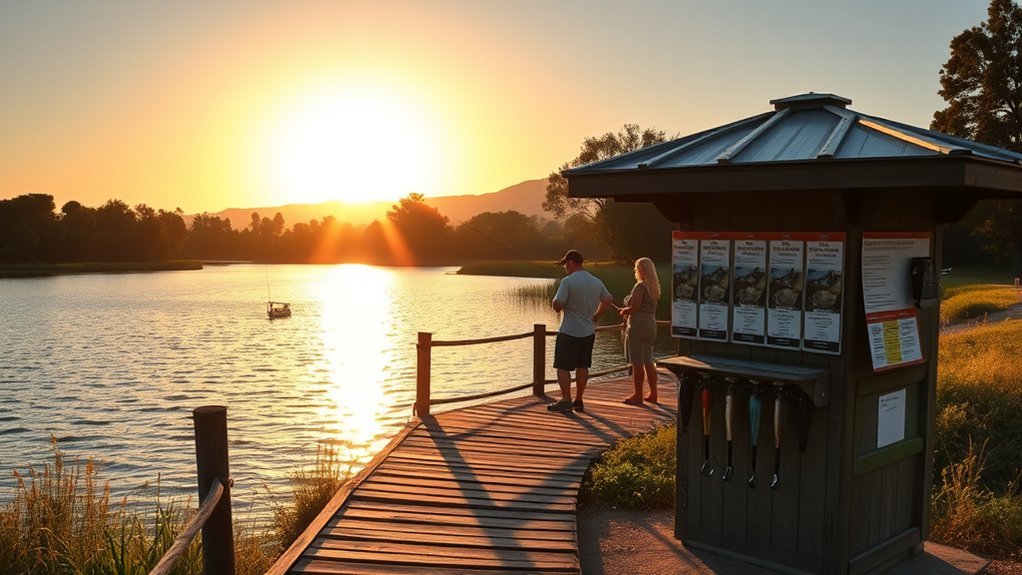
California offers alpine lakes, reservoirs, rivers, bays, public piers, beaches, and offshore fishing. Use the CDFW Fishing Guide to find regulations, fish-planting locations, boat launches, marine protected areas, and license agents.
- Lake Tahoe: Anglers target trout and kokanee in a large interstate lake. Check the rules for the exact side of the lake, launch requirements, and any boat-inspection rules before arriving.
- San Francisco Bay: The bay supports opportunities for species such as striped bass and California halibut. Public-pier, shore, and boat rules differ, and local gear, daylight, size, and measuring-device requirements may apply.
- Mammoth Lakes and the Eastern Sierra: Lakes and streams are popular for trout fishing, but seasons, bait rules, special regulations, and stocking schedules vary by water.
Do not assume that live bait is legal everywhere. Check the current rules for the specific lake, stream, bay, or ocean area before carrying or using bait.
Essential Fishing Equipment for California Anglers
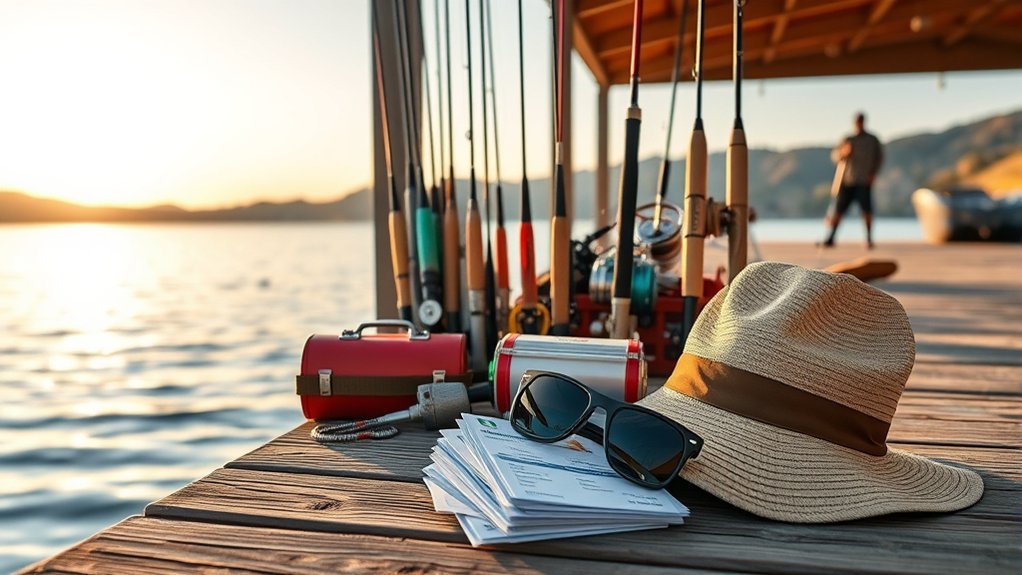
The right gear depends on the species and water, but a basic California fishing checklist should include more than a rod and reel.
- License and required documents: Carry your license or eligible digital display, plus every required physical report card.
- Rod, reel, line, hooks, and legal tackle: Match the setup to the target species and local gear restrictions.
- Measuring device: Use an accurate ruler or gauge when the species has a size limit.
- Tackle storage: Keep hooks, weights, lures, leaders, and tools organized and secured.
- Landing and release tools: Pliers, a dehooker, an appropriate net, and wet hands can help reduce handling time.
- Catch storage: Bring a clean cooler and ice when you plan to keep legal fish.
- Safety gear: Wear a properly fitted personal flotation device when boating or when conditions call for one. Carry sun protection, drinking water, weather-appropriate clothing, and a first-aid kit.
Pro Tip: Save the current regulations to your phone before traveling to a remote area, but also check for posted closures or emergency notices when you arrive.
Frequently Asked Questions
Can I fish without a license in California?
Yes, in limited situations. Anglers under 16, people fishing from a qualifying public pier in ocean or bay waters, and anyone fishing on an official Free Fishing Day may fish without a sport fishing license. All other applicable regulations and report-card requirements still apply.
Is a California fishing license valid for saltwater and freshwater?
Yes. A California sport fishing license generally covers both inland and ocean fishing, but additional validations, report cards, marine protected area rules, and species-specific regulations may apply.
How long is a California 365-day fishing license valid?
It is valid for 365 days from the purchase date. Report cards may follow separate seasons and reporting periods, so their validity does not necessarily match the license.
What should I do if I lose my fishing license?
Check whether the license is available in the CDFW License App. If you need a duplicate, purchase one online, from an authorized license agent, or at a CDFW office. The 2026 duplicate sport fishing license fee is $14.30.
Are there fishing license discounts for seniors or veterans?
Yes, but eligibility is limited. Qualifying disabled veterans and recovering service members can receive reduced-fee licenses. California residents age 65 or older who receive SSI or CAPI may qualify for the low-income senior license. Documentation and preapproval may be required.
Can I use my California fishing license in another state?
Generally, no. A California license authorizes fishing in California. Buy the required license for the state where you will fish. A narrow exception applies on specified Colorado River waters, where California law recognizes a valid Arizona or California sport fishing license; always check the current border-water rules before fishing.
Do children and public-pier anglers need report cards?
Yes, when targeting a species that requires a report card. The report-card rule applies even when the angler is under 16, is fishing from a qualifying public pier, or is fishing on a Free Fishing Day.
Can I show my California fishing license on my phone?
Eligible licenses and validations can be displayed through the official CDFW License App. Physical fishing report cards must still be carried when required; an app display or proof of purchase does not replace the card.
Conclusion
For 2026, California’s standard 365-day sport fishing license costs $64.54 for residents and $174.14 for nonresidents. Short-term, lifetime, reduced-fee, and free options can lower the cost for the right angler, but validations and report cards may still be required. Before each trip, confirm your license dates, target-species rules, location restrictions, and current CDFW updates.
Sources
- California Department of Fish and Wildlife: Sport Fishing Licenses and Report Cards — 2026 license, validation, report-card, lifetime, duplicate, and reduced-fee amounts.
- California Department of Fish and Wildlife: Free Fishing Days — 2026 dates and rules that remain in effect.
- California Department of Fish and Wildlife: California Beach Fishing — public-pier definition, pier map, and license exemption limits.
- California Department of Fish and Wildlife: Fishing and Hunting Regulations — current freshwater and ocean regulation resources.
- California Department of Fish and Wildlife: CDFW License App — electronically displayable licenses and the physical report-card requirement.
- California Department of Fish and Wildlife: Fishing Guide — fishing locations, regulations, planting information, launches, and marine protected areas.

Stay organized with a durable 1-subject notebook set designed for school, note-taking, and digital study support. The college ruled pages resist ink bleed, tear out cleanly, and work with the Five Star Study App to create flashcards and sync notes to Google Drive. Tough pockets, a water-resistant cover, and Spiral Lock wire help protect your work throughout the year.

This Ultra PRO bundle provides layered protection for standard trading cards with clear rigid toploaders and soft inner sleeves. It helps guard against bending, scratches, and dust while keeping cards visible for display, storage, shipping, and everyday handling. Ideal for collectors who want a reliable way to protect and organize valuable cards.

This hardcover cookbook offers fast, approachable recipes designed for busy days and low-energy nights. Caroline Chambers focuses on simple, flavorful meals that help you get dinner on the table without overthinking it. It's a practical pick for home cooks who want quick weeknight inspiration and minimal-fuss cooking.
