
Saltwater fishing license costs vary by state, license term, age, and residency. This guide compares Rhode Island’s Recreational Saltwater Fishing License with North Carolina’s Coastal Recreational Fishing License (CRFL), explains who needs each license, and covers short-term, annual, lifetime, exemption, purchase, and compliance rules.
Quick Answer
Saltwater fishing license prices depend on the state. In Rhode Island, an annual license costs $7 for residents and $10 for nonresidents, while a seven-day license costs $5. In North Carolina, annual coastal licenses cost $19/$38, ten-day licenses $8/$14, and adult lifetime licenses $315/$630.
Key Takeaways
- Rhode Island annual licenses expire on December 31; North Carolina annual CRFLs normally last 12 months from purchase.
- Rhode Island offers a $5 seven-day license but no lifetime recreational saltwater license.
- North Carolina offers 10-day, annual, and lifetime coastal licenses, with lower-cost resident senior and disability options.
- A license does not replace species seasons, size limits, possession limits, gear rules, or harvest-reporting duties.
- Always confirm the state and water classification before buying because coastal, joint, inland, shellfish, and commercial-gear rules differ.
At a Glance
| Rhode Island Annual | $7 resident; $10 nonresident; expires December 31 |
| Rhode Island Short-Term | $5 for seven days; same base price for residents and nonresidents |
| North Carolina Annual | $19 resident; $38 nonresident; normally valid 12 months from purchase |
| North Carolina Short-Term/Lifetime | 10-day: $8 resident or $14 nonresident; adult lifetime: $315 resident or $630 nonresident |
Rhode Island Saltwater License Requirements and Types
Rhode Island generally requires saltwater anglers and spearfishers to hold one of the following: a Rhode Island Recreational Saltwater Fishing License, a National Saltwater Angler Registry registration, or a recreational saltwater license from a reciprocal state. Rhode Island recognizes licenses from New York, Connecticut, Massachusetts, and Maine. See the Rhode Island Department of Environmental Management license guide for the official rules.
The Rhode Island annual license costs $7 for residents and $10 for nonresidents. A temporary license costs $5 and remains valid for seven days after activation. Annual licenses expire on December 31, so a license bought late in the year does not run for a full 12 months.
Rhode Island residents age 65 or older and qualifying active military personnel can obtain a no-fee license. Other exemptions may apply to anglers under 16, passengers actively fishing on properly licensed party or charter boats, anglers on leave from active military duty, and people who are blind or permanently disabled.
Note: A non-fishing passenger does not need a Rhode Island recreational saltwater license, but the exemption ends if that person begins angling or spearfishing.
North Carolina Annual Coastal Fishing Licenses

North Carolina requires most people age 16 or older to hold a Coastal Recreational Fishing License when recreationally taking finfish in coastal waters. In joint waters, either a CRFL or a Wildlife Resources Commission inland fishing license may satisfy the fishing-license requirement. A CRFL does not authorize fishing in inland waters.
The standard annual CRFL costs $19 for residents and $38 for nonresidents. Unless a license description says otherwise, an annual North Carolina license is valid for 12 months from the purchase date. The official North Carolina recreational fishing license page lists current fees and privileges.
North Carolina residents who want broader coverage can consider a Unified Inland/Coastal Recreational Fishing License, which covers inland, coastal, and joint waters. A Unified Sportsman/Coastal license adds hunting privileges, although separate stamps or permits may still be required for some activities.
A coastal fishing license gives you legal access to fish; it does not guarantee that every species, season, location, or fishing method is open.
Products Worth Considering

North Carolina Pride: Showcase your love for North Carolina with this eye-catching License Plate Magnet, featuring the state's iconic design.
NORTH CAROLINA STATE FLAG DESIGN: Features a textured, raised North Carolina flag design for an authentic, high-end look and feel.
North Carolina Lifetime Coastal Fishing Licenses
North Carolina offers Coastal Recreational Fishing Lifetime Licenses for anglers who expect to fish the state’s coastal and joint waters for many years. The standard adult lifetime license, for ages 12 and older, costs $315 for residents and $630 for nonresidents.
Other lifetime CRFL prices include:
- Youth, ages 1–11: $189 for residents or nonresidents.
- Infant, under age 1: $126 for residents or nonresidents.
- Resident senior: $19, subject to North Carolina’s birth-date and age rules.
- Resident disabled veteran: $14 for a veteran rated at least 50% disabled by the U.S. Department of Veterans Affairs.
- Resident totally disabled: $14 when the applicant meets the state’s qualifying disability standard.
Residents born on or before August 1, 1953, become eligible for the senior lifetime license at age 65. Residents born after that date generally become eligible at age 70. A coastal-only lifetime license does not cover inland waters; anglers who need statewide fishing privileges should compare it with the Unified Inland/Coastal lifetime license.
Pro Tip: Compare the lifetime price with your expected years of fishing and the waters you use. A coastal-only lifetime license may not be the best value if you regularly fish North Carolina lakes and inland rivers.
Products Worth Considering

Item Package Dimension: 12.20L x 6.25W x 0.47H inches

Us & Canada Standard Sizes: The license plate frame measures 12.2 x 6.3 inches and fits standard US and Canadian license plate frames.

PICNIC COOLER BAG - The Zuma Backpack Cooler is an insulated picnic cooler backpack ideal for picnic lunches, days at the beach, hiking and mountain biking, or for a school tote
Short-Term Saltwater Fishing Licenses
Short-term licenses are useful for vacations, weekend trips, and occasional fishing, but Rhode Island and North Carolina use different terms and prices.
- Rhode Island: A seven-day recreational saltwater license costs $5 for either a resident or nonresident. It expires seven days after activation.
- North Carolina: A 10-day CRFL costs $8 for a resident and $14 for a nonresident. It authorizes fishing in coastal and joint waters, not inland waters.
North Carolina also allows eligible private-vessel owners or operators to buy a $150 block containing ten separate 10-day licenses. The boat must be at least 23 feet long and registered in North Carolina or documented with the U.S. Coast Guard. These licenses are tied to the approved vessel and cannot be used for for-hire fishing.
Warning: Do not assume a short-term license lasts the same number of days in every state. Rhode Island uses seven days; North Carolina uses ten days.
Products Worth Considering

A-One-Of-A-Kind-Collectible – Be the first to own an exceptionally durable, fade resistant 12" x 6" car frame. Expertly made, using heavy-duty chrome which ensures your frame can survive the different seasons and extreme weather.

[Compliance] This license plate is a decorative craft item, not a real license plate. It is for interior decoration only and is prohibited from being installed on vehicles. Please comply with US laws and state regulations.
Decorative Item Only: This product is a vintage-style decorative license plate, crafted as a replica/artifact. It is NOT a real license plate and cannot be used as such. Please comply with all applicable laws—it must NOT be mounted on any vehicle to replace, cover, or imitate an official license plate. Use only for indoor or outdoor decoration where legally permitted.
Other Recreational Licenses and Exemptions
A standard finfish license does not cover every coastal activity. Shellfish, lobster, crab, commercial gear, charter fishing, and organized events may use separate rules.
Rhode Island Related Licenses and Exemptions
- Under age 16: No recreational saltwater finfish license is required.
- Licensed party or charter boat: Anglers fishing as customers on a properly licensed vessel do not need an individual Rhode Island saltwater license.
- Reciprocal license or federal registration: A recognized reciprocal-state license, National Saltwater Angler Registry registration, or qualifying Highly Migratory Species permit may satisfy the requirement.
- Non-angling gear: Rhode Island does not require the recreational saltwater finfish license for certain non-angling methods such as recreational cast nets, minnow traps, dip nets, umbrella nets, seines, or eel pots, although separate gear and species rules still apply.
- Spearfishing: Spearfishers do need qualifying saltwater authorization in Rhode Island.
- Blue crabs: Rhode Island residents may harvest blue crabs recreationally without a license; nonresidents may not harvest them.
- Horseshoe crabs: Harvest is limited to residents and requires a separate license.
- Lobster: Rhode Island residents need a separate recreational lobster pot or diver license.
- Shellfish: Residents generally do not need a recreational shellfish license, while nonresidents need the applicable nonresident shellfish license.
North Carolina Related Licenses and Exemptions
- Under age 16: No CRFL is required to recreationally take finfish in coastal waters.
- Piers and for-hire boats: An individual license may not be required when the pier or for-hire operator holds the correct blanket license. Confirm coverage before fishing.
- Private boats: A boat owner’s individual CRFL does not cover other anglers aboard. Each person age 16 or older needs a license unless another exemption or vessel license applies.
- Shellfish and crabs: A CRFL is for finfish. It is not required solely to harvest oysters, clams, or crabs recreationally, although other rules may apply.
- Spears, gigs, and nets: A CRFL is generally required when these methods are used to take finfish recreationally.
- Commercial fishermen: A commercial license does not replace the CRFL when the person is fishing recreationally for finfish.
- Subsistence waiver: Qualifying North Carolina residents receiving certain public benefits may obtain a license waiver through their county Department of Social Services.
- Older lifetime licenses: Some people who bought a qualifying WRC Lifetime Sportsman or Lifetime Comprehensive fishing license before January 1, 2006, are exempt from buying a separate CRFL.
Where to Buy a Saltwater Fishing License
Rhode Island Purchase Options
Buy a Rhode Island recreational saltwater license through the Rhode Island Outdoors online licensing system or from a participating state vendor, including selected bait and tackle shops. Keep a digital or printed copy available while fishing.
North Carolina Online Purchase Options
North Carolina CRFLs can be purchased through the Go Outdoors North Carolina licensing system. Online purchasing gives you immediate account access and a record of the license tied to your WRC customer profile.
North Carolina In-Person Vendors
Most CRFLs are also sold by Wildlife Resources Commission license agents and at many Division of Marine Fisheries offices. Blanket licenses have more limited purchase channels, so contact a DMF office before traveling.
North Carolina Phone Purchases
You can buy many North Carolina licenses by calling Wildlife Resources Commission customer service at 888-248-6834, Monday through Friday from 8 a.m. to 5 p.m. Have your identity details and payment method ready.
Special Permits, Events, and Tournament Licenses
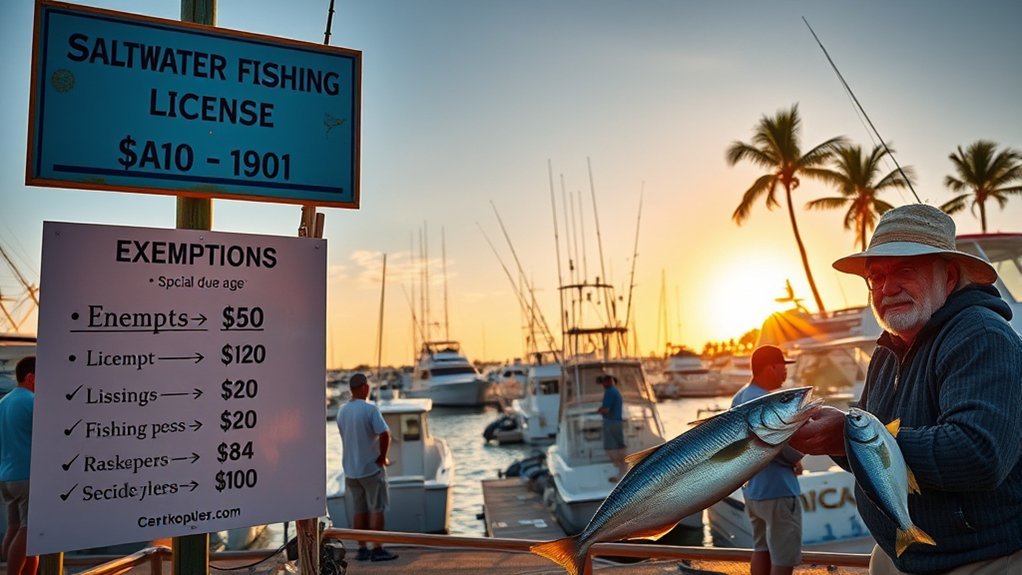
North Carolina may issue a Coastal Recreational Fishing License Exemption Permit for an organized fishing event in coastal or joint waters. The organizer must submit all required information in writing at least 30 days before the event. Fish taken under the exemption remain recreational catch and cannot be sold.
A recreational tournament that plans to sell fish caught during the event needs a Recreational Fishing Tournament License to Sell Fish. Conservation, education, youth, and community events should contact the Division of Marine Fisheries early because the correct permit depends on the event structure, participants, water classification, gear, and intended use of the catch.
Note: A license exemption for participants does not waive species seasons, size limits, possession limits, prohibited-gear rules, or reporting requirements.
How to Choose and Apply for the Right License
- Identify the state: License fees and exemptions are state-specific. A North Carolina CRFL is not a substitute for a Rhode Island license.
- Confirm the water type: In North Carolina, check whether the location is classified as inland, coastal, or joint water. In Rhode Island, confirm that you are fishing marine rather than freshwater areas.
- Confirm the activity: Decide whether you will target finfish, shellfish, crabs, lobster, or another species and whether you will use hook and line, a spear, a net, traps, or commercial-style gear.
- Check exemptions: Review age, military, disability, reciprocal-license, charter, pier, blanket-license, and older lifetime-license rules.
- Choose the term: Compare short-term, annual, lifetime, and unified licenses based on trip length and the waters you fish.
- Buy through an authorized channel: Use the official online portal, an approved license agent, a state office, or the authorized phone service.
- Save proof: Keep your license or customer record available and note the activation and expiration dates.
- Check current fishing rules: Review species seasons, minimum sizes, possession limits, gear rules, closures, and harvest-reporting requirements before each trip.
Fishing Regulations and Compliance
Licenses only establish your authority to fish. You must still follow current seasons, minimum and maximum sizes, daily possession limits, vessel limits, area closures, protected-species rules, and gear restrictions.
Rhode Island anglers should review the state’s marine minimum sizes and possession limits before fishing. Rules can change during the season, so do not rely on an old printed chart.
North Carolina anglers should check the current recreational size and bag limits. Beginning December 1, 2025, all recreational anglers in North Carolina must report harvest of red drum, spotted seatrout, striped bass, weakfish, and flounder to the Division of Marine Fisheries at the end of the trip. The official mandatory harvest-reporting guide explains electronic and paper reporting.
Finfish taken under a North Carolina CRFL are for personal consumption and cannot be sold. The license also cannot be assigned, loaned, or transferred. Rhode Island and North Carolina both require commercial or tournament authorization when catch is sold.
Warning: Fishing without the required license or violating size, season, possession, reporting, or gear rules can lead to enforcement action. Check the official state rules immediately before your trip.
Frequently Asked Questions
Can I fish without a license in an emergency?
Do not assume an emergency creates a fishing-license exemption. License exemptions are defined by state law and agency rules. Contact the state fish and wildlife or marine fisheries agency if an unusual survival, rescue, or public-safety situation is involved.
Are there penalties for fishing without a license?
Yes. Fishing without required authorization is unlawful and may result in a citation, fines, license action, or other penalties under the applicable state law. The exact consequence depends on the violation and jurisdiction.
How do I renew my saltwater fishing license?
Renew through the same official state portal or an authorized agent. Rhode Island annual licenses expire on December 31. North Carolina annual CRFLs normally expire 12 months after purchase, so check the date shown in your account or on the license.
Can I transfer my fishing license to someone else?
No. An individual license is issued to the named holder and generally cannot be sold, loaned, assigned, or transferred. Each angler who is not exempt needs the correct authorization.
What should I do if I lose my fishing license?
Sign in to your official licensing account to view or reprint your record, or contact an authorized agent. North Carolina law allows a lost or destroyed license to be replaced after a proper application and a $5 replacement fee.
Do I need a license to fish from shore or a pier?
Usually yes when you are age 16 or older and taking finfish in licensed coastal waters. In North Carolina, a public pier may cover anglers through a blanket license. Confirm the pier’s status before relying on that exemption.
Does a saltwater fishing license cover shellfish and crabs?
Not always. North Carolina’s CRFL applies to recreational finfish, not solely to oysters, clams, or crabs. Rhode Island uses separate rules for shellfish, lobster, blue crabs, and horseshoe crabs, including residency limits and separate licenses for some activities.
Conclusion
Saltwater fishing license costs depend on where, how, and how long you plan to fish. Rhode Island offers low-cost annual and seven-day authorization, while North Carolina offers 10-day, annual, lifetime, unified, and special-license choices. Confirm your water type and activity, buy through an official channel, and check current species and reporting rules before every trip.
Sources
- Rhode Island DEM — Recreational Saltwater Fishing Licenses — Rhode Island fees, exemptions, reciprocity, validity, and covered waters.
- Rhode Island DEM — Recreational Fishing — finfish, shellfish, lobster, blue crab, and horseshoe crab licensing rules.
- North Carolina DEQ — Recreational Fishing Licenses — current annual, lifetime, short-term, unified, disability, and special-license fees.
- North Carolina DEQ — Purchase a CRFL — water classifications and online, phone, and in-person purchase methods.
- North Carolina DEQ — Recreational License FAQs — exemptions, blanket licenses, gear, transfers, replacement licenses, and personal-use rules.
- North Carolina DEQ — Mandatory Harvest Reporting — reporting requirements effective December 1, 2025.
