
If you’re a nonresident angler, you’ll need a California sportfishing license: an annual nonresident license costs $169.82 (valid through Dec 31), or you can buy short-term options—one day $20.52, two days $31.58, or a ten-day $62.90—with short-term licenses exempt from the Ocean Enhancement Validation. Targeted species may require extra validations or report cards (e.g., salmon, sturgeon, spiny lobster) with mandatory reporting and deadlines, and more details follow if you want specifics.
Who Must Buy a California Sportfishing License
If you’re 16 or older and plan to take fish or other aquatic life in California, you must hold a sportfishing license—residency doesn’t matter. You’ll need to meet clear license requirements: any individual aged 16+ must purchase a California sportfishing license before harvesting aquatic life, while anglers under 16 are exempt though they may need species-specific report cards.
Policy data shows fee options scaling from short-term to annual access, but those details belong to the fee section. Note an important regulatory exception: fishing from public ocean piers doesn’t require a license for anyone, including non-residents, which alters enforcement priorities at pier sites.
From a compliance perspective, you should view license requirements and fishing regulations as primary control measures for resource management and data collection. Practically, you’ll be accountable for following season, bag, and gear rules regardless of license duration, and failure to comply can trigger citations intended to sustain stock assessments and conservation objectives.
Annual Nonresident Sportfishing License Fees and What They Cover

Having established who must hold a California sportfishing license, you should next consider the fee structure for nonresidents: the Annual Nonresident Sportfishing License costs $169.82 for individuals 16 and older and grants permission to take fish, mollusks, crustaceans, amphibians, and reptiles from the purchase date through December 31, subject to all state seasons, bag limits, and gear rules.
You’ll assess license coverage quantitatively: one fee provides year-long access within the specified taxa but not unlimited take. Policy-wise, the license functions as baseline authorization; additional validations or report cards may be required for targeted species and carry separate fees, increasing total compliance costs.
You must still follow fishing regulations enacted to manage stocks—closed seasons, area restrictions, and bag limits remain enforceable. For budgeting and regulatory planning, compare the $169.82 base cost plus probable species-specific add-ons against trip frequency and management obligations to determine whether the annual license aligns with your compliance and conservation objectives.
Short-Term Licenses: One-, Two-, and Ten-Day Options

You’ll compare the one- and two-day rates — $20.52 for a single specified day and $31.58 for two consecutive days — against the ten-day nonresident option at $62.90 to assess short-term cost-efficiency.
Consider that all short-term licenses waive the Ocean Enhancement Validation, reducing administrative barriers for visitors.
Also note that non-residents 16 and older must hold one of these licenses to fish legally in California waters.
Products Worth Considering

【Auto Parts Material】: Made of stainless steel, the design style is fashionable and the appearance is more beautiful, which is very suitable for decorating the front and rear of the car license plate. Make your car more attractive and recognizable, and make your car more distinctive.

【Material】Our License Plate Frame Is Made Of Stainless Steel, Strong And Durable.

Material:License Plate made of Stainless steel. Non-blocking and street legal, that won't block the upper and lower status and year labels, never having to worry about getting a ticket and wasting time
One- and Two-Day Rates
While non-residents can buy short-term sport fishing permits for single or consecutive two-day use, these options are priced distinctly and carry specific possession and validation rules.
You’d pay $20.52 for a one-day license, which provides clear one day advantages if your trip is brief and cost-sensitive. The two-day license costs $31.58, offering two day benefits by lowering per-day cost for short stays.
Both permits exempt you from the Ocean Enhancement Validation, simplifying compliance. Policy requires immediate possession of the short-term permit while fishing and limits activity strictly to the purchased duration—one calendar day or two consecutive days.
Use this data to choose the option that minimizes cost per day while meeting your trip timing and regulatory obligations.
Ten-Day Nonresident Option
If the one- and two-day permits don’t match your itinerary, consider the Ten-Day Nonresident Sport Fishing License: at $62.90 it covers ten consecutive days for non-residents aged 16 and older and carries the same fishing privileges as a resident while still exempting you from the Ocean Enhancement Validation.
You’ll get ten day benefits that balance cost-efficiency and regulatory parity without long-term commitment. Policy-wise, this short-term option reduces administrative overhead for transient anglers and aligns access with resident-equivalent catch limits.
You must comply with all California fishing regulations during the period. Operational considerations include purchase timing, validation carry, and enforcement awareness.
- Cost per day: $6.29
- Eligibility: non-residents 16+
- No Ocean Enhancement Validation required
- Subject to standard fishing regulations
Required Validations and Report Cards for Specific Species

Because certain species and areas carry extra regulatory requirements, non-resident anglers must secure specific report cards and validations in addition to any fishing license: you’ll need to follow clear report card requirements and species regulations tied to target gear and location.
If you fish salmon in designated North Coast river systems, buy the North Coast Salmon Report Card ($8.90). Targeting sturgeon requires a Sturgeon Fishing Report Card; it’s free when you’re strictly catch-and-release, but mandatory regardless.
Harvesting spiny lobster mandates a Spiny Lobster Report Card; failing to return it by the specified deadline triggers a non-return fee, so track submission dates. Fishing ocean waters south of Point Arguello requires an Ocean Enhancement Validation ($7.05).
Note that these document requirements apply even in cases where a general fishing license isn’t required, and return deadlines vary by species. For compliance, you should budget for these ancillary fees, record deadlines, and confirm species-specific obligations before you fish.
Reduced-Fee and Free Licenses for Eligible Visitors
When budgeting for a California non-resident sport fishing trip, note that the standard one-year license costs $169.82. However, the state offers targeted reduced-fee and free licenses for qualifying visitors to improve access and equity.
Reduced-fee options—commonly about $10.29—cover groups like disabled veterans and low-income seniors, while free licenses are reserved for specific populations such as low-income Native Americans and people with certified mobility impairments.
You’ll want to assess eligibility and document requirements before applying to minimize delays. Policy design prioritizes equity by lowering financial barriers for vulnerable populations while preserving revenue from standard fees.
- Verify reduced fee eligibility with qualifying documentation.
- Prepare free license documentation (disability certification or low-income verification).
- Use the prescribed application PDFs to guarantee completeness.
- Expect administrative verification by the issuing agency.
You should treat these provisions as targeted exemptions: data show they modestly shift cost burden without compromising conservation funding.
Where and How to Purchase a Nonresident License
After confirming eligibility for reduced-fee or free licenses, you’ll need to decide where and how to purchase your nonresident sport fishing license to guarantee timely compliance and receipt.
Evaluate license purchase methods by comparing speed, cost, and transaction requirements. Online purchases via the California Department of Fish and Wildlife (CDFW) site provide immediate printing and are ideal for last-minute arrivals. Phone assistance is available through CDFW’s authorized agent at (800) 565-1458 if you need guided processing.
If you prefer in-person transactions, authorized license agents—sporting goods stores and bait shops—sell nonresident licenses across California.
CDFW license sales offices also handle purchases but don’t accept cash; you’ll need debit/credit, check, or money order.
Match fishing license options to trip length: annual ($169.82), ten-day ($62.90), or two-day ($31.58).
Use this data-driven approach to select the method and option that minimizes compliance risk and administrative delay.
Products Worth Considering

PREMIUM QUALITY: Crafted from high-grade materials, our License Plate is built to withstand the elements and maintain its vibrant appearance over time. It is resistant to fading, cracking, and peeling, ensuring long-lasting performance.

CUSTOMIZE NOW – Select te finish, choose the size and add your personalized text. NOT embossed

USA, License, plate, Vintage, tag, lot, set, plates, number, wall, decor, art, bar, restaurant, design, gift, cool, nice, american, america, hawaii, alaska, california, texas
Lifetime Fishing License Options for Nonresidents and Residents

You’ll compare lifetime price tiers that range from $691.75 to $1,131.75 depending on residency and age cohort to assess cost-effectiveness.
Focus on age-based costs—0–9 and 62+ at $691.75, 40–61 at $1,019.50, and residents 10–39 (and nonresidents) at $1,131.75—to model long-term savings versus annual fees.
Also quantify what’s included, since the lifetime license grants statewide fishing privileges and the $467.25 fishing privilege package adds required validations and report cards.
Lifetime Price Tiers
Although lifetime fishing licenses eliminate annual renewals and often offer long-term savings for frequent anglers, California limits those lifetime options to residents only — so nonresidents can’t legally purchase them despite published tiered pricing examples.
You should treat the published nonresident figures as illustrative rather than actionable when doing a lifetime benefits cost comparison.
- Nonresident 10–39 tier: $1,131.75 — highest published rate.
- Nonresident 40–61 tier: $1,019.50 — lower, reflects age-based pricing.
- Nonresident 62+ tier: $691.75 — aligns with resident 62+ pricing.
- Policy implication: published tiers inform revenue modeling but don’t confer purchase rights.
This data-driven view helps you evaluate fiscal impacts and equity considerations in license policy.
Age-Based Costs
One useful way to compare lifetime fishing license options is to look at age bands and their price points, since pricing both reflects actuarial assumptions and shapes who benefits from a lifetime purchase.
You’ll note clear tiers: ages 0–9 and 62+ are priced identically at $691.75, ages 10–39 at $1,131.75, and ages 40–61 at $1,019.50.
This structure reveals policy choices about who receives discounts and how age limitations influence cost recovery and equity.
If you’re evaluating fiscal impacts, younger and older cohorts subsidize lifetime access at lower upfront costs, while prime-age adults pay higher rates reflecting longer expected use.
Comparing these figures helps you weigh short-term affordability against long-term license benefits and agency revenue stability.
What’s Included
Having examined age-based pricing, it helps to look at what lifetime licenses actually cover so you can compare value across cohorts and residency status.
You’ll see uniformity: nonresidents and residents access the same lifetime fee bands ($1,131.75 for ages 10–39; $1,019.50 for 40–61; $691.75 for 62+), so Fishing License Benefits hinge on longevity versus the $169.82 annual nonresident sport license.
A separate Fishing Privilege Package ($467.25) bundles validations and report cards for either group.
- Lifetime license: unlimited annual access tied to age band.
- Privilege package: required validations and harvest reporting.
- Annual alternative: lower upfront, recurring cost.
- Regulatory parity: Visitor Regulations and residency don’t change entitlement.
How to Report Your Catch Online and Deadline Rules
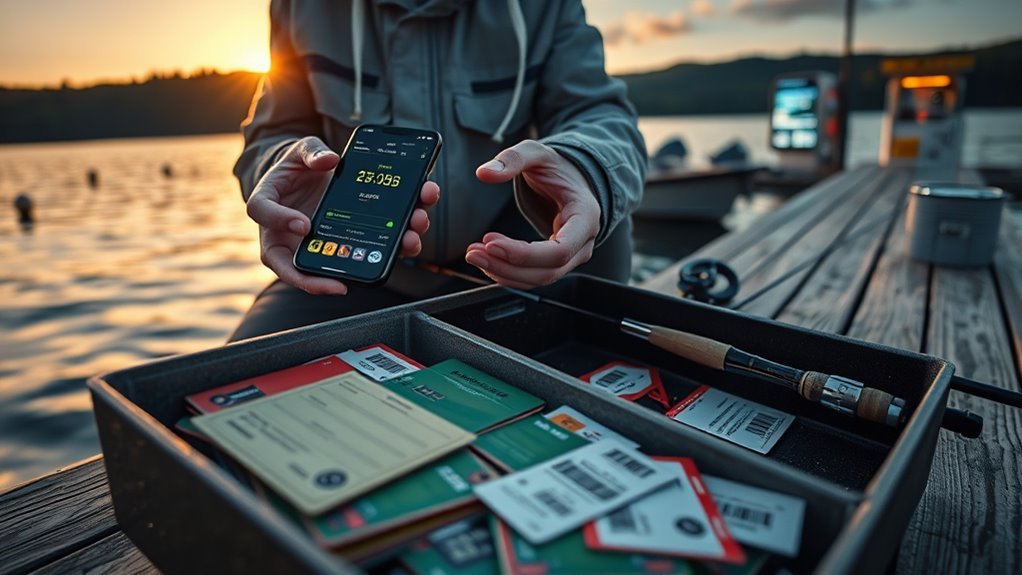
When you fish species that require reporting—such as sturgeon or spiny lobster—you must submit your catch data through the CDFW Online License Service by the stated deadlines to remain in adherence.
You’ll follow reporting guidelines that mandate catch submission for specified species, and you must complete a report even if you don’t hold a fishing license. For spiny lobster, the system requires reports by January 31 and April 30; missing these dates triggers a late-report fee. The policy treats each angler as individually responsible, so group reporting isn’t acceptable.
Use the CDFW Online License Service portal to enter species, number, date, and location; the platform timestamps submissions and enforces deadlines.
From a regulatory perspective, timely, accurate electronic entries reduce enforcement actions and improve stock assessments. If you submit late, expect administrative penalties and potential fees.
Track deadlines on CDFW notices, keep digital confirmations, and confirm successful uploads to maintain compliance with reporting requirements.
Rules for Fishing From Public Piers and License Exemptions
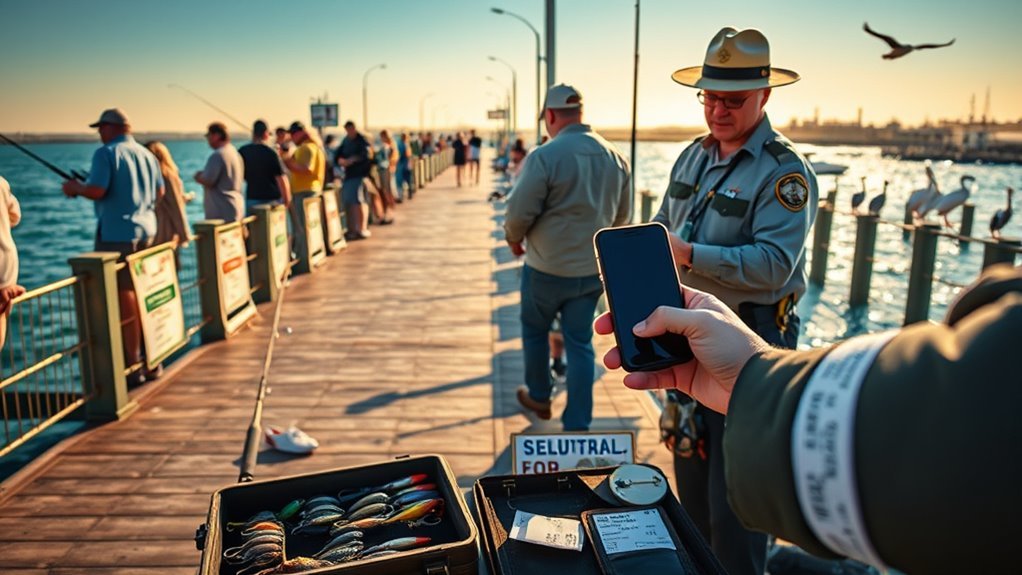
When evaluating non-resident costs, you should account for the public pier license exemption, which allows fishing in ocean waters without buying a license.
Public piers must offer unrestricted access and be specifically designated for angling to qualify, so verify designation status before assuming exemption.
Even exempt anglers — including children under 16 — must follow statutory rules like bag and size limits to stay compliant and protect stocks.
Public Pier License Exemption
Although public piers and publicly owned jetties or breakwaters provide anglers with license-free access to ocean fishing, the exemption applies only where access is truly unrestricted and the structure is designated for angling; you should still follow all applicable bag limits, size restrictions, and other regulatory measures, and note that anglers under 16 remain exempt from licensing regardless of location.
You’ll appreciate the public pier benefits and increased fishing accessibility, but policy compliance matters: exemptions reduce administrative barriers yet don’t waive conservation rules. Data shows cost-free access concentrates effort on these sites, so managers monitor catch composition and compliance rates.
When evaluating exemptions, consider enforcement capacity, ecological impact, user equity, and signage clarity to guarantee objectives are met.
Definition of Public Piers
Public piers are defined as publicly accessible structures specifically intended for angling—typically piers, publicly owned jetties, or breakwaters on ocean or bay waters—where access is truly unrestricted and no fishing license is required. You should treat public pier access as a narrow, statute-based exemption: it’s limited to ocean/bay locations and facilities intended for fishing. Policy-wise, you don’t need a license at these sites, but you must comply with fishing regulations (bag/size limits, seasons). Publicly owned jetties and breakwaters meet the definition. Data-driven enforcement focuses on location, ownership, and intended use. When evaluating access, officials confirm public ownership and unrestricted entry before applying the exemption.
| Feature | Criteria | Implication |
|---|---|---|
| Location | Ocean/bay | Eligible |
| Ownership | Public | Required |
| Use | Angling | Required |
| Access | Unrestricted | Required |
| License | Exempt | Conditional |
Rules Still Apply
Having established which structures qualify as public piers, note that the license exemption doesn’t remove other regulatory obligations: you still must follow species-specific bag and size limits, seasonal closures, and gear restrictions while fishing from these sites.
You should treat public piers access as a conditional waiver of licensing, not a repeal of the fishing regulations overview. Policy enforcement remains data-driven: citations, measured compliance rates, and clear signage reduce violations.
Note exemptions for anglers under 16 and designated free fishing days, but apply all limits and seasons uniformly. For operational clarity, consider these compliance priorities:
- Verify bag and size limits per species before you fish.
- Observe seasonal closures and area-specific restrictions.
- Use permitted gear types and follow tackle rules.
- Respect ownership and access designations for each structure.
Replacing Lost Licenses, Duplicate Copies, and Payment Methods

If you lose or destroy your non‑resident fishing license, you can obtain a replacement online or at CDFW license sales offices for a small fee. Authorized license agents across California can issue duplicate copies to minimize downtime for anglers.
When you submit replacement licenses or duplicate requests, expect standardized processing and a nominal administrative charge; agents and the CDFW maintain records to verify prior purchases. Payment options are checks, money orders, or debit/credit cards (Visa/Mastercard); note that CDFW offices don’t accept cash.
Protecting your license reduces administrative burden: avoid heat lamination that destroys credentials and store cards away from extreme temperatures and sunlight. Discolored cards remain valid provided text and signature are legible, but degraded readability can trigger enforcement issues.
From a policy perspective, the system balances low-cost recovery with secure payment methods and document integrity standards to minimize fraud, guarantee compliance, and keep non‑resident anglers fishing with minimal interruption.
Frequently Asked Questions
Are There Age-Based Discounts for Nonresident Fishing Licenses?
Yes — you’ll find age discounts apply in some jurisdictions; you’ll need to check license eligibility criteria, which specify age brackets, documentation, and fee reductions, so compare published rates and policy tables before applying.
Can Nonresidents Fish on Private Property With a License?
Yes — you can fish on private property if you have permission, but don’t assume universal access; investigate private property regulations, verify landowner consent, and consult local fishing rights clarification and statutes before you fish to avoid penalties.
Do Licenses Cover Charter or Guided Fishing Trips?
Yes — you’ll usually need individual licenses unless specific exemptions exist; review charter fishing regulations and guided trip requirements, verify boat or captain permits, catch limits, and documented exemptions to guarantee compliance with regional policies.
Are Fishing Licenses Refundable or Transferable?
Refunds vary by state—are you aware of the specific refund policy? You’ll find license refunds are rare and tightly regulated, and transferable licenses are generally prohibited; check agency rules, dates, and documented exceptions before purchase.
Is a California License Valid in Federal Waters Beyond State Limits?
No, a California license generally doesn’t cover federal waters beyond state limits; you’ll need to follow federal regulations and applicable permits for fishing boundaries seaward, so check agency rules, quotas, and vessel documentation before fishing.
Conclusion
Think of your fishing license as the key that opens California’s managed fisheries—each fee and validation feeds data streams that shape sustainable policy. You’ll choose between annual, short-term, reduced, or lifetime options based on stay and species, then report catches on time to keep statistics accurate. Keep copies, replace lost credentials, and use approved payments to stay compliant; these small administrative acts translate into measurable conservation outcomes.
