
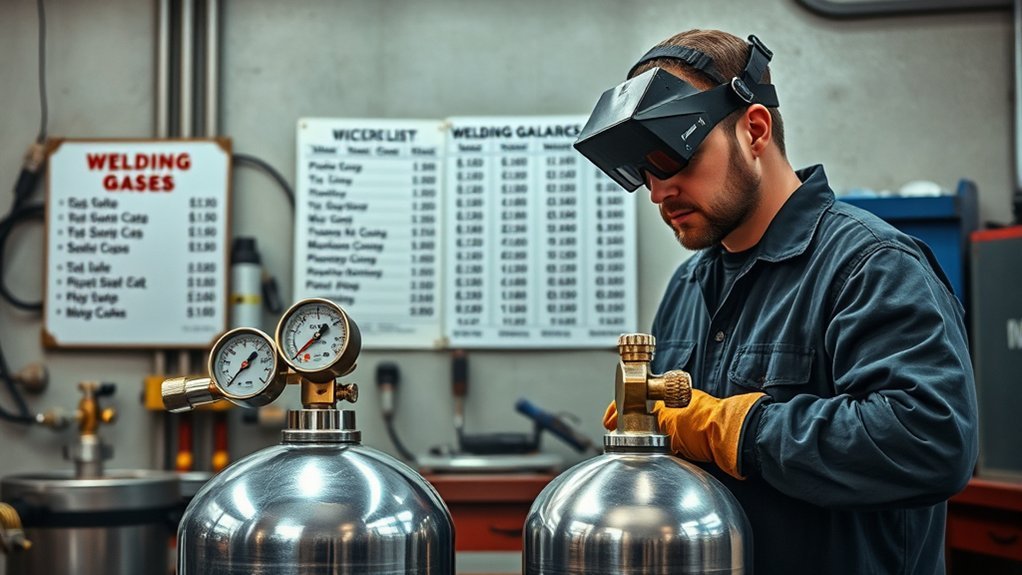
Welding gas costs depend on the gas, cylinder size, ownership arrangement, and local supplier. A full customer-owned 40–125 cubic-foot cylinder may cost roughly $230–$400, while refills or exchanges are commonly much less but vary widely by location. The best way to budget is to compare the total delivered price and estimate how many cubic feet you use per hour.
Quick Answer
Budget about $230–$400 for a full, customer-owned 40–125 CF welding-gas cylinder. A local refill or exchange may cost roughly $50–$120, although gas type, tank size, rental terms, hazmat fees, and regional supply can move the price outside that range. Always request a complete local quote.
Key Takeaways
- Confirm whether a quoted price covers an empty cylinder, a full cylinder, a refill, an exchange, or a rental.
- Larger cylinders usually reduce the cost per cubic foot, but they are heavier and may be harder to transport or exchange.
- Calculate usage from arc-on hours and gas flow instead of assuming a fixed number of refills per year.
- A pressure gauge gives only a rough quantity estimate for argon and argon mixtures; weigh a CO₂ cylinder to estimate the remaining contents.
- Check that a local supplier accepts customer-owned cylinders before buying one online.
Welding Gas Costs at a Glance
| Full 40–125 CF Owner Cylinder | Approximately $230–$400 in current retail and local-market examples |
| Empty 40–125 CF Cylinder | Approximately $110–$175 in sampled online listings, before gas, shipping, or local filling fees |
| Refill or Exchange | Often about $50–$120 for common hobby-size shielding-gas cylinders, but local quotes can fall outside this range |
| Main Extra Costs | Rental, deposit, delivery, hazmat, environmental, cylinder-maintenance, and out-of-test fees |
Note: These are budgeting ranges rather than national fixed prices. Gas suppliers commonly price by branch, customer account, gas grade, cylinder program, and delivery method. Ask for the total price after all fees.
Common Welding Gases and Their Cost Differences
The correct gas depends on the welding process, base metal, filler wire, transfer mode, and required weld quality. Price matters, but using the wrong gas can cause porosity, excess spatter, poor penetration, or an unstable arc.
| Gas | Common Use | Cost Tendency |
|---|---|---|
| 100% argon | TIG welding and MIG welding aluminum | Moderate; widely available in common cylinder sizes |
| 75% argon/25% CO₂ | Short-circuit MIG welding of mild steel | Moderate; commonly called C25 |
| 100% CO₂ | Some MIG and flux-cored steel applications | Often cheaper per unit of gas, but it can produce more spatter and a harsher arc |
| Argon/helium blends | Higher heat input for aluminum, copper, and thicker nonferrous work | Usually more expensive because helium costs more |
| Oxygen and acetylene | Oxy-fuel cutting, heating, brazing, and welding | Requires two cylinders, two regulators, hoses, and additional safety equipment |
Miller’s TIG shielding-gas guidance identifies pure argon as a common choice and notes that the required flow depends on the torch setup and surrounding conditions. For MIG welding, follow the welding-machine manual and the wire manufacturer’s recommended gas specification.
The cheapest gas is not a bargain if it causes rejected welds, excess cleanup, or repeated troubleshooting.

The DEWALT TSTAK Mobile Storage unit delivers a spacious, stackable solution for organizing and transporting tools with ease. Its telescopic handle, durable 7-inch wheels, and bi-material top handle make moving loads more comfortable, while rust-resistant metal latches and side latches support secure stacking with other TSTAK units. Built for convenience and mobility, it is ideal for professionals and DIY users who need dependable on-the-go storage.

BioSilk Hydrating Therapy Pure Moisture Leave-In Spray helps replenish moisture in dry, coarse hair for a softer, smoother feel. This daily styling spray also helps control frizz, boost shine, and improve manageability while supporting hair against environmental stressors. Formulated with silk and maracuja oil, it is suitable for all hair types, including color-treated hair.

OGX Extra Strength Damage Remedy + Coconut Miracle Hair Oil helps hydrate dry, coarse hair while smoothing frizz and flyaways for a silky finish. This nourishing leave-in treatment blends coconut oil, vanilla bean extract, and tiare essence to add softness, shine, and a pleasant scent. It is paraben-free and designed to support a restorative hair care routine for medium to coarse hair types.
Welding Gas Cylinder Purchase Costs
A cylinder price can describe several different products. Before comparing offers, determine whether each price includes the cylinder, gas fill, shipping, certification, valve, and any exchange privileges.
Current Full and Empty Cylinder Price Examples
Current online examples show how strongly the contents and cylinder size affect the advertised price:
- A full 40 CF 100% argon cylinder was listed at about $229.99.
- A full 80 CF C25 cylinder was listed at about $305.99.
- A full 125 CF argon cylinder was listed at about $310.
- Sampled empty steel cylinders were listed near $112.50 for 40 CF, $141.80 for 80 CF, and $171.80 for 125 CF before filling and shipping.
These examples are not guaranteed local prices. Stock status, shipping restrictions, cylinder age, gas mix, taxes, and supplier acceptance can change the final cost.
Choosing the Right Cylinder Size
| Nominal Size | Best For | Main Trade-Off |
|---|---|---|
| 20–40 CF | Occasional repairs, backup gas, or mobile work | Easy to move, but usually the highest refill cost per cubic foot |
| 80 CF | Home shops and moderate hobby use | Good balance of portability and capacity |
| 125 CF | Frequent TIG or MIG work | Better value per fill but heavier and less convenient to transport |
| 250–300 CF | Production shops and high-volume fabrication | Low handling frequency but often available mainly through rental or commercial accounts |
A larger cylinder provides more gas for each supplier transaction. However, the savings only help if you can safely secure, transport, store, and exchange the cylinder.
Ownership, Rental, and Exchange
There are three common cylinder arrangements:
- Customer-owned cylinder: You buy the cylinder and pay for each fill or exchange. This can work well for occasional use, but the supplier may require proof of ownership and an in-date cylinder.
- Rental or lease: The supplier owns and maintains the cylinder. You pay periodic rental plus gas and delivery charges. This is often practical for large cylinders or business use.
- Exchange program: You surrender an accepted empty cylinder and receive a filled cylinder of the same gas and size. You may not receive the same physical cylinder back.
Pro Tip: Call the intended refill supplier before purchasing a cylinder online. Ask whether it accepts customer-owned cylinders of that size, valve type, brand, specification, and requalification date.
Welding Gas Refill and Exchange Costs
There is no single nationwide welding-gas refill price. Suppliers may quote a refill, an exchange, or a delivered cylinder, and each method can include different fees.
How Tank Size Affects Refill Value
Refilling a larger cylinder does not normally cost twice as much as refilling a cylinder with half the capacity. The supplier still performs handling, inspection, filling, and administrative work for each cylinder. As a result, the price per cubic foot often falls as cylinder size increases.
Use this calculation when comparing two quotes:
Cost per cubic foot = total refill or exchange charge ÷ nominal cylinder capacity
For example, a $65 total charge for a 40 CF cylinder equals about $1.63 per cubic foot. A $95 charge for a 125 CF cylinder equals about $0.76 per cubic foot. These figures are examples only, but they show why the larger fill may provide better value.
How Gas Type Affects the Price
Pure CO₂ is often less expensive than argon-rich mixtures, while helium-containing blends can be substantially more expensive. Oxygen and acetylene must be priced separately because oxy-fuel work requires two different gases and cylinders.
When comparing prices, make sure every quote covers the same:
- Gas and mixture percentage.
- Gas grade or purity.
- Cylinder capacity.
- Customer-owned, exchange, or rental arrangement.
- Pickup or delivery method.
- Taxes and added fees.
Regional Pricing and Supplier Fees
Local prices can change because of gas availability, branch overhead, cylinder supply, delivery distance, account volume, and local competition. A price from another state is not meaningful unless the cylinder size, gas, date, and fee structure are identical.
Ask each supplier for the complete out-the-door price and whether it includes:
- Gas charge.
- Cylinder exchange or handling fee.
- Hazmat or environmental fee.
- Delivery or fuel surcharge.
- Rental, lease, or demurrage.
- Tax.
- Requalification or inspection charges.
Estimating Refill Frequency
Refill frequency should be based on actual gas consumption rather than an assumed monthly schedule.
- Estimate your average gas flow in cubic feet per hour.
- Track your monthly arc-on welding time.
- Multiply flow by arc-on hours to estimate monthly gas use.
- Divide annual gas use by the cylinder capacity.
- Add a reserve for pre-flow, post-flow, purging, testing, and minor losses.
Annual gas use = flow rate × annual arc-on hours
Estimated fills per year = annual gas use ÷ usable cylinder capacity
If you weld for 40 arc-on hours per year at 20 CFH, estimated consumption is 800 cubic feet. That is about 20 nominal 40 CF fills, 10 nominal 80 CF fills, or 6.4 nominal 125 CF fills before accounting for reserve gas and losses.
How to Calculate the Real Cost of Welding Gas
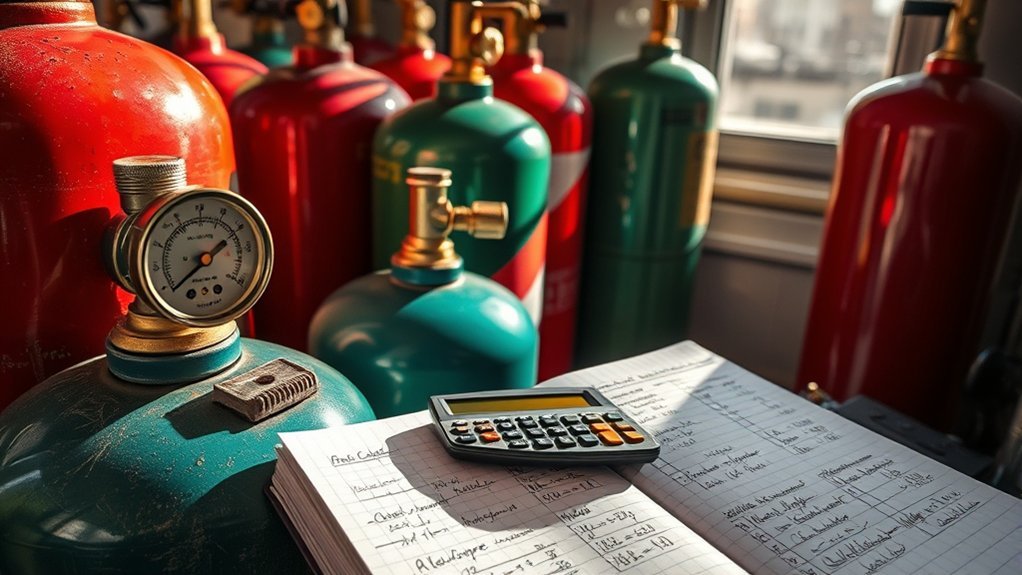
The cylinder purchase price is only one part of the total. A complete first-year estimate includes the cylinder or deposit, every gas refill, supplier fees, and the cost of collecting or receiving the cylinders.
First-year cost = cylinder purchase or rental + annual fills × total cost per fill + delivery and other fees
Recurring annual cost = annual fills × total cost per fill + rental, delivery, and other recurring fees
Worked Cost Example
Assume the following example:
- 125 CF customer-owned cylinder: $310.
- Refill or exchange: $85.
- Added fee per visit: $10.
- Four fills per year.
First year: $310 + 4 × ($85 + $10) = $690.
Later years: 4 × ($85 + $10) = $380, assuming no new cylinder or requalification charge.
Four 125 CF fills provide a nominal 500 cubic feet. The recurring gas-and-fee cost in this example is about $0.76 per nominal cubic foot. The first-year cost is about $1.38 per nominal cubic foot after adding the cylinder.
Note: Nominal cylinder capacity is a planning figure. Actual usable gas can be lower because of temperature, residual pressure, regulator operation, pre-flow, post-flow, purging, and leaks.
Calculate Cost per Arc-On Hour
You can also compare gas costs by welding time:
Estimated gas hours = cylinder capacity ÷ flow rate
Gas cost per arc-on hour = total refill charge ÷ estimated gas hours
For example, a 125 CF cylinder used at 20 CFH provides a theoretical 6.25 arc-on hours. If the delivered refill costs $95, the theoretical gas cost is about $15.20 per arc-on hour. Actual runtime will usually be lower.
Compare Buying With Renting
To compare ownership and rental, calculate both choices over the same period. Include the purchase price, annual rental, fill price, fees, requalification responsibility, and expected years of use.
Ownership often suits occasional hobby use when a supplier supports customer-owned cylinders. Rental may be more convenient for large cylinders, frequent use, delivery accounts, or users who do not want to manage cylinder testing and acceptance.
How Long Will Welding Gas Last?
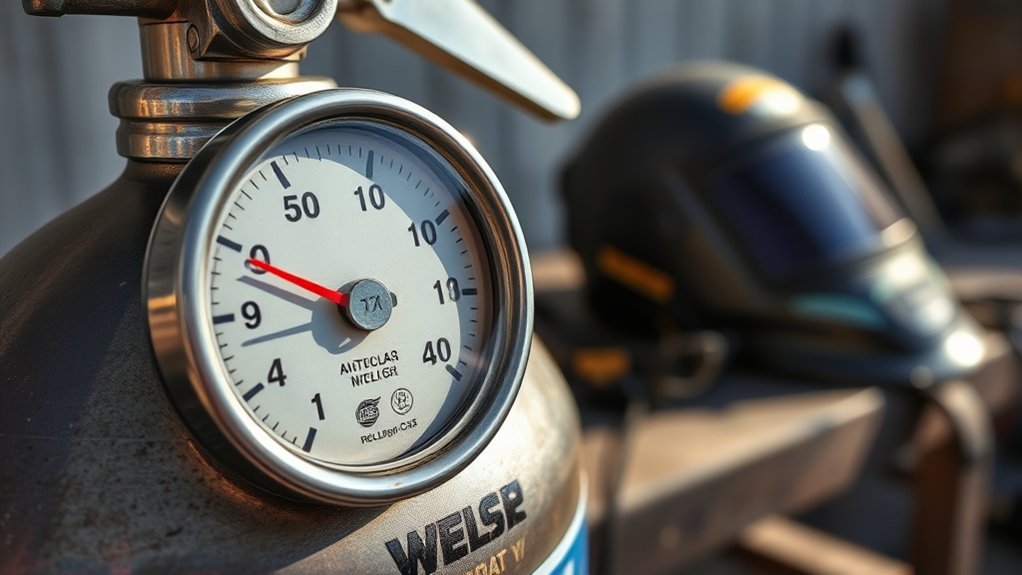
Gas life depends mainly on cylinder capacity, flow rate, pre-flow, post-flow, purge time, leaks, and how long the arc is active. TIG flow rates commonly fall within roughly 10–35 CFH, although the correct setting depends on the cup, gas lens, joint, torch angle, draft, and manufacturer instructions.
| Cylinder Capacity | Theoretical Runtime at 20 CFH | Likely Use |
|---|---|---|
| 40 CF | 2 arc-on hours | Small repairs or backup cylinder |
| 80 CF | 4 arc-on hours | Moderate hobby use |
| 125 CF | 6.25 arc-on hours | Frequent home-shop work |
These are theoretical figures. A machine may release gas before the arc begins and after it stops, and every tack or restart uses additional gas. Outdoor drafts can also tempt welders to raise flow unnecessarily.
Pro Tip: Do not increase flow automatically when shielding is poor. Excess flow can create turbulence and pull surrounding air into the shielding envelope. First check for drafts, damaged hoses, loose fittings, an incorrect cup, and a poor torch angle.
How Do I Know When I Need More Gas?
For high-pressure, non-liquefied gases such as argon and many argon mixtures, the cylinder-pressure gauge can show a rough downward trend. However, the reading changes with temperature, and the full pressure depends on the cylinder’s stamped service pressure. Do not assume that every full cylinder begins at 2,015 psi.
Carbon dioxide requires different handling. A CO₂ cylinder contains liquid and vapor, so its pressure can remain fairly steady while liquid is present. The most reliable way to estimate the contents is to weigh the cylinder and subtract the stamped tare weight.
Plan a refill or exchange when the remaining gas is no longer enough to complete the next job safely. There is no universal rule requiring every cylinder to be refilled at 20% or 30% remaining.
Unexpectedly fast pressure loss may indicate:
- A loose regulator connection.
- A cracked or cut hose.
- A leaking solenoid valve.
- Excessive pre-flow or post-flow.
- A regulator or flowmeter problem.
- A cylinder valve that was left open while the system was idle.
Use an approved leak-detection solution or an oil-free soap-and-water solution on appropriate connections. Never use a flame to look for a leak. Follow the regulator and gas supplier’s instructions.
Does Welding Gas Go Bad?
Pure argon, helium, oxygen, and carbon dioxide do not spoil like food. When the correct gas remains sealed in a sound, uncontaminated, in-date cylinder, it can normally remain usable for a long period.
Storage problems can still affect safety or performance. Moisture, damaged valves, incorrect regulators, contamination, corrosion, and an expired cylinder-requalification date may prevent a supplier from accepting the cylinder.
Industrial premixed shielding gases are prepared to a specified composition. Do not place a cylinder on its side or roll it in an attempt to remix the contents. Keep the cylinder upright and secured. If weld behavior suggests contamination or an incorrect mixture, close the cylinder and ask the supplier to inspect or replace it.
Warning: Never deliberately lay down or roll a compressed-gas cylinder as a mixing method. Protect the valve, keep the cylinder upright, and secure it against falling.

This hardcover cookbook offers fast, approachable recipes designed for busy days and low-energy nights. Caroline Chambers focuses on simple, flavorful meals that help you get dinner on the table without overthinking it. It's a practical pick for home cooks who want quick weeknight inspiration and minimal-fuss cooking.

This versatile glass storage set includes multiple container sizes for meal prep, leftovers, and pantry organization. Made from borosilicate glass with airtight, leakproof lids and a built-in vent, it is designed for convenient reheating and reliable food storage. The containers are freezer, microwave, oven, and dishwasher safe for everyday use, while the BPA-free lids help keep food fresh and secure.

This cordless mini dehumidifier helps keep small spaces dry, fresh, and odor-free without spills, cords, or batteries. Its rechargeable silica gel design is ideal for closets, cabinets, cars, bathrooms, boats, and gun safes, with a moisture indicator that shows when it is ready to recharge. Compact and easy to place or hang, it offers a simple low-maintenance solution for controlling humidity in tight areas.
Where to Buy or Refill Welding Gas
Common options include local welding-supply stores, industrial-gas distributors, farm and industrial suppliers, cylinder-exchange programs, and online sellers that ship full or empty cylinders.
Local suppliers may refill your cylinder, exchange it for another cylinder, or require you to join a rental program. Policies can differ between branches of the same company.
Before buying, ask the supplier:
- Do you refill or exchange customer-owned cylinders?
- Which cylinder sizes and brands do you accept?
- Will I receive my cylinder back or a different exchange cylinder?
- What gas mixture and grade are included?
- What is the complete price after hazmat, environmental, handling, delivery, and tax charges?
- Do you require proof of ownership?
- Will you accept the current valve and DOT specification?
- Is the cylinder’s requalification date acceptable?
- How long does a fill or exchange take?
Inspect any cylinder before purchase. The permanent markings should be legible, and the cylinder should not have severe rust, dents, fire damage, an altered serial number, or an illegible test date. Requalification intervals vary by cylinder specification, service, and markings, so allow the gas supplier to confirm whether the cylinder remains eligible for filling.
Additional Welding Gas Fees and Buying Challenges
The advertised gas price may not be the final amount. Common extra charges include:
- Hazmat or environmental fee: A branch-level charge added to hazardous-material transactions.
- Cylinder rental: A monthly, annual, or long-term lease charge.
- Deposit: A refundable or nonrefundable amount tied to the supplier’s cylinder.
- Delivery and fuel surcharge: Common with commercial accounts or home delivery.
- Requalification charge: Possible when a customer-owned cylinder is out of test.
- Handling or exchange fee: May be separate from the gas charge.
- Lost-cylinder fee: Charged when a rented cylinder is not returned.
- Minimum order fee: Sometimes applied to small deliveries.
A cheap used cylinder can become expensive if no nearby supplier will fill it. Before paying a private seller, record the cylinder specification, size, valve, serial number, owner markings, and latest test stamp. Give those details to the intended gas supplier and confirm acceptance.
Ways to Reduce Welding Gas Costs
- Repair leaks promptly. Close the cylinder valve when equipment is not in use and follow the manufacturer’s shutdown procedure.
- Use the recommended flow. More gas does not always produce better shielding.
- Control drafts. Welding screens can protect the gas envelope without wasting gas through excessive flow.
- Review pre-flow and post-flow. Use the machine or procedure recommendation rather than an unnecessarily long timer.
- Choose a practical cylinder size. An 80 or 125 CF cylinder can reduce trips and cost per cubic foot for regular users.
- Compare complete prices. A lower gas charge can be canceled out by rental, delivery, and hazmat fees.
- Track arc-on hours. Recording actual usage makes future budgets and cylinder-size decisions more accurate.
- Keep a backup cylinder only when justified. A spare prevents downtime but ties up money and requires additional safe storage.
Safe Storage and Transportation
Warning: Argon, helium, and carbon dioxide can displace oxygen. Never release welding gas in a confined or poorly ventilated space. An oxygen-deficient atmosphere can cause unconsciousness or death without a noticeable odor.
OSHA’s compressed-gas requirements provide a useful safety baseline for workplace handling. Applicable rules depend on the workplace and jurisdiction, but the following practices are also sensible for a home shop:
- Keep cylinders upright and secure them with an appropriate chain, strap, rack, or cart.
- Close the valve when the cylinder is not in use.
- Install the valve-protection cap when the cylinder is moved or stored, where the cylinder is designed for one.
- Remove regulators before transporting cylinders unless an approved protected transport system specifically permits otherwise.
- Keep cylinders away from excessive heat, sparks, flames, electrical circuits, and physical damage.
- Store and use cylinders in a ventilated area.
- Never use oil or grease on oxygen equipment.
- Keep oxygen separated from stored fuel-gas cylinders and combustible materials as required by applicable fire and workplace rules. OSHA’s construction standard specifies 20 feet or an approved noncombustible barrier in covered storage situations.
- Use a cart designed for cylinders rather than dragging, dropping, or rolling them.
For vehicle transport, secure the cylinder upright so it cannot slide, roll, or fall. Close the valve, remove the regulator, install the cap, ventilate the vehicle, avoid smoking and ignition sources, and travel directly to the destination. Do not leave cylinders in a hot enclosed vehicle.
Commercial transportation can be subject to additional federal hazardous-material rules. Private and noncommercial requirements may also vary by state and cylinder contents, so follow the supplier’s transport instructions and applicable laws.
Frequently Asked Questions
Can I use welding gas for other applications?
Only when the gas, purity, cylinder, regulator, and application requirements match. Industrial welding gas should not be used for breathing, medical treatment, diving, food, or beverage service unless it is specifically certified and supplied for that use.
How do I store welding gas safely?
Keep cylinders upright, securely restrained, capped when appropriate, and protected from heat, corrosion, impact, and unauthorized access. Use a ventilated storage area and separate oxygen from fuel gases and combustibles as required by applicable rules.
Are there alternative gases for welding?
Yes. Common options include argon, argon/CO₂ mixtures, pure CO₂, helium blends, and process-specific mixtures containing small amounts of oxygen or other gases. The welding process, wire, metal, and procedure determine which alternatives are suitable.
What factors affect welding gas prices?
Important factors include the gas mixture, purity, cylinder size, local supply, customer-owned or rental arrangement, refill versus exchange service, account volume, delivery distance, taxes, and hazmat or environmental fees.
Can I transport welding gas in my vehicle?
A small number of cylinders may be transported when allowed by applicable rules, but they must be closed, capped, secured upright, and protected from movement and heat. Remove the regulator, ventilate the vehicle, avoid enclosed trunks, and follow the supplier’s instructions. Commercial transport may trigger additional requirements.
Is 100% CO₂ cheaper than a 75/25 argon and CO₂ mix?
Pure CO₂ is often less expensive, but it can produce a harsher arc, deeper penetration, and more spatter in some MIG applications. Compare the total cost of gas, cleanup, productivity, and weld quality rather than the refill price alone.
Should I buy or rent a welding gas cylinder?
Buying can suit occasional users who want a small or medium cylinder and have a supplier that accepts customer-owned bottles. Renting often suits businesses, high-volume users, and people who need large cylinders, delivery service, and supplier-managed testing.
Conclusion
Welding gas usually costs more than the number printed beside a cylinder. A complete budget includes the cylinder or rental, gas fills, supplier fees, delivery, travel, and the amount of gas consumed during actual arc time. Full owner cylinders in common hobby sizes may cost about $230–$400, but local refill and exchange quotes remain essential.
Choose the gas required by the welding procedure, estimate consumption from flow rate and arc-on hours, and compare the complete cost per cubic foot. Above all, keep every cylinder upright, secured, protected, and properly ventilated during storage, use, and transportation.
Sources
- Occupational Safety and Health Administration — Gas Welding and Cutting — cylinder storage, securing, valve caps, movement, and oxygen/fuel-gas separation.
- OSHA — Controlling Hazardous Fume and Gases During Welding — ventilation and oxygen-displacement hazards.
- Miller Electric — Best Practices for Proper Shielding Gas in TIG Welding — argon selection and general flow-rate guidance.
- Pipeline and Hazardous Materials Safety Administration — Cylinder Requalification Interpretation — DOT 3AA requalification conditions and markings.
- PrimeWeld — Full Argon Cylinder Listing — current full-cylinder pricing and DOT 3AA product example.
- Weldfabulous — Full 80 CF C25 Cylinder Listing — current price, service pressure, valve, and supplier-acceptance guidance.

This heartfelt memoir blends laugh-out-loud honesty with tender reflections on love, loneliness, and the unexpected healing power of rescue dogs. Isabel Klee shares her journey fostering pups in the city while navigating dating and self-discovery, offering an intimate, relatable story for readers who enjoy emotional, character-driven narratives. It is a warm, engaging read about opening your heart and finding connection in surprising places.

Die With Zero offers a fresh perspective on personal finance by encouraging readers to use money intentionally to create memorable life experiences instead of simply accumulating wealth. Written by Bill Perkins, this book combines practical guidance with a motivating philosophy to help readers align spending, saving, and life goals for a more fulfilling future.

TERRO Multi-Surface Liquid Ant Baits provide a ready-to-use solution for managing common household ants by attracting workers and helping eliminate the colony at its source. The discreet bait stations use adhesive strips for flexible placement on walls, under cabinets, and other hidden spots, making them a convenient fit for indoor spaces. Designed for fast visible reduction in ant activity, they help keep your home protected with minimal effort.
