

In 2026, a complete welding program can cost a few thousand dollars at a public or community college and $25,000 or more at some private career schools. For context, the National Center for Education Statistics reports average 2024–25 in-district tuition and required fees of $4,231 at public two-year institutions across all programs. Current welding-specific examples include a $5,520 entry-level certificate at Anne Arundel Community College and a $25,255 Welding Technology diploma at UTI’s San Antonio campus. These are planning benchmarks, not a single national welding-school average. Your real total also depends on lab fees, tools, protective gear, certification tests, transportation, housing, and financial aid.
Last updated: August 10, 2026. Cost and wage benchmarks were rechecked against NCES, current school pages and catalogs, AWS, and the U.S. Bureau of Labor Statistics.
Quick Answer
For 2026 planning, expect complete welding training to range from a few thousand dollars at some public colleges to $25,000 or more at some private career schools. Short individual classes can cost much less. Compare the complete program price, not tuition alone, and add lab fees, protective gear, testing, transportation, housing, and other costs before enrolling.
Key Takeaways
- Public technical and community colleges often have lower tuition than private welding schools, especially for in-district students.
- Current prices vary widely: one public-college welding certificate is listed at $5,520, while a current private career-school welding diploma example totals more than $25,000.
- The advertised tuition may exclude lab fees, consumables, personal protective equipment, books, testing fees, and living expenses.
- A school certificate is not automatically the same as an AWS or employer welder certification.
- Grants, scholarships, veterans benefits, workforce funding, employer assistance, and paid apprenticeships may reduce your out-of-pocket cost.
- Compare net price, supervised hands-on training, completion data, employer connections, and testing opportunities—not tuition alone.
How Much Does Welding School Cost?
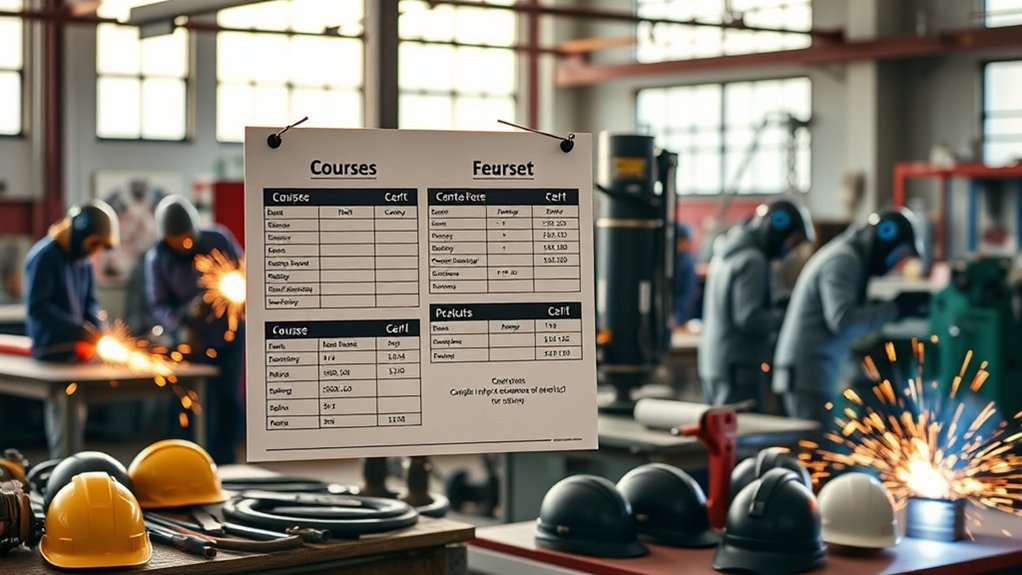
There is no single national welding-school price. Schools may charge by credit, clock hour, course, semester, or complete program, and welding-specific charges can differ substantially even between programs with similar lengths.
For current public-college context, the National Center for Education Statistics IPEDS data reports average 2024–25 in-district tuition and required fees of $4,231 at public two-year institutions. That figure covers all programs at those schools, not welding alone, and it does not represent tools, housing, transportation, or a guaranteed price at any individual college.
Welding-specific prices show how wide the spread can be. Anne Arundel Community College currently lists an entry-level welding certificate at $5,520. The UTI San Antonio catalog lists its Welding Technology diploma at $25,255 total for students enrolled under its current 2026 tuition schedule. These are examples, not national averages. You can also compare school-level cost measures through the U.S. Department of Education’s College Scorecard.
At a Glance
| Typical Program Length | Several weeks to about one year for many focused certificate or diploma programs; about two years for an associate degree |
| Public Two-Year Benchmark | $4,231 average 2024–25 in-district tuition and required fees across all programs; not a welding-specific national average |
| Current Welding Examples | $5,520 entry-level certificate at Anne Arundel Community College; $25,255 Welding Technology diploma at UTI San Antonio |
| Common Extra Costs | Lab fees, consumables, helmet, protective clothing, tools, books, testing, transportation, and housing |
| Best Comparison Number | Your estimated net price after grants and scholarships, plus required expenses excluded from the school estimate |

The DeLonghi Water Filter helps reduce scale buildup and unwanted impurities that can affect your coffee machine's performance and taste. Its active carbon and ion-exchange technology helps improve brew consistency, maintain flavor, and reduce the need for frequent descaling. Designed as an OEM authorized replacement part, it fits select DeLonghi models for reliable everyday maintenance.

This daily devotional helps parents pray purposefully for their children through a full year of Scripture readings, reflections, and guided prayer prompts. Written to encourage faithful family discipleship, it offers practical, biblically grounded support for parents who want to shape their prayers around God's Word. A foreword by Sinclair B. Ferguson adds trusted theological insight and encouragement.

These colorful answer buzzers turn lessons, review games, and family activities into lively game-show style challenges that boost participation and make learning more interactive. Each buzzer has a distinct sound to clearly identify who buzzed in first, while the durable, palm-sized design makes them easy for kids and adults to use in classrooms, homeschools, and group settings.
Sticker Price, Cost of Attendance, and Net Price
These three terms describe different numbers:
- Sticker price: The published tuition and required fees before financial aid.
- Cost of attendance: A school estimate that may include tuition, fees, books, supplies, housing, food, transportation, and personal expenses.
- Net price: The estimated cost after grants and scholarships are subtracted. Loans are not discounts because they must be repaid.
Pro Tip: Ask every school for an itemized estimate covering the complete program—not just the first term. Then use the school’s net price calculator to estimate what you may actually pay.
Types of Welding Institutions
Welding training is available through public colleges, private trade schools, adult-education centers, employers, unions, and apprenticeship sponsors. Each pathway has a different cost structure.
Community and Technical Colleges
Public colleges commonly charge by credit hour. In-district or in-state students usually pay less than out-of-district or out-of-state students. Programs may lead to a short certificate, diploma, or associate degree and may include general education courses.
This option can offer strong value, but compare the number of required credits, lab fees, consumables, course availability, and time needed to finish. A low per-credit rate does not help if required classes are rarely offered or the program takes longer than expected.
Private Welding and Trade Schools
Private career schools often provide concentrated schedules and extensive booth time. Some programs can be completed in less than a year, but current private-school welding diploma totals can exceed $25,000 before living costs.
Before enrolling, ask for the complete program price, refund policy, expected weekly schedule, included equipment, financing terms, completion data, and documentation supporting any advertised job-placement rate.
Registered Apprenticeships and Employer Training
A Registered Apprenticeship combines paid employment, classroom instruction, structured on-the-job learning, mentoring, progressive wage increases, and a portable credential. The U.S. Department of Labor describes Registered Apprenticeships as paid jobs that let participants earn while developing skills.
Search for current opportunities through Apprenticeship.gov’s Job Finder. Availability, entry requirements, program costs, and starting wages depend on the employer, trade, union, sponsor, and location.
The cheapest advertised tuition is not always the lowest-cost path. A paid apprenticeship or nearby public program may reduce both debt and living expenses.
Program Length and Structure

Welding-program length depends on the credential, weekly schedule, required lab hours, and number of processes taught. Full-time programs are usually completed faster than evening or part-time programs.
| Training Path | Common Length | Typical Focus | Credential |
|---|---|---|---|
| Focused course | Days to several weeks | One process, safety topic, or skill upgrade | Course completion record |
| Certificate or diploma | Several months to about one year | Safety, blueprint reading, cutting, fabrication, and multiple welding processes | School certificate or diploma |
| Associate degree | About two years full time | Welding labs plus technical and general education courses | Associate degree |
| Bachelor’s program | About four years full time | Welding engineering, technology, metallurgy, automation, management, or inspection | Bachelor’s degree |
Certificate Program Duration
A certificate or diploma program is designed to build practical skills faster than a degree program. The curriculum may cover shielded metal arc welding, gas metal arc welding, flux-cored arc welding, gas tungsten arc welding, oxyfuel cutting, plasma cutting, blueprint reading, weld symbols, fabrication, and workplace safety.
Do not choose a program by duration alone. Ask how many hours are spent welding in a booth, which materials and positions are taught, whether students practice destructive or visual testing, and how often equipment is available.
Degree Program Length
An associate degree generally takes about two years of full-time study. It may combine welding labs with mathematics, technical writing, computer applications, general education, and fabrication courses. This broader curriculum can support future work in supervision, inspection, estimating, quality control, or advanced manufacturing.
Bachelor’s-level welding programs are less common and are normally aimed at welding engineering, welding engineering technology, manufacturing, automation, metallurgy, or management rather than basic entry-level welder training.
Note: A school certificate confirms that you completed its curriculum. An industry certification or employer qualification confirms that you passed a specific performance test. The AWS Certified Welder Program, for example, requires a performance qualification test at an AWS Accredited Testing Facility.
Additional Costs Associated With Welding School

Tuition may be only part of the bill. Request a written list of everything students must buy, rent, replace, or pay for during the entire program.
| Expense | What to Confirm |
|---|---|
| Application and registration fees | Whether they are refundable or included in tuition |
| Lab and consumable fees | Whether metal, electrodes, wire, gas, grinding discs, and replacement parts are included |
| Personal protective equipment | Required helmet, safety glasses, gloves, jacket, boots, hearing protection, and respirator rules |
| Hand tools | Whether students need pliers, clamps, chipping tools, measuring tools, soapstone, or a tool storage box |
| Books and online access | Whether codes, textbooks, software, and digital access expire after the course |
| Testing and certification | Which tests are included, who conducts them, and whether retests cost extra |
| Transportation and housing | Fuel, parking, public transit, relocation, rent, utilities, food, and travel home |
| Lost income | How a full-time daytime schedule may reduce your ability to work |
Most training labs provide welding machines, booths, ventilation, and large shop equipment. Do not buy a welding machine unless the school’s written equipment list specifically requires one.
Warning: Do not reduce costs by using damaged, unapproved, or poorly fitted protective equipment. OSHA welding and cutting requirements require suitable eye protection and other safeguards for welding hazards. Follow the school’s safety rules and equipment specifications.
Build a Complete Welding-School Budget
Use this simple formula:
Tuition and required fees + tools and PPE + books and consumables + testing + transportation + housing and food + lost income − grants and scholarships = estimated out-of-pocket cost.
Keep loans separate when comparing offers. A loan may help you pay the bill now, but it does not reduce the total price and may add interest.
Compare Cost per Supervised Lab Hour
Tuition alone does not show how much hands-on practice you receive. Ask each school for the number of supervised welding-lab or booth hours required for the complete program, then calculate a rough comparison index:
Estimated net program price ÷ supervised lab hours = cost-per-supervised-lab-hour comparison index.
This is not an accounting measure of what each lab hour actually costs because your tuition also pays for classroom instruction, facilities, administration, and other services. It is simply a way to compare two programs that charge similar prices but provide very different amounts of supervised practice. Also check whether consumables, testing, and equipment access are included.
Funding Options for Welding School

Financial assistance depends on the student, school, and program. Confirm that the exact program—not simply the institution—is eligible before relying on an award or loan.
Scholarships and Grants
Complete the Free Application for Federal Student Aid if the school and program participate in federal student-aid programs. Depending on eligibility, students may receive grants, work-study, or federal loans.
Grants and scholarships generally do not require repayment when all conditions are met. However, some grant funds may have to be repaid after an early withdrawal, enrollment change, or loss of eligibility.
The AWS Foundation Welder Training Scholarship currently offers up to 800 $1,000 awards annually for qualifying students seeking welder training in certificate programs lasting less than two years. The Welder Training Scholarship cannot be applied to an associate or bachelor’s degree program. AWS says eligible funds may be used for tuition, fees, books, supplies, and equipment required for the course.
Student Loan Options
Federal Direct Subsidized and Unsubsidized Loans may be available at participating schools. Review the interest rate, origination fee, annual borrowing limit, total projected debt, repayment start date, and estimated monthly payment before accepting a loan.
Private education loans may have different rates, credit requirements, cosigner rules, and repayment protections. Compare them carefully and exhaust grants, scholarships, employer assistance, and eligible federal options first.
Veterans Education Benefits
Eligible veterans, service members, National Guard or Reserve members, and qualifying dependents may be able to use GI Bill benefits for an approved non-college degree or welding program. Use the VA GI Bill Comparison Tool to confirm that the school and program are approved and to estimate available benefits.
Workforce Funding and Employer Assistance
State and local workforce agencies may help eligible job seekers pay for training connected to in-demand occupations. Employers and unions may also offer tuition reimbursement, paid entry-level training, or apprenticeship opportunities.
Pro Tip: Ask the financial-aid office for grants and scholarships before discussing loans. Then ask whether any award applies to tools, PPE, books, testing fees, transportation, or only tuition.
Career Prospects After Welding School
Welding education can support entry into manufacturing, construction, repair, fabrication, and specialty trade work, but completing a program does not guarantee a job or a particular salary.
The latest national wage release from the U.S. Bureau of Labor Statistics Occupational Employment and Wage Statistics program provides May 2025 wage data. The BLS Occupational Outlook Handbook provides the current 2024–34 employment projections.
| Measure | Current BLS Figure |
|---|---|
| Median hourly wage | $25.84 in May 2025 |
| Mean annual wage | $56,760 in May 2025 |
| Projected employment growth | 2% from 2024 to 2034 |
| Projected openings | About 45,600 per year, mainly from replacement needs |
The BLS Occupational Outlook Handbook still displays its May 2024 median wage figure, while the separate May 2025 OEWS release contains newer national wage data. That is why the table above uses the May 2025 wage release together with the still-current 2024–34 employment projections.
Actual pay varies by location, industry, employer, shift, overtime, travel requirements, union agreement, experience, process, material, position, and code qualification. Jobs involving difficult conditions or extensive travel may pay more, but they can also bring higher safety risks and demanding schedules.
Ask each school for its most recent completion and placement information. Find out how the school defines “placed,” whether the job must be welding-related, how many graduates were excluded from the calculation, and whether the data were independently verified.

Stay organized with a durable 1-subject notebook set designed for school, note-taking, and digital study support. The college ruled pages resist ink bleed, tear out cleanly, and work with the Five Star Study App to create flashcards and sync notes to Google Drive. Tough pockets, a water-resistant cover, and Spiral Lock wire help protect your work throughout the year.

The DEWALT TSTAK Mobile Storage unit delivers a spacious, stackable solution for organizing and transporting tools with ease. Its telescopic handle, durable 7-inch wheels, and bi-material top handle make moving loads more comfortable, while rust-resistant metal latches and side latches support secure stacking with other TSTAK units. Built for convenience and mobility, it is ideal for professionals and DIY users who need dependable on-the-go storage.

This interactive sentence building set helps children practice early reading, writing, and grammar through hands-on play. Color-coded word cards, photo cards, and punctuation pieces make it easy to build simple sentences while reinforcing capitalization, parts of speech, and sentence structure. It is a versatile learning tool for homeschool and classroom use, with included game ideas and teaching suggestions to support multiple skill levels.
Cost of Living Considerations
Living expenses can exceed tuition when a student relocates for a private welding school. Avoid relying on generic national or state averages. Use the school’s current cost-of-attendance estimate and research the specific neighborhood where you would live.
Include these expenses in your comparison:
- Rent, deposits, utilities, internet, and renter’s insurance
- Food and household supplies
- Fuel, vehicle maintenance, parking, or public transportation
- Travel home during breaks
- Work clothing and laundry
- Health insurance and medical expenses
- Child care or dependent care
- Reduced work hours while attending class
A nearby program with slightly higher tuition may cost less overall than a distant school that requires relocation. Compare the entire program period, not just one month or one academic year.
How to Lower the Total Cost of Welding School
Reducing the program price is only one part of controlling your cost. The following steps may also lower borrowing and living expenses:
- Apply for grants and scholarships early. Some awards are made on a rolling basis or have limited funds.
- Compare public resident tuition. In-district rates may be much lower than private-school or out-of-state charges.
- Ask about used tools and books. Confirm that used equipment still meets the school’s safety and course requirements.
- Keep commuting costs realistic. A long daily drive can erase part of the savings from lower tuition.
- Consider a paid apprenticeship. This can reduce tuition exposure while providing wages and structured work experience.
- Ask employers about reimbursement. Some companies help current employees train for welding, fabrication, maintenance, or production roles.
- Avoid unnecessary borrowing. Accept only the amount needed after grants, scholarships, savings, and employment income.
- Finish on schedule. Repeated courses and delayed completion can add tuition, fees, transportation, and lost income.
How to Compare Welding Programs Before Enrolling
Use the same checklist for every school so that a low advertised price does not hide missing equipment, weak training, or poor outcomes.
- Verify institutional status. Check accreditation, state approval, and federal-aid participation through the U.S. Department of Education.
- Request the complete price. Get tuition, required fees, tools, PPE, books, consumables, testing, and graduation charges in writing.
- Calculate net price. Subtract grants and scholarships, but do not subtract loans.
- Review the curriculum. Confirm which welding processes, positions, metals, cutting methods, drawings, and safety topics are taught.
- Compare hands-on time. Ask how many supervised lab hours each student receives and whether booth access is limited.
- Calculate the lab-hour comparison index. Divide estimated net program price by supervised lab hours, then compare what consumables, equipment access, and tests are included.
- Check testing opportunities. Ask whether industry or employer qualification tests are included and whether retesting costs extra.
- Verify outcomes. Review completion, placement, debt, earnings, and employer-partnership information.
- Visit the facility. Inspect ventilation, booths, equipment condition, instructor access, material availability, and safety practices.
- Read the cancellation policy. Understand deposits, withdrawal deadlines, refunds, leave policies, and transfer-credit rules before signing.
Note: A school’s accreditation does not guarantee that every credit will transfer, that every employer will recognize the credential, or that you will qualify for a particular certification. Confirm those points separately.
Frequently Asked Questions
Are there prerequisites for enrolling in a welding course?
Many beginner welding programs do not require previous welding experience. A school may require a minimum age, high school diploma or equivalent, identification, placement testing, an orientation, or proof that you can safely participate in lab work. Check the exact admissions rules before applying.
What types of welding certifications can I earn?
A school may award a certificate or diploma for completing its curriculum. Separate performance-based qualifications may cover a particular process, position, material, thickness, or welding code. AWS Certified Welder testing is completed through an Accredited Testing Facility. Employers may also require their own qualification tests.
How do I choose the right welding program?
Compare total net price, supervised lab hours, class size, instructor access, processes taught, testing opportunities, completion data, placement methodology, employer relationships, schedule, equipment, safety practices, and refund terms. Choose the program that matches the jobs available in the area where you plan to work.
What is the job-placement rate for welding graduates?
There is no single national placement rate for all welding schools. Request the school’s latest documented rate and ask how it was calculated. Confirm whether the figure includes only completers, whether the jobs are welding-related, how long graduates were tracked, and how many students were excluded.
Can I take welding courses online?
You can study welding theory, terminology, safety, symbols, inspection concepts, and some code material online. However, online study cannot replace supervised hands-on practice with welding equipment. Performance-based welder certification also requires an in-person test under controlled conditions.
Is welding school worth the cost?
It may be worth the cost when the program provides substantial supervised practice, relevant skills, recognized testing opportunities, reasonable debt, and access to real employers. Compare the total price with local starting wages and job openings. A lower-cost public program, apprenticeship, or employer-training route may provide a better return for some students.
How long does welding school take?
There is no single program length. A focused welding course may last days or several weeks, many certificate or diploma programs take several months to about a year, and an associate degree commonly takes about two years of full-time study. Evening or part-time schedules may take longer.
Can you go to welding school for free?
Sometimes. A qualifying grant or scholarship may cover part or all of eligible training costs, some employers sponsor training, and Registered Apprenticeships are paid jobs that combine work with instruction. Availability and eligibility vary, so confirm the exact program terms before assuming your tuition will be fully covered.
Do I need a college degree to become a welder?
A college degree is not the standard entry requirement for most welding jobs. The U.S. Bureau of Labor Statistics lists a high school diploma or equivalent, combined with technical and on-the-job training, as the typical path. The AWS Certified Welder program is performance-based and does not require prerequisite courses or certifications before testing.
How much does AWS Certified Welder certification cost?
AWS lists a $70 Certified Welder application fee for 2026 and a $105 yearly certification-maintenance subscription. The actual performance-test fee is not a single nationwide price; AWS directs candidates to contact an Accredited Testing Facility for its testing and retesting charges. Check the current AWS program price list and the testing facility before budgeting.
Conclusion
Welding-school costs vary too much for one price to fit every student. Current examples range from a public-college certificate costing several thousand dollars to private career-school welding diplomas above $25,000. A paid apprenticeship may offer another route that combines wages with structured training. The most useful number is your complete net cost after grants and scholarships—not the advertised tuition alone.
Before paying a deposit, get five numbers from every finalist: the complete program price, estimated net price after grants and scholarships, supervised lab hours, included testing costs, and your transportation or living expenses for the entire program. Compare those figures with local job requirements and wages before deciding which school provides the strongest value.
Sources
- National Center for Education Statistics / IPEDS — 2024–25 Cost of Attendance Data — current public two-year tuition and required-fee benchmark
- Anne Arundel Community College — Welding — current entry-level welding certificate price example
- Universal Technical Institute San Antonio Catalog — current 2026 Welding Technology tuition and fee example
- U.S. Bureau of Labor Statistics — May 2025 National Occupational Employment and Wage Data — current national welding wage data
- U.S. Bureau of Labor Statistics — Welders, Cutters, Solderers, and Brazers — education, job outlook, and projected opening figures
- Federal Student Aid — Choosing a School — net price calculators and school-cost comparisons
- American Welding Society Foundation — Welder Training Scholarship — current scholarship eligibility, award amount, and permitted uses
- American Welding Society — Certified Welder Program — performance-testing and certification requirements
- American Welding Society — Certification and Education Program Price List — current Certified Welder application and maintenance fees
- Apprenticeship.gov — Registered Apprenticeship Program — paid-job, mentoring, education, wage-progression, and credential structure
- U.S. Department of Veterans Affairs — Non-College Degree Programs — use of qualifying GI Bill benefits for approved career training
- Occupational Safety and Health Administration — Welding, Cutting, and Brazing Requirements — welding safety and eye-protection requirements

Aegend Swim Goggles are designed to help swimmers enjoy a clear, comfortable, and secure fit in the pool. Built for adults and youth, they aim to reduce leaking and provide full eye protection for training, recreation, and water sports. Their versatile design makes them a practical choice for men and women looking for dependable swim eyewear.

This kid-friendly cookbook helps young chefs build confidence in the kitchen with more than 100 recipes designed for fun, learning, and delicious results. Created by America's Test Kitchen Kids, it offers approachable instructions, helpful guidance, and a wide range of dishes that make cooking and eating an engaging family activity.

This seven-book box set brings together classic Curious George stories that encourage early learning through fun, curiosity-driven adventures. With simple language and engaging illustrations, it helps young readers build alphabet awareness, listening skills, and a love of books. The hardcover collection is ideal for reading aloud, bedtime routines, and gifting to early learners.
