
If you’re weighing welding training, expect wide cost variation based on program type, length, and credential level. Short certificate courses can run a few thousand dollars while associate degrees may exceed $20,000. Extra gear, materials, and certification tests add more. You’ll want to compare trade schools, community colleges, and private academies by what they include and the career outcomes they target—here’s how to break it down.
Quick Answer
Welding training costs vary a lot by program type and length. Most people spend between $5,000 and $15,000 total, but you’ll pay extra for tools and tests.
- Basic certificates: $3,000–$10,000
- Diplomas: $5,000–$15,000
- Associate degrees: $10,000–$25,000
- Tools, gear, and tests: add $500–$2,500
- Smart moves: community colleges, scholarships, and short programs for fastest payback
Average Cost Ranges for Welding Courses
You can expect welding training costs to vary widely depending on program type and level. Basic certificate courses typically run $3,000–$10,000. Diploma programs cost $5,000–$15,000. Associate degrees range from $10,000–$25,000. Advanced or specialized programs can exceed $20,000.
Most programs fall between $5,000 and $15,000. When you look at pricing, remember the extras: consumables, personal protective equipment, and tools can add $100–$2,500.
Compare total cost of attendance rather than tuition alone. Short-term certificates keep upfront costs low but may limit depth. Associate degrees raise tuition yet deliver broader technical training and stronger credentials.
Compare total cost of attendance, not just tuition—short certificates cut upfront cost; associate degrees offer broader training and credential value.
Use a cost-per-credit and equipment-cost breakdown to see real value. That approach helps you pick a program that balances spending, skill building, and long-term job chances.
Types of Schools and How Price Varies
When comparing providers, trade schools usually price intensive hands-on programs from $5,000 to $20,000 because of equipment and shop time.
Community colleges average about $5,000 for two-year programs and often bundle general education, which lowers per-credit costs.
Private academies and certificate routes vary a lot—expect $3,000 to $15,000 depending on length and included materials.
Products Worth Considering

Crafted with precision, our steel plates are laser-cut, offering unparalleled edge smoothness and dimensional accuracy compared to stamped and sheared parts.
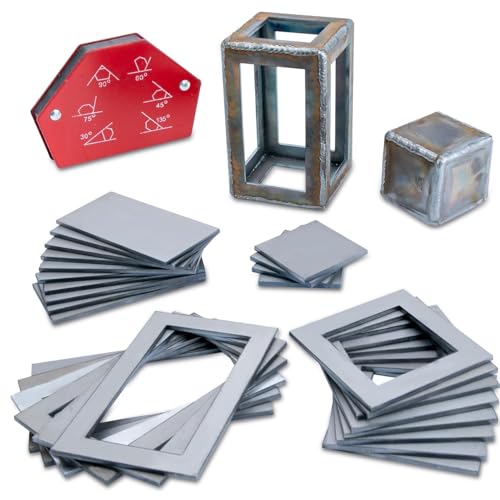
Richly Packed Welding Kit: This kit includes 10 pieces of 3x2-inch plates, 10 pieces of 2x2-inch plates, 10 pieces of 5x3-inch plates, and 10 pieces of 4x2-inch plates. You can weld them into basic 3x3x3-inch and 2x2x2-inch cubes, or create rectangular shapes like a 5x3x3-inch box or a 4x2x2-inch box. Perfect for beginners looking to enhance their welding skills.

Quantity and size:Welding Practice Kit, With 8 Of 3x5”, 8 Of 2x4”, 4 Of 3x3” And 4 Of 2x2” 24 pieces in total.
Trade School Costs
Trade schools for welding vary widely in scope and cost, so match program length and credential to your career goals and budget.
Certificate courses lasting weeks to months run roughly $3,000–$10,000. They focus on core welding processes and cert prep that match current industry demand.
One-year diploma programs cost about $5,000–$15,000 and add more shop hours plus advanced process instruction.
Full associate-level trade programs span two years and typically cost $10,000–$25,000. They often include added equipment, consumables, and simulated production training.
Community College Pricing
Community colleges typically price two-year welding programs between about $5,000 and $10,000. They mix shop instruction with general education credits.
Certificate options compress core welding skills into weeks or months and usually cost $3,000–$10,000 depending on lab hours and equipment.
Financial aid, grants, and scholarships make these programs more accessible. Flexible scheduling or part-time enrollment lets you keep working while you train.
Compared with private trade schools, community colleges offer lower average tuition, state-subsidized resources, and transferable credits that cut total cost.
Check program length, required consumables, and lab-to-class ratios to know your true out-of-pocket expense.
Private Academy Tuition
Private welding academies span a wide price range—typically $5,000 to $20,000—because program length, credential type, and school model drive costs.
Specialized certificate programs sit near $3,994 while diploma tracks run from $5,000 to $15,000 for one-year curricula. Advanced specialties like underwater welding exceed $15,000 due to simulator time and instructor ratios.
Expect equipment, consumables, and PPE to add $100–$2,000. Many private academies offer tuition assistance, payment plans, or financing—verify eligibility upfront.
Compare program hours, instructor credentials, and shop-to-student ratios to judge value. If you need theory, check whether online courses cover code and safety; practical hours must be in-person.
Budget for certification test fees and recurring consumables.
Program Lengths and What They Include
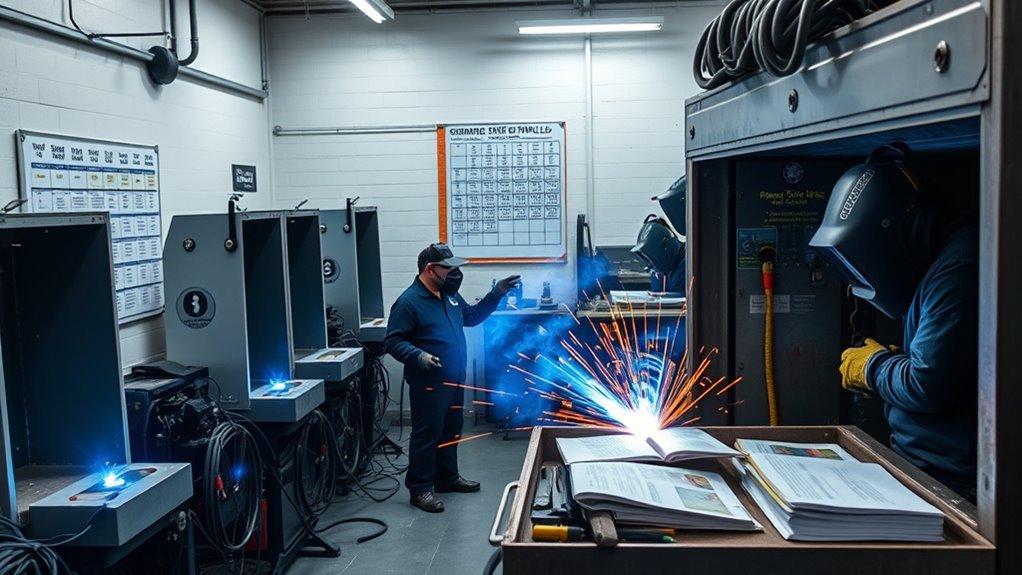
You’ll choose between short certificate tracks (weeks to months) and longer diploma or associate degree paths (one to two years) based on your certification goals and budget.
Expect a clear duration breakdown tied to cost tiers—with certificates typically $3,000–$10,000, diplomas around $5,000–$15,000, and associate degrees $10,000–$25,000. Curricula mix safety and theory with progressive welding techniques.
Programs commonly include hands-on lab time, consumable materials, and equipment access. Confirm what’s covered in tuition and what you’ll need to supply.
Products Worth Considering

Complete 123-Piece Set:All necessary TIG torch accessories and consumables for WP-17, WP-18, and WP-26 torches.

For WP-9 WP-20 WP-25 Series TIG Welding Torch

Engineered for precision, our steel plates undergo laser cutting for unmatched edge smoothness and accuracy, surpassing traditional stamped or sheared methods.
Certificate vs. Degree
Shorter certificate programs—often running from a few weeks to several months—focus tightly on hands-on welding techniques and cost between about $3,000 and $10,000. Diploma, associate, and bachelor’s tracks expand both duration and curriculum: diplomas typically take a year ($5,000–$15,000) and deepen shop skills; associate degrees span two years ($10,000–$25,000) and add welding theory and fabrication principles; four-year bachelor’s programs ($40,000–$100,000) incorporate advanced engineering and business coursework alongside practical training.
Weigh certificate benefits against degree advantages: certificates deliver targeted skill acquisition and rapid entry to work; degrees provide thorough theory, quality control, and supervisory preparation.
Compare credentials by outcomes:
- Entry-level employment speed and cost.
- Depth of technical theory and documentation skills.
- Career mobility and supervisory potential.
- Employer preference for certifications versus degrees.
Course Duration Breakdown
Having weighed certificates against degrees, it helps to look at program lengths and exact content so you can match time commitment to career goals. You’ll find clear tiers: short certificate courses (weeks–months), one-year diplomas, two-year associate degrees, and four-year bachelor’s programs. Each tier scales curriculum depth—from a practical welding techniques overview and certification prep to advanced metallurgy and fabrication theory—and emphasizes safety practices at every level. Trade-school options concentrate on hands-on experience to boost employability. Use the table below to compare duration, typical cost range, and primary focus so you can decide which aligns with your schedule and objectives.
| Program | Duration | Typical Focus |
|---|---|---|
| Certificate | Weeks–Months | Practical skills, certification |
| Diploma | 1 Year | Applied techniques, job prep |
| Associate | 2 Years | Theory + practice balance |
| Bachelor | 4 Years | Advanced theory, leadership |
Included Materials & Labs
Because program lengths dictate how much hands-on time you get, shorter certificate courses concentrate lab hours on core techniques and certification prep. One- and two-year programs layer progressively more complex projects, theory-driven labs, and safety simulations.
Included materials vary by program type: certificates emphasize consumables and basic safety gear; diplomas add intermediate tooling; associate degrees often include access to advanced equipment.
Expect added fees for personal tools and PPE.
- Certificate: focused practical applications, minimal tools included, lab safety orientation.
- Diploma: expanded consumables, intermediate tools, structured shop time.
- Associate: advanced equipment access, extended lab sequences, simulation exercises.
- Cost add-ons: PPE $100–$500, tools $500–$2,000.
Required Tools, Gear, and Material Expenses
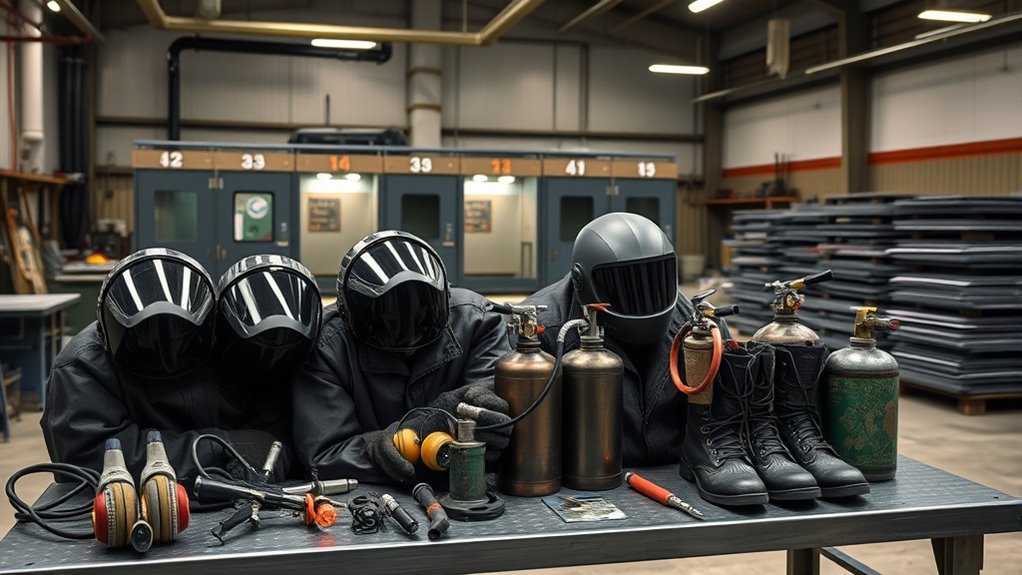
Tools and safety gear for a welding course typically cost between $500 and $1,500. Basic supplies (rods, gases, consumables) add another $100–$500. A welding machine runs $500–$2,000 depending on model and capability.
Budget welding equipment expenses carefully: helmet with appropriate lens, flame-resistant jacket, gloves, boots, and respirator. Safety gear costs vary by certification level and material handled; higher-spec PPE raises initial outlay but reduces replacement frequency.
Consumables—electrodes, filler wire, shielding gas—are recurring costs; estimate monthly usage based on curriculum intensity.
If the program excludes tools, source a machine sized for the processes taught (MIG, TIG, stick) and match amperage and duty cycle to lab requirements. Confirm whether tuition covers any items to avoid duplicate purchases.
Track warranties and consumable compatibility with your chosen welder to minimize downtime and guarantee consistent training outcomes.
Products Worth Considering
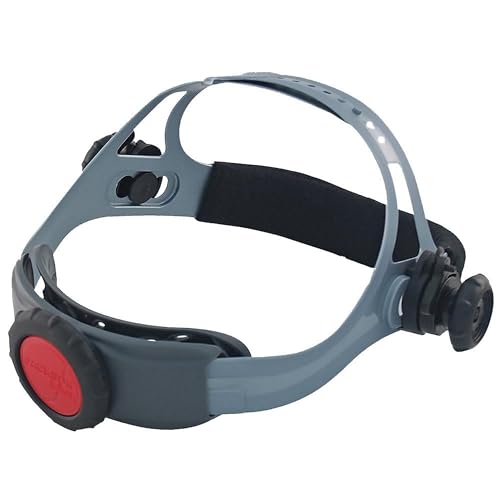
REPLACEMENT WELDING HELMET HEADGEAR - Jackson Safety's Premium 370 Speed Dial Replacement Headgear offers a perfect fit and secure hold for your welding hood


FR MATERIALS:Made from 5.5oz lightweight 100% cotton flame-resistant fabric in both paisley print and solid styles,this balaclava delivers a soft,breathable feel for long-hour comfort.One size fits all,the stretchable knit adapts to any head shape,ensuring a universal fit.Multiple wearing methods allow you to pull the face mask down when full coverage is not needed.
Certification and Testing Fees to Expect
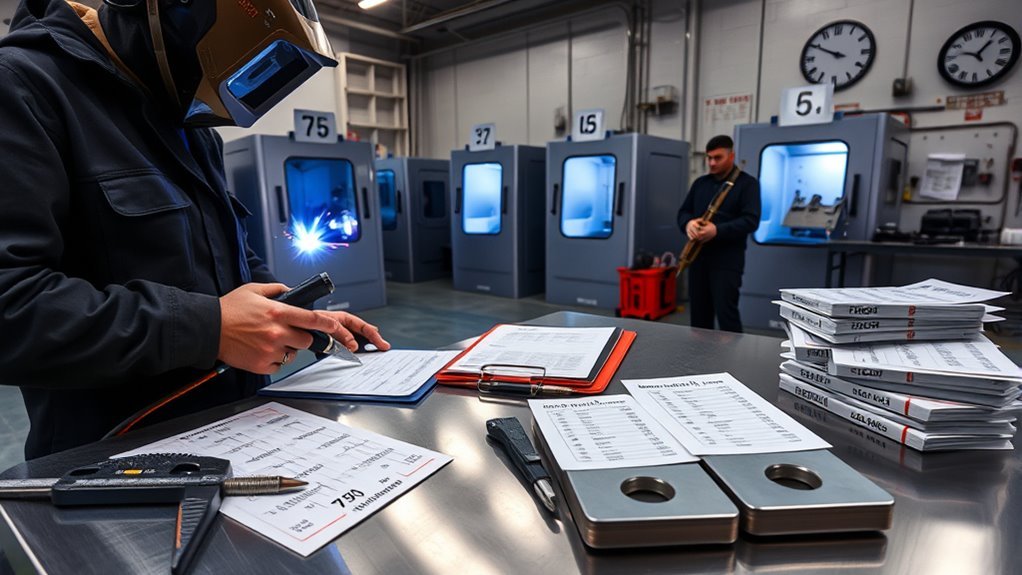
Once you’ve accounted for equipment and consumables, budget for certification and testing fees—these exams typically run $300–$550 apiece and are frequently billed separately from tuition.
Don’t forget certification and testing fees—typically $300–$550 per exam and often billed separately from tuition.
You’ll need to plan for multiple exams depending on the certification types you pursue. Some programs include exam fees, but many don’t. Verify whether your school covers the cost or passes it to you.
- Identify required certification types for your career path (SMAW, GMAW, FCAW, TIG).
- Confirm testing locations and their scheduling to avoid retest fees.
- Budget for specialized endorsements (pipe welding, underwater) which carry higher fees.
- Allow for retest and administrative fees if you don’t pass on the first attempt.
Research specific test outlines and fee schedules in advance. Treat certification costs as a discrete line item in your budget; they materially affect total program cost and your time-to-employment.
Financial Aid, Scholarships, and Payment Plans

Financing your welding education combines federal aid, targeted scholarships, and flexible payment plans to make training attainable without derailing your budget.
Evaluate financial aid options: federal grants reduce upfront cost, low-interest student loans bridge gaps, and the GI Bill® covers eligible veterans. Use a checklist to quantify aid versus tuition, factoring in ancillary expenses—tools, PPE, and certification tests—typically $500–$1,500.
Seek scholarship opportunities from the American Welding Society and institution-specific programs; apply early and document eligibility to maximize awards.
Many schools provide interest-free or low-interest payment plans that split tuition into manageable installments; verify enrollment deadlines, down payments, and refund policies.
Combine grants, scholarships, and loans strategically to minimize borrowed amounts. Maintain records of awards and repayment terms so you can project net cost.
Products Worth Considering

Father's Day Gift: If your father is an excellent welder, you can give this as a gift to him. He will be very happy.

🎲Superior Processing: Our steel plates are all laser-cut, providing edge and overall flatness that is unmatched by other stamped and sheared components.

Father's Day Gift: If your father is an excellent welder, you can give this as a gift to him. He will be very happy.
Return on Investment and Career Earnings

A welding credential typically pays off quickly: the median annual wage for welders was $51,000 in May 2024, according to the U.S. Bureau of Labor Statistics. Completing a certified program measurably increases your employability in high-demand sectors like oil and gas and manufacturing.
You’ll convert training costs into faster job placement because many programs include placement services that shorten unemployment intervals and reduce total cost-per-employer-entry. Your welding career trajectory depends on skill specialization, experience, and industry choice.
- Entry-level baseline: median wage reflects standard credentialed hires.
- Specialized roles: underwater or pipeline welding substantially raise earning potential.
- Advancement pathway: certifications plus experience create stepwise wage increases.
- Employer demand: oil, gas, and heavy manufacturing prioritize certified welders, improving job stability.
Quantify ROI by comparing tuition plus opportunity cost against differential wages over 3–5 years.
If you target specialized certifications and leverage placement services, the payback period shortens and cumulative earning potential rises, making welding a high-ROI trade relative to many alternatives.
Tips for Lowering Your Welding Training Costs
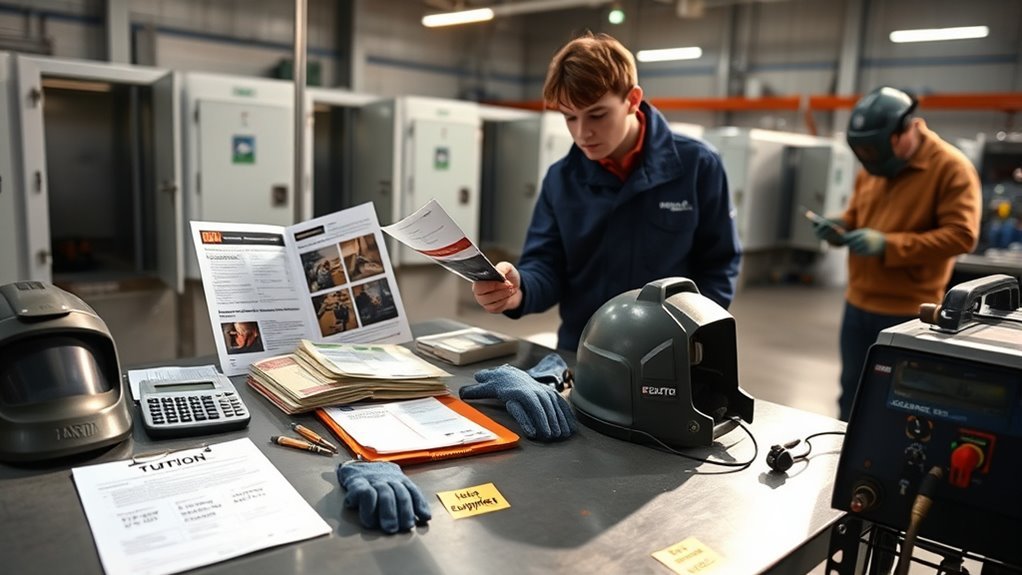
Although welding programs vary widely in cost, you can cut your outlay considerably by choosing community colleges or short certificate tracks, pursuing scholarships and grants from industry groups, and buying used tools and PPE when appropriate.
Prioritize community colleges and accredited trade schools: typical program tuition is $5,000–$15,000 versus private institutions exceeding $20,000.
Opt for certificate programs when time-to-employment matters; certificates commonly cost $3,000–$10,000 and concentrate hands-on hours.
Apply systematically for welding scholarships and grants from professional associations and manufacturers—these awards reduce tuition without repayment and improve net training cost.
Use institutional payment plans that let you spread expenses without accruing interest to smooth cash flow.
For tools and PPE, budget $500–$1,500 and procure quality used items or manufacturer-refurbished gear to shave expenses while retaining safety standards.
Combine these cost saving tips to lower upfront investment and optimize return on training dollars.
Products Worth Considering

Work areas with chemicals, glass, metal, paint, agriculture, formaldehyde and other irritating vapors. Protective against particles in mechanical work such as welding, sawing, grinding, graffiti etc. (Depending on the type of filter used)
![KwikSafety TORNADO [COMBO] 1D Full Body Safety Harness, 6 ft Lanyard, Tool Lanyard, ANSI OSHA PPE Fall Protection Arrest Restraint Equipment Universal Construction Roofing](https://m.media-amazon.com/images/I/51yOMvOGRnL._SL500_.jpg)
FALL PROTECTION COMBO - The KwikSafety TORNADO Fall Protection Kit is the ultimate bang for your buck, high value PPE products all bundled into one! Each Kit comes with a: 1D TORNADO Safety Harness, 6’ RATTLER Safety Lanyard, and a 10 lb Tool Lanyard. Truly the perfect Construction / Roofing / Roofer tool kit for a great value.

Size - 150 x 155 x 50mm / 6 x 6.1 x 2"(L*W*H); Weight: 44g, The protective glasses are lightweight, do not put pressure on the bridge of the nose, and are comfortable to wear.
Frequently Asked Questions
Are There Age Restrictions for Enrolling in Welding Courses?
Yes — you’ll face welding age requirements: most programs require you’re 16–18 with parental consent, while adult courses start at 18. Youth enrollment policies vary by institution, so check specific school or apprenticeship rules.
Can I Transfer Welding Course Credits Between Schools?
Yes — you can often transfer credits; check credit transfer policies and inter institutional agreements. You’ll follow formal evaluations, equivalency exams, and documented syllabi to secure approval.
Do Welding Programs Offer Online or Hybrid Instruction Options?
Yes — you can find online welding programs for theory and hybrid welding courses combining virtual instruction with on-site labs; you’ll complete technical coursework remotely but must attend in-person practical sessions for hands-on welding certification competencies.
How Often Are Welding Classes Offered Throughout the Year?
You’ll find welding class schedules updated quarterly; many schools run rolling sessions and intensive modules, with seasonal course offerings peaking spring and fall, ensuring continuous enrollment opportunities year-round.
Are Childcare Services Available for Welding Students on Campus?
Yes — you can access childcare availability through campus services; contact the student support office to confirm hours, eligibility, costs, and licensing compliance, and request accommodations or subsidies if you need flexible scheduling during welding lab sessions.
Conclusion
So you want a welding course and you’re counting coins like a foreman. Prices swing from bargain-bin sparks to wallet-melting arcs, but investing in proper training, gear, and certification buys competence, safety, and better pay. Scrimping risks rework and stitches you won’t want. Shop community colleges, grants, and payment plans, factor tool costs, and pick a program that matches your career goal—then weld smart, not cheap.
