
Welding class costs vary widely because a one-course introduction, a community college certificate, and a full-time private trade school are very different products. The best comparison is not tuition alone. Look at the full published cost, hands-on training hours, included equipment, certification testing, financial aid, completion rates, and local employer demand.
Quick Answer
There is no single national price for welding classes. Public colleges usually charge per credit, while intensive private programs can exceed $25,000 after equipment and training materials. Your real cost may also include PPE, books, testing, transportation, and housing, so compare each school’s complete cost of attendance and net price.
Key Takeaways
- Short courses usually cost less than certificates or degree programs, but prices and included supplies vary by school.
- Public community colleges may be cheaper for in-district or in-state students; private trade schools may offer faster, more concentrated schedules.
- A school completion certificate is not automatically the same as an AWS Certified Welder credential or an employer-specific qualification.
- Use the FAFSA, scholarships, workforce funding, and paid apprenticeship options before relying on private loans.
- Compare net price, lab hours, testing, completion, placement, refund rules, and total debt—not marketing claims alone.
Overview of Welding School Costs
Welding education can range from a single evening class to a 40-week intensive program or a two-year associate degree. Because there is no universal tuition rate, broad national averages can be misleading. A better approach is to compare published prices from schools that offer the training level you need.
Public colleges commonly charge standard tuition by credit hour or semester. The amount depends heavily on residency, district status, and fees. Private career schools may publish one bundled program price. For example, the Hobart Institute of Welding Technology lists a 2026 structural welding program at $14,200 tuition and $16,828 total projected cost, while its 40-week pathways program lists $23,700 tuition and $26,485 total projected cost.
| Training option | How pricing usually works | Best for |
|---|---|---|
| Single or continuing-education class | One course fee, sometimes plus consumables or a lab fee | Trying welding, hobby skills, or learning one process |
| Community college certificate | Per-credit tuition plus lab, equipment, books, and student fees | Lower-cost career preparation with college credit |
| Private trade school | Published program tuition, often with separate equipment and materials charges | Fast, concentrated, hands-on training |
| Associate degree | Two years of tuition and fees, including welding and general education courses | Students who want broader technical education or transfer options |
| Apprenticeship or employer training | The apprentice earns wages; related classroom or tool costs depend on the sponsor | People who can secure a paid work-based training position |
Note: Sticker price is not the same as net price. Grants and scholarships can reduce what you pay, while housing, commuting, missed work, and loan interest can increase your total cost.

These colorful answer buzzers turn lessons, review games, and family activities into lively game-show style challenges that boost participation and make learning more interactive. Each buzzer has a distinct sound to clearly identify who buzzed in first, while the durable, palm-sized design makes them easy for kids and adults to use in classrooms, homeschools, and group settings.

This interactive sentence building set helps children practice early reading, writing, and grammar through hands-on play. Color-coded word cards, photo cards, and punctuation pieces make it easy to build simple sentences while reinforcing capitalization, parts of speech, and sentence structure. It is a versatile learning tool for homeschool and classroom use, with included game ideas and teaching suggestions to support multiple skill levels.

Stay organized with a durable 1-subject notebook set designed for school, note-taking, and digital study support. The college ruled pages resist ink bleed, tear out cleanly, and work with the Five Star Study App to create flashcards and sync notes to Google Drive. Tough pockets, a water-resistant cover, and Spiral Lock wire help protect your work throughout the year.
Types of Welding Institutions
Most students choose among a trade school, community college, union or employer program, or a short continuing-education course. The right choice depends on your budget, schedule, location, and target job.
Trade Schools Overview
Trade schools usually focus on practical welding and cutting skills with fewer general education classes. Full-time programs may run for several months and can cover shielded metal arc welding (SMAW), gas metal arc welding (GMAW or MIG), flux-cored arc welding (FCAW), gas tungsten arc welding (GTAW or TIG), blueprint reading, safety, and fabrication.
- Advantages: concentrated schedules, extensive booth time, career-focused curriculum, and access to multiple welding processes.
- Possible drawbacks: higher sticker prices, relocation costs, private-loan pressure, and limited transferability of credits.
- Questions to ask: How many actual lab hours are included? Are metal, gas, PPE, tools, and qualification tests included? What is the refund policy?
Do not assume that “job-ready” or “career placement assistance” guarantees employment. Ask for the program’s completion rate, placement definition, reporting period, typical starting wage, and the number of graduates included in the calculation.
Community Colleges Benefits
Community colleges can offer certificates, diplomas, and associate degrees at public tuition rates. Residents may pay less than out-of-state students, and credits may be easier to transfer. Programs may also include math, communication, technical drawing, and general education courses that support long-term advancement.
| Factor | Community college | Private trade school |
|---|---|---|
| Pricing | Usually per credit or semester; residency matters | Usually a published program price |
| Course mix | Welding plus general education in degree programs | Mostly occupational and hands-on training |
| Schedule | May include day, evening, part-time, and semester formats | Often intensive and cohort-based |
| Credit transfer | Often stronger, but never automatic | May be limited; verify before enrolling |
| Financial aid | Often available for eligible programs and students | Varies by school and program eligibility |
Apprenticeships and Employer Training
A registered apprenticeship combines paid employment, mentoring, classroom instruction, progressive wage increases, and a portable credential. Availability depends on the occupation, employer, union, and location. Search current opportunities through Apprenticeship.gov and ask local unions, manufacturers, shipyards, contractors, and American Job Centers about welding-related pathways.
Pro Tip: Apply to paid training and school programs at the same time. Apprenticeship openings can be competitive and may not match your preferred start date.
Program Length and Structure
Program names are not standardized. One school’s “certificate” may be a short introduction, while another school’s certificate may require hundreds of clock hours. Compare clock hours, lab hours, processes taught, welding positions, materials, and assessments rather than relying on the credential name alone.
Certificate Program Duration
Certificate programs may last from several weeks to more than a year. Short programs often teach one process or entry-level skills. Longer programs may include plate and pipe welding, fabrication, cutting, blueprint reading, welding symbols, metallurgy, inspection, and employability skills.
A school-issued certificate normally proves that you completed its curriculum. It does not automatically make you an AWS Certified Welder. AWS certification is performance-based, has no course prerequisite, and requires passing a weld test to an approved Welding Procedure Specification. Ask whether testing is included, which process and position are tested, who administers the test, and whether retests cost extra.
Degree Program Length
A diploma or associate degree usually takes longer because it includes more technical and general education coursework. An associate degree may support advancement into inspection, supervision, quality, manufacturing, or further education, but it is not required for every entry-level production welding job.
Bachelor’s programs related to welding are usually welding engineering, welding engineering technology, materials, manufacturing, or a similar field. They prepare students for engineering or technical roles and should not be treated as a longer version of basic welder training.
What a Strong Welding Curriculum Should Include
The AWS SENSE framework provides minimum standards and guidelines that schools can use to build welding education programs. A strong entry-level curriculum should clearly state which of the following it teaches and assesses:
- Welding safety, ventilation, fire prevention, and PPE
- Blueprint reading, welding symbols, measurement, and trade math
- SMAW, GMAW, FCAW, and GTAW, as appropriate for the program
- Oxyfuel, plasma, or carbon-arc cutting
- Machine setup, polarity, electrodes, filler metals, and shielding gases
- Plate or pipe positions and the thickness ranges practiced
- Weld discontinuities, visual inspection, destructive or nondestructive testing basics
- Fabrication, fit-up, joint preparation, and distortion control
Additional Costs Associated With Welding School
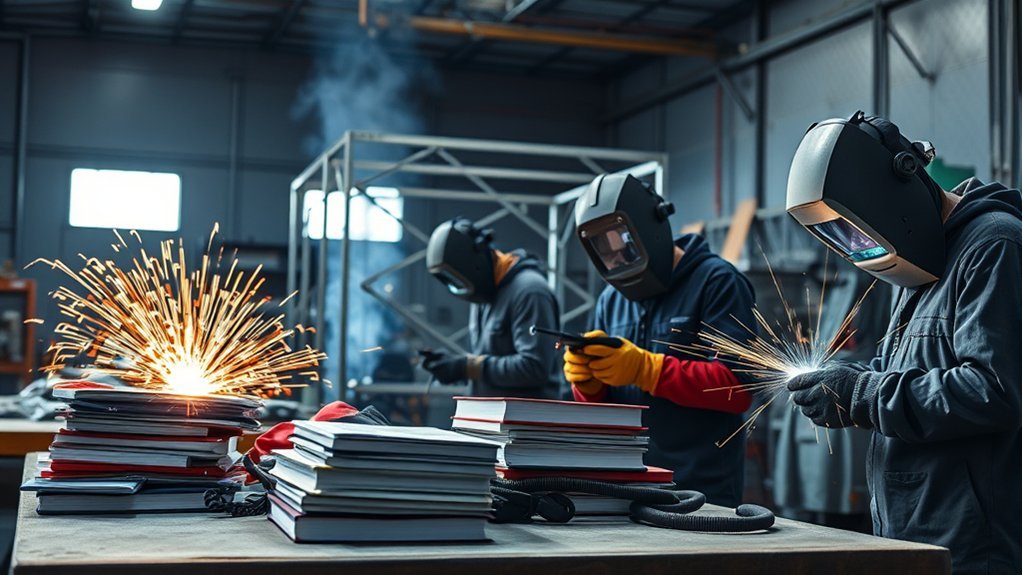
Tuition is only one part of the budget. Request a written cost sheet that separates required, optional, refundable, and one-time charges.
- Personal protective equipment: helmet, safety glasses, welding gloves, jacket or sleeves, leather boots, hearing protection, and sometimes a respirator selected under a proper safety program.
- Hand tools: chipping hammer, wire brush, pliers, soapstone, tape measure, square, clamps, and tool storage.
- Books and digital access: textbooks, code books, online platforms, and blueprint materials.
- Lab and consumable fees: plate, pipe, electrodes, wire, filler rod, shielding gas, grinding discs, and replacement lenses.
- Testing: welder qualification tests, certification applications, retests, drug screening, physical exams, or background checks when required by an employer.
- Living and travel: commuting, parking, relocation, housing, meals, and lost income if the schedule limits paid work.
- Loan cost: origination fees and interest can make the final amount repaid much higher than the amount borrowed.
Most students should not need to buy a full welding machine for class unless the school explicitly requires one. A legitimate hands-on program normally provides industrial lab equipment. Buying a machine for home practice is a separate decision and requires suitable electrical service, ventilation, fire protection, cylinder handling, and supervision.
Warning: Welding can expose you to metal fumes, ultraviolet radiation, burns, eye damage, electrical shock, and fire hazards. Practical training should take place with proper ventilation, PPE, equipment safeguards, and qualified supervision. Review OSHA’s welding hazard guidance before practicing outside a school lab.
Financial Aid and Funding Options

Eligible students at participating colleges and career schools can submit the Free Application for Federal Student Aid to be considered for federal grants, work-study, and student loans. Aid eligibility depends on the student, school, and specific program, so confirm the program’s federal school code and eligibility before enrolling.
| Funding source | What to know |
|---|---|
| Grants | Usually do not require repayment, but eligibility and satisfactory academic progress rules apply. |
| Scholarships | Check the school, local employers, unions, community foundations, and AWS Foundation scholarships. |
| Federal work-study | Part-time work is limited and not guaranteed; the FAFSA is required. |
| Federal loans | Borrow only after reviewing grants and scholarships. Compare the total amount repaid, not just the monthly payment. |
| WIOA or workforce funding | An American Job Center may help eligible workers pay for approved training in an in-demand occupation. |
| Employer or union sponsorship | May cover training or tools in exchange for employment, membership, or service commitments. |
Use the College Scorecard to compare average annual cost, completion, debt, and earnings data. You can also verify a school’s reported accreditation through the U.S. Department of Education accreditation database. Accreditation is one screening tool, not a guarantee of job placement or credit transfer.
Career Prospects and Earning Potential
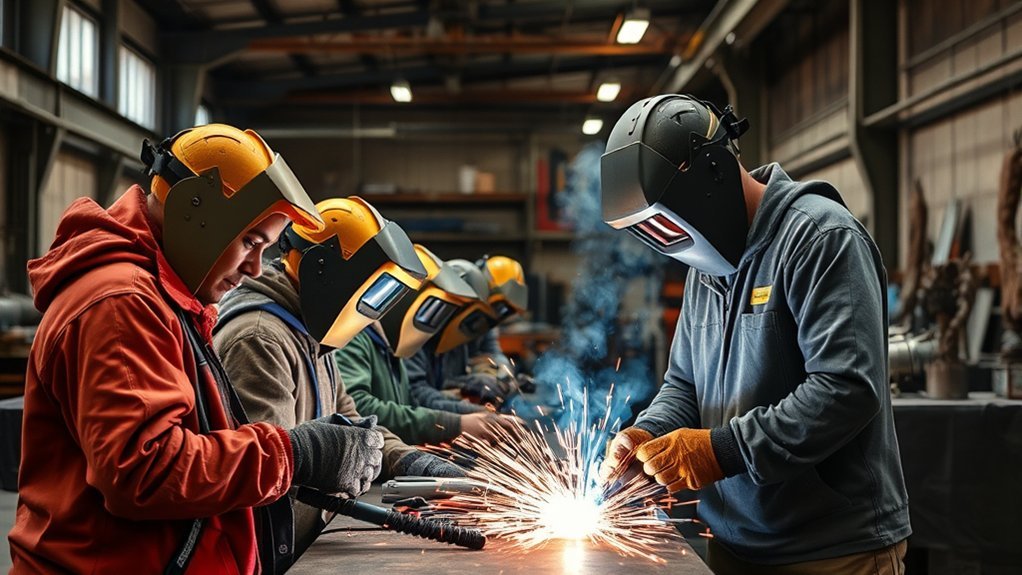
The latest Occupational Outlook Handbook data available from the U.S. Bureau of Labor Statistics reports a median annual wage of $51,000 for welders, cutters, solderers, and brazers in May 2024. The lowest 10% earned less than $38,130, and the highest 10% earned more than $75,850.
BLS projects about 45,600 openings for welders, cutters, solderers, and brazers each year from 2024 to 2034, mostly to replace workers who leave the occupation.
Pay varies by experience, welding process, industry, shift, union status, overtime, travel, security clearance, location, and the difficulty of the work. Specialized jobs such as pipe welding, aerospace fabrication, field construction, shipbuilding, and underwater work may require additional training, qualifications, travel, or hazardous-duty conditions. They should not be treated as typical entry-level outcomes.
Welding school can improve skills and access to employers, but a high tuition bill does not guarantee a high wage. Compare local job postings with the exact processes, materials, positions, certifications, and experience they require before choosing a program.

These Stanley MaxSteel straight aviation snips are built for clean, controlled cutting through sheet metal and other tough materials. Serrated cutting edges help prevent slippage for more accurate results, while the double pivot action delivers increased cutting power with less effort. Designed for dependable performance, they are a practical choice for metalworking, HVAC tasks, and general workshop use.

The Fullstar Pro Original Vegetable Chopper is a large-capacity kitchen tool designed to speed up everyday meal prep with fast, consistent dicing. Its compact, dishwasher-safe design features sharp stainless steel blades, a non-skid base, and a built-in catch tray for cleaner, easier cooking. Built for convenience and versatility, it helps make healthy dinners and family meals quicker and more enjoyable.

This daily devotional helps parents pray purposefully for their children through a full year of Scripture readings, reflections, and guided prayer prompts. Written to encourage faithful family discipleship, it offers practical, biblically grounded support for parents who want to shape their prayers around God's Word. A foreword by Sinclair B. Ferguson adds trusted theological insight and encouragement.
Factors Influencing the Cost of Welding Education

| Cost factor | Why it changes the price |
|---|---|
| Program length | More clock hours, semesters, and lab time usually mean more tuition and living costs. |
| Public or private school | Public colleges may receive taxpayer support; private schools set their own program prices. |
| Residency | In-district and in-state rates may be lower than out-of-state tuition. |
| Processes and materials | Pipe, stainless steel, aluminum, and multiple processes can require more equipment and consumables. |
| Included equipment | Some schools bundle PPE, tools, books, and testing; others bill them separately. |
| Schedule and location | Full-time attendance, commuting, relocation, and reduced work hours can raise indirect costs. |
| Financial aid | Gift aid lowers net price; loans delay payment but add interest and repayment risk. |
How to Compare Welding Programs
Collect the same information from at least three schools. Use a written comparison instead of relying on admissions calls or advertising.
- Define the target job. Review local postings for the welding processes, positions, materials, travel, and credentials employers request.
- Calculate total cost. Add tuition, mandatory fees, tools, PPE, books, testing, travel, housing, lost wages, and expected loan interest.
- Compare hands-on hours. Ask how much scheduled time is spent welding rather than watching demonstrations or completing theory.
- Check equipment access. Confirm booth-to-student ratios, machine types, ventilation, open-lab time, and whether consumables are rationed.
- Verify outcomes. Review completion, placement, debt, licensure or qualification results, and the school’s method for calculating each figure.
- Check transfer and refund rules. Get policies in writing before paying a deposit.
- Visit the lab. Speak with current students and observe cleanliness, supervision, PPE use, ventilation, and equipment condition.
Pro Tip: Divide the program’s total projected cost by its scheduled hands-on lab hours. This does not measure quality by itself, but it can expose expensive programs that provide limited booth time.
Frequently Asked Questions
Are there scholarships specifically for welding students?
Yes. Schools, employers, unions, community foundations, and the AWS Foundation offer welding-related scholarships. Eligibility, award amounts, and deadlines vary. Submit the FAFSA as well because some schools use it when awarding institutional aid.
Can I take welding classes online?
You can study safety, symbols, metallurgy, inspection, and process theory online. However, learning to weld requires supervised hands-on practice with real equipment. Treat an online-only course as theory training unless it includes an approved local lab or skills assessment.
What tools or equipment do I need for welding classes?
Most schools provide welding machines and shop equipment. Students often supply PPE and small hand tools. Ask for the official tool list before buying anything because helmet shade requirements, clothing rules, and approved equipment vary by program.
Is there an age requirement to enroll in welding programs?
There is no universal age rule. Adult career programs may require a high school diploma, GED, or minimum age, while high schools and community colleges may offer dual-enrollment welding to younger students. Safety, insurance, labor-law, and parental-consent rules can affect eligibility.
How do I choose the right welding program?
Start with the jobs available in your area. Then compare total cost, hands-on hours, processes taught, instructor qualifications, equipment, certification testing, completion, placement, debt, financial aid, and refund policies. Visit the lab and speak with current students before enrolling.
Is welding school required to become a welder?
Not always. BLS lists a high school diploma or equivalent plus technical and on-the-job training as the typical route. Some people enter through employers, the military, unions, or apprenticeships. School can provide structured practice and employer access, but employers still evaluate practical skill.
Does graduation make me a certified welder?
Not automatically. A school certificate documents program completion. AWS Certified Welder status requires a performance test, and employers may require additional qualifications for a specific code, process, material, thickness, position, or procedure.
Sources
- Hobart Institute of Welding Technology: Welding Programs — 2026 program tuition, equipment, materials, total projected cost, duration, and clock hours.
- U.S. Bureau of Labor Statistics: Welders, Cutters, Solderers, and Brazers — education, pay, safety context, and 2024–2034 employment outlook.
- American Welding Society: Certified Welder Program — performance-testing requirements and lack of educational prerequisites.
- Federal Student Aid: FAFSA Steps — federal grants, work-study, and loan access for eligible college and career-school students.
- Occupational Safety and Health Administration: Welding Hazards and Solutions — fumes, radiation, burns, electrical shock, and PPE controls.
- U.S. Department of Education: Database of Accredited Postsecondary Institutions and Programs — accreditation lookup.
Conclusion
Welding classes can be a practical investment, but the best-value program is not always the cheapest or fastest. Compare the complete cost, supervised welding hours, curriculum, equipment, testing, safety, aid, outcomes, and local hiring requirements. Get every promise in writing, avoid borrowing more than you can reasonably repay, and choose the program that builds the skills employers in your target field actually request.

This versatile cookware set equips home cooks with essential pots, pans, and a steamer insert for everyday meals and larger gatherings. The aluminum-encapsulated base promotes quick, even heating, while Cool Grip handles and tight-fitting glass lids support comfortable, controlled cooking. Designed for stovetop, oven, broiler, and dishwasher use, it offers reliable performance across a wide range of recipes.

This Ultra PRO bundle provides layered protection for standard trading cards with clear rigid toploaders and soft inner sleeves. It helps guard against bending, scratches, and dust while keeping cards visible for display, storage, shipping, and everyday handling. Ideal for collectors who want a reliable way to protect and organize valuable cards.

The DEWALT TSTAK Mobile Storage unit delivers a spacious, stackable solution for organizing and transporting tools with ease. Its telescopic handle, durable 7-inch wheels, and bi-material top handle make moving loads more comfortable, while rust-resistant metal latches and side latches support secure stacking with other TSTAK units. Built for convenience and mobility, it is ideal for professionals and DIY users who need dependable on-the-go storage.
