
Choosing between a hostel and a hotel in the United States is not just about finding the lowest nightly rate. A hostel dorm bed is often the cheapest choice for one traveler, while a private hostel room or a hotel can offer better value for couples, families, and anyone who wants more privacy. The best deal depends on dates, location, room occupancy, taxes, amenities, and cancellation terms.
Quick Answer
For a solo traveler, a hostel dorm bed usually costs much less than a hotel room. However, private hostel rooms can approach or exceed budget-hotel prices. Compare the final price per person for the same dates, neighborhood, refund policy, bathroom type, and included amenities before booking.
Key Takeaways
- Dorm beds are priced per person, while hotel rooms and most private hostel rooms are priced per room.
- A current U.S. hostel data set reports an average dorm-bed rate of about $38 before taxes and fees, while the U.S. hotel industry’s June 2026 average daily room rate was $173.76. These figures use different methods and are not a direct like-for-like comparison.
- For two or more travelers, one private room may cost less than buying several dorm beds.
- Since May 12, 2025, U.S. short-term lodging sellers must display known mandatory fees in the upfront total price, although taxes and optional extras may appear later before payment.
- Privacy, location, cancellation rules, age policies, lockers, parking, breakfast, and transit costs can change which option is the better value.
Understanding the Basics: What Is a Hostel vs. a Hotel?

A hostel is a budget-focused lodging property that commonly sells individual beds in shared dorm rooms. Many hostels also offer private rooms, shared kitchens, lounges, laundry facilities, tours, and social events. Bathrooms may be shared, ensuite, or a mix of both.
A hotel generally sells private rooms with controlled access and either one or more beds. Most hotels include a private bathroom, while services such as breakfast, parking, housekeeping, a gym, a pool, or room service depend on the property and rate.
The biggest pricing difference is the unit being sold. A dorm rate usually covers one bed for one person. A hotel rate usually covers one room up to its stated occupancy. A private hostel room is also usually sold by the room, but you should confirm this before paying.
| Feature | Hostel | Hotel |
| Typical booking unit | One dorm bed or one private room | One private room |
| Bathroom | Shared, ensuite, or mixed | Usually private |
| Social setting | Often communal and activity-focused | Usually more private and independent |
| Best fit | Solo travelers, backpackers, and social travelers | Couples, families, business travelers, and privacy-focused guests |
Cost Breakdown: Nightly Rates for Hostels vs. Hotels
There is no single national price that applies to every hostel or hotel. Rates change by city, neighborhood, weekday, season, event calendar, room type, and refund policy. A useful comparison must also separate a per-person dorm rate from a per-room hotel rate.
Current 2026 Price Benchmarks
A current U.S. hostel-price data set based on hundreds of listings reports an average dorm-bed rate of about $38 per person per night before taxes and fees. That number is a broad planning average, not a guaranteed quote for a specific city or date.
By comparison, CoStar reported a U.S. hotel average daily rate of $173.76 per occupied room in June 2026. This figure covers the wider hotel market, not only economy hotels, and June pricing was lifted by major events, including the 2026 FIFA World Cup.
Note: The $38 hostel figure is per dorm bed, while the $173.76 hotel figure is per occupied room. They come from different data sets and should be used as broad context, not as a promise that a hostel will always be a certain percentage cheaper.
Compare Price per Person, Not Just the Nightly Price
Group size can reverse the result. Using a $38 dorm-bed planning figure, two travelers would spend $76 for two beds and four travelers would spend $152 for four beds before taxes and fees. One hotel room or private hostel room that legally accommodates the group may cost less, especially when a private bathroom, breakfast, towels, and parking are included.
| Traveler setup | What to compare | Likely value winner |
| One traveler | One dorm bed versus one hotel room | Usually the dorm bed |
| Two travelers | Two dorm beds versus one private room | Depends on the live rate and bathroom type |
| Family or small group | Several beds versus one or two legal-occupancy rooms | Often a hotel, suite, or whole private hostel room |
Seasonal and Event Price Fluctuations
Hostel and hotel rates can rise sharply during summer weekends, holidays, conventions, concerts, college events, and major sports tournaments. CoStar’s June 2026 data showed U.S. hotel rates up 6.7% from June 2025, with World Cup demand affecting several markets. A property that is affordable on a quiet Sunday may be expensive on a Friday with a major event nearby.
Check at least two date combinations when your schedule is flexible. Moving a stay by one or two nights, choosing a nearby neighborhood, or staying close to reliable public transportation can reduce the total cost without lowering the quality of the trip.
Pro Tip: Compare the same room type on the property’s direct site and one established booking platform. Match the dates, number of guests, refund terms, taxes, mandatory fees, and bed or bathroom type before deciding which listing is cheaper.
Hidden Fees and the Upfront Total Price Rule
The U.S. pricing rules changed before 2026. Under the Federal Trade Commission’s Rule on Unfair or Deceptive Fees, effective May 12, 2025, sellers of short-term lodging must display the total price including known mandatory fees upfront. Government taxes and optional add-ons may be excluded from that first displayed total, but the final amount must be shown before payment.
This means a required resort fee, destination fee, mandatory cleaning fee, or unavoidable service charge should not appear as a surprise at the end of checkout. You should still review the final payment screen because taxes, parking, pet fees, optional breakfast, laundry, luggage storage, late checkout, or other chosen extras can increase the amount you pay.
Monthly Rates: Hostels vs. Hotels
Monthly prices vary too much to support a universal claim such as “hostels cost $500 to $800 per month.” At a $38 nightly dorm-bed average, 30 nights would equal $1,140 before any discount, tax, or extra fee. Some properties offer weekly or monthly deals, but others limit the maximum stay or do not accept local residents.
How to Calculate a Long-Stay Price
- Enter the full 28- or 30-night stay on the booking site instead of multiplying a one-night quote.
- Check whether the rate is for one bed, one private room, or the entire unit.
- Add taxes and any optional services you will actually use.
- Ask whether linens, towels, housekeeping, laundry, kitchen access, luggage storage, and Wi-Fi are included.
- Review maximum-stay, local-resident, identification, deposit, and cancellation rules.
- Compare the total with an extended-stay hotel, furnished rental, or sublet that is legal for the location.
Long-Term Stay Benefits and Tradeoffs
A hostel can reduce food costs when it has a usable kitchen, but the savings depend on your eating habits and local grocery prices. A hotel may offer a refrigerator, microwave, free breakfast, workspace, regular housekeeping, and stronger loyalty benefits. Extended-stay hotels may also include a kitchenette and quote a lower weekly rate than a standard hotel.
For a long stay, comfort matters more than it does for one night. Ask about quiet hours, workspace, storage, bathroom capacity, ventilation, laundry, mattress privacy curtains, and how often dorm roommates change. A cheap bed can become poor value if you must spend more on meals, transportation, coworking space, or secure storage.
Identifying Common Fees in Hostels and Hotels
Mandatory charges should now be included in the prominently displayed lodging total under the FTC rule. However, government taxes and optional services may still appear separately before payment. The exact amount depends on the city, property, and choices you make.
| Possible charge | Hostel | Hotel |
| Taxes | Common and location-specific | Common and location-specific |
| Towels or linens | Often included, but confirm | Normally included |
| Locker or lock | Locker may be included; a padlock may be needed | In-room safe may be included |
| Parking | Limited or unavailable in many city properties | May be free, paid, valet-only, or off-site |
| Breakfast | Included at some properties | Included, optional, or paid depending on rate |
| Luggage storage or late checkout | May be free or paid | May be free for a limited time or paid |
Taxes are not uniform across the country. For example, New York City lodging can include city hotel occupancy tax, state and city sales taxes, and a state hotel unit fee. Check the final total for your actual destination instead of applying a national percentage.
Amenities and Services: What to Expect
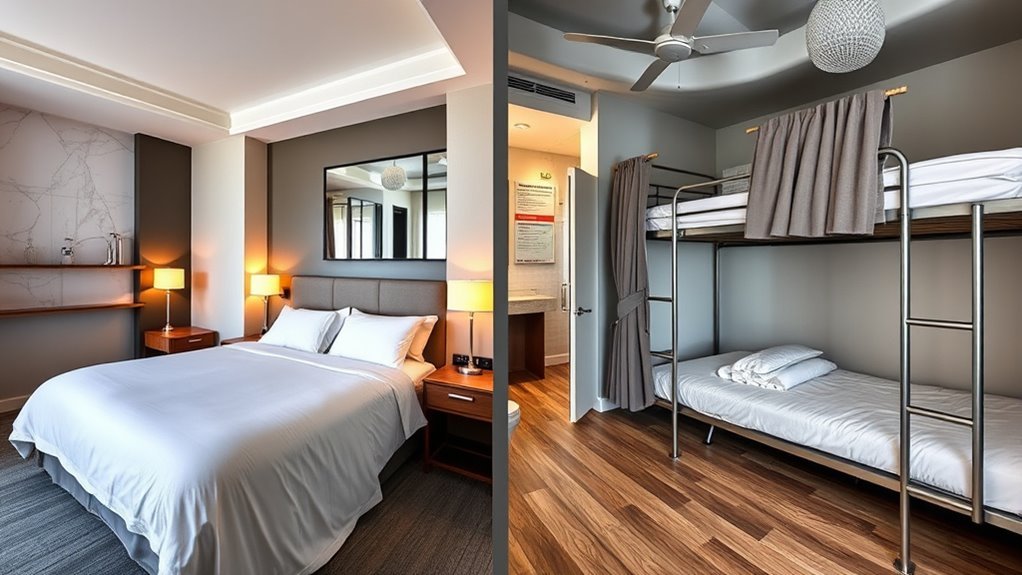
Hostels often focus on shared facilities and social experiences. You may find a communal kitchen, lounge, game room, walking tour, group dinner, laundry room, or coworking area. The tradeoff is that you may share sleeping space, bathrooms, outlets, and storage with other guests.
Hotels usually focus on private space and predictable service. A private bathroom, climate control, television, desk, daily or request-based housekeeping, and front-desk support are common, but not guaranteed at every budget property. Breakfast, parking, pools, gyms, and airport shuttles may be included or may cost extra.
Do not compare labels alone. A well-run hostel private room can be quieter and cleaner than a low-rated hotel, while a full-service hotel can provide far more comfort than a large dorm. Read recent reviews that mention your exact room type, not only the property’s overall score.
Comparing Safety and Privacy in Hostels vs. Hotels
Neither category is automatically safe or unsafe. Safety depends on the building, neighborhood, management, access controls, staff coverage, guest behavior, and how you protect your belongings.
In a dorm, look for assigned lockers, secure room access, a staffed desk, adequate lighting, clear emergency exits, recent cleanliness reviews, and separate or mixed dorm choices that fit your comfort level. HI USA states that its dorm guests receive in-room lockers, although guests may need to bring their own lock at many properties. Property rules can also require valid photo identification or an adult guardian for minors.
A hotel gives you a private room, but you should still use the deadbolt or secondary lock, store valuables securely, confirm visitors before opening the door, and check recent reviews for security and maintenance problems. Soundproofing, housekeeping quality, and 24-hour staffing vary widely, especially among low-cost properties.
Warning: Avoid listings that demand wire transfers, gift cards, cryptocurrency, or payment outside a trusted booking channel. The FTC recommends researching the property’s name with words such as “scam,” “review,” or “complaint” and verifying that you are using the real company website.
How to Decide: Hostel or Hotel?
Start with the final cost, then check whether the cheaper option supports the trip you actually want. A low nightly rate is not a bargain if it creates extra transportation costs, poor sleep, unsafe storage, or a cancellation loss.
A Five-Step Decision Method
- Calculate the all-in price per person. Include taxes, mandatory fees, parking, breakfast, towels, locks, and transit.
- Match the dates and policies. Compare refundable with refundable, or nonrefundable with nonrefundable.
- Check the room details. Confirm dorm size, bed type, private or shared bathroom, legal occupancy, air conditioning, and accessibility needs.
- Measure location value. Estimate the time and money needed to reach the places you plan to visit.
- Read recent reviews. Focus on noise, cleanliness, security, staff response, Wi-Fi, and the exact room type you intend to book.
Best Choice by Traveler Type
- Solo budget traveler: A dorm bed is often the lowest-cost option and makes it easier to meet people.
- Couple: Compare two dorm beds with one private hostel room and one budget hotel room.
- Family with children: A hotel or whole private hostel room is often easier because of privacy, bathroom access, and age rules.
- Business traveler or light sleeper: A hotel usually provides a more predictable private workspace and sleeping environment.
- Long-stay traveler: Compare hostel discounts with extended-stay hotels and legal furnished rentals, then consider kitchens, laundry, storage, and maximum-stay limits.
- Social traveler: A hostel with organized events and strong recent reviews may provide more value than a private hotel room.
Booking Checklist
- Is the price per bed or per room?
- How many guests are included?
- Are taxes shown before payment?
- Are all mandatory property fees included in the upfront total?
- Is the bathroom private, ensuite, or shared?
- Are towels, linens, breakfast, Wi-Fi, lockers, and parking included?
- Do you need to bring a padlock?
- Are there age, local-resident, identification, curfew, or maximum-stay rules?
- What is the cancellation deadline and no-show charge?
- How recent are the reviews about cleanliness, noise, and security?
The cheapest listing is not always the lowest-cost stay. Compare the final price per person after room occupancy, taxes, transportation, meals, and required extras.
Frequently Asked Questions
How much does a hostel cost compared with a hotel in the USA?
A current U.S. hostel data set reports an average dorm bed of about $38 per person before taxes and fees. CoStar reported a U.S. hotel average daily room rate of $173.76 for June 2026. These are different measures, so use them as broad context and compare live all-in quotes for your exact dates.
Are hostels always cheaper than hotels?
No. A dorm bed is often cheaper for one person, but two or more dorm beds can cost more than one budget hotel room. Private hostel rooms may also be close to hotel prices during busy dates.
What are the main disadvantages of staying in a hostel?
Common tradeoffs include less privacy, shared bathrooms, roommate noise, limited storage, changing roommates, and property-specific age or stay rules. A private hostel room can reduce some of these issues.
Is a private hostel room better than a budget hotel?
It can be. A private hostel room may include access to a kitchen and social areas, while a hotel may offer a private bathroom, quieter space, parking, breakfast, or more predictable housekeeping. Compare the exact room and included services.
Are hostels suitable for families and older travelers?
Many are, especially when they offer private family rooms. However, age rules, top-bunk limits, guardian requirements, and dorm policies vary. Check the property’s rules before booking.
Can hotels and hostels still charge extra fees in 2026?
Yes, but known mandatory lodging fees must be included in the upfront displayed total under the FTC rule. Government taxes and optional extras can be shown later, as long as the final amount is clearly disclosed before payment.
Do hostels offer cheaper monthly rates?
Some offer weekly or monthly discounts, but there is no standard national monthly rate. Enter the full stay dates, check maximum-stay rules, and compare the total with extended-stay hotels and other legal long-term options.
Conclusion
A hostel dorm is usually the strongest budget choice for a solo traveler who is comfortable sharing space. A hotel or private hostel room may provide better value for couples, families, groups, business travelers, and light sleepers. Compare the final per-person total, location, privacy, amenities, reviews, and cancellation rules. The better option is the one that meets your needs without creating extra costs elsewhere in the trip.
Sources
- Budget Your Trip: USA Average Hostel Prices — current planning data for U.S. dorm-bed prices based on hostel listings.
- CoStar: U.S. Hotel Performance for June 2026 — national hotel average daily rate, occupancy, and event-related movement.
- Federal Trade Commission: Rule on Unfair or Deceptive Fees FAQ — upfront total-price requirements for short-term lodging.
- U.S. General Services Administration: FY 2026 Per Diem Bulletin — official FY 2026 standard federal lodging allowance context.
- Hostelling International USA: New to Hostels FAQ — hostel lockers, age policies, and guest expectations.
- Federal Trade Commission: How to Avoid a Travel Scam — booking and payment safety guidance.