
California doesn’t offer a dedicated seven‑day fishing license, so you’ll pay about $62.90 for the nonresident 10‑day short‑term license or combine one‑ and two‑day resident licenses (one‑days are $20.52, two‑days $31.58) to cover a week, which typically costs at least the same. Short‑term licenses don’t include validations or species report cards (Ocean Enhancement $7.05, second rod $19.70, salmon $8.90), and discounted options exist for veterans and qualified individuals — keep going to get full purchase, reporting, and replacement details.
Who Needs a 7-Day Fishing License in California
Wondering who needs a 7‑day fishing license in California? You technically won’t find a 7‑day product: California offers a Two‑Day Sport Fishing License at $31.58 and a Ten‑Day Nonresident Sport Fishing License at $62.90, while residents can buy a 365‑Day Sport Fishing License for $62.90.
Under state fishing regulations, anyone 16 or older must possess a valid fishing license when taking fish or aquatic life, regardless of residency. That means you’d need to buy one of the available short‑term or annual licenses if you plan to fish off a boat or shoreline where a license is required.
If you’re 16 or older, you must carry a valid fishing license when taking fish or aquatic life from shore or boat.
You don’t need a license to fish from public piers, and anglers under 16 are exempt from licensing (though they may need species‑specific report cards).
To determine who qualifies for each product, check residency status and trip length: nonresidents usually choose the Ten‑Day option for short stays, while residents often purchase the 365‑Day license for year‑round coverage.
One-Day, Two-Day, and Weekly License Options Compared
Because California doesn’t offer a seven‑day license, you’ll choose between short‑term options that fit your trip length and residency: a One‑Day Sport Fishing License ($20.52) covers a single specified day, a Two‑Day Sport Fishing License ($31.58) covers two consecutive days, and nonresidents can opt for a Ten‑Day license ($62.90) for longer stays.
You can also combine one‑ and two‑day licenses to span a week, and note that all these short‑term licenses are exempt from the Ocean Enhancement Validation.
Compare costs and coverage: two consecutive days cost $31.58 (average $15.79/day), one day costs $20.52, and the ten‑day nonresident pass averages $6.29/day.
If you need seven days, combining one two‑day and five one‑day licenses is inefficient; instead mix two‑day blocks plus single days to minimize unused days.
Check fishing regulations before you buy: season, size, and catch limits still apply regardless of license duration.
Buy only the short term licenses that match your itinerary to avoid overpaying.
Products Worth Considering

Comes with pre-drilled holes for easy installation
Cost Breakdown: Resident Vs Nonresident Weekly Rates
If you need a full week of fishing, compare the fixed short‑term prices so you won’t overpay: residents must stitch together one‑ and two‑day licenses (one day = $20.52; two days = $31.58), which means the cheapest resident seven‑day combination costs at least $62.90 in total when using only one‑day licenses, while non‑residents can simply buy the ten‑day nonresident license for $62.90 and cover seven days with lower per‑day cost.
You’ll want to calculate per‑day rates: residents paying $20.52 per one‑day license average $20.52/day; a two‑day at $31.58 equals $15.79/day but you can’t buy a 7‑day flat resident pass.
Nonresident options include the $62.90 ten‑day license, which averages $6.29/day over ten days and $8.99/day across seven days.
Factor in resident benefits like eligibility for longer seasonal passes (not the ten‑day), and weigh convenience versus exact cost when choosing combinations to cover a seven‑day trip.
What’s Included: Validations and Report Cards for a 7-Day Pass
If you’re planning short-term fishing, know that a true 7-day license isn’t offered—your closest options are a Two‑Day Sport Fishing License ($31.58) or a Ten‑Day Nonresident License ($62.90).
You’ll also need to add specific validations like the Ocean Enhancement ($7.05) or Second Rod ($19.70) depending on gear and location, and separate species report cards such as the North Coast Salmon card ($8.90) or the no‑fee Sturgeon report card.
Note that some short-term exemptions exist but harvest reporting deadlines still apply, with penalties for late submissions on species like Spiny Lobster.
Required Fishing Validations
Wondering what additional costs you’ll face for a 7-day fishing outing? You need a clear fishing regulations overview and a validation necessity explanation: short-term licenses don’t include required validations or species report cards, so budget separately.
- Ocean Enhancement Validation: $7.05 — mandatory for ocean fishing south of Point Arguello, even on short-term passes.
- Second Rod Validation: $19.70 — required to use two rods in inland waters during your 7-day period.
- Species report cards: costs vary — North Coast Salmon Report Card $8.90; Sturgeon report card free for catch-and-release but still may be required.
- License base: two-day sport license priced at $31.58; no dedicated cumulative 7-day pass exists.
Purchase validations and report cards in addition to the license.
Species Report Card Needs
Because short-term licenses don’t cover species-specific obligations, you’ll often need to buy separate report cards and validations for a 7-day outing: examples include the North Coast Salmon Report Card ($8.90), the Sturgeon Fishing Report Card (free for catch‑and‑release but may still be required), and the Ocean Enhancement Validation ($7.05) for ocean fishing south of Point Arguello — note that some report cards (e.g., Spiny Lobster) have fixed return deadlines like January 31 or April 30 regardless of license duration.
You should verify species regulations before you fish: a two-day license ($31.58) or ten-day nonresident ($62.90) doesn’t waive report card requirements. Report cards can be mandatory even when a license isn’t. Track submission deadlines and carry proof of validations while fishing.
Short-Term License Exemptions
Want to know what a short-term (seven-day) fishing plan actually includes?
You can assemble a week of coverage by combining a one-day ($20.52) and a two-day ($31.58) license; that approach illustrates short term license benefits and fishing license flexibility without a formal 7-day product.
Short-term licenses are exempt from the $7.05 Ocean Enhancement Validation.
Report cards apply only for specific species: Sturgeon requires a Sturgeon Fishing Report Card; North Coast salmon needs an $8.90 Salmon Report Card.
Plan trips around license durations to remain compliant.
- One-day + two-day combo covers seven days.
- No Ocean Enhancement Validation required.
- Species-specific report cards may still apply.
- Schedule fishing days to match license validity.
Reduced‑Fee and Free Short‑Term Licenses
While there isn’t a specific 7‑day option, you can purchase short‑term licenses at several price points: a one‑day sport fishing license costs $20.52, a two‑day license is $31.58 for residents and nonresidents, and a ten‑day nonresident license is $62.90.
Disabled veterans and recovering service members can buy a reduced‑fee short‑term license from CDFW for $9.79, and certain individuals (for example, qualifying low‑income Native Americans and people with verified mobility impairments) are eligible for free short‑term licenses.
Disabled veterans and recovering service members can purchase reduced $9.79 short-term licenses; some qualifying Native Americans and mobility-impaired individuals get free licenses.
You should know reduced fee options apply only when you meet documented eligibility criteria; disabled veterans and recovering service members must present appropriate proof to CDFW.
Free short‑term licenses require verification of status, such as tribal enrollment or medical certification of mobility impairment, and are limited to qualifying groups.
One‑day and two‑day short‑term licenses are exempt from the Ocean Enhancement Validation, so you won’t need that extra endorsement.
Review the specific eligibility criteria before applying to ascertain you select the correct reduced or free short‑term license.
Products Worth Considering


Product Material: Our license plate frame is made of premium quality aluminum, which ensures that the plate frame will never wear out. Corrosion resistant, Personalized Car Frame Can Perfect to Put on Your Front of Car,Decorate your car to make it look more beautiful and unique.

FISHING LICENSE HOLDER W/ZIP CLOSURE
Where and How to Purchase a 7-Day Fishing License
Looking for a seven‑day option? You’ll use consecutive Two‑Day Sport Fishing Licenses ($31.58 each) to cover a week. Buy online via the California Department of Fish and Wildlife (CDFW) website, at CDFW license sales offices, or through independent license agents statewide. Note payment rules and documentation requirements before you purchase.
- Online: fast, available 24/7, prints or stores license digitally; good for immediate use.
- CDFW offices: accept debit/credit or checks only (no cash); staff can verify License Documentation.
- Independent agents: available across California; agents may accept different payment methods—confirm first.
- Reduced‑fee process: bring ID and supporting documents; offices and agents will require proof.
Keep each Two‑Day license in immediate possession while fishing to meet regulations. Track purchase dates so two consecutive Two‑Day licenses equal seven days of coverage.
Double‑check License Documentation rules for reduced fees to avoid denied purchases.
Products Worth Considering

Add a touch of humor and flair to your car with this funny "Weekend Hooker" front license plate. Perfect for the bass fishing enthusiast, this custom car tag is a great gift for men, especially for dads, husbands, or any fishing fanatic. Whether you're an outdoorsman or just enjoy a good laugh, this novelty license plate is sure to bring a smile to your face and enhance your fishing-themed car decor. Let your personality shine on the road with this fun and unique accessory.

USA, License, plate, Vintage, tag, lot, set, plates, number, wall, decor, art, bar, restaurant, design, gift, cool, nice, american, america, hawaii, alaska, california, texas

EASY & FUN TO CUSTOMIZE: Click "Customize Now" to add your personalization to your mini Calfironia state plate!
How to Report Harvests During a Weekly License Period
When you fish under a weekly license, report harvests by the species-specific deadlines (for example, January 31 for the Spiny Lobster Report Card) to avoid non-return fees.
Log into the Online License Service, choose HARVEST REPORTING, and follow the prompts to submit date, location, species, and count for each catch.
Remember you must obtain and complete required report cards for species like sturgeon and salmon even on short-term licenses.
When to Report
Need to report now? You must meet species-specific reporting deadlines for timely harvest submission; failure can trigger fines or late fees. Check reporting deadlines before you fish and again after harvests.
- Spiny Lobster: report by April 30 per the Spiny Lobster Report Card.
- Sturgeon: follow its report card rules; catch-and-release has no fee but still requires compliance.
- Youth under 16: buy required report cards for regulated species and report their harvests on the same schedule.
- Online option: use CDFW’s Online License Service, choose HARVEST REPORTING to file records electronically.
Track species, dates, and card numbers. Missing deadlines may incur penalties, so prioritize timely, accurate submissions.
How to Submit
1 clear step: during a weekly license period you must record and submit any regulated-species harvests using the correct report card (for example, the Spiny Lobster Report Card), and failure to return required cards by their deadlines can trigger non‑return fees or other penalties.
You’ll note species, dates, and counts as you fish, because harvest reporting deadlines vary by species — e.g., Spiny Lobster cards are due April 30.
For online submission, log into the Online License Service, select harvest reporting, follow prompts, and confirm receipt number.
Even on days a license isn’t required you must still return mandated cards.
Accurate, timely reports improve management and avoid fines; set reminders for each card’s deadline and keep a personal catch log to cross-check submissions.
What to Include
Having recorded your catches and obtained a receipt number, you’ll also need to include specific items on each report card for weekly-license harvests: species name, date and time of take, exact count or weight, location (river, lake, or defined marine area), gear type, and whether the catch was kept or released.
You must report species that require a card (spiny lobster, steelhead, salmon), even on short-term licenses. Use the CDFW Online License Service to log entries and retain confirmation.
Note deadlines (spiny lobster due April 30) and fees for non-return. The North Coast Salmon Report Card costs $8.90 and is required in designated systems.
Accurate reporting supports compliance with fishing regulations and conservation efforts.
- Species and quantity
- Date/time and location
- Gear and disposition
- Receipt/submission confirmation
Replacing Lost Short‑Term Licenses and Duplicate Fees
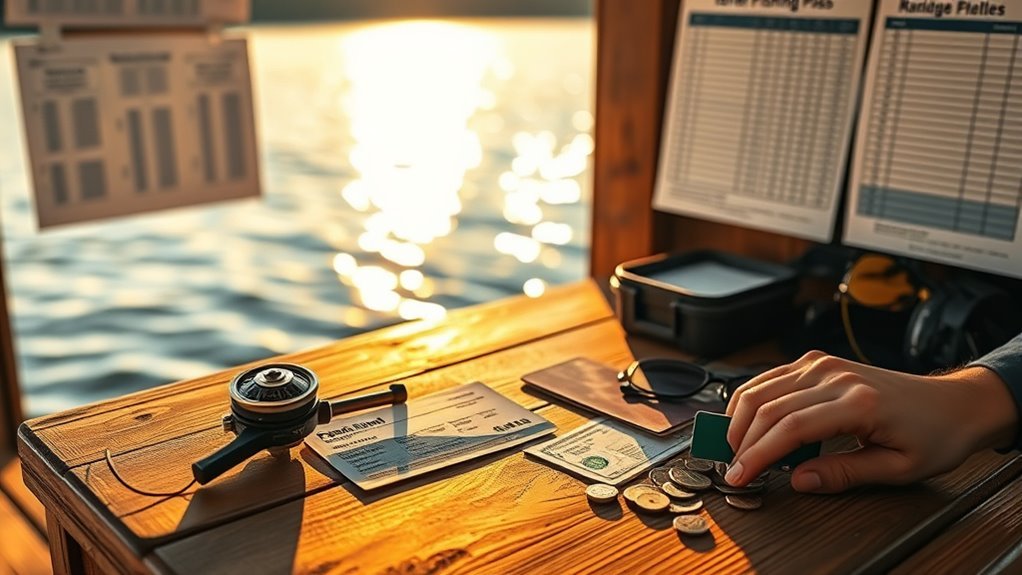
If you lose a short-term fishing license, you can quickly restore your legal status by purchasing a duplicate online, at licensed agents, or at CDFW offices for a small fee; note that Sturgeon Fishing Report Cards can only be replaced in person at CDFW offices.
The duplicate license process is straightforward: pay the stipulated replacement fee, provide identifying information or original purchase details, and receive a duplicate that reestablishes your authority to fish without reapplying for a new license.
Consider these lost license solutions to minimize downtime: register accounts where available to speed verification, keep purchase receipts, and note agent locations and CDFW office hours.
Register accounts, keep receipts, and note agent locations and CDFW hours to minimize lost-license downtime.
Protect physical licenses from heat damage—do not heat-laminate—as thermal alteration can invalidate them. Duplicate licenses remain valid even if discolored, provided text and signature are legible.
Track your license status and document replacements to avoid duplicate fees paid in error; contact CDFW promptly if you suspect billing or processing issues to resolve them efficiently.
Frequently Asked Questions
Can I Transfer My 7-Day License to Another Person?
No — you can’t transfer a 7-day license to another person; license transfer policies and fishing license regulations typically prohibit reassignment. Check your state agency’s data for exceptions, documentation requirements, or refund/cancellation procedures.
Are There Age Limits for Purchasing a Weekly Pass?
Yes — you’re usually limited by age restrictions; agencies require proof and set minimums or senior rules. Check purchasing options, fees, ID requirements, and exemptions; state-by-state data confirm varying minimum ages and discounted rates.
Do Weekly Passes Cover Both Freshwater and Saltwater Fishing?
Yes — your weekly pass can cover both freshwater regulations and saltwater rules, but you’ll need to verify the state’s specific endorsements, zones, and species limits, since some jurisdictions require separate permits or additional fees.
Are Boat-Based Anglers Subject to Different Weekly Fees?
Yes — you’ll often pay additional boat fees and different weekly rates; check fishing regulations per state or jurisdiction, since vessel permits, launch fees, and required endorsements can change costs and legal requirements for boat-based anglers.
Can I Extend a 7-Day License After It Expires?
You can’t extend a 7-day license after expiration; investigating renewal process records shows agencies require new purchase, not retroactive extension, per expiration policy data—so renew promptly to avoid fines, gaps, or lost coverage.
Conclusion
You’ll save select sums and stay swimmingly safe by securing a seven‑day stamp when short stays spur sportfishing. Check California’s current costs for resident versus nonresident weekly rates, confirm required validations and report cards, and note reduced‑fee exceptions. Buy online, at license agents, or on the go; report harvests promptly to prevent penalties. Replace lost short‑term papers quickly to avoid duplicate fees—smart shopping saves money, smooths stewardship, and supports sustainable saltwater and freshwater sportfishing.
