
West Virginia does not offer a three-day fishing license in 2026. The closest short-term choices depend on residency: qualifying residents can buy a five-day license, while nonresidents can buy a one-day license. The advertised base price is only part of the cost because most anglers also need a conservation stamp, and trout fishing generally requires a separate trout stamp.
Quick Answer
West Virginia does not sell a three-day fishing license. In 2026, residents can buy an $8 five-day Class L license, while nonresidents can buy a $3 one-day Class LL license. Required stamps and purchase fees increase the total, and trout anglers generally need an additional trout stamp.
Key Takeaways
- West Virginia has no resident or nonresident three-day fishing license.
- A resident five-day license normally starts at $13 after adding the required $5 conservation stamp but before purchase fees.
- A nonresident’s first one-day license normally starts at $16 after adding the $13 Conservation/Law Enforcement Stamp but before purchase fees.
- Trout fishing generally raises those totals to $23 for a resident five-day license or $32 for a nonresident’s first one-day license.
- Anglers age 15 and older generally need a license and must carry valid identification while fishing.
- West Virginia’s 2026 Free Fishing Days are June 13 and 14.
West Virginia Short-Term Fishing License Options
The current 2026 West Virginia Fishing Regulations Summary lists two main short-term options:
- Residents: The Class L five-day fishing license costs $8 and covers five consecutive days selected by the buyer and shown on the license.
- Nonresidents: The Class LL one-day fishing license costs $3 for each licensed day.
Neither option becomes a three-day license. A nonresident planning to fish for three days would normally purchase one-day privileges for each fishing day and add any required annual stamps. A qualifying resident would normally choose the five-day license even when the trip lasts only three days.
Note: The resident five-day license is not a visitor license. West Virginia generally defines a resident as someone who has been domiciled in the state for at least 30 consecutive days immediately before applying, subject to specific student and military provisions.

This daily devotional helps parents pray purposefully for their children through a full year of Scripture readings, reflections, and guided prayer prompts. Written to encourage faithful family discipleship, it offers practical, biblically grounded support for parents who want to shape their prayers around God's Word. A foreword by Sinclair B. Ferguson adds trusted theological insight and encouragement.

These colorful answer buzzers turn lessons, review games, and family activities into lively game-show style challenges that boost participation and make learning more interactive. Each buzzer has a distinct sound to clearly identify who buzzed in first, while the durable, palm-sized design makes them easy for kids and adults to use in classrooms, homeschools, and group settings.

This heartfelt memoir blends laugh-out-loud honesty with tender reflections on love, loneliness, and the unexpected healing power of rescue dogs. Isabel Klee shares her journey fostering pups in the city while navigating dating and self-discovery, offering an intimate, relatable story for readers who enjoy emotional, character-driven narratives. It is a warm, engaging read about opening your heart and finding connection in surprising places.
2026 Costs and Required Stamps
The $8 resident and $3 nonresident figures are base-license prices. Most anglers must also buy the conservation stamp assigned to their license type. Trout anglers generally need a separate trout stamp.
| License option | Base license | Required conservation stamp | Standard total before purchase fee | Total when fishing for trout |
|---|---|---|---|---|
| Resident five-day, Class L | $8 | $5 Class CS | $13 | $23, including the $10 Class O trout stamp |
| Resident annual, Class B | $19 | $5 Class CS | $24 | $34, including the $10 Class O trout stamp |
| Nonresident one-day, Class LL | $3 per fishing day | $13 Class CS/LE | $16 for the first day | $32 for the first trout-fishing day, including the $16 Class OO trout stamp |
| Nonresident annual, Class F | $37 | $13 Class CS/LE | $50 | $66, including the $16 Class OO trout stamp |
The conservation and trout stamps are annual privileges. If you already hold the required current-year stamp, you generally do not buy the same stamp again for each additional short-term license.
Purchase and Location Fees
- Online: The official system charges a $2 transaction fee.
- Telephone: The Hunting and Fishing License Unit charges a $2 transaction fee.
- Retail agent or designated county clerk: The stated issuing fee is $3 for the first purchase and $1 for subsequent purchases.
- National Forest fishing: A nonresident fishing on National Forest land with Class F, LL, or F-L also needs the $2 Class I stamp.
A resident five-day fishing package normally starts at $13 before the purchase fee, not $8. Adding the resident trout stamp raises the starting total to $23.
Pro Tip: Compare the annual option before buying several short-term licenses. A resident annual fishing license plus the conservation stamp starts at $24 before purchase fees, only $11 more than the first resident five-day package.
How to Buy a Short-Term Fishing License
You can buy a West Virginia fishing license online, from an authorized agent, or by telephone.
- Confirm your residency status. Choose Class L only if you qualify as a West Virginia resident. Otherwise, choose the nonresident Class LL one-day license.
- Select the license and dates. Residents select the five consecutive days covered by Class L. Nonresidents select each day for which Class LL is needed.
- Add the required stamp. Add Class CS for a resident or Class CS/LE for a nonresident unless an exemption or existing current-year privilege applies.
- Add a trout stamp when required. Choose Class O for a resident or Class OO for a nonresident if you plan to fish for trout.
- Add any location-specific stamp. Nonresidents fishing on National Forest land may also need Class I.
- Pay and keep the license available. Follow the system instructions to print your active license and carry valid identification while fishing.
For online purchases, use the official WVDNR license-purchase page. For in-person service, check the current authorized license-agent directory. You may also call the Hunting and Fishing License Unit at 304-558-2758.
Rules for Short-Term License Holders
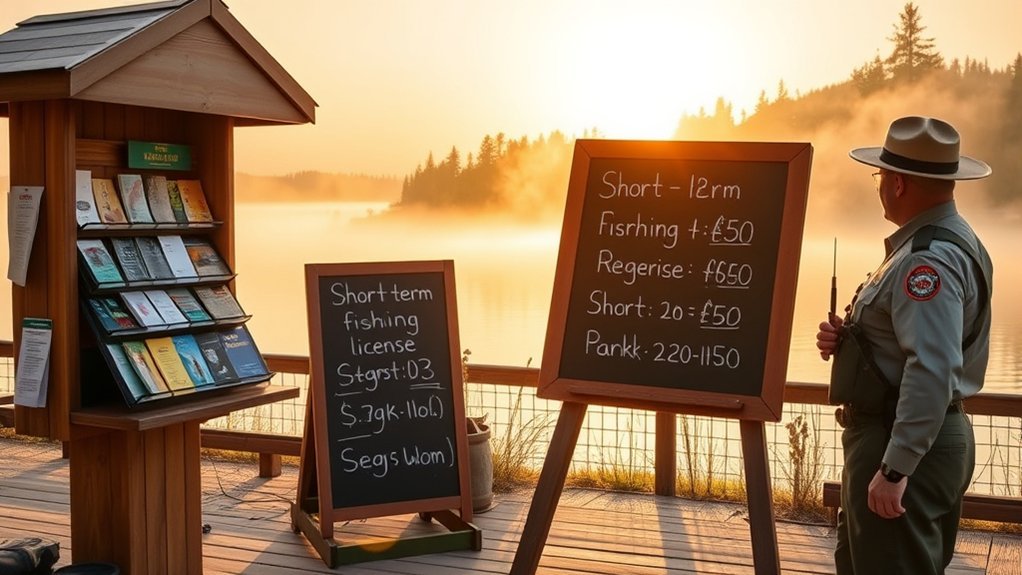
A short-term license changes the length of the fishing privilege, not the fishing rules. You must still follow all statewide and water-specific regulations, including:
- Daily creel and possession limits.
- Minimum and maximum size limits.
- Special catch-and-release areas.
- Trout delayed-harvest restrictions.
- Legal bait, tackle, and fishing methods.
- Rules for reciprocal boundary waters.
- Boating and personal-flotation-device requirements when fishing from a vessel.
All licensed anglers must carry a valid form of identification while fishing. Review the current West Virginia fishing regulations for the specific lake, stream, river, and species you plan to fish.
Warning: Buying a base license alone may not make you legal. Confirm that you have the required conservation, trout, and location-specific stamps, and carry valid identification. Regulations and special-water rules can change.
Who Can Fish Without a West Virginia License?
Residents and nonresidents under age 15 generally do not need a West Virginia fishing license. Anglers age 15 and older generally need the appropriate license unless a specific exemption applies.
Other exemptions may cover qualifying resident landowners fishing on their own land, certain seniors, totally blind residents, eligible disabled veterans or former prisoners of war, residents on active-duty military leave, developmentally disabled residents with the required DNR card, and supervised residents or patients of certain state institutions.
Documentation requirements vary. For example, an exempt senior, veteran, military member, or disabled angler may need to carry identification, a DNR-issued card, leave information, or another certificate while fishing. Check the current WVDNR regulations before relying on an exemption.

Stay organized with a durable 1-subject notebook set designed for school, note-taking, and digital study support. The college ruled pages resist ink bleed, tear out cleanly, and work with the Five Star Study App to create flashcards and sync notes to Google Drive. Tough pockets, a water-resistant cover, and Spiral Lock wire help protect your work throughout the year.

From Brian Tyler Cohen, this book offers a progressive roadmap for protecting democracy and navigating a post-Trump political landscape. It blends political analysis with practical strategy, making it a timely read for voters, activists, and anyone seeking actionable insight into the future of American governance.

The Athlon Optics Midas G2 UHD 8x42 Binoculars deliver a bright, sharp viewing experience with ED glass, advanced fully multi-coated lenses, and phase-corrected prisms for improved color, contrast, and clarity. Argon purging and waterproof construction help provide dependable performance in changing weather, while the long eye relief and wide field of view make them comfortable and easy to use for extended observation.
2026 Free Fishing Days
West Virginia’s Free Fishing Days are June 13 and 14, 2026. Residents and nonresidents may fish public waters without buying a fishing license on those dates, but all creel limits, size limits, methods, and other fishing regulations still apply.
Benefits of the Actual Short-Term Options
The resident five-day and nonresident one-day licenses give occasional anglers a lower-cost alternative to an annual license. They can work well for a vacation, family visit, first fishing trip, or brief return to the sport.
The license itself is not limited to bass, catfish, or another general species group. It allows legal fishing under the privileges of that license, but species-specific rules still apply. Trout anglers generally need a trout stamp, and certain waters have special size, harvest, bait, or catch-and-release rules.
License and stamp revenue also supports fish and wildlife management, habitat work, public access, law enforcement, and outdoor education. The correct choice is therefore not simply the cheapest base license. It is the lowest-cost license and stamp combination that legally covers your residency, dates, location, and target species.
Frequently Asked Questions
Does West Virginia offer a three-day fishing license?
No. The 2026 license schedule offers residents a five-day Class L license and nonresidents a one-day Class LL license. There is no separate three-day fishing license.
Can I fish without a license in West Virginia?
Anglers age 15 and older generally need a license unless they qualify for an exemption. People under 15 generally do not need one. Fishing is also license-free on West Virginia’s designated Free Fishing Days, although all other fishing regulations remain in effect.
Are there age restrictions for obtaining a three-day license?
There is no three-day license. Residents and nonresidents under age 15 generally do not need a fishing license. Anglers age 15 and older generally need the appropriate resident or nonresident privilege unless an exemption applies.
Can I upgrade a one-day license to a three-day license?
No three-day upgrade exists. A nonresident who wants to fish on additional days can purchase the required one-day privileges for those dates or compare the cost of an annual nonresident license.
How much does the resident five-day license really cost?
The Class L base license is $8. Adding the normally required $5 Class CS conservation stamp brings the standard total to $13 before the purchase fee. Fishing for trout generally raises the total to $23 after adding the $10 Class O trout stamp.
Is the five-day resident license valid for consecutive days?
Yes. WVDNR describes the resident Class L license as valid for five consecutive days selected by the buyer and specified on the license.
How much is a nonresident one-day fishing license?
The Class LL base license is $3 per fishing day. A nonresident who does not already hold the required current-year stamp normally adds the $13 Class CS/LE stamp, bringing the first-day total to $16 before the purchase fee. Trout fishing generally raises that first-day total to $32.
What types of fish can I catch with a short-term license?
A short-term license may cover legal fishing for species such as bass, catfish, crappie, sunfish, walleye, and trout. However, species-specific creel limits, size limits, seasons, methods, and special-water rules still apply. Trout fishing generally requires a trout stamp.
Is there a limit on the number of three-day licenses I can purchase?
This question does not apply because West Virginia does not sell a three-day fishing license. Nonresidents may purchase one-day privileges for the days they plan to fish. Residents should compare another eligible short-term license with the $19 annual resident fishing license before purchasing additional coverage.
Conclusion
West Virginia does not have a three-day fishing license. Residents can use the $8 Class L five-day license, which normally costs $13 after adding the required conservation stamp and before purchase fees. Nonresidents can use the $3 Class LL one-day license, which normally costs $16 for the first day after adding the required CS/LE stamp.
Trout fishing generally raises those totals to $23 for a resident five-day license or $32 for a nonresident’s first one-day license. Buy through an official WVDNR channel, carry valid identification, and review the current regulations for your fishing location and target species before heading out.
Sources
- West Virginia Fishing Regulations Summary 2026 — license fees, stamps, age rules, exemptions, identification requirements, transaction fees, and fishing regulations.
- WVDNR License Purchase Guide — current online purchase process and electronic licensing instructions.
- Authorized West Virginia License Agents — current in-person license-agent locations.
- West Virginia Free Fishing Days — official June 13–14, 2026 dates and eligibility.
- WVDNR 2026 License and Stamp Notice — how license and stamp revenue supports conservation, habitat, public access, law enforcement, and education.

Celebrate birthdays, anniversaries, and other special moments with this handcrafted set of number candle holders from 1 to 10. Made from recycled aluminum in Mexico, each piece offers a distinctive handmade finish and lasting keepsake quality. Presented in a petite box, it makes a thoughtful gift and a charming addition to home décor.

Die With Zero offers a fresh perspective on personal finance by encouraging readers to use money intentionally to create memorable life experiences instead of simply accumulating wealth. Written by Bill Perkins, this book combines practical guidance with a motivating philosophy to help readers align spending, saving, and life goals for a more fulfilling future.

This interactive sentence building set helps children practice early reading, writing, and grammar through hands-on play. Color-coded word cards, photo cards, and punctuation pieces make it easy to build simple sentences while reinforcing capitalization, parts of speech, and sentence structure. It is a versatile learning tool for homeschool and classroom use, with included game ideas and teaching suggestions to support multiple skill levels.
