
California offers 365-day sport fishing licenses for residents and nonresidents, along with one-day, two-day, 10-day, reduced-fee, free, and lifetime options. The correct choice depends on your age, residency, trip length, fishing location, target species, and gear. This guide uses the official 2026 California Department of Fish and Wildlife fee schedule and current reporting rules.
Quick Answer
A 2026 California resident sport fishing license costs $64.54, while a nonresident license costs $174.14. Both are valid for 365 days from purchase. Short-term licenses start at $21.09. Validations and species report cards may cost extra, even when an angler is under 16 or otherwise exempt from the license requirement.
Key Takeaways
- The 2026 resident license is $64.54, and the nonresident license is $174.14.
- Annual licenses are valid for 365 days from purchase, not only through December 31.
- Anglers under 16 do not need a basic license, but they may still need a species report card.
- A qualifying ocean public pier is license-exempt, but bag limits, seasons, gear rules, and report-card requirements still apply.
- Always check current CDFW regulations because seasons, closures, and emergency rules can change after you buy a license.
At a Glance
| Time Required | About 5–15 minutes for a standard online purchase; longer when eligibility documents require review |
| Difficulty | Easy for standard licenses; moderate for first-time reduced-fee or free applications |
| Tools Needed | Personal identification, GO ID or customer account, payment method, and any required eligibility documents |
| Cost | $21.09 for one day, $64.54 for a resident 365-day license, or $174.14 for a nonresident 365-day license, plus any required validations or report cards |
Warning: Fishing regulations can change during the year. A valid license does not override a seasonal closure, emergency rule, bag limit, size limit, restricted method, or species-specific report-card requirement. Check the current CDFW regulations for the exact water and species before fishing.
Who Needs a California Sport Fishing License?
Under California Fish and Game Code section 7145, a person who is 16 or older generally needs a valid sport fishing license when taking or attempting to take fish, reptiles, or amphibians for a noncommercial purpose.
CDFW applies the license requirement to fishing for fish, mollusks, crustaceans, aquatic invertebrates, amphibians, and reptiles in California inland and ocean waters. The license must be in your immediate possession while fishing, subject to limited rules for divers.
A person is generally treated as a California resident for licensing purposes after living continuously in the state for at least six months immediately before applying. Certain active-duty military members and Job Corps participants may also qualify as residents under California law.

This daily devotional helps parents pray purposefully for their children through a full year of Scripture readings, reflections, and guided prayer prompts. Written to encourage faithful family discipleship, it offers practical, biblically grounded support for parents who want to shape their prayers around God's Word. A foreword by Sinclair B. Ferguson adds trusted theological insight and encouragement.

These colorful answer buzzers turn lessons, review games, and family activities into lively game-show style challenges that boost participation and make learning more interactive. Each buzzer has a distinct sound to clearly identify who buzzed in first, while the durable, palm-sized design makes them easy for kids and adults to use in classrooms, homeschools, and group settings.

This heartfelt memoir blends laugh-out-loud honesty with tender reflections on love, loneliness, and the unexpected healing power of rescue dogs. Isabel Klee shares her journey fostering pups in the city while navigating dating and self-discovery, offering an intimate, relatable story for readers who enjoy emotional, character-driven narratives. It is a warm, engaging read about opening your heart and finding connection in surprising places.
Who Does Not Need the Basic License?
- Children age 15 and younger: They do not need a basic sport fishing license.
- People fishing on an official Free Fishing Day: California’s 2026 Free Fishing Days are July 4 and September 5.
- People angling from a qualifying public fishing pier in ocean waters: The structure must meet California’s legal definition of a public pier.
- Certain qualifying private ponds: A narrow exemption may apply to an offstream pond or lake wholly enclosed by private property and disconnected from state waterways.
Note: A license exemption does not automatically create a report-card exemption. Children, public-pier anglers, and people fishing on Free Fishing Days may still need the appropriate card for steelhead, white sturgeon, spiny lobster, or North Coast salmon.
California Fishing License Prices for 2026
The official CDFW 2026 fee schedule lists the following prices. Most published fees already include the applicable 5% license-agent handling fee and 3% nonrefundable application fee, so do not automatically add those percentages again.
| License type | 2026 fee | Validity |
| Resident Sport Fishing License | $64.54 | 365 days from purchase |
| Nonresident Sport Fishing License | $174.14 | 365 days from purchase |
| One-Day Sport Fishing License | $21.09 | One specified day |
| Two-Day Sport Fishing License | $32.40 | Two consecutive days |
| Ten-Day Nonresident License | $64.54 | Ten consecutive days |
Resident Annual Fee
A California resident age 16 or older pays $64.54 for a 365-day sport fishing license in 2026. For example, a license purchased on July 28, 2026, normally remains valid through July 27, 2027.
The resident license covers recreational fishing in both inland and ocean waters, but it does not replace required species report cards, validations, or location-specific permits.
Nonresident Annual Fee
A nonresident age 16 or older pays $174.14 for a 365-day sport fishing license. That is $109.60 more than the resident price.
An occasional visitor should compare the annual fee with the $21.09 one-day, $32.40 two-day, and $64.54 nonresident 10-day options. Two separate two-day licenses would cost $64.80, while three would cost $97.20. The annual nonresident license becomes more practical when trips are frequent or spread across the year.
Pro Tip: Check the exact start and end dates before completing payment. Standard 365-day licenses are nonrefundable once purchased.
Reduced-Fee and Free License Programs
CDFW offers reduced-fee or free licenses to specific applicants. Eligibility is based on defined legal criteria rather than age, income, veteran status, or disability alone.
| Program | 2026 fee | Main eligibility rule |
| Disabled Veteran | $10.04 at CDFW offices; $10.54 from license agents | Honorably discharged veteran with a service-connected disability rating of at least 50% |
| Recovering Service Member | $10.04 at CDFW offices; $10.54 from license agents | Qualifying service member receiving outpatient treatment, recuperation, or therapy for a serious service-related injury or illness |
| Low-Income Senior | $10.04 | California resident age 65 or older receiving SSI or CAPI benefits |
| Free Disability License | No fee | Qualifying blindness, developmental disability, or severe mobility impairment |
| Low-Income Native American | No fee | California resident who meets CDFW’s tribal-documentation and financial-eligibility requirements |
Eligibility and Documentation
A disabled veteran generally needs identification, a GO ID or CDFW customer record, and a VA Benefits Summary Letter showing honorable discharge and a service-connected disability rating of at least 50%.
A recovering service member needs verification from a commanding officer or military medical doctor. The letter should include the expected recovery date so CDFW can establish the applicant’s qualification period.
A low-income senior must be a California resident age 65 or older and provide annual verification of Supplemental Security Income or Cash Assistance Program for Aged, Blind, and Disabled Legal Immigrants benefits.
Free-license documentation depends on the category. It may include certification from an optometrist, ophthalmologist, physician, state regional-center director, or recognized tribal documentation.
How to Apply
- Review the eligibility category on the CDFW fishing-license page.
- Create or locate your CDFW customer record and GO ID.
- Gather identification and the exact eligibility letter, certification, or benefits verification required for your category.
- Submit the documents using the method allowed by CDFW, such as secure upload, mail, fax, or an application at the appropriate sales office.
- Wait for CDFW to update or approve your eligibility before attempting to buy the reduced-fee product.
- Keep copies of every document and approval notice.
CDFW advises applicants to allow up to 15 business days for review and processing of first-time free sport fishing license applications. Low-income senior licenses must be renewed each year at a CDFW license sales office with current eligibility verification.
Note: A free or reduced-fee license does not include every validation or species report card. Required add-ons are generally purchased separately at their regular prices.
Short-Term and Lifetime License Options
Short-term licenses work well for occasional trips, while lifetime licenses are designed for California residents who expect to fish for many years.
Short-Term Licenses
- One day: $21.09 for a resident or nonresident. It covers one specified day.
- Two days: $32.40 for a resident or nonresident. It covers two consecutive days.
- Ten days: $64.54 and available only to nonresidents. It covers ten consecutive days.
One-day and two-day licenses are exempt from the Ocean Enhancement Validation requirement. The nonresident 10-day license does not receive that exemption.
Lifetime License Prices
| Age at purchase | 2026 lifetime fee |
| 0–9 | $709.00 |
| 10–39 | $1,160.25 |
| 40–61 | $1,045.00 |
| 62 and older | $709.00 |
| Lifetime Fishing Privilege Package | $478.75 |
Lifetime licenses are available to California residents. The Fishing Privilege Package includes a Second Rod Validation, Ocean Enhancement Validation, North Coast Salmon Report Card, and Steelhead Report Card each year under the program’s terms.
At the 2026 resident annual price of $64.54, the $1,160.25 lifetime fee for an angler age 10–39 is roughly equal to 18 annual-license purchases. The $709 fee is roughly equal to 11 annual-license purchases. These comparisons do not include future annual fee increases or the time value of the upfront payment.
Required Validations and Species Report Cards
A basic sport fishing license does not cover every location, method, or species. Review the following requirements before buying.
| Item | 2026 fee | When required |
| Ocean Enhancement Validation | $7.30 | Fishing in ocean waters south of Point Arguello, except while using a one-day or two-day license |
| Second Rod Validation | $20.26 | Using two rods or lines in eligible inland waters |
| Recreational Crab Trap Validation | $2.98 | Taking crab with qualifying crab traps; not required for hoop nets or crab loop traps |
| Sturgeon Fishing Report Card | $8.13 | Fishing for white sturgeon in California waters; current fishing is catch-and-release only |
| North Coast Salmon Report Card | $9.21 | Fishing for salmon in the Smith River or Klamath-Trinity river systems |
| Steelhead Report Card | $10.29 | Fishing for steelhead in inland waters |
| Spiny Lobster Report Card | $12.70 | Taking spiny lobster during the applicable season |
| Abalone Report Card | Not available | The recreational abalone fishery is currently closed |
Beginning January 1, 2026, anglers using crab traps from a Commercial Passenger Fishing Vessel are no longer required to hold the Recreational Crab Trap Validation. Other crab-trap users should confirm that the validation and gear rules apply to their setup.
The 2025–2026 white sturgeon season ended June 30, 2026. The next season is scheduled to open October 1, and the 2026–2027 card is scheduled to become available August 15, 2026. White sturgeon fishing remains catch-and-release only, and taking green sturgeon is prohibited.
Warning: The CDFW License App can display eligible licenses and validations, but a digital proof-of-purchase screen does not replace a required physical species report card. Carry the physical card and complete it exactly as instructed.
Where and How to Purchase Your License
You can purchase most California sport fishing products through the CDFW Online License Sales and Services system, an authorized license agent, a CDFW license sales office, or CDFW’s authorized telephone sales service.
- Decide whether you need an annual, one-day, two-day, 10-day, reduced-fee, or lifetime product.
- Check the regulations for your fishing location, species, and gear.
- Add any required validation or report card.
- Sign in with your CDFW customer information or create a customer record.
- Review the start date, expiration date, products, and final amount before payment.
- Save the receipt and temporary license if one is provided.
- Install the CDFW License App if you want to display eligible licenses and validations electronically.
CDFW license counters do not accept cash. They accept checks, money orders, and qualifying Visa or Mastercard debit or credit cards. Independent retail agents may have different accepted payment methods.
Your license must be in your immediate possession while fishing. You may use the official app for supported electronic items, but physical species report cards must still be carried when required.
How License Revenue Supports Fisheries and Habitat
California law directs part of sport fishing license revenue to fisheries programs. Under Fish and Game Code section 13007, one-third of specified sport fishing license fees is deposited into the Hatchery and Inland Fisheries Fund.
Subject to legislative appropriation, that money may support:
- Management, maintenance, and capital improvements for California fish hatcheries
- The Heritage and Wild Trout Program
- Hatchery fish production and facility rehabilitation
- Native trout production and cold-water ecosystem restoration
- Related enforcement, scientific work, and other eligible fisheries activities
California law directs 33⅓% of specified sport fishing license fees to the Hatchery and Inland Fisheries Fund.
Report-card data provide another form of support. Accurate fishing-effort and catch records help CDFW evaluate fishing pressure, participation, catch rates, and management needs.

This interactive sentence building set helps children practice early reading, writing, and grammar through hands-on play. Color-coded word cards, photo cards, and punctuation pieces make it easy to build simple sentences while reinforcing capitalization, parts of speech, and sentence structure. It is a versatile learning tool for homeschool and classroom use, with included game ideas and teaching suggestions to support multiple skill levels.

Die With Zero offers a fresh perspective on personal finance by encouraging readers to use money intentionally to create memorable life experiences instead of simply accumulating wealth. Written by Bill Perkins, this book combines practical guidance with a motivating philosophy to help readers align spending, saving, and life goals for a more fulfilling future.

This hardcover cookbook offers fast, approachable recipes designed for busy days and low-energy nights. Caroline Chambers focuses on simple, flavorful meals that help you get dinner on the table without overthinking it. It's a practical pick for home cooks who want quick weeknight inspiration and minimal-fuss cooking.
Reporting Harvests and Returning Report Cards
Purchasing a report card creates a reporting obligation. You may need to report even when you caught nothing or did not fish. Follow the instructions printed on the specific card because recording rules and deadlines differ by species.
When to Report
| Report card | Regular deadline | Important detail |
| Sturgeon | July 31 after the season ends | The 2025–2026 card must be reported by July 31, 2026 |
| North Coast Salmon | January 31 of the following year | Report even when the card contains no harvest |
| Steelhead | January 31 of the following year | Follow the card’s fishing-effort and catch-entry instructions |
| Spiny Lobster | April 30 following the season | Failure to report by the deadline can trigger a $21.60 non-return fee on the next card |
How to Return a Report Card
- Sign in to the CDFW Online License Sales and Services system.
- Select HARVEST REPORTING.
- Choose the correct species and report-card period.
- Enter the requested fishing, catch, location, and date information accurately.
- Save the confirmation number or take a screenshot of the completion page.
You may also return a physical report card to the address printed on it. A mailed card should be sent early enough to meet the applicable deadline. Do not assume that buying a new license automatically submits the previous card.
Pro Tip: Make each required card entry during or immediately after the fishing trip. Waiting until the reporting deadline increases the chance of missing dates, locations, or catch details.
Replacing Lost Licenses and Obtaining Duplicates
A lost or stolen sport fishing license should be replaced before you continue fishing unless you can legally display the entitlement through the CDFW License App.
The 2026 duplicate sport fishing license fee is $14.30.
- Duplicate sport fishing license: $14.30
- Duplicate Second Rod or Ocean Enhancement Validation: $3.81
- Duplicate Recreational Crab Trap Validation: $2.98
Duplicate licenses and supported validations can be purchased online, from an authorized agent, or from a CDFW license sales office. Duplicate report cards may have stricter procedures. A lost Sturgeon Fishing Report Card must be replaced at a CDFW license sales office and requires the applicable affidavit and fee.
Do not heat-laminate a printed license. Heat can darken and destroy the license stock. A discolored license may remain valid if its text and signature are readable, but an unreadable license should be replaced.
Special Rules: Public Piers, Second Rods, and Crab Traps
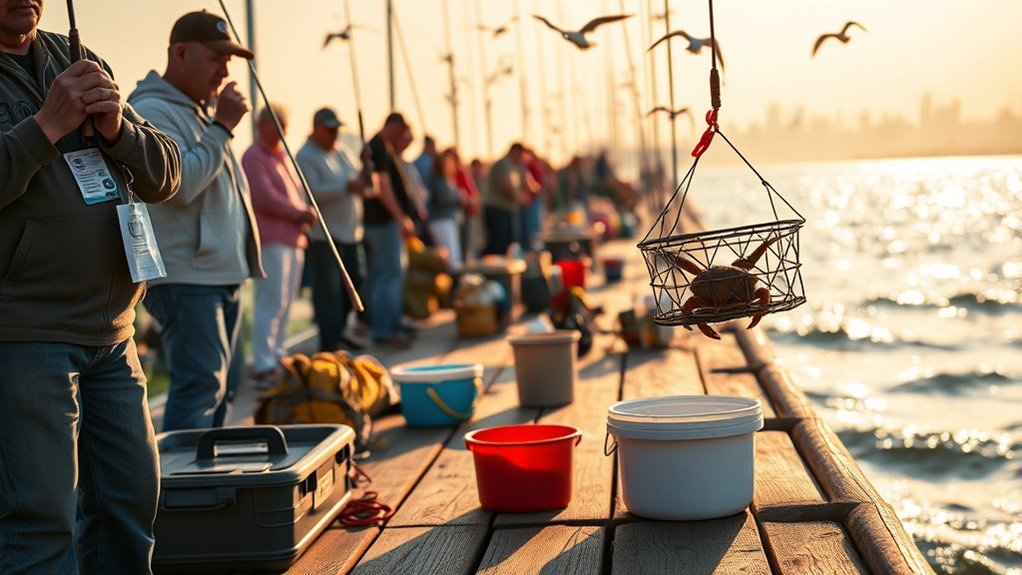
Public Fishing Piers
A sport fishing license is not required when angling from a qualifying public fishing pier in California ocean waters. The pier must be publicly owned, freely accessible, connected to the mainland or a named natural island above mean high tide, and built or functioning primarily for angling access.
Some publicly owned jetties and breakwaters qualify when they form the most seaward protective boundary of an ocean harbor. A beach, private dock, promenade, seawall, marina dock, or ordinary harbor structure does not automatically qualify.
Size limits, bag limits, seasons, closures, gear restrictions, and applicable report cards remain in force on a public pier.
Second Rod Rules
The $20.26 Second Rod Validation allows a licensed angler to use two rods or lines in eligible inland waters. It does not authorize two rods where regulations allow only artificial lures or barbless hooks, and it does not increase a species bag or possession limit.
A child under 16 may generally use two rods in eligible inland waters without buying the validation, but the same water-specific restrictions still apply.
Crab Trap Rules
The $2.98 Recreational Crab Trap Validation applies when taking crab with a qualifying crab trap. It is not required for hoop nets or crab loop traps. Trap construction, marking, servicing, retrieval, and seasonal restrictions must still be followed.
As of January 1, 2026, anglers using crab traps from a Commercial Passenger Fishing Vessel are exempt from this validation requirement.
Free Fishing Days and the Colorado River Rule
California’s two Free Fishing Days in 2026 are Saturday, July 4, and Saturday, September 5. A basic license is not required on those dates, but all other fishing regulations and report-card requirements remain active.
California does not sell a general multi-state reciprocal fishing license. However, the former Colorado River Special Use Validation has been discontinued. A valid California or Arizona sport fishing license may be used from either shore of the portion of the Colorado River that forms the California-Arizona boundary, subject to the applicable regulations.
Frequently Asked Questions
Do California license fees vary by fishing method?
The basic recreational sport fishing license is not priced separately for rod fishing, legal recreational spearfishing, or every other permitted method. However, gear-specific rules and add-ons may apply. Examples include the Second Rod Validation and Recreational Crab Trap Validation. Commercial nets and commercial fishing activities require separate licenses or permits.
Are there California fishing-license discounts for military members or veterans?
Yes, but eligibility is specific. Honorably discharged veterans need a service-connected disability rating of at least 50% for the disabled-veteran reduced-fee license. Qualifying recovering service members may also receive a reduced-fee license. Some active-duty military members qualify as California residents for licensing purposes, but active-duty status alone does not automatically qualify a person for the reduced-fee program.
Can nonresidents buy a multi-state reciprocal fishing license?
California does not offer a general multi-state sport fishing license. A limited boundary rule applies on the portion of the Colorado River forming the California-Arizona border, where a valid California or Arizona license may be used from either shore. It does not authorize fishing elsewhere in both states.
Does a license purchase include catch-and-release gear recommendations?
No. A license authorizes eligible recreational fishing but does not include a personalized gear package. Check CDFW species pages and current regulations for hook restrictions, barbless-hook rules, handling instructions, release methods, and prohibited gear.
Is commercial fishing covered by a sport fishing license?
No. A sport fishing license covers eligible recreational activity. Taking fish for commercial purposes, assisting with commercial operations, selling catch, or using commercial gear may require separate commercial licenses, permits, registrations, and reporting.
How long is a California annual fishing license valid?
A resident or nonresident 365-day sport fishing license is valid for 365 days from the purchase date. It does not automatically expire on December 31. Report cards continue to use their own species-specific seasons and reporting periods.
Does a child under 16 need a California fishing license?
No basic sport fishing license is required for a child age 15 or younger. However, the child must possess the appropriate report card when fishing for a species that requires one, including steelhead, white sturgeon, spiny lobster, or salmon in the designated North Coast river systems.
Can I use a digital California fishing license?
Supported sport fishing licenses and validations can be displayed through the official CDFW License App. Physical species report cards are different: proof of purchase in the app does not replace the physical card that must be carried and completed while fishing.
Conclusion
A 2026 California resident sport fishing license costs $64.54, and a nonresident license costs $174.14. Both remain valid for 365 days from purchase. Short-term, reduced-fee, free, and lifetime options can lower the cost for eligible anglers or specific trip plans.
Before fishing, confirm four things: your license is valid, the water is open, your gear is permitted, and you have every required validation or report card. Keep the license in your immediate possession, carry physical report cards when required, record fishing activity promptly, and submit each card by its species-specific deadline.
Sources
- California Department of Fish and Wildlife — Sport Fishing Licenses and Report Cards — 2026 prices, eligibility, validations, report cards, duplicate fees, and purchasing rules
- California Department of Fish and Wildlife — Lifetime Licenses — lifetime fishing-license prices and privilege-package details
- California Department of Fish and Wildlife — Free Fishing Days — 2026 dates and continuing regulatory requirements
- California Department of Fish and Wildlife — Sturgeon Report Card — current sturgeon season, catch-and-release rules, card entries, and July 31 reporting deadline
- California Department of Fish and Wildlife — License App — electronic license availability and physical report-card limitations
- California Fish and Game Code section 13007 — statutory allocation of sport fishing license revenue

Keep papers neatly sorted with this Oxford 8-pocket paper folder designed for classroom, office, and home organization. Eight color-coded pockets help separate subjects or projects, while the comb-bound design opens flat for easy access and page turning. It also includes an inside business card holder and a high-capacity layout that makes managing letter-size documents simple and efficient.

This Pokémon card bundle gives collectors and players a fun mix of 50 assorted cards plus one double rare legendary card for extra excitement. It also includes an LCC deck box that can store up to 100 cards, making it easy to organize and protect your collection at home or on the go.

These Business Source open-ring rubber bands are designed for easy one-handed use, making everyday bundling and organization more efficient. They offer a firm, reliable stretch with quality construction that meets or exceeds federal specifications, and their sustainable design supports practical office and industrial use. The compact box format makes them convenient to store and keep on hand for fast access.
