
You depend on batteries to start vehicles and power accessories, and sulfation is one reason a lead-acid battery can lose useful capacity after sitting partly discharged. The right smart charger or desulfation-capable maintainer may help with recoverable sulfation, keep stored batteries properly maintained, and reduce avoidable battery neglect.
This guide compares six battery chargers and maintainers for different jobs, from compact long-term maintenance to higher-output shop charging and emergency engine-start support. Read on to find the right balance of charging power, battery compatibility, recovery features, safety, and convenience.
Affiliate Disclosure: This article contains affiliate links. If you purchase through one of these links, we may earn a commission at no extra cost to you.
Quick Verdict
Best all-round choice: NOCO GENIUS5 combines 6V/12V charging, multiple battery chemistries, automatic maintenance, Force Mode, and a dedicated 12V Repair mode in a compact 5A unit.
Best for long-term storage: BatteryMINDer 2012 focuses on 12V lead-acid maintenance with temperature compensation and full-time automatic desulfation.
Best for a workshop: Clore PL2320 adds 20/10/2A charging, battery reconditioning, and a 0–20A power-supply mode for many diagnostic and service tasks.
Top Picks
|
Category |
Product |
Key Strength |
|---|---|---|
|
🏆 Best All-Round |
5A smart charging plus 12V Repair Mode |
|
|
🎯 Best for Long-Term Storage |
2A maintenance with automatic desulfation |
|
|
🚀 Best for Workshop Use |
20/10/2A charging, reconditioning and power supply |
|
|
⭐ Best for Engine-Start Support |
100A engine start plus charging and desulfation |
|
|
🔰 Best for Rapid Smart Charging |
15A rapid charge with automatic maintenance |
|
|
💰 Best Budget Maintainer |
800mA maintenance with automatic pulse desulfation |
How We Selected
We focused first on manufacturer-documented desulfation, repair, reconditioning, or smart-maintenance functions rather than assuming every battery charger performs the same type of recovery.
Charging output and versatility also matter, so we considered amperage, 6V/12V support, compatible battery chemistries, maintenance capability, and whether a product is meant for slow storage care, routine charging, or higher-output workshop use.
Safety and battery care were also important. Features such as temperature compensation, multi-stage charging, reverse-polarity protection, automatic maintenance, battery-fault detection, and clearly defined battery modes can make a charger easier to use correctly.
Finally, we looked at practical ownership factors such as portability, control layout, included connection options, and whether the charger solves a distinct buyer problem rather than duplicating another pick.
Before You Buy
- Check voltage first: confirm whether your battery is 6V or 12V.
- Match the chemistry: flooded, AGM, gel, and LiFePO4 batteries can require different charging modes.
- Choose output by use: sub-2A units are best suited to maintenance, while higher-current chargers restore normal state of charge faster on larger batteries.
- Do not assume “desulfation” repairs every battery: shorted cells, physical damage, leaking cases, severe plate deterioration, and some deeply discharged batteries require replacement.
- Follow the battery and charger manuals: repair or reconditioning modes may use charging behavior different from ordinary maintenance.
Safety Note: Do not charge a frozen, leaking, swollen, cracked, or otherwise physically damaged battery. Work in a ventilated area, keep sparks and flames away from lead-acid batteries, verify polarity before connecting clamps, and follow the charger and battery manufacturer’s instructions.
Schumacher SC1359

The Schumacher SC1359 is the pick for buyers who care more about faster automatic charging and maintenance than a dedicated manual repair mode. It is a 6V/12V automatic charger/maintainer with a 15A rapid-charge capability and automatic maintenance behavior.
Its digital display, automatic voltage detection, multi-stage charging, and reverse-hookup protection make it suitable for routine garage use on compatible automotive and marine batteries.
Best for: Cars, trucks, SUVs, boats, RV batteries, and owners who want faster charging plus automatic maintenance.
Why you’ll like it: Higher charging output can restore normal state of charge faster than a small storage maintainer.
Before you buy: Choose another model if a clearly documented dedicated repair/desulfation mode is your main reason for purchasing.
Buyer Feedback Snapshot
The review sample, collection date, and analysis method behind the sentiment-analysis chart below are not documented. Treat it as a directional snapshot and check the current Amazon listing for the newest buyer feedback.

Versatility
The SC1359 works as a general-purpose charger and maintainer for compatible 6V and 12V batteries. It is particularly useful when you want substantially more charging current than a small 800mA or 2A storage maintainer can provide.
Charging & Maintenance Behavior
Its microprocessor-controlled system automatically manages the charging process, while multi-stage charging and maintenance behavior reduce the need to manually control charging current throughout a normal cycle.
Key Benefits
- 15A rapid-charge capability for faster routine charging
- Automatic maintenance after charging
- 6V/12V automatic voltage detection
- Multi-stage charging for managed battery care
- Reverse-hookup protection
- Compatible with standard, AGM, and deep-cycle batteries listed by the manufacturer
Check Product Details on Amazon
NOCO Genius5

The NOCO GENIUS5 is the strongest all-round choice here because it combines ordinary smart charging, long-term maintenance, multiple battery chemistries, and a dedicated 12V Repair Mode intended for old, idle, stratified, or sulfated lead-acid batteries.
It delivers 5A charging for 6V and 12V systems and supports lead-acid batteries as well as compatible lithium-ion/LiFePO4 batteries when the appropriate charging mode is selected.
Best for: Buyers who want one compact charger for everyday vehicles, motorcycles, seasonal equipment, trailers, boats, or stored batteries.
Why you’ll like it: It covers charging, maintenance, low-voltage recovery, and lead-acid repair functions in one portable unit.
Before you buy: The dedicated Repair Mode is for compatible lead-acid batteries, not a general repair setting for lithium batteries.
Buyer Feedback Snapshot
This chart is a historical snapshot. Because the underlying review sample and sentiment-analysis methodology are not documented, use it only as a directional reference and verify current owner feedback on the live listing.

Versatility
The GENIUS5 supports 6V and 12V charging and several lead-acid types, including flooded, AGM, gel, enhanced flooded, and maintenance-free batteries. It also includes a dedicated lithium mode for compatible lithium batteries with a battery-management system.
Its 5A output is rated for charging batteries up to about 120Ah, while its maintenance function can be used beyond that charging-capacity range when appropriate.
Charging & Maintenance Behavior
Temperature sensing adjusts charging to ambient conditions, and automatic maintenance continues after the primary charging cycle. Force Mode is available for batteries too low for ordinary automatic detection, while 12V Repair Mode provides a separate recovery routine for compatible lead-acid batteries.
Key Benefits
- 5A charging for 6V and 12V batteries
- Dedicated 12V Repair Mode for compatible sulfated lead-acid batteries
- Temperature-compensated charging
- Force Mode for batteries below normal automatic-detection voltage
- Lead-acid and compatible lithium charging modes
- Compact design with clamps, integrated eyelets, and mounting hardware
Check Product Details on Amazon
BatteryMINDer 2012
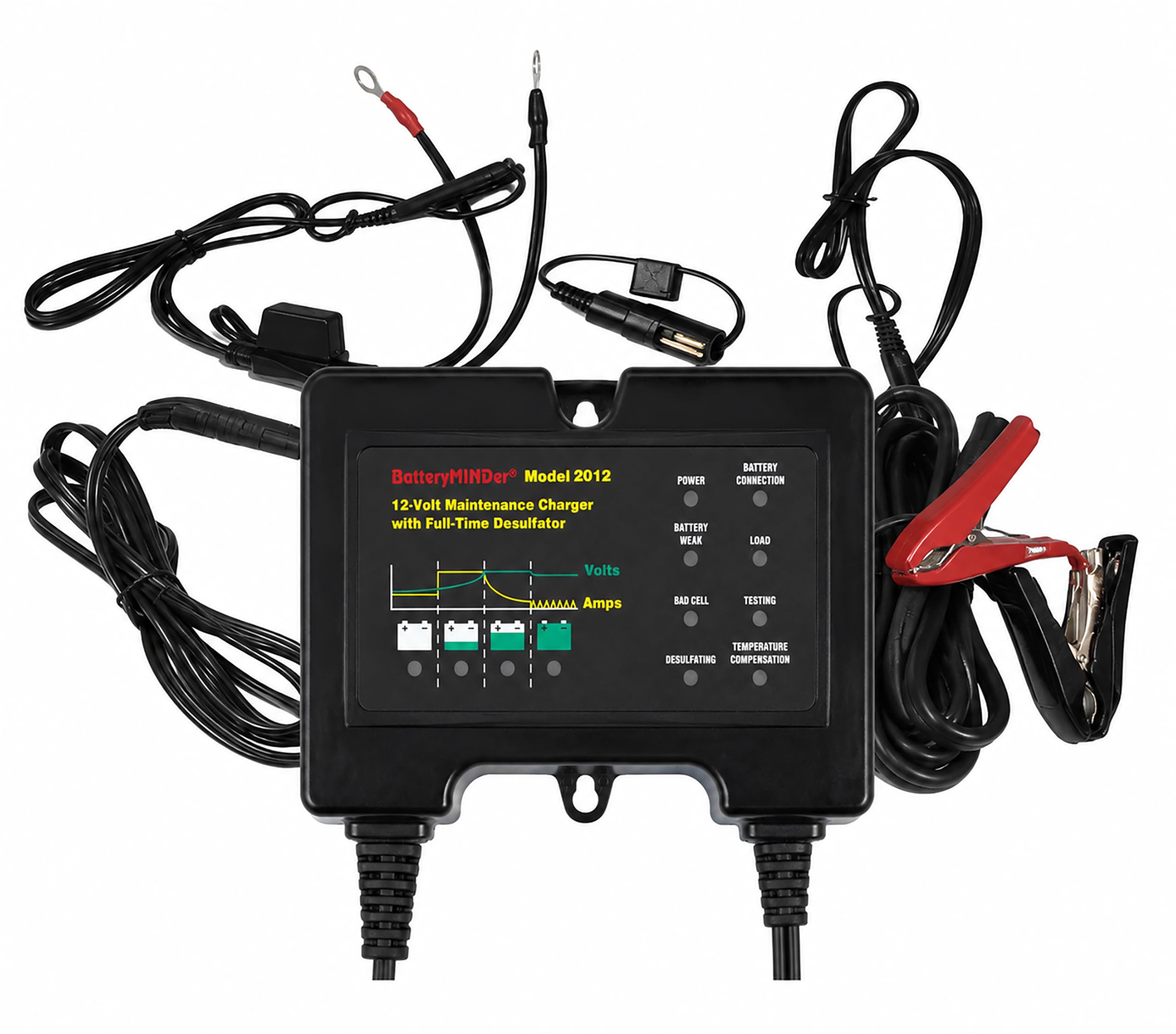
The BatteryMINDer 2012 is designed around long-term 12V lead-acid battery care. Its 2A output is modest compared with a rapid charger, but it combines automatic charging, maintenance, temperature compensation, and full-time high-frequency pulse desulfation.
That makes it especially attractive for classic cars, motorcycles, seasonal equipment, and other batteries that may spend long periods connected to a maintainer.
Best for: Stored vehicles and 12V lead-acid batteries that need gentle, ongoing maintenance.
Why you’ll like it: Its core design focuses on maintaining charge while automatically applying its desulfation routine.
Before you buy: This is a 12V 2A model, so it is not the best choice when rapid charging is the priority. BatteryMINDer also sells a separate 2012-AGM version for specialty high-performance AGM batteries, so confirm the exact battery type before ordering.
Buyer Feedback Snapshot
The sentiment chart below is a historical snapshot, and no review-analysis methodology or collection date is documented. Use it as historical or directional context rather than a current rating claim.

Versatility
The standard Model 2012 is intended for 12V lead-acid batteries and works best as a maintenance-oriented charger rather than a high-current recovery charger. It includes battery clips and fused ring-terminal connections for temporary or more permanent installations.
Charging & Maintenance Behavior
The unit uses an automatic multi-stage charging routine, temperature compensation, and high-frequency pulse desulfation. Once the battery reaches the appropriate state of charge, the maintainer is designed to continue managing it without the constant high output associated with bulk charging.
Key Benefits
- 12V 2A charger/maintainer/desulfator
- Automatic high-frequency pulse desulfation
- Temperature-compensated charging
- Multi-stage automatic battery management
- Reverse-polarity and overcharge protection
- Well suited to long storage periods and infrequently used vehicles
Check Product Details on Amazon
Clore PL2320

The Clore PRO-LOGIX PL2320 is the most workshop-oriented charger in this roundup. It combines 20/10/2A charging, 6V/12V support, an automatic Recondition Mode, enhanced maintenance, and a 0–20A power-supply function.
It is a strong fit for serious DIYers, technicians, and garages that want one charger for ordinary charging, long-term maintenance, battery reconditioning, and many electrical-system service tasks.
Best for: Workshops, technicians, larger batteries, and buyers who want both charging and a steady 12V power-supply function.
Why you’ll like it: Selectable 20/10/2A charging gives it much more flexibility than a small maintainer, while automatic Recondition and Soft Start modes address distressed batteries.
Before you buy: Its 20A power-supply mode is useful for many diagnostic, repair, maintenance, and ADAS-support tasks, but it should not be assumed sufficient for every vehicle-module flash or programming procedure.
Buyer Feedback Snapshot
The chart below is a historical snapshot. Its review sample and analysis method are not documented, so it should not be treated as a current independently verified customer rating.

Versatility
The PL2320 offers 20A, 10A, and 2A charging rates for 6V and 12V batteries. It supports common lead-acid battery types and manufacturer-listed LiFePO4 batteries, while its power-supply mode can provide up to 20A on demand to help maintain vehicle-system voltage during suitable service procedures.
Charging & Maintenance Behavior
The charger uses a multi-phase automatic charging routine and includes Soft Start for severely depleted batteries, Recondition Mode for distressed or sulfated batteries, temperature compensation, battery-fault detection, and enhanced long-term maintenance.
Key Benefits
- 20/10/2A selectable charging rates
- 6V and 12V battery charging
- Automatic battery Recondition Mode
- Soft Start for severely depleted batteries
- 0–20A power-supply mode for appropriate service tasks
- Temperature compensation and battery-fault detection
- Support for multiple lead-acid types and manufacturer-listed LiFePO4 batteries
Check Product Details on Amazon
MOTOPOWER MP00205C

The MOTOPOWER MP00205C is the simple, low-output choice for owners who want 12V battery maintenance plus automatic pulse desulfation without paying for workshop-level charging power.
Its 800mA output makes it much better suited to maintaining motorcycles, ATVs, lawn equipment, powersports batteries, and infrequently used 12V vehicles than rapidly charging a large, deeply discharged starter battery.
Best for: Budget-conscious buyers maintaining smaller or infrequently used 12V lead-acid batteries.
Why you’ll like it: It automatically combines maintenance charging with pulse-current desulfation in a compact package.
Before you buy: At 800mA, this is a maintainer first. Choose a higher-output model if you regularly need to recharge large batteries quickly.
Buyer Feedback Snapshot
The sentiment chart below is a historical snapshot. Because the underlying review dataset and methodology are not documented, verify current feedback directly on the product listing.

Versatility
The MP00205C is a 12V-only charger/maintainer for compatible lead-acid batteries, including flooded, maintenance-free, AGM, and gel-cell designs listed by the manufacturer. Its low output is particularly appropriate for storage maintenance and smaller battery applications.
Charging & Maintenance Behavior
The charger automatically detects sulfation conditions and applies pulse-current technology as part of its charging routine. It also provides overcharge, short-circuit, and reverse-polarity protection and transitions into a lower-voltage maintenance stage after charging.
Key Benefits
- 12V 800mA automatic charger and maintainer
- Automatic pulse-current desulfation
- Compatible with manufacturer-listed flooded, AGM, gel, and sealed lead-acid batteries
- Overcharge, short-circuit, and reverse-polarity protection
- Compact output well suited to storage maintenance
- Simple automatic operation
Check Product Details on Amazon
Schumacher SC1281

The Schumacher SC1281 is the most useful pick here when you want one larger garage unit that can charge, maintain, test, desulfate, boost, and provide engine-start assistance. Its 100A engine-start and 30A boost functions separate it from compact maintainers such as the GENIUS5 or BatteryMINDer.
It supports 6V and 12V batteries and is intended for standard, AGM, gel, and deep-cycle battery types listed by Schumacher.
Best for: Home garages, trucks, SUVs, larger batteries, farms, and users who want engine-start assistance in the same unit as a charger.
Why you’ll like it: It combines several functions that would otherwise require separate charging, testing, and starting tools.
Before you buy: It is considerably more shop-like and less portable than a compact maintenance charger, so it is unnecessary if your only goal is keeping a motorcycle or seasonal battery topped up.
Buyer Feedback Snapshot
The sentiment chart is a historical snapshot. Its review sample, date, and analysis methodology are not documented, so use current marketplace feedback when making the final buying decision.

Versatility
The SC1281 handles 6V and 12V charging and adds high-current boost and engine-start functions for larger automotive batteries. Battery and alternator testing also makes it more useful for troubleshooting than a basic storage maintainer.
Charging & Maintenance Behavior
Microprocessor-controlled multi-stage charging automatically manages the normal charging cycle, while float-mode monitoring maintains a charged battery. Schumacher also describes the SC1281 as providing a desulfation function when a compatible sulfated battery is detected.
Key Benefits
- 100A engine-start capability
- 30A boost function
- 6V/12V automatic charging and maintenance
- Desulfation capability for compatible sulfated batteries
- Built-in battery and alternator testing
- Multi-stage charging and float-mode monitoring
- Reverse-hookup protection
Check Product Details on Amazon
FAQ
How Do Battery Desulfators Work?
Desulfation and battery-repair systems use controlled charging routines, pulse-current techniques, or manufacturer-specific reconditioning stages intended to address some forms of sulfation on lead-acid battery plates. The exact process varies by charger. Results also depend heavily on battery condition, so a repair or desulfation mode should be viewed as a recovery attempt rather than a guarantee that an old battery will return to full capacity.
Which Desulfator or Smart Charger Should I Choose?
Choose based on the battery and the job. A low-current maintainer is ideal for motorcycles, classic cars, lawn equipment, and seasonal storage. A 5A smart charger such as the NOCO GENIUS5 provides more general-purpose charging while adding a dedicated repair mode. Higher-current chargers such as the Clore PL2320 are better suited to larger batteries and workshop use, while the Schumacher SC1281 is the better fit when engine-start assistance is also important.
Always check voltage and chemistry compatibility before connecting a charger. A charger designed for standard lead-acid batteries should not automatically be assumed suitable for LiFePO4 or another lithium chemistry.
How Do I Use Desulfators Safely and Effectively?
Inspect the battery first. Do not attempt to recover a battery with a cracked or swollen case, leaking electrolyte, obvious physical damage, or other conditions that the battery manufacturer identifies as unsafe.
Connect the charger with the correct polarity, select the proper voltage and battery mode, and follow the charger manufacturer’s sequence. Use high-current boost or recovery functions only for their intended purpose. When a repair mode uses unusual charging voltage, follow the manufacturer’s instructions about disconnecting the battery from vehicle electronics.
Can a Desulfator Bring Every Dead Battery Back to Life?
No. Desulfation can only help when the battery’s problem is recoverable and compatible with the charger’s repair process. A battery with a shorted cell, serious internal deterioration, physical damage, or an inability to hold charge may need replacement. If a charger repeatedly reports a battery fault or the battery still fails a proper load or conductance test after charging, further diagnosis or replacement is the safer choice.
Customer Preferences
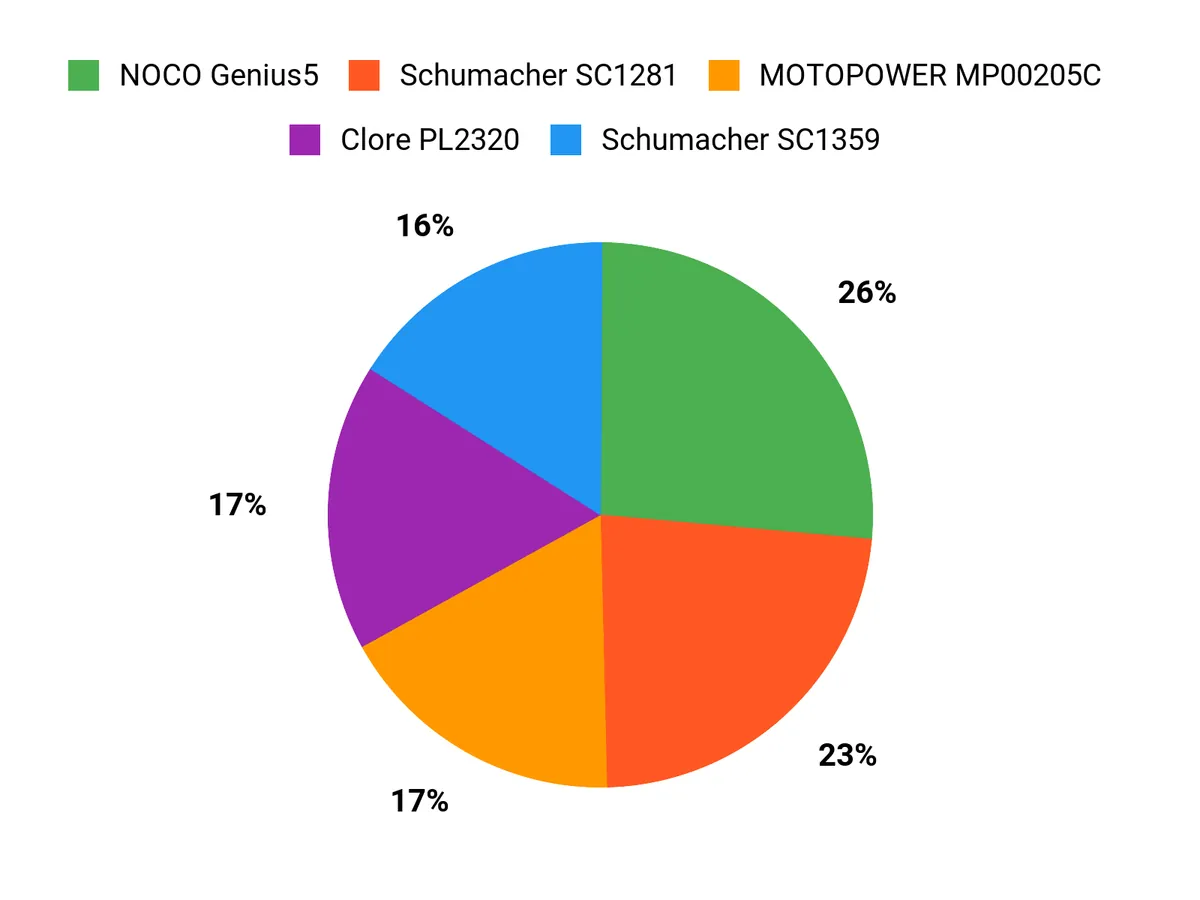
Your best choice depends more on use case than on a single headline specification. Choose the NOCO GENIUS5 when you want the broadest balance of smart charging, maintenance, battery compatibility, and a dedicated lead-acid Repair Mode. Choose the BatteryMINDer 2012 when long-term 12V lead-acid maintenance and automatic desulfation matter more than charging speed.
The Clore PL2320 makes more sense for workshop users who value 20/10/2A charging, reconditioning, and a power-supply function. The Schumacher SC1281 is the stronger choice when high-current boost, engine starting, and diagnostics are important. The SC1359 is aimed at buyers who primarily want faster automatic charging and maintenance, while the MOTOPOWER MP00205C is a compact budget option for low-current 12V maintenance and automatic pulse desulfation.
Wrapping Up
Final Recommendation: For most buyers, the NOCO GENIUS5 offers the best balance because it combines everyday smart charging with 6V/12V support, multiple battery modes, maintenance capability, low-voltage Force Mode, and a dedicated 12V lead-acid Repair Mode.
If long-term storage is your main concern, the BatteryMINDer 2012 is a more specialized 12V lead-acid maintainer with automatic pulse desulfation and temperature compensation. For a professional or serious DIY workspace, the Clore PL2320 offers higher output, automatic reconditioning, and a useful power-supply mode.
The Schumacher SC1281 is the better garage tool when you also need high-current boost, engine-start assistance, and battery/alternator testing. The SC1359 is a straightforward choice when rapid smart charging is more important than a dedicated repair setting, while the MOTOPOWER MP00205C makes sense for inexpensive low-current maintenance.
Whichever charger you choose, match it to the battery’s voltage and chemistry, use recovery modes only as directed, and remember that a desulfator cannot correct every type of battery failure.
Quick Comparison: Schumacher SC1359 vs NOCO GENIUS5
| Schumacher Electric Rapid Battery Charger and Maintainer, SC1359 | NOCO GENIUS5: 5A Smart Battery Charger | |
|---|---|---|
|
|
|
|
| Primary Role | Rapid automatic charger and maintainer | Smart charger, maintainer and lead-acid repair/desulfation option |
| Output Voltage | 6V/12V | 6V/12V |
| Charging Output | Up to 15A rapid charging | 5A |
| Compatible Batteries | Standard, AGM and deep-cycle batteries listed by the manufacturer | Lead-acid types including AGM, gel, flooded and related types, plus compatible lithium batteries in the correct mode |
| Recovery Focus | Best treated as a higher-output smart charger/maintainer | Dedicated 12V Repair Mode plus Force Mode for very low-voltage batteries |
| Check Product Details on Amazon | Check Product Details on Amazon |
This roundup is reader-supported. When you click through affiliate links, we may earn a referral commission on qualifying purchases at no extra cost to you.