By: Travel Consumer Rights Team | Reviewed by: Legal & Policy Editor | Last Updated: September 7, 2026
Fact check: FTC pricing guidance, Choice Hotels fee examples, Wyndham Safemark terms, New York hotel-safe law, and State Department travel guidance were rechecked September 7, 2026.
There is no authoritative nationwide average hotel safe fee in the United States for 2026. Current official property pages show why a single average is misleading: Econo Lodge Florence–Darlington lists an optional in-room safe-warranty fee of $1.50 per night, while Quality Inn & Suites Sun Prairie Madison East lists $2.00 per night plus tax. Wyndham says participating Safemark properties may automatically post an optional safe-warranty fee, but it does not publish one universal amount. Under the FTC Rule on Unfair or Deceptive Fees, mandatory lodging fees must be included in the upfront total price, while genuinely optional add-ons may be excluded only when consumers can meaningfully choose them and the charge is disclosed before payment.
Quick Answer
There is no authoritative nationwide average hotel safe fee for 2026. Two current Choice Hotels examples list optional safe-warranty charges of $1.50 per night and $2.00 per night plus tax. Treat those as property examples, not an industry average. Check whether a charge is truly optional, how consent is obtained, and whether the property allows removal for non-use.
Key Takeaways
- No authoritative U.S. national average was found in the government and hotel-industry sources reviewed.
- Current verified Choice Hotels examples list $1.50 per night and $2.00 per night plus tax; these are property examples, not a market average.
- Safe access may be included with the room, bundled into a mandatory amenity/resort fee, or offered through a separate safe or warranty charge.
- Under the FTC fee rule, required or effectively unavoidable lodging charges belong in the upfront total price; genuinely optional add-ons may be shown separately when properly disclosed.
- Inspect your booking disclosure and itemized folio, and ask for correction of an optional charge that the property’s terms allow you to decline or remove.
What Is the Average Hotel Safe Fee in 2026?
There is no trustworthy nationwide figure that establishes an average hotel safe fee in the United States for 2026. The strongest current evidence is property-specific, so a verified example should not be promoted into a national norm.
One current example is the Econo Lodge Florence–Darlington listing from Choice Hotels, which publishes an optional in-room safe-warranty fee of $1.50 per night.
A second current Choice Hotels example, Quality Inn & Suites Sun Prairie Madison East, publishes an optional safe-warranty fee of $2.00 per night plus tax.
Wyndham’s current Safemark information says participating properties may automatically post an optional safe-warranty fee to the guest’s folio. Wyndham describes removal for non-use on request at checkout but does not publish one universal fee amount.
| Current verified source | Published safe charge | What it proves |
|---|---|---|
| Econo Lodge Florence–Darlington | $1.50 per night, optional in-room safe warranty | A current property-level U.S. example, not a national average |
| Quality Inn & Suites Sun Prairie Madison East | $2.00 per night plus tax, optional safe warranty | Current property pricing can differ even within one hotel group |
| Wyndham Safemark | No universal amount published; participating properties may post an optional warranty fee | The exact hotel’s amount and opt-out terms control |
Across the two currently verified Choice Hotels examples above, the published charges are $1.50 to $2.00 per night. That is an observed example range from two properties, not a statistically valid U.S. average or an industry standard.
The most accurate 2026 answer is not a single national price: check the fee disclosure for the exact hotel and dates you plan to book.
How Do Hotel Safe Fees Vary by Location?
Safe charges can differ between hotels, but there is no reliable evidence that supports fixed urban and rural price ranges. A downtown hotel may provide a complimentary safe, while a roadside property may charge an optional warranty fee. The reverse can also be true.
The useful comparison is therefore between individual properties and their published terms, not between cities, regions, or hotel classes.
Geographic Pricing Differences
Local taxes, state consumer laws, franchise arrangements, resort-fee practices, and the company supplying the safe can all affect how a charge appears. However, those factors do not create a dependable national pattern for safe fees.
When comparing hotels, review the final booking screen, fee details, hotel alerts, rate rules, and cancellation terms. Search for wording such as:
- In-room safe fee
- Safe-warranty fee
- Safemark fee
- Amenity fee
- Resort or destination fee
- Optional services
Urban vs. Rural Rates
It is tempting to assume that urban hotels charge more, but published evidence does not support a standard urban-versus-rural safe-fee table. Hotel location may affect the total room price, parking, taxes, resort fees, and deposits, but it does not reliably predict whether a separate safe fee applies.
Use the hotel’s own disclosure for your travel dates. A chain’s general policy may not tell you whether one franchised location participates in a safe-warranty program.
Note: A fee shown at one hotel should not be applied to every property using the same brand name. Many U.S. hotels are independently owned or operated under franchise agreements.
What Does a Hotel Safe Fee Cover?
The phrase “hotel safe fee” can refer to different products. Before accepting or disputing a charge, determine what the hotel says it covers.
Understanding Safe Fees
A separate line on your folio may fall into one of these categories:
| Charge type | What it may cover | What to verify |
|---|---|---|
| Safe usage fee | Access to the in-room safe | Whether use is optional and how consent is recorded |
| Safe-warranty fee | A limited warranty connected to forced entry or theft | Claim limits, exclusions, reporting deadlines, and proof requirements |
| Amenity or resort fee | A package of services that may include safe access | Whether it is mandatory and included in the displayed total |
| Incidental hold | Temporary security for room damage or extra purchases | The hold amount and expected release process |
Costs and Variations
Current verified official U.S. examples show $1.50 per night at Econo Lodge Florence–Darlington and $2.00 per night plus tax at Quality Inn & Suites Sun Prairie Madison East. Other properties may publish a different amount, a one-time charge, a bundled fee, or no separately listed safe fee.
At those two specific properties, a four-night stay would add $6.00 or $8.00 before any applicable tax. The terms still matter more than the arithmetic: a safe-warranty charge can carry claim limits and reporting conditions, while safe access included with the room may not include a separate warranty.
Waiving the Fees
Some properties allow an optional safe-warranty charge to be removed when the guest does not use the safe. Wyndham’s Safemark policy, for example, says a guest at a participating property may ask the front desk to deduct the fee if the safe was not used.
There is an important pricing-rule nuance: Wyndham’s page describes the Safemark fee as optional even though it may be automatically posted. FTC staff guidance separately says default billing, preselected options, or opt-out practices can make a charge effectively mandatory for total-price disclosure. That does not by itself decide whether a particular hotel violates the rule; the booking flow, disclosure, and consumer-consent process matter.
The removal policy is not universal. Ask before using the safe, and request written confirmation when staff agrees to remove a charge.
Pro Tip: At check-in, ask: “Is there a separate safe or safe-warranty charge, is it optional, and will it appear automatically on my folio?” This wording covers the amount, consent process, and billing method in one question.
Typical In-Room Safe Fees
Because no nationwide average is available, the clearest way to describe typical pricing is by billing pattern rather than an invented range.
| Billing pattern | Current evidence | Guest action |
|---|---|---|
| No separately listed fee | The safe may be included with the room or unavailable. | Confirm whether safe access is complimentary. |
| Published optional nightly fee | Current Choice Hotels examples list $1.50 per night and $2.00 per night plus tax. | Read the hotel alert and removal policy. |
| Automatically posted optional warranty | Wyndham describes automatic posting at participating Safemark properties; FTC guidance says default billing can affect whether a fee is treated as optional. | Ask for removal if the published terms permit it and the safe was not used. |
| Included in a mandatory amenity fee | Safe access may be one item in a broader service package. | Compare the total mandatory price, not only the room rate. |
Are Hotel Safe Fees Included in Room Rates?
Sometimes. A hotel may include safe access with the room, identify it as part of a mandatory amenity fee, or offer a separate optional service. The booking page should explain which arrangement applies.
Safe Fee Overview
The FTC Rule on Unfair or Deceptive Fees requires businesses advertising short-term lodging prices to display the total price with mandatory fees that are known and calculable upfront.
Government charges and genuinely optional add-ons may be excluded from the first displayed total, but the nature and amount of an optional charge must be disclosed before the customer is asked to pay.
The FTC also explains that default billing, preselected options, and opt-out practices can make a charge effectively mandatory. In other words, a business cannot necessarily treat a fee as optional simply because it removes the charge after a guest notices and challenges it.
For a broader lodging-budget checklist covering mandatory fees, taxes, parking, deposits, and optional extras, see our U.S. hotel cost budgeting guide.
Warning: “Optional” should mean that you knowingly choose the service. An automatically added charge that is difficult to avoid may be subject to the FTC rule’s mandatory-fee requirements.
Variations by Hotel
Do not assume that all upscale hotels charge for safes or that all budget hotels provide them free. Safe policies can vary between two properties in the same chain because of franchise ownership, local contracts, equipment providers, and property-specific fees.
Before booking, compare these items:
- The all-in mandatory lodging price
- Optional service descriptions
- Hotel alerts and property policies
- Whether safe access requires activation
- Whether a warranty fee is posted automatically
- The procedure and deadline for declining the service
Can You Get a Hotel Safe Fee Removed?
You may ask a hotel to remove an optional fee when you did not request or use the service, especially when the property’s own policy permits removal. Staff may also correct a billing mistake or explain that a charge is part of a mandatory package.
A mandatory fee is different. The hotel may decline to remove it, but it should have been included in the displayed total price when required by federal law.
Keep screenshots of the booking page, the confirmation email, any chat transcript, and your final folio. These records make it easier to show what was disclosed.
Key Factors to Evaluate Before Using Hotel Safes
Consider more than the daily charge before placing valuables in a hotel safe.
| Factor | Question to ask | Why it matters |
|---|---|---|
| Fee type | Is this payment for access or a limited warranty? | The benefits and claim rules may be different. |
| Safe size | Will it hold a laptop, passport, camera, or documents? | Small safes may not fit the items you need to store. |
| Installation | Is the safe securely fixed in place? | A loose portable box offers different protection from an anchored unit. |
| Warranty conditions | What events, values, and reporting deadlines are covered? | Payment may depend on forced entry, police reports, receipts, and proof of ownership. |
| Hotel liability | Does the hotel have a posted valuables or front-desk-deposit policy? | State law and hotel terms may limit recovery. |
| Insurance | Does your travel or homeowners policy cover theft away from home? | Coverage limits and exclusions can affect the best storage choice. |
Wyndham’s Safemark terms illustrate why the details matter. Its limited warranty describes recourse of up to $5,000 after forced entry, but the incident must be reported to hotel personnel and local police within 24 hours, a police report must be filed, and the guest must provide acceptable evidence identifying the stolen property and ownership.
Hotel liability rules also vary by state. For example, New York General Business Law Section 200 establishes specific conditions and limits relating to valuables and hotel safes. Other states may use different limits and procedures.
Note: This discussion provides general consumer information, not legal advice. Read the hotel’s posted notice and consult an appropriate professional when a high-value loss or legal dispute is involved.
Tips for Avoiding Unnecessary Hotel Safe Fees
A few checks can prevent most billing surprises:
- Review the final price before booking. Look beyond the first nightly rate and open every fee-details section.
- Search the property page. Use your browser’s find function for “safe,” “warranty,” “amenity,” and “optional.”
- Ask before check-in. Confirm whether the charge is mandatory, optional, included, or added automatically.
- Decline correctly. Follow the hotel’s stated process before using the safe.
- Inspect the folio early. Request an updated folio the night before checkout when possible.
- Keep proof. Save booking screenshots, rate rules, receipts, and written staff responses.
A personal luggage lock or portable safe may reduce casual access, but it should not be treated as guaranteed theft protection. Do not leave irreplaceable documents, unusually valuable jewelry, large amounts of cash, or sensitive data in a hotel room without considering stronger storage and insurance options.
What Alternatives Exist for Storing Valuables?
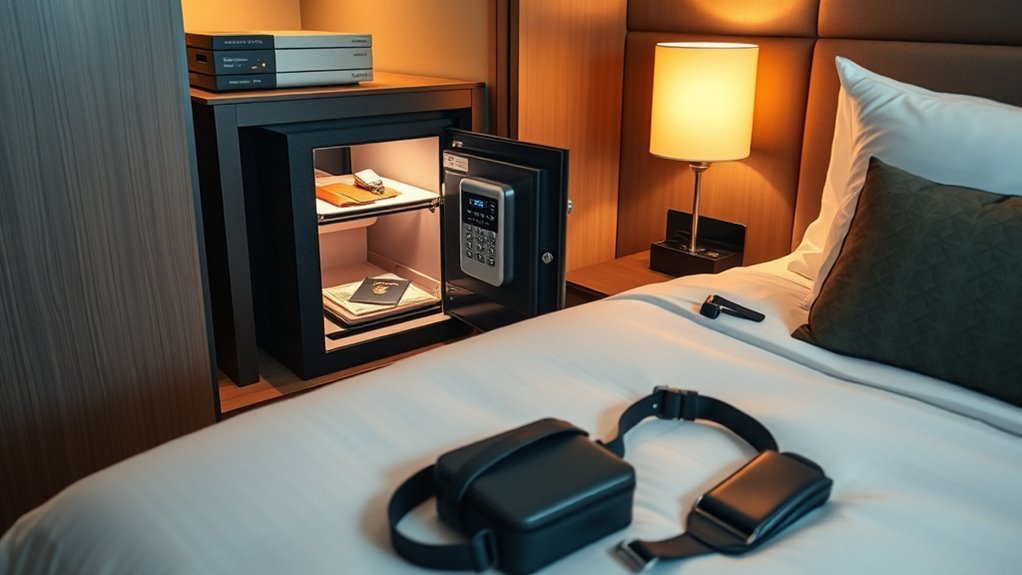
The best alternative depends on the item’s value, size, and how often you need it.
- Front-desk safe or safe-deposit box: Ask whether the hotel accepts valuables, provides a receipt, imposes a declared-value limit, or charges for storage.
- Carry only what you need: Leave unnecessary jewelry and large amounts of cash at home.
- Money belt or concealed pouch: Useful for a limited amount of cash, cards, or documents while traveling, provided it remains concealed and comfortable.
- Portable travel safe: A lockable bag or container secured to a fixed object may deter casual theft but is not equivalent to a bank safe-deposit box.
- Bank or professional storage: Consider this for property whose value exceeds the hotel’s stated limits or your insurance coverage.
- Encrypted digital copies: Keep protected copies of passports, insurance information, and emergency contacts separately from the originals.
Official U.S. travel guidance for some destinations recommends keeping passports and important valuables in a hotel safe or another secured location. For example, the U.S. Department of State’s Vietnam travel advisory, issued June 24, 2026, advises travelers to keep passports and other important valuables in a hotel safe or another secured location and carry copies. That guidance does not guarantee the security of a particular hotel safe, so use judgment based on the property and item value.
What Should a Hotel Disclose About a Safe Fee?
Clear disclosure lets travelers compare the real cost of different hotels and decide whether an optional safe service is worthwhile. It also reduces checkout disputes and helps guests understand what a warranty does and does not cover.
Under the FTC rule, the displayed lodging price must include mandatory, calculable fees. A hotel may still itemize those fees, but the itemization cannot overshadow the total price. Optional services can be offered separately when they are genuinely optional and properly disclosed.
Transparent disclosure should answer four questions:
- How much is the charge?
- Is it mandatory or optional?
- What product or service does it cover?
- How and when can the guest accept, decline, or dispute it?
What Should You Ask About a Hotel Safe Fee at Check-In?
Ask the front desk to explain all mandatory charges, optional services, deposits, and card holds. A simple script is:
“Please confirm whether the room has a separate safe or safe-warranty charge, whether it is optional, whether it has already been added, and what I must do to decline it.”
If a fee appears unexpectedly, follow this 4-step consumer dispute workflow:
- Request Disclosure Proof: Ask the front desk staff what the charge covers and where it was disclosed prior to your booking confirmation.
- Reference Published Opt-Out Terms: State clearly that you did not request or use the safe, and point to the hotel or chain’s published policy permitting removal for non-use.
- Escalate to Duty Manager: If front desk staff cannot remove the charge, ask to speak with the General Manager or Duty Manager before settling your folio.
- Document & Dispute Externally: Obtain a final itemized copy of your folio. If an unauthorized optional charge remains, submit a billing complaint with your credit card issuer (attaching your booking confirmation and folio) and file a report with the FTC Fraud Portal.
Do not confuse a safe fee with a security deposit or incidental authorization. A deposit or hold is normally intended to cover potential room damage or extra purchases. It may temporarily reduce your available credit even though it is not supposed to become a final charge when no amount is owed.
Frequently Asked Questions
What is the average hotel safe fee in the United States?
There is no authoritative nationwide average. Current verified Choice Hotels examples list optional safe-warranty fees of $1.50 per night and $2.00 per night plus tax. Those are property examples, not an industry average, so check the exact hotel’s fee disclosure.
Are hotel safes usually free?
This update did not find an authoritative national dataset showing what share of hotels charge separately for safes. Many properties do not list a separate safe charge, while some publish a safe-access or safe-warranty fee. Use the exact property’s booking disclosure rather than assuming a brand-wide rule.
Is a hotel safe fee mandatory?
It depends on the property and billing flow. Under FTC guidance, a required or effectively unavoidable charge belongs in the upfront total price. Default billing or an opt-out structure can make a fee effectively mandatory, while a genuinely optional add-on may be shown separately when the guest can meaningfully choose it and the charge is disclosed before payment.
Can a hotel charge for a safe I did not use?
A hotel may publish a safe-fee policy, but calling a charge optional does not settle the federal pricing question. If the fee is added by default or is not reasonably avoidable, FTC guidance may treat it as mandatory for total-price display. If the property’s own terms allow removal for non-use, ask for a corrected folio.
Can I ask the hotel to remove a safe-warranty fee?
Yes, when the property’s published terms allow it. Wyndham’s Safemark policy says guests at participating properties who do not use the safe may ask the front desk to deduct the fee at checkout. Other properties can use different rules, so ask promptly and keep the corrected folio.
Does a safe-warranty fee guarantee reimbursement?
No. A limited warranty can impose exclusions, value limits, reporting deadlines, proof-of-ownership requirements, and a forced-entry requirement. Wyndham’s Safemark terms, for example, describe recourse up to $5,000 but also require timely reporting, a police report, and evidence of the stolen property and ownership.
What is a normal hotel security deposit?
There is no single national standard. A property may require a fixed deposit, a nightly amount, or a credit-card authorization based on the room, stay length, payment method, or local policy. A deposit or incidental hold is different from a safe fee, so ask whether the amount is a hold or a final charge and how release is handled.
Conclusion
There is no verified national average hotel safe fee for the United States in 2026. Current official property examples show $1.50 per night and $2.00 per night plus tax for optional safe-warranty charges at two Choice Hotels properties, while Wyndham publishes Safemark terms without one universal fee amount. These examples show that charges vary by property; they do not establish a U.S. average.
Check the hotel’s final price, optional-service disclosures, and warranty terms before booking. At check-in, ask whether a safe charge is added automatically. At checkout, examine the itemized folio and request correction of any improperly disclosed or unauthorized charge. For expensive or irreplaceable property, also consider state liability rules, written receipts, declared-value limits, and applicable insurance coverage.
Sources
- Federal Trade Commission: Rule on Unfair or Deceptive Fees FAQ — mandatory lodging prices, optional add-ons, default billing, and disclosure requirements.
- Federal Trade Commission: Fees Rule Effective May 12, 2025 — effective date and short-term lodging coverage.
- Wyndham Hotels: About Safemark — optional safe-warranty billing, removal for non-use, coverage limit, and claim conditions at participating properties.
- Choice Hotels: Econo Lodge Florence–Darlington — current property example listing a $1.50 nightly optional safe-warranty fee.
- Choice Hotels: Quality Inn & Suites Sun Prairie Madison East — current property example listing a $2.00 nightly optional safe-warranty fee plus tax.
- New York State Senate: General Business Law Section 200 — state-specific hotel-safe and valuables-liability example.
- U.S. Department of State: Vietnam Travel Information — official guidance on securing passports and important valuables while traveling.