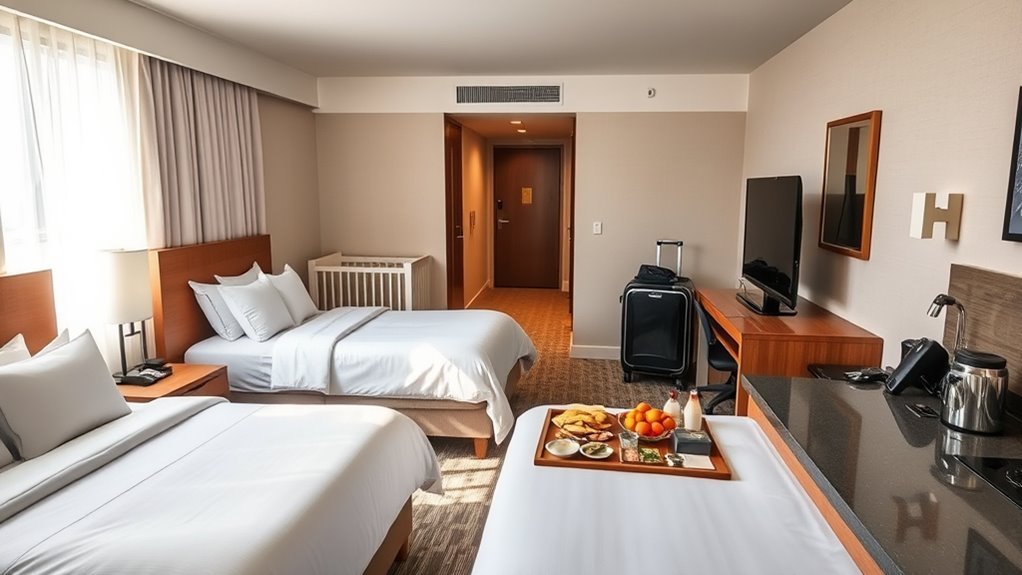
Booking a hotel for six people costs more than checking the average price of a standard room. Your final rate depends on whether one room legally accommodates everyone, whether you need a suite or two rooms, where you travel, and the ages of the guests. Taxes, parking, pet charges, and optional services can also change the total.
Quick Answer
In 2026, a practical starting budget for a family of six is about $300 to $500 per night before taxes and optional extras. This is a planning allowance, not an official national average. A legal family suite may cost less than two rooms, while major cities, resorts, holidays, and special events can push the total much higher.
Key Takeaways
- There is no published national hotel average specifically for a family of six.
- The U.S. hotel average daily rate measures one sold room, not a room that necessarily sleeps six.
- Always search with all six guests and the correct ages so the booking system shows legal room options.
- Compare one family suite with two standard rooms using the complete stay total, not only the first nightly price shown.
- Check taxes, parking, pet charges, cancellation rules, deposits, bedding, and whether connecting rooms are confirmed.
Average Hotel Costs for Families in 2026
The hotel industry does not publish a nationwide average specifically for two adults and four children, six adults, or any other six-person group. Published averages normally measure the price of one sold room, regardless of how many people that room can hold.
CoStar reported an average U.S. daily room rate of $174.49 for the week ending July 18, 2026. That is a useful market benchmark, but it does not mean a family of six can book a suitable room for $174.49.
At the July 2026 national weekly room average, two rooms would have a subtotal of about $349 per night before taxes and optional charges.
For early planning, allow about $300 to $500 per night before taxes and optional extras. A family may spend less when an approved suite is available in a lower-cost market. Two rooms in an expensive city, a resort stay, or travel during a major event can cost $500 to $900 or more per night.
Note: The $300 to $500 range is a practical budgeting allowance, not an official U.S. family-hotel average. Live rates for your exact destination, dates, room type, and guest ages are the only reliable final estimate.
Sample Family Hotel Budgets
The following calculations show how room configuration affects a three-night stay. They are examples rather than advertised rates.
| Booking setup | Nightly room subtotal | Three-night subtotal |
|---|---|---|
| One suite listed at $329 | $329 | $987 |
| Two rooms at $175 each | $350 | $1,050 |
| Two rooms at $425 each | $850 | $2,550 |
Taxes and optional charges must be added to these subtotals. A refundable deposit or temporary credit-card authorization can also reduce your available spending balance during the trip, even when it is not part of the final cost.
Factors Influencing Hotel Prices for Families
The number of guests is only one part of the price. Hotels also consider room type, bedding, location, demand, stay dates, cancellation terms, and sometimes the ages of the children.
Guest Count and Occupancy
A four-person maximum is common in standard rooms, but it is not a universal hotel rule. Some rooms hold two or three people, while selected suites, family rooms, and multi-bedroom units may hold six or more.
Marriott explains that adult and child counts help determine the correct room size and bedding configuration. Definitions of a child can also differ by region or property.
Warning: Do not leave guests off the reservation to unlock a cheaper room. The hotel may refuse check-in, require another room, adjust the rate, or determine that the room cannot safely accommodate the group.
Destination and Demand
Large cities, beach resorts, national-park gateways, ski destinations, theme-park areas, and convention markets often cost more when demand is high. Special events can matter as much as the season.
For example, CoStar reported a New York City ADR of $425.03 for the week ending July 18, 2026. Two rooms at that market-wide average would total about $850 before taxes. This does not represent every New York hotel, but it shows why a single nationwide price cannot answer every family’s question.
Room and Rate Type
A prepaid, nonrefundable rate may be cheaper than a flexible rate. However, the savings can disappear if your plans change. A room with breakfast, parking, or more flexible cancellation may offer better overall value even when its listed price is higher.
Compare identical room types and cancellation conditions. A studio suite, one-bedroom suite, two-bedroom suite, and two standard rooms are different products and should not be compared by nightly price alone.
Types of Accommodations: What’s Available?
Families of six usually choose among a family-capacity room, an extended-stay suite, or two separate rooms. The best choice depends on privacy, bedding, bathrooms, meal needs, and whether the rooms connect.
| Accommodation | Advantages | What to verify |
|---|---|---|
| Family room or large studio | One booking and often the lowest room subtotal | Maximum occupancy, actual beds, sofa-bed size, and bathroom count |
| One-bedroom suite | Separate living area and possible kitchen | Whether the living-room sleeper and bedroom legally hold all six guests |
| Two-bedroom suite | More privacy, more beds, and sometimes two bathrooms | Price compared with two ordinary rooms and any minimum-stay rule |
| Two connecting rooms | Two bathrooms and more sleeping space | Whether the connection is confirmed rather than merely requested |
| Two nearby rooms | Widely available when suites are sold out | Adult supervision, room location, and whether “adjoining” means only nearby |
Connecting and adjoining are not always the same. Connecting rooms have an interior door. Adjoining rooms may simply be next to or near each other.
Marriott states that ordinary connecting-room requests depend on availability and may not be guaranteed. Participating Hilton hotels offer a separate Confirmed Connecting Rooms booking feature.
Best Budget Hotels for Families
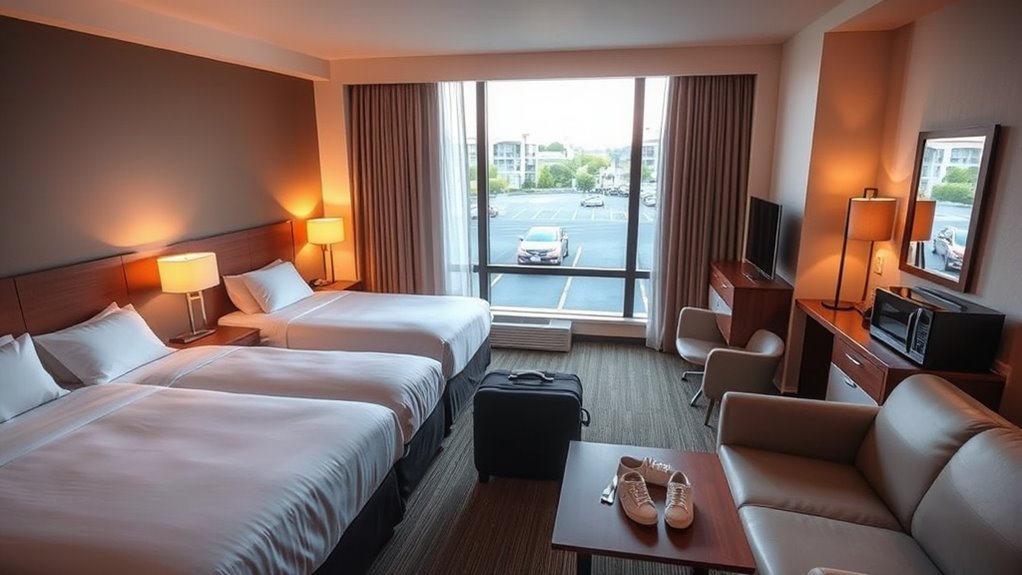
The best budget choice is not always the room with the lowest listed price. A slightly more expensive suite can cost less overall if it includes breakfast, parking, a kitchen, or enough legal sleeping space to avoid booking a second room.
Affordable Family Suites
Extended-stay and all-suite brands are useful places to start because many properties include larger living areas and kitchen facilities. However, a suite label does not guarantee space for six people.
Residence Inn properties commonly advertise full kitchens and complimentary breakfast. Homewood Suites advertises in-suite kitchens and free hot breakfast. The selected room’s occupancy and bedding still need to be checked individually.
Before booking, confirm:
- The number and size of permanent beds
- Whether a sofa bed is included
- Whether a crib or rollaway is permitted
- The maximum number of adults and children
- Whether the kitchen has a stovetop or only a microwave and refrigerator
- Whether the suite has one or two bathrooms
Free Breakfast Options
Breakfast can be valuable for a six-person group, but avoid assigning it a fixed dollar value without checking the menu and your family’s needs.
Estimate the value by multiplying what six people would otherwise spend on breakfast. Then consider whether the hotel’s offering includes hot food, protein, fruit, allergy-friendly choices, and serving hours that match your schedule.
Some Drury properties include hot breakfast plus the brand’s 5:30 Kickback with dinnertime snacks and drinks. Treat the evening benefit as a useful food perk rather than a guaranteed replacement for a complete dinner, because menus and needs vary.
Kid-Friendly Amenities
Useful family amenities may include:
- A pool with suitable operating hours
- Cribs or pack-and-plays
- Guest laundry
- A refrigerator, microwave, or full kitchen
- Free or lower-cost parking
- Connecting-room booking
- On-site food or nearby grocery stores
- Elevators, ramps, and accessible bathrooms when needed
Check whether an amenity is open during your stay. Pools, restaurants, and breakfast areas may close for maintenance or operate on reduced schedules.
Average Costs of Mid-Range Family Hotels: Value for Money
Mid-range hotels can provide a useful balance of space, cleanliness, location, and included services. The challenge is that hotel category does not determine room capacity. A mid-range standard room may still hold only four people.
Average Rates Analysis
Instead of relying on a nationwide mid-range price band, search the exact destination twice:
- Search for one room with all six guests and their correct ages.
- Search for two rooms with the guests divided correctly between them.
Compare the complete totals for the same dates. Include the room subtotal, mandatory lodging fees, taxes, parking, breakfast, and any extra-person or rollaway charge.
A useful calculation is:
Complete nightly budget = displayed lodging total + taxes and government charges + optional parking, pet, meal, or bedding charges
Multiply that amount by the number of nights, then add any one-time charges.
Family Amenities Offered
A mid-range family stay may include breakfast, a mini-fridge, a microwave, laundry facilities, a pool, or free parking. These benefits are valuable only when they replace expenses your family would otherwise pay.
For example, free parking has little value when you arrive without a car. A full kitchen may be extremely valuable during a weeklong stay but less useful for one night. Compare amenities based on your actual travel plan rather than the length of the hotel’s feature list.
Evaluating Luxury Family Hotels: Are They Worth the Cost?
Luxury family hotels can be worthwhile when the rate includes space, location, activities, transportation, meals, or services your family would otherwise purchase separately. They are less compelling when the higher price mainly pays for décor or facilities you will not use.
Compare these points:
- Room layout: A large suite with two bedrooms and two bathrooms may reduce stress and improve sleep.
- Included services: Kids’ activities, breakfast, transportation, or lounge access can add value.
- Optional expenses: Valet parking, paid activities, spa services, premium meals, and babysitting can increase the bill.
- Location: A higher room rate may be worthwhile if it reduces rental-car, parking, or transportation costs.
- Time at the property: Resort amenities have less value when most of the trip will be spent elsewhere.
Always compare a luxury suite with the best realistic alternative, such as two mid-range rooms. Do not compare it with a standard room that cannot legally accommodate the family.
Seasonal Price Variations: When to Book
There is no universal cheapest month for U.S. hotels. January may be inexpensive in one city but costly at a ski resort or warm-weather destination. The relevant low season is the low season for your specific destination.
Peak Travel Seasons
Rates often rise when demand increases because of:
- School vacations
- National holidays
- Concerts and sporting events
- Conventions and trade shows
- Graduations and college events
- Beach, ski, fall-color, or festival seasons
- Friday and Saturday demand in leisure markets
Check the destination’s event calendar before booking. Moving the trip by one day or choosing a suburb with convenient transportation can produce a larger saving than switching hotel brands.
Off-Peak Savings Opportunities
Off-peak and shoulder dates can offer lower rates, but the amount saved depends on the destination, room type, and length of stay. Avoid relying on a fixed claim such as “save $300 to $700.”
Use a flexible-date search and compare the same hotel, room, guest count, and cancellation policy across several date combinations. This produces a real saving figure for your trip rather than a national estimate.
Holiday Price Fluctuations
Holiday rates do not always move in the same direction. Leisure destinations may become more expensive, while some business districts can become cheaper when offices close. New Year’s Eve, major sporting events, and local festivals can create unusually high rates even during an otherwise quiet period.
Pro Tip: Compare the trip with one-night flexibility on both sides. A Thursday-to-Sunday stay may price very differently from Friday-to-Monday, even though both include three nights.
Common Hidden Costs in Family Hotel Stays
Mandatory lodging fees should no longer be hidden behind a lower room-only price. Under the FTC’s Rule on Unfair or Deceptive Fees, effective May 12, 2025, hotels and booking platforms must display the total price including mandatory fees they can calculate in advance.
Taxes, government charges, and optional services may still be shown separately. Review the final booking page for the following items:
- Taxes and government charges: These vary by state, city, county, and tourism district.
- Parking: Self-parking and valet rates can differ, and oversized vehicles may cost more.
- Pet charges: A property may charge per stay, per night, or per pet.
- Extra-person charges: Some rates change with the number or ages of guests.
- Rollaway or crib charges: Availability may be limited even when the item can be requested.
- Breakfast exclusions: A rate may include breakfast for only a limited number of registered guests.
- Destination or facility charges: Mandatory calculable charges should appear in the displayed lodging total, but read the itemization.
- Optional activities: Kids’ clubs, water sports, transportation, or resort programs may cost extra.
- Cancellation penalties: A prepaid rate can result in the loss of the full booking amount.
- Early check-in or late checkout: These may be unavailable or subject to a charge.
Deposits and Incidental Holds
A hotel may place a temporary authorization on your payment card for possible incidentals. This is not necessarily a final charge, but the money or available credit may remain unavailable until the hold is released.
Ask the hotel about the amount, whether it is per night or per stay, and how long the release normally takes after checkout. This is especially important when using a debit card.
Tips for Finding the Best Family Deals
- Enter every guest: Include all adults, children, and child ages from the beginning of the search.
- Compare one room with two: Do not assume a suite is cheaper or that two rooms are more comfortable.
- Use the final total: Compare identical stay totals after mandatory fees, not partial nightly prices.
- Check direct and third-party rates: Compare cancellation rules, breakfast, loyalty benefits, and payment timing.
- Search flexible dates: Try nearby weekdays, weekends, and alternative arrival dates.
- Consider nearby areas: A suburb may offer more space and parking, but calculate transportation costs.
- Value kitchens realistically: A kitchen saves money only when your family plans to use it.
- Join free loyalty programs: Member rates, points, Wi-Fi, or other benefits may improve the offer.
- Read recent family reviews: Look for comments about sofa beds, noise, breakfast crowds, elevators, and room layout.
- Verify the booking source: Use the hotel’s official website or a recognized platform and check the web address carefully.
The FTC warns that travel scammers may use paid advertisements, copied websites, and phone numbers that appear to belong to known travel companies. Use an official app or independently verified website before entering payment details.
How to Book Your Family Hotel Stay
- List the travelers. Record the number of adults, each child’s age at check-in, and any crib or accessible-room needs.
- Set the real budget. Decide on a nightly target and a maximum complete-stay amount.
- Search for one room first. Enter all six guests and review only options that the booking system approves for the full party.
- Search for two rooms. Divide the guests accurately and look for confirmed connecting rooms when needed.
- Compare layouts. Check beds, sofa beds, bedrooms, bathrooms, floor plans, and kitchen equipment.
- Review the total. Add taxes, optional parking, pet charges, meals, and transportation.
- Check the rules. Read cancellation deadlines, deposit requirements, payment timing, and age restrictions.
- Confirm important features. Contact the hotel when occupancy, accessibility, crib availability, or room connection is unclear.
- Save the evidence. Keep the confirmation email and screenshots showing the guest count, room type, included benefits, and cancellation terms.
- Recheck before travel. Confirm the reservation and any essential room request several days before arrival.
Note: A request for connecting rooms, a crib, a rollaway, or early check-in is not the same as a confirmed feature. Obtain written confirmation when the feature is essential to the stay.
Family Hotel Safety and Accessibility Checks
Confirm any accessibility feature your family needs before paying. The U.S. Department of State’s lodging-safety guidance recommends confirming facilities such as elevators and ramps and checking alarms, locks, emergency exits, and carbon-monoxide detection.
After check-in, locate the nearest exit, make sure doors and windows lock, and report missing or damaged safety equipment to the front desk.
Frequently Asked Questions
What is the average hotel price in the United States?
CoStar reported a 2025 annual U.S. hotel ADR of $160.54 and a weekly ADR of $174.49 for July 12–18, 2026. ADR measures one sold room and does not guarantee that the room can accommodate a family of six.
Can a family of six stay in one hotel room?
Sometimes. Selected family rooms and suites permit six guests, but many standard rooms do not. Enter all travelers and their ages during the search, then confirm the listed maximum occupancy and bedding.
Is one suite cheaper than two hotel rooms?
It can be, but not always. Compare the complete price of a suite approved for six guests with two standard rooms. Also consider the number of bathrooms, breakfast coverage, kitchen facilities, privacy, and whether connecting rooms are confirmed.
What U.S. city has the cheapest hotels?
No city is consistently cheapest for every date and family. Rates change with local events, neighborhood, weekday, season, and room capacity. Search several lower-demand destinations for your exact dates and compare the final totals.
Do displayed hotel prices include resort fees?
Mandatory fees that the seller can calculate in advance must be included in the prominently displayed total lodging price under the FTC rule effective May 12, 2025. Taxes, government charges, and optional services may still be listed separately.
How far ahead should a family of six book?
Book earlier when you need a rare six-person suite, confirmed connecting rooms, accessible features, or travel during a holiday or major event. Flexible trips can be compared over time, but there is no single booking window that always produces the lowest rate.
Conclusion
A family of six should begin with a working hotel budget of about $300 to $500 per night before taxes and optional costs, while recognizing that the real total can fall outside that range. Published U.S. hotel averages measure one sold room and do not show whether that room legally sleeps six.
Search with the correct guest count, compare an approved suite with two rooms, and review the complete stay total. Confirm bedding, occupancy, connecting-room status, cancellation terms, deposits, parking, breakfast coverage, and essential accessibility features before paying. Those checks provide a more reliable answer than any unsupported nationwide price promise.
Sources
- CoStar: U.S. Hotel Results for the Week Ending July 18, 2026 — current weekly U.S. and major-market ADR data.
- CoStar: 2025 U.S. Hotel Year-End Results — annual U.S. occupancy, ADR, and RevPAR.
- Federal Trade Commission: Rule on Unfair or Deceptive Fees — upfront hotel-price and mandatory-fee requirements.
- Marriott Help: Why Hotels Ask for Adult and Child Counts — room size, bedding, and guest-age guidance.
- Homewood Suites by Hilton — official information about kitchens and breakfast.
- U.S. Department of State: Lodging Safety — safety and accessibility checks.