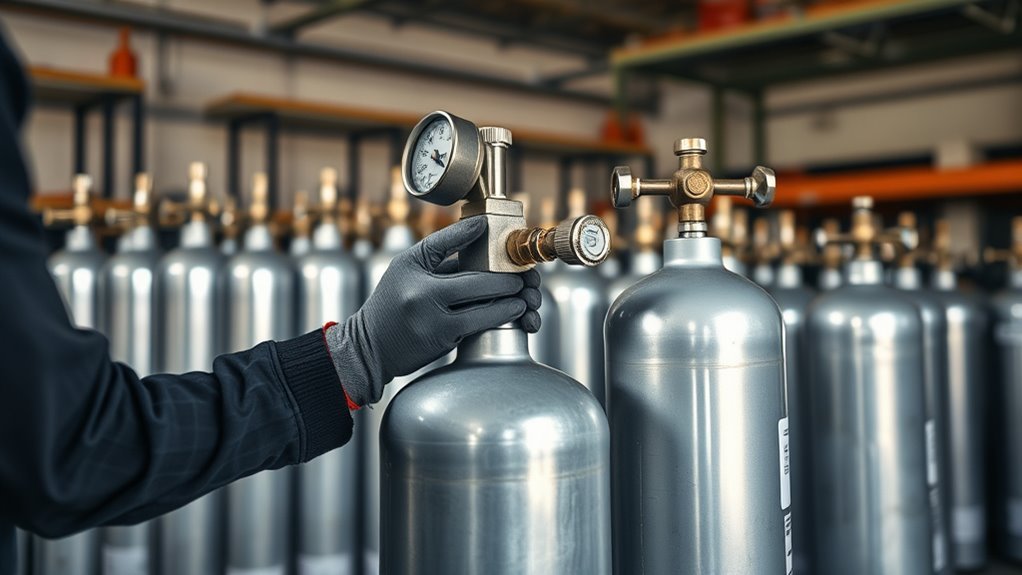
The cost to refill or exchange a 75% argon/25% CO₂ welding-gas cylinder depends on its capacity, your supplier’s program, local availability, and whether the cylinder needs inspection or requalification. As of August 10, 2026, one current U.S. retail program lists C25 gas fills or exchanges from $47.99 for 20 CF to $109.99 for 390 CF. Treat those figures as shopping benchmarks, not nationwide averages.
Quick Answer
A current 125-CF 75/25 argon CO₂ refill or exchange costs $69.99 in one U.S. retail program. Smaller and larger cylinders can have very different costs per cubic foot. Always confirm whether a quote covers only the gas, an exchange, testing, rental fees, or the cylinder itself.
Key Takeaways
- Current Northern Tool examples range from $47.99 for 20 CF to $109.99 for 390 CF, with a 125-CF fill or exchange at $69.99.
- In the current price sample, larger cylinders provide substantially more gas per dollar, although local supplier pricing can follow a different pattern.
- Ask whether the quote includes gas, exchange service, handling, requalification, taxes, delivery, or cylinder rent.
- C25 is a premixed MIG shielding gas containing 75% argon and 25% CO₂; it is not the same product as a pure CO₂ refill.
- Secure cylinders, protect the valve, and use adequate ventilation whenever storing, using, or transporting welding gas.
What Does a 75/25 Argon CO2 Refill Cost?
For a useful U.S. benchmark, Northern Tool currently lists C25 gas fill or exchange prices of $47.99 for 20 CF, $62.99 for 40 CF, $69.99 for 80 CF, $69.99 for 125 CF, and $109.99 for 390 CF.
Those prices were checked on August 10, 2026. They apply to the retailer’s participating-store program and are not national averages. Your local welding supplier may charge less or substantially more.
| Cylinder Capacity | Current Fill/Exchange Example | Approximate Cost per CF |
|---|---|---|
| 20 CF | $47.99 | $2.40 |
| 40 CF | $62.99 | $1.57 |
| 80 CF | $69.99 | $0.87 |
| 125 CF | $69.99 | $0.56 |
| 390 CF | $109.99 | $0.28 |
Note: A refill or contents quote should not be compared directly with the price of buying a complete cylinder. For example, PrimeWeld currently displays a full C25 cylinder product with a 125-CF option at $369. Confirm the selected capacity before comparing purchase prices because the same product page also offers smaller cylinders.
Your final bill may include:
- A gas or contents charge
- A cylinder-exchange charge
- Hazardous-material or handling fees
- Local taxes
- Delivery charges
- Annual rental or lease fees
- Requalification or inspection charges for an out-of-date owner cylinder
Compare Cubic Feet, Not Just the Supplier’s Size Number
Retailers may label cylinders with internal size numbers such as #2, #3, #4, or #6. Those labels are not the best way to compare competing suppliers. Ask for the rated gas capacity in cubic feet, the gas mixture, and the complete out-the-door price.
Also confirm whether the quoted capacity describes the actual cylinder offered in that supplier’s program. A retailer’s size label should not be assumed to match another company’s cylinder with the same size number.
At one current retailer, the 40-CF and 125-CF C25 fills differ by only $7, even though the larger cylinder holds more than three times as much gas.
Why Tank Size Changes Refill Prices
Shielding-gas prices do not necessarily rise in a straight line with cylinder capacity. A supplier still has to receive the cylinder, inspect or process it, handle paperwork, connect filling or exchange equipment, and complete the transaction. Those fixed costs can make a small cylinder expensive on a per-cubic-foot basis.
Using the current examples above, a 20-CF fill works out to approximately $2.40 per cubic foot, a 40-CF fill is about $1.57 per cubic foot, and a 390-CF fill is about $0.28 per cubic foot. In this particular retail program, the larger cylinders provide substantially more gas for each dollar.
A larger cylinder is not automatically the right choice. Consider:
- Portability: A larger steel cylinder is heavier and harder to load and move safely.
- Storage space: The cylinder needs a secure location protected from heat and physical damage.
- Usage: An occasional hobby welder may not benefit from tying up money in a large cylinder.
- Supplier rules: Some large cylinders are offered mainly through rental or exchange programs.
- Vehicle capacity: You need an appropriate way to secure the cylinder during transport.
Pro Tip: Calculate the cost per cubic foot before choosing a cylinder. Divide the complete fill price, including mandatory fees, by the cylinder’s rated gas capacity. Then consider how often you weld, because a cheaper cost per cubic foot is useful only if the larger cylinder fits your storage, transport, and supplier program.
Where to Get the Cheapest 75/25 Argon CO2 Refill
No supplier category is always the cheapest. An independent welding store may offer a lower gas price, while a chain exchange program may save time, include cylinder maintenance, or provide longer opening hours.
Compare at least three nearby options:
- Independent welding-supply stores
- Industrial-gas distributors
- Farm and equipment retailers with exchange programs
- Welder dealers that sell shielding gas
- Cylinder-testing facilities that also provide gas service
How to Compare Refill Quotes Fairly
Ask every supplier for the same service and cylinder capacity. A $60 gas-only refill, a $75 exchange, and a $300-plus full-cylinder purchase are three different transactions and should not be placed in the same price column.
Ask each supplier the same questions:
- What is the out-the-door price for 75% argon/25% CO₂ in my cylinder size?
- Is the service a same-cylinder refill or an exchange?
- Do you accept customer-owned cylinders from another supplier?
- Are handling, environmental, hazardous-material, or membership fees added?
- What happens if the cylinder’s test date is expired?
- Is requalification included in an exchange?
- Must I provide proof that I own the cylinder?
- Will you exchange it only for the same capacity?
Include driving costs in the comparison. Saving $15 on gas is not useful if the trip costs more than $15 and several hours of your time.
Should You Refill, Exchange, or Buy?
A refill, exchange, cylinder purchase, and rental agreement solve different problems. Compare the complete long-term cost rather than looking only at the next gas bill.
| Option | Best For | Main Advantage | Possible Drawback |
|---|---|---|---|
| Refill | Owners who want to keep the same cylinder | You retain your cylinder | May require a wait or separate testing |
| Exchange | Welders who need a full cylinder immediately | Fast turnaround and simplified cylinder maintenance | You normally receive a different cylinder |
| Purchase | Regular hobbyists and small shops | No recurring cylinder-rental charge | High upfront price and possible testing responsibility |
| Rent or lease | Businesses and high-volume users | Lower upfront cost and supplier-managed cylinders | Ongoing fees and supplier restrictions |
Buying is often attractive for a home shop that will use the same cylinder for years. Renting can make more sense when you need a large cylinder, want supplier-managed maintenance, or prefer to avoid a major upfront purchase.
Estimate Your Long-Term Gas Cost
For a rough usage estimate, multiply your average gas-flow setting by your actual arc-on welding time:
Flow rate in CFH × arc-on hours = approximate cubic feet of shielding gas used
For example, two hours of actual arc-on welding at 25 CFH uses about 50 cubic feet of shielding gas before allowing for purging, leaks, or other losses. Use that consumption figure with your supplier’s cost per cubic foot to compare cylinder programs over a month or year.
Will a Supplier Accept Your Cylinder?
Owning a cylinder does not guarantee that every gas supplier will fill or exchange it. Supplier policies can depend on cylinder capacity, ownership markings, valve type, physical condition, test status, and the supplier’s own exchange program.
Before driving to the store, check:
- Gas label: Confirm that the cylinder is intended for 75/25 argon/CO₂ or a compatible high-pressure shielding-gas service.
- Ownership: Bring a receipt or ownership certificate if you have one.
- Valve and regulator: CGA-580 is commonly used on U.S. equipment intended for argon and argon/CO₂ service; for example, Miller lists CGA-580 on an argon/CO₂ flowmeter regulator. Verify your exact cylinder valve and regulator rather than assuming compatibility.
- Test stamp: Locate the stamped qualification or requalification date and associated markings on the cylinder shoulder.
- Condition: Heavy corrosion, fire damage, gouges, damaged threads, or unreadable required markings may cause rejection.
- Capacity: Ask whether the supplier supports your exact cylinder size.
Federal cylinder-requalification intervals vary by cylinder specification, gas service, test method, and markings. A DOT 3AA cylinder does not automatically qualify for a 10-year interval in every situation. Review the current requirements in 49 CFR 180.209, and let an authorized supplier or requalifier determine whether the cylinder is in date and eligible to be filled.
Note: Do not assume that a stamped “3AA” specification alone tells you the next test interval. Certain cylinders and services can qualify for longer intervals only when the applicable federal conditions and markings are satisfied.
How Long Does a 125 CF C25 Cylinder Last?
You can estimate shielding-gas runtime by dividing cylinder capacity by the flow rate:
Cylinder capacity ÷ flow rate = approximate arc-on hours
Miller’s mild-steel MIG guidance recommends setting shielding-gas flow around 20 to 25 cubic feet per hour as a starting point. At that rate, a 125-CF cylinder provides approximately:
- 6.25 arc-on hours at 20 CFH
- 5 arc-on hours at 25 CFH
Approximate Runtime by Cylinder Capacity
| Cylinder Capacity | At 20 CFH | At 25 CFH |
|---|---|---|
| 20 CF | 1.0 hour | 0.8 hour |
| 40 CF | 2.0 hours | 1.6 hours |
| 80 CF | 4.0 hours | 3.2 hours |
| 125 CF | 6.25 hours | 5.0 hours |
| 390 CF | 19.5 hours | 15.6 hours |
These are mathematical arc-on estimates, not guaranteed shop runtimes. Actual shop time will usually be longer because you are not continuously holding the trigger. Actual gas consumption can also increase because of purging, leaks, excessive flow settings, loose fittings, or leaving the cylinder valve open between jobs.
At a $69.99 fill price, a 125-CF cylinder costs approximately $11.20 to $14 in gas for each continuous arc-on hour at 20 to 25 CFH. Your actual cost will change with your local gas price, flow setting, and gas losses.
Pro Tip: More flow is not automatically better. Follow your welder, regulator, nozzle, or consumable manufacturer’s recommended range. Excessive shielding-gas flow wastes gas and can contribute to turbulent flow around the weld area.
C25 Is Not the Same as a Pure CO2 Refill
C25 is a premixed shielding gas containing 75% argon and 25% carbon dioxide. It is commonly used for MIG/GMAW welding on mild or carbon steel.
According to Miller’s mild-steel MIG guidance, C25 is an all-purpose shielding-gas choice for carbon steel that produces low spatter, good bead appearance, and less tendency to promote burn-through on thinner metal. Miller notes that 100% CO₂ provides deeper penetration but produces more spatter and a rougher bead than C25.
Pure CO₂ can also have a different local refill price and uses different equipment or supplier programs in some situations. Do not assume that a pure CO₂ cylinder, valve, regulator, or refill program is interchangeable with your C25 setup. Ask the supplier to verify the gas, cylinder, valve, pressure rating, and regulator connection.
How to Store and Transport a C25 Cylinder Safely
Warning: A 75/25 argon CO₂ cylinder contains high-pressure gas. A damaged valve can release gas violently, and released shielding gas can reduce breathable oxygen in an enclosed area. Never attempt to fill, repair, modify, or requalify a compressed-gas cylinder yourself.
Follow the cylinder label, the gas supplier’s instructions, your welder manual, and any workplace regulations that apply to you. OSHA’s construction welding-cylinder rule, for example, contains specific requirements for covered workplaces. Basic precautions include:
- Keep the cylinder secured against falling or being knocked over with an appropriate chain, strap, rack, stand, or cylinder cart.
- Close the valve when the cylinder is not being used.
- When required for the cylinder and the applicable transport procedure, remove the regulator and install the valve-protection cap before moving it.
- Do not lift a cylinder by its valve-protection cap or valve.
- Protect the cylinder from impacts, sparks, electrical circuits, and excessive heat.
- Use a suitable cylinder cart or the handling method specified by the supplier; do not drag, intentionally drop, strike, or abuse the cylinder.
- For covered construction work, OSHA states that cylinders moved manually may be tilted and rolled on their bottom edges and that cylinders transported by powered vehicles must be secured vertically.
- Restrain the cylinder during vehicle transport so it cannot shift, fall, or become a projectile.
- Use appropriate ventilation during storage, transport, and use.
- Do not leave a cylinder for extended periods in a hot, enclosed vehicle.
- If a significant leak cannot be stopped safely, leave the affected area, keep others away, and contact the gas supplier or emergency services as appropriate.
Airgas’s SDS directory lists a dedicated Nonflammable Gas Mixture: Argon 75% / Carbon Dioxide 25%, SDS 020162. Review the SDS supplied with your gas. OSHA’s 1926.350 welding-cylinder requirements also require cylinders to be secured upright in covered construction workplaces except during specified short handling periods and include requirements for valve caps, cylinder trucks, and transport.
How to Lower Argon CO2 Refill Costs
The cheapest advertised fill is not always the lowest total cost. Use these steps to control your long-term gas expense:
- Compare out-the-door prices. Ask for all mandatory fees, not only the gas charge.
- Compare the same capacity. Use cubic feet rather than relying only on a supplier’s cylinder-size number.
- Choose capacity carefully. Larger cylinders can reduce cost per cubic foot in some supplier programs, but only when you can store and transport them safely.
- Check acceptance before buying used. A cheap cylinder has little value if your nearby suppliers will not fill or exchange it.
- Inspect the qualification date and markings. An out-of-date cylinder may need authorized requalification before it can be filled.
- Fix leaks. Check the hose, fittings, regulator connection, gun, and solenoid according to the equipment manufacturer’s instructions.
- Close the valve after welding. Do not rely only on the welder’s gas solenoid.
- Use the correct flow rate. Excess flow wastes gas without automatically improving shielding.
- Compare ownership and rental over several years. Include cylinder purchase price, rental fees, testing, gas fills, mandatory fees, and travel.
- Keep records. Track the fill date, price, cylinder capacity, flow rate, and approximate welding hours.
- Ask about business or volume pricing. Frequent users may qualify for account rates or delivery programs.
Frequently Asked Questions
How much does it cost to fill a 75/25 argon CO2 tank?
As of August 10, 2026, one current U.S. retail program lists a 125-CF C25 fill or exchange at $69.99. The same program lists $47.99 for 20 CF, $62.99 for 40 CF, $69.99 for 80 CF, and $109.99 for a 390-CF content fill. Local prices and fees can differ substantially.
How much does a pure CO2 tank refill cost?
Pure CO₂ refill pricing varies by cylinder capacity, how the supplier measures and sells the gas, local market conditions, and the supplier program. Do not compare a pure CO₂ refill directly with a 75/25 argon CO₂ fill unless you also compare capacity and confirm that the cylinder, valve, regulator, and welding setup are appropriate for the gas.
How much does a 75 lb CO2 tank cost?
The description “75 lb tank” is not specific enough for an accurate price. It may refer to cylinder weight, water capacity, or gas contents. Ask the seller for the DOT specification, gas capacity, empty weight, valve type, ownership status, qualification date, and whether the quoted price includes gas.
What is 75% argon and 25% CO2 used for?
C25 is commonly used as a shielding gas for MIG/GMAW welding mild or carbon steel. Miller describes 75% argon/25% CO₂ as an all-purpose carbon-steel shielding gas that produces low spatter and good bead appearance. It is not the standard gas for every welding process or base metal.
How long does a 125 CF C25 cylinder last?
At a flow rate of 20 to 25 CFH, a 125-CF cylinder provides approximately five to 6.25 hours of continuous arc-on time. Actual consumption can be higher because of purging, leaks, excessive flow, loose connections, or gas left flowing when no welding is taking place.
Is it better to refill or exchange a welding-gas cylinder?
Exchange is usually faster and can simplify cylinder maintenance within the supplier’s program. A same-cylinder refill is useful when you want to retain a specific owner cylinder, but it can take longer or require separate requalification. Compare the complete price, turnaround time, and cylinder policy.
Can any welding supplier refill my C25 cylinder?
No. Suppliers may limit the cylinder capacities, ownership types, valves, brands, markings, or conditions they accept. Call first and provide the gas type, cylinder capacity, ownership status, valve information, and stamped qualification or requalification date.
Does every DOT 3AA cylinder need testing every 10 years?
No. Federal requalification intervals depend on the cylinder specification, gas service, test method, conditions, and required markings. Some qualifying cylinders can use longer intervals, but “DOT 3AA” by itself does not guarantee a 10-year interval. Let an authorized requalifier or gas supplier determine the due date.
Conclusion
A realistic 75/25 argon CO₂ budget must separate the gas price from the cost of the cylinder, rental program, requalification, mandatory fees, taxes, and travel. As of August 10, 2026, one current retail program lists a 125-CF fill or exchange at $69.99, but your local out-the-door quote is the figure that matters.
Smaller cylinders are easier to handle but can cost more per cubic foot. Larger cylinders can provide better gas value in some supplier programs but require more storage space, more careful handling, and an appropriate transport setup. Before choosing a supplier, confirm the complete price, rated cubic-foot capacity, cylinder-acceptance policy, qualification status, and whether the service is a refill, exchange, purchase, rental, or lease.
Sources
- Northern Tool 125-CF C25 fill or exchange — current gas-only retail price example and participating-store program.
- Northern Tool 390-CF C25 content fill — large-cylinder gas-content price example.
- PrimeWeld 75% argon / 25% CO₂ cylinder listing — full-cylinder purchase example, gas mixture, and DOT 3AA product specifications.
- Miller MIG welding guide — C25 application, 100% CO₂ comparison, and 20–25 CFH starting flow guidance.
- OSHA 1926.350 — compressed-gas cylinder handling, securing, valve-cap, movement, and storage requirements for covered construction workplaces.
- 49 CFR 180.209 — federal specification-cylinder requalification requirements and intervals.