
If you fish Texas public waters, you’ll need an annual license and you’ll pay by residency: resident freshwater $30, saltwater $35, all‑water $40; nonresident freshwater $58, saltwater $63, all‑water $68. Annual licenses run through August 31 and one‑day permits cost $11 (resident) or $16 (nonresident); lifetime resident licenses are available for a one‑time $1,000. Exemptions apply for under‑17s, those born before 1/1/1931, and certain disabilities — keep documentation handy to learn more.
Who Must Hold a Texas Fishing License
Who needs a Texas fishing license? You do if you’re 17 or older and plan to fish in public waters; that’s the baseline fishing license requirements under Texas law.
You must carry a valid license for all types of fishing: from docks and shores, in rivers and lakes, and in federal waters beyond nine nautical miles offshore.
Exceptions are specific and limited: individuals under 17, residents born before January 1, 1931, and persons with intellectual disabilities who are fishing under approved supervision.
You won’t need a license for private waters or when fishing from banks or piers inside Texas State Parks.
Note the annual Free Fishing Day on the first Saturday in June, when public waters regulations allow fishing without a license. You’ll still follow size and bag limits and other rules.
Keep documentation of any exemption on hand when required, and confirm current rules before fishing to guarantee compliance with state regulations.
Residency Rules and Proof Requirements

To qualify for a Texas resident fishing license you’ll need to prove residency with documents dated within the last six months—examples include a Texas driver’s license, recent utility bills, pay stubs, or tax statements—and you must present that proof whether buying online or in person.
You’ll undergo residency verification at purchase; provide clear documentation types that match your legal name and current Texas address. If the boat used for fishing is registered in Texas, you must hold a resident license; registration determines residency status for vessel-based fishing.
- Primary documentation types: Texas driver’s license, state ID, or tax statement dated within six months.
- Secondary documentation types: utility bills, pay stubs, or other official mail within six months to corroborate address.
- Transaction rules: present originals or certified electronic copies when buying in person or upload legible scans for online purchases.
Follow agency guidelines precisely; incomplete or outdated documents will lead to denial or classification as non-resident.
License Exemptions and Special Cases
You’re entitled to specific exemptions that can eliminate the need for an annual fishing license, starting with age-based rules — anyone under 17 and residents born before January 1, 1931 are exempt.
If you or someone you care for has a qualifying intellectual disability, you’ll need documentation and a licensed angler or certified care provider to accompany the individual for the exemption to apply.
Also note that fishing on private property and the statewide Free Fishing Day (first Saturday in June) allow fishing without a license under defined conditions.
Age and Senior Exemptions
Although most anglers must hold a valid Texas fishing license, people under 17, residents born before January 1, 1931, and certain individuals with documented intellectual disabilities are exempt from licensing when fishing in public waters.
You should note statutory age limits: anyone under 17 needn’t purchase a license. If you were born before 1/1/1931, you qualify for a permanent exemption; this functions similarly to senior discounts but is an outright waiver, not a reduced-rate permit.
Documentation requirements apply for intellectual disability exemptions; bring appropriate proof when required. Free Fishing Day (first Saturday in June) waives licensing for all participants.
Follow agency guidelines to confirm eligibility and retain documentation or proof of birth when requested.
- Age limits: under 17 exemption
- Senior discounts: birthdate waiver (pre‑1931)
- Documentation: intellectual disability proof
Disability and Therapy Exemptions
The exemptions noted above also cover anglers with intellectual disabilities, but specific supervision and documentation rules apply.
You’re exempt from buying a license only when fishing under approved therapy supervision or direct supervision by a licensed angler or certified care provider. You must present documentation verifying the intellectual disabilities to qualify; keep records accessible during enforcement checks.
Minors under 17 remain license-exempt regardless of residency, and residents born before January 1, 1931 are exempt when fishing public waters.
The disability exemption requires that the supervising person hold a valid fishing license or be a certified care provider; third-party verification may be requested.
Failure to comply with supervision or documentation requirements voids the exemption and may result in citation.
Freshwater, Saltwater, and All‑Water Packages
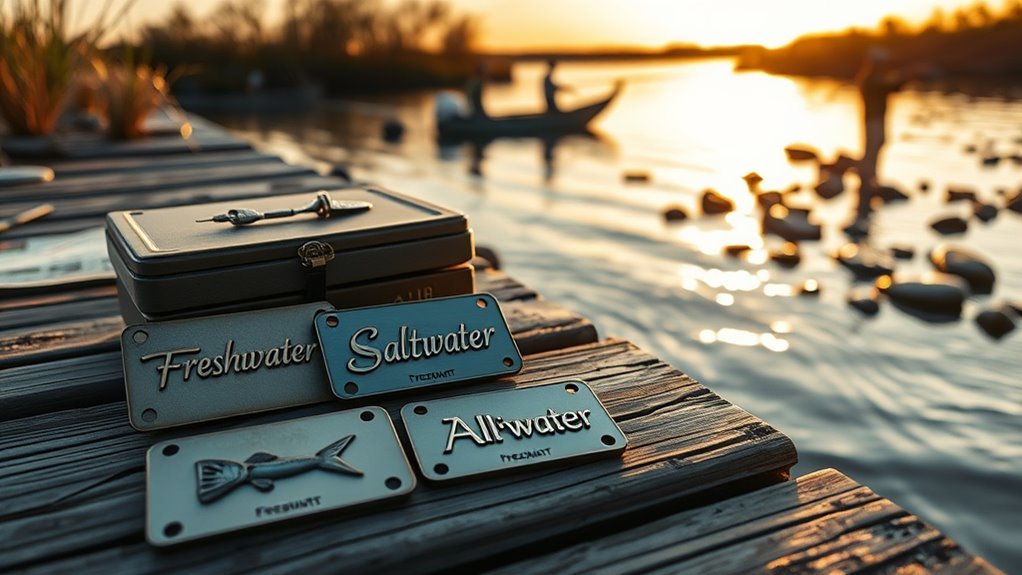
You’ll note the Resident Freshwater License is $30 and the Non‑Resident freshwater is $58, covering inland waters until August 31 from purchase.
Compare that to the Saltwater option at $35 (resident) and $63 (non‑resident) and the All‑Water Package, which bundles both privileges for $40 (resident) and $68 (non‑resident).
When choosing, you should weigh the cost difference against the range of waters you plan to fish and any applicable senior discounts.
Products Worth Considering

Material :High-Quality Metal Aluminum With High Gloss Stamped Metal License Plate.Lightweight, Waterproof,Anti-Rust And Very Durable.

Add a touch of humor and flair to your car with this funny "Weekend Hooker" front license plate. Perfect for the bass fishing enthusiast, this custom car tag is a great gift for men, especially for dads, husbands, or any fishing fanatic. Whether you're an outdoorsman or just enjoy a good laugh, this novelty license plate is sure to bring a smile to your face and enhance your fishing-themed car decor. Let your personality shine on the road with this fun and unique accessory.

This Largemouth Bass fishing license plate features a black background with silver design elements. Choose with our without the American flag faded into the background!
Freshwater Package Pricing
Fishing privileges for residents and non‑residents are broken into freshwater, saltwater, and all‑water packages, each carrying a fixed fee and a uniform expiration date of August 31 of the purchase year.
You’ll find freshwater benefits centered on cost-effectiveness and targeted access; package comparisons clarify when a standalone freshwater permit suffices versus broader coverage.
- Resident freshwater: $30, valid through August 31; senior resident discounts apply for freshwater (and saltwater) with specific rates published separately.
- Non‑resident freshwater: $58, valid through August 31; choose this when freshwater access alone meets your needs.
- Consider cost per water type: compare $30 freshwater to $40 all‑water for residents and $58 freshwater to $68 all‑water for non‑residents before purchasing.
All‑Water vs. Saltwater
If your freshwater needs might extend to coastal waters, compare saltwater-only and all‑water options before buying.
You’ll see residents pay $40 for an All‑Water package covering inland and coastal waters versus $35 for a Saltwater package limited to coastal fishing; non‑residents pay $68 and $63 respectively.
A Resident Freshwater license is $30 and covers inland waters only, but you can add a Saltwater endorsement to extend coverage to coastal areas.
All annual licenses, including All‑Water and Saltwater packages, expire August 31 of the purchase year.
Review fishing regulations to confirm species, size, and season rules for each water type.
Evaluate package benefits based on where you fish most and whether a single All‑Water license simplifies compliance.
One‑Day, Annual, and Lifetime License Options
When choosing between one‑day, annual, and lifetime options, consider cost, duration, and residency status:
a one‑day permit runs $11 for residents and $16 for non‑residents;
resident annual freshwater and saltwater licenses cost $30 and $35 respectively, while non‑residents pay $58 and $63;
an all‑water annual package is $40 for residents and $68 for non‑residents;
and Texas offers a resident lifetime license for a one‑time $1,000 fee.
You’ll weigh frequency of participation against per‑use cost and long‑term value while aligning with fishing conservation strategies and sustainable fishing practices.
Select the one‑day permit if you fish infrequently, annual if you fish seasonally or regularly, and lifetime if you expect decades of consistent use.
Compliance with regulations remains mandatory regardless of license type; recordkeeping and adherence to bag limits protect resources.
Consider administrative convenience, transferability limits, and state residency proofs before purchasing.
Choose the option that minimizes cost per trip while supporting sustainable use of fisheries resources.
- Compare frequency, cost, and regulatory obligations.
- Prioritize conservation and compliance.
- Evaluate long‑term value.
Products Worth Considering


PREMIUM QUALITY: Give your vehicle a new look and more personality with our high quality 100% heavy duty insert metal 2-hole black license plate frame that will last for years. It’s a perfect license plate frame for car.

Enough to Use: you will receive 6 pieces of fishing license holders, and 6 pieces of safety pins, abundant in quantity, enough for you to choose and replace, can meet your different needs; You can also share them with your friends
Cost Breakdown by Residency and License Type
You’ll compare resident and non‑resident rates across freshwater, saltwater, and all‑water licenses to determine exact costs and eligibility.
In Texas, yearly resident fees are $30 freshwater, $35 saltwater, and $40 all‑water, while non‑resident yearly fees are $58 freshwater, $63 saltwater, and $68 all‑water.
Note the senior freshwater discount ($30 for 65+) and the differing validity periods for yearly licenses (through August 31) versus all‑water packages (purchase date through the end of the following month).
Products Worth Considering


😎 PERSONALIZED TEXAS REPLICA PLATE ~ This is the colorful mountains and star Texas license plate. Please note this tag has the text, "REPLICA" in the lower righthand corner. Choose from regular or blackout style!

Customize It - Create the perfect personal gift and novelty item by choosing from a huge selection of backgrounds to customize your very own custom sign. Easy customization for high durability product.
Resident vs. Non‑Resident Rates
Compare residency rates carefully: residents pay substantially less across all annual license types—$30 for freshwater, $35 for saltwater, and $40 for an all‑water license—while non‑residents are charged $58, $63, and $68 respectively.
You should note resident fishing entitles lower statutory fees and senior discounts that non-resident fishing doesn’t receive. Fee differentials affect budgeting for regular anglers, seasonal operators, and enforcement planning.
- Annual comparison: residents $30–$40 vs non‑residents $58–$68, influencing permit uptake and compliance monitoring.
- Short‑term option: one‑day licenses cost $11 (resident) and $16 (non‑resident), useful for visitors and inspections.
- Senior policy: resident seniors qualify for a $7 freshwater package; non‑residents lack equivalent concessions, altering access equity.
Freshwater, Saltwater, All‑Water
1 clear way to understand annual fishing fees is by breaking them into freshwater, saltwater, and all‑water categories and comparing resident versus non‑resident rates.
You’ll see residents pay $30 for freshwater, $35 for saltwater, and $40 for an all‑water package; non‑residents pay $58, $63, and $68 respectively.
Licenses run to August 31 unless you buy a year‑from‑purchase license, which expires at the end of the same month next year.
You must follow freshwater regulations and saltwater conservation rules tied to each license type; these govern seasons, bag limits, and gear.
Certain exemptions permit license‑free fishing for eligible individuals, but everyone aged 17 and over without an exemption needs the correct license and must carry proof.
Sport Oyster Boat and Vessel Licensing

When harvesting oysters recreationally with dredges or tongs in Texas waters, you must hold a Sport Oyster Boat License tied to the vessel’s residency as shown by boat registration or U.S. Coast Guard documentation.
You’ll follow specific oyster harvesting techniques rules and a clear license application process: the license covers only recreational use with dredges or tongs and excludes commercial taking.
Residency is determined by vessel registration or federal documentation showing a Texas address; if the boat’s registered in Texas you’ll need a resident license, otherwise a non‑resident license applies.
Lifetime resident licenses are available and remain valid without renewal. You must verify the vessel’s paperwork accurately reflects residency before harvesting.
- Confirm vessel registration or Coast Guard documentation showing Texas residency.
- Choose resident, non‑resident, or lifetime resident status per documentation.
- Use only approved oyster harvesting techniques during recreational activity; commercial methods aren’t authorized by this license.
Where and How to Purchase Your License
If you’ve confirmed your vessel’s residency and chosen the correct Sport Oyster Boat License type, you can obtain your license online, by phone, or in person.
For immediate access, complete online purchases via the Texas Parks and Wildlife Department website; the system issues a digital license you must carry or display while fishing.
If you prefer direct support, call (800) 895-4248 for phone assistance to complete the transaction and receive instructions for displaying your credential.
In-person issuance is available at roughly 1,800 approved retailers statewide, including hardware stores and tackle shops; bring required identification and payment.
If your paper or digital license is lost, obtain a replacement at any retailer for about $10 and complete the simple application.
Keep proof of purchase and the license accessible while aboard or shore-side to comply with enforcement.
Follow these procurement options to guarantee you meet regulatory requirements and avoid citations.
Products Worth Considering

😎 PERSONALIZED TEXAS REPLICA PLATE ~This is the Texas Lone Star Replica License Plate. Please note this tag has the text, "REPLICA" in the lower righthand corner. Choose from the regular style or the blackout version!

🚗【STANDARD FRAME SIZE】- Check dimensions to make sure it won't cover your state name. Llicense plate frames texas are designed to accommodate about 12.3" x 6.3" (16 x 31 cm), you can see the detailed drawing,four Pre-Drilled,apply to the United States, Canada any vehicle.

When You Can Fish Without a License
Although most anglers need a license, you can fish without one in specific situations: on Texas’s Free Fishing Day (the first Saturday in June), on private property, if you’re under 17, if you were born before January 1, 1931, or if you have an intellectual disability and are either under approved therapy supervision or directly supervised by a licensed angler.
You should treat these License Alternatives as narrow exceptions within broader Fishing Regulations; they don’t negate bag limits, size limits, or other statutory requirements.
- Know the timetable: Free Fishing Day applies only on the designated Saturday each June; all other days require compliance with licensing statutes.
- Private property rule: No license is required when fishing on private land or private ponds, irrespective of age or residency, but state regulations still govern species protections.
- Exempt persons: Under-17s, pre-1931-born residents, and qualifying persons with intellectual disabilities under approved supervision are exempt; carry proof of age or documentation when requested.
Confirm specifics with the Texas wildlife authority before relying on an exemption.
Tips for Choosing the Right License Package
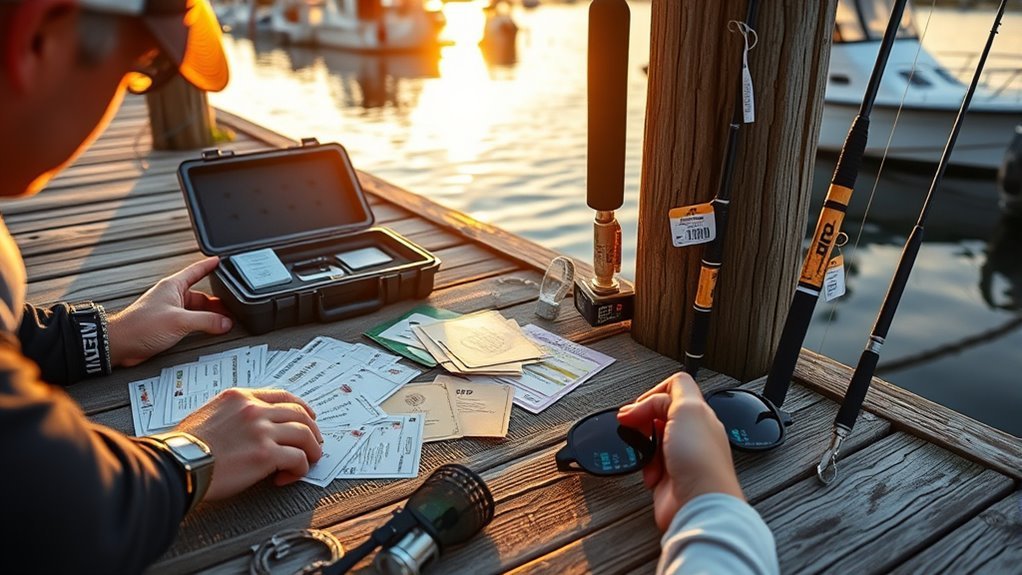
Wondering which license saves you money and fits your habits? You should match use to cost and compliance. If you fish both fresh and salt, the All-Water Package ($40 resident, $68 non-resident) delivers clear license benefits and simplifies adherence to fishing regulations. Freshwater-only anglers save with Resident Freshwater ($30) or Non-Resident ($58). Seniors born on/after Jan 1, 1931, get a reduced Senior Freshwater Package; check eligibility before purchase. For occasional trips, the One-Day All-Water ($11 resident, $16 non-resident) limits expense and still meets regulatory requirements.
| Use case | Typical fee | Regulatory note |
|---|---|---|
| All-water frequent | $40 / $68 | Covers both water types |
| Freshwater regular | $30 / $58 | Suits inland rules |
| Occasional day | $11 / $16 | Valid one calendar day |
Remember all annual licenses expire Aug 31; time purchases to maximize season and remain compliant with state fishing regulations.
Frequently Asked Questions
Do Fishing License Fees Ever Change Mid-Year?
Yes — you’ll see license fee fluctuations when agencies implement mid-year regulatory changes; they’ll notify stakeholders and update schedules, and you’ll sometimes encounter seasonal pricing adjustments tied to policy, revenue needs, or emergency conservation actions.
Are Discounts Available for Military Veterans?
Yes — about 40% of states offer military discounts; you’ll find veteran benefits listed in agency rules, so check specific regulations for eligibility, documentation, fee reductions, and application procedures to guarantee compliance and claim military discounts.
Can I Transfer My Lifetime License to Another Person?
No — you can’t transfer a lifetime license to another person. State lifetime license transfer rules generally tie the license to the original holder; license ownership rules prohibit reassignment except in specific statutory circumstances (estate settlement, death).
Do Online Purchase Receipts Count as Proof While Fishing?
Yes — you can use an online receipt as fishing permit proof if your jurisdiction accepts online receipt validity; carry the email or printout with ID, guarantee it shows permit details, purchase date, and transaction number for inspection.
Is a Fishing License Valid Across Neighboring States?
Usually no — you’ll need to check interstate fishing regulations and license reciprocity agreements, because some states honor neighboring licenses under specific terms, seasons, species, or fees, while others require you to obtain their local permit.
Conclusion
You’re required to carry the correct Texas fishing license, yet exceptions quietly let some fish free. Know residency rules, proofs, and exemptions, and contrast single-day convenience with annual or lifetime value. Match freshwater, saltwater, or all‑water packages to your habits, and add sport oyster or vessel endorsements when needed. Buy online, in‑person, or through agents, and keep regulatory limits in mind—make the right choice so compliance is simple, predictable, and enforceable.
