MIG welding cost is driven mainly by labor time, base material, filler wire, shielding gas, equipment, preparation, finishing, and shop overhead. There is no single national “cost per weld” because supplier prices, joint size, travel speed, operator efficiency, location, and the required quality level all change the result. For customer-facing welding work, published general welding rates commonly fall around $50–$125 per hour, but that is a service-pricing range rather than an employee wage.
Last updated: September 7, 2026. The equipment and wire examples below were checked against current U.S. listings and are examples, not guaranteed national prices.
Quick Answer
- Calculate MIG cost from material + filler wire + shielding gas + labor + equipment + electricity + preparation + inspection + finishing + overhead.
- Labor usually matters more than electricity or filler price in manual welding. Miller notes that labor can account for roughly 50–85% of welding expense in manual and semi-automatic operations.
- Do not budget every 44 lb spool at one fixed price. Current ER70S-6 examples range from about $79 per 44 lb for one commodity listing to about $261 for a premium Lincoln 44 lb spool.
- Shielding-gas cost varies sharply by supplier, cylinder size, ownership/rental terms, and whether you are buying a filled cylinder or only exchanging/refilling one.
- Do not apply one 95–98% deposition-efficiency number to every MIG weld. Lincoln Electric shows GMAW electrode efficiency can range from the mid-80s to about 98% depending on transfer mode and shielding gas.
| Cost Input | 2026 Planning Evidence | Best Estimating Method |
|---|---|---|
| Customer-facing welding rate | Published general-welding planning range: about $50–$125/hr | Use the actual quote or your loaded shop rate |
| 44 lb ER70S-6 wire | Current examples: about $79–$261 | Use current supplier $/lb |
| Shielding gas | Highly supplier- and cylinder-dependent | Flow rate × gas-on time × effective $/ft³ |
| Machine | Current brand-name examples range from hundreds to several thousand dollars | Convert ownership/rental cost to a machine-hour rate |
| GMAW electrode efficiency | About 85–98% depending on transfer mode/gas | Use procedure/manufacturer data for the actual process |
For a broader shop-estimating method, see our step-by-step welding cost calculation guide. For current gas-specific examples, see our MIG welding gas cost guide.
Overview of Factors That Determine MIG Welding Costs
The most reliable way to estimate MIG welding cost is to separate the job into measurable cost groups instead of starting with one national hourly rate.
Total MIG job cost = base material + filler + shielding gas + direct labor + equipment + electricity + preparation + inspection + finishing + allocated overhead + contingency.
Start with the drawing or job scope. Record the material, joint type, weld size, weld length, number of passes, position, access, preparation, required finish, inspection, and any applicable welding procedure. A small, easy fillet weld can cost much less than an equal-length joint that requires beveling, multiple passes, repositioning, grinding, or inspection.
Base-metal cost is separate from weld-metal cost. Aluminum, stainless steel, carbon steel, and specialty alloys require different filler metals, shielding gases, preparation, and sometimes different equipment. Use current material invoices rather than a generic price per pound.
Labor must include more than arc-on time. Fit-up, tacking, measuring, moving the workpiece, changing consumables, interpass cleaning, inspection support, grinding, and finishing can all add paid time.
Finally, avoid counting the same overhead twice. If your shop billing or machine-hour rate already contains equipment, rent, insurance, or administration, do not add those costs again unless your accounting method deliberately separates them.
Breakdown of Equipment Expenses for MIG Welding
MIG welder prices vary much more widely than the old “$300 versus $1,000” comparison suggests. Current U.S. examples show why machine class, output, duty cycle, pulse capability, accessories, and brand matter.
| Current Example | Observed Price | What It Shows |
|---|---|---|
| Hobart Handler 140 | About $635 in one current retail listing | Compact 120 V MIG-class equipment can still cost several hundred dollars |
| Miller Millermatic 142 | About $1,141 in one current specialty-retailer listing | Professional compact equipment can exceed $1,000 |
| Miller Millermatic 255 | About $4,191 in one current specialty-retailer listing | Higher-output production equipment moves into several-thousand-dollar pricing |
Sources checked September 7, 2026: current Hobart Handler 140 listing and current Miller MIG welder listings. Retail prices can change without notice.
Welder Machine Costs
Do not charge the entire machine purchase price to one project unless that machine was acquired solely for the job. For normal shop estimating, convert ownership into an hourly equipment cost.
Machine-hour cost = annual ownership and support cost ÷ practical productive machine-hours.
Depending on your accounting method, annual machine cost can include depreciation or lease expense, expected maintenance, repairs, calibration, accessories, and machine-specific support. Use productive operating hours rather than every calendar hour so the rate does not assume impossible utilization.
Duty cycle also matters. A higher-output machine may have more available arc time at the amperage required by the job, but buying a larger machine does not automatically make a low-volume project cheaper.
Consumables and Gases
Wire and shielding gas are recurring costs, but the old assumption of one $64 wire spool and one $40 gas refill is too narrow for a dependable 2026 estimate.
For example, one current ER70S-6 listing prices a 44 lb spool at $1.79/lb, or about $78.76 per spool. A premium Lincoln SuperArc L-56 44 lb listing was about $260.92. Diameter, brand, quantity, distributor contract, and shipping can move the number substantially.
Current examples: commodity ER70S-6 listing and premium Lincoln ER70S-6 listing.
Shielding-gas pricing is even more local because an exchange/refill transaction is not the same as buying a filled cylinder. Cylinder rent, demurrage, deposits, delivery, and supplier contracts may also apply. Use your supplier’s current invoice and see our MIG gas price breakdown for a deeper comparison.
Maintenance and Accessories
Include contact tips, nozzles, liners, drive rolls, gun components, anti-spatter products, cleaning tools, and normal repair costs when they are not already included in your machine-hour or overhead rate.
Do not assume one universal monthly or quarterly maintenance schedule. Inspect and replace components based on the machine manufacturer’s instructions, actual wire throughput, contamination, duty cycle, and observed wear.
Personal protective equipment and fume-control requirements are also part of operating a welding setup safely. Budget helmets, gloves, protective clothing, ventilation or extraction, and other required safety equipment separately when they are not already treated as shop overhead.
Consumables and Material Costs (Wire, Gases, Flux)
For solid-wire MIG/GMAW, calculate consumables from the actual filler classification, wire diameter, electrode efficiency, shielding-gas flow, and gas-on time. Do not treat flux as a normal solid-wire MIG consumable: flux-cored wires belong to the FCAW process family.
A useful filler calculation is:
Purchased wire required = deposited weld-metal weight ÷ electrode efficiency.
Then:
Wire cost = purchased wire required × wire price per pound.
For shielding gas:
Gas volume = flow rate in CFH × gas-on hours.
Gas cost = gas volume × effective supplier cost per cubic foot.
Use actual gas-on time if you can measure it. Preflow, postflow, purging where applicable, leak losses, and non-welding gas flow can make cylinder consumption higher than a simple arc-time estimate.
Wire Type and Diameter
Wire classification and diameter must match the base material, joint, required mechanical properties, transfer mode, and machine capability. ER70S-6 is common for carbon-steel GMAW, but stainless and aluminum require different filler choices.
Miller’s current mild-steel guidance describes .030-inch wire as a useful all-around size, .023-inch wire for thinner material, and .035-inch or .045-inch wire for thicker material when the machine supports the required output. See Miller’s MIG welding guidance.
Do not assume larger wire always lowers total cost. The correct diameter must support the required deposition rate and weld quality without causing lack of fusion, burn-through, excessive spatter, or unnecessary over-welding.
Shielding Gas Choices
Shielding gas affects arc behavior, penetration, spatter, bead profile, transfer mode, and recurring gas expense.
For mild-steel MIG welding, 75% argon / 25% CO2 (C25) is a common all-purpose mix. Miller notes that C25 provides low spatter and good bead appearance, while 100% CO2 is generally a lower-cost option but produces more spatter and a rougher arc. A 90% argon / 10% CO2 blend can be appropriate for spray-transfer applications. See Miller’s shielding-gas guide.
Choose gas for the required procedure and weld quality first, then compare the full economic effect. A cheaper gas can cost more overall if it increases spatter removal, rework, or production time.
Never assume a cylinder’s nominal capacity equals usable gas delivered to the weld. Supplier practices, remaining pressure, leaks, regulator settings, and changeover policy can affect real consumption.
Consumable Life and Deposition Efficiency
Solid-wire GMAW does not use flux. If you switch to self-shielded or gas-shielded flux-cored wire, you are estimating FCAW and must include the wire’s own efficiency, slag removal, and—where required—shielding gas.
For GMAW, Lincoln Electric shows that electrode efficiency depends on transfer mode and gas. Short-circuit GMAW with an argon/CO2 blend is typically at least 93% efficient; short circuit with 100% CO2 is about 90–93%; globular transfer can fall to roughly 85–90%; and axial spray, STT, and many pulsed applications can approach about 98%. See Lincoln Electric’s electrode-efficiency guidance.
That is why a blanket 95–98% assumption should not be used for every MIG estimate.
Contact-tip wear, feeding problems, excessive spatter, poor storage, contaminated wire, incorrect drive-roll tension, and unnecessary wire clipping can also increase consumable cost even when the theoretical process efficiency is high.
Labor, Training, and Certification Expenses
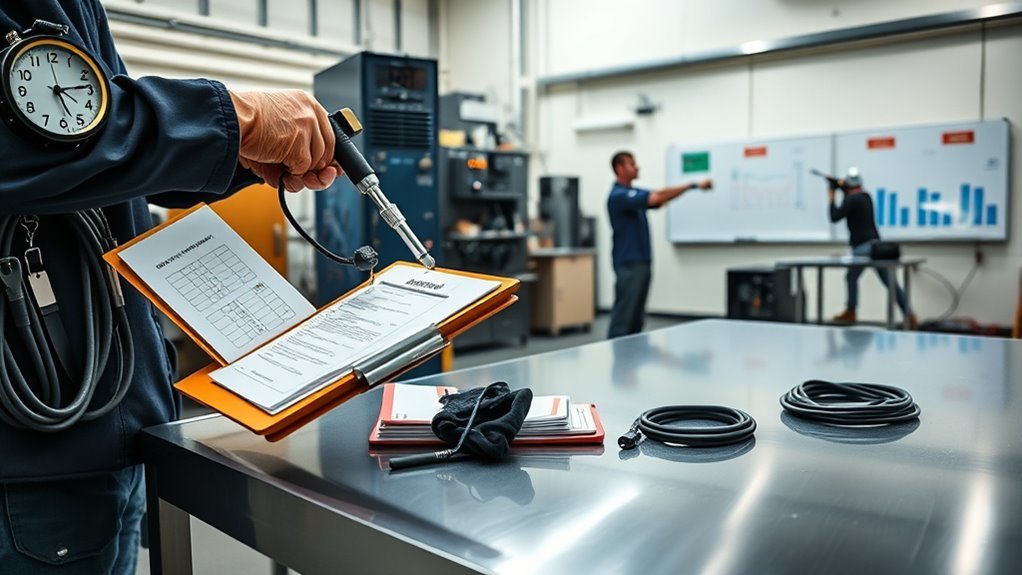
Labor is often the largest component of a manual MIG welding job. Miller reports that labor can represent roughly 50–85% of total welding expense in manual and semi-automatic operations, with the exact share depending on the application.
Do not confuse three different numbers:
- Employee wage: what the worker is paid.
- Loaded labor cost: wage plus the employer’s applicable payroll burden, benefits, and other labor costs.
- Customer billing/shop rate: what the business charges, which may also recover equipment, facility overhead, administration, insurance, profit, and other costs.
Published consumer guides currently place general welding service pricing around $50–$125 per hour. That is only a planning range. See our welding rates and pricing guide for a broader comparison.
For an internal estimate, calculate total paid labor from the activities the job actually requires. Arc time alone is not enough.
Total labor = welding labor + layout + preparation + fit-up + tacking + handling + repositioning + cleaning + inspection support + finishing.
An operating factor can help convert arc time into productive welding labor. Measure your own ratio of arc-on time to the work period rather than importing one universal percentage from another shop.
Certification should be included only when the job actually requires qualified personnel or a specific code/customer requirement. The American Welding Society Certified Welder program states that testing fees vary by Accredited Testing Facility. Do not assign one universal welding-school or certification cost to every MIG project.
Calculating Cost Per Pound and Deposition Efficiency

The cleanest way to compare filler economics is to calculate cost per deposited pound from the actual wire price and electrode efficiency.
Wire cost per deposited pound = wire price per pound ÷ electrode efficiency.
Example 1: if ER70S-6 costs $1.79/lb and the actual process operates at 93% electrode efficiency:
$1.79 ÷ 0.93 ≈ $1.92 per deposited pound of weld metal.
Example 2: if a premium wire costs $5.93/lb at the same 93% efficiency:
$5.93 ÷ 0.93 ≈ $6.38 per deposited pound.
Those figures cover filler wire only. They do not include shielding gas, labor, electricity, preparation, equipment, overhead, or profit.
| GMAW Transfer Example | Published Electrode-Efficiency Guidance | Cost Effect |
|---|---|---|
| Short circuit, Ar/CO2 blend | Typically ≥93% | Low filler loss when setup is controlled |
| Short circuit, 100% CO2 | About 90–93% | More spatter can reduce efficiency |
| Globular transfer | About 85–90% | Higher spatter increases filler loss |
| Axial spray / many pulsed applications | Around 98% | High electrode efficiency when the application supports the mode |
Stick/SMAW should not be assigned one universal 68–70% figure either. Published ESAB electrode data show efficiency varies by electrode type and size, with examples ranging from roughly 60% into the mid-70s.
To estimate purchased filler for either process, divide the required deposited weld-metal weight by the appropriate efficiency for that filler and process.
Hidden and Ongoing Operational Costs

Wire and gas are visible costs, but they are rarely the whole story. A strong MIG estimate also accounts for non-arc labor, rework, over-welding, machine downtime, consumable replacement, electricity, inspection, and overhead.
Miller identifies poor fit-up and over-welding as important hidden cost drivers because they consume extra filler metal and labor and can increase rework. See Miller’s field-welding cost guidance.
| Cost Type | How to Estimate It | Common Cost Risk |
|---|---|---|
| Shielding gas | CFH × gas-on hours × effective $/ft³ | Leaks, excess flow, purchase/rental fees |
| Wire | Deposited lb ÷ efficiency × $/lb | Spatter, clipping, feeding problems, overwelding |
| Electricity | Measured input kWh × electricity rate | Using arc volts × amps as if it were utility input |
| Maintenance/repairs | Machine-hour allocation or recorded job expense | Unplanned downtime and emergency parts |
| Labor | Total paid job hours × loaded rate | Ignoring setup, fit-up, handling, inspection and finishing |
| Overhead | Documented hourly allocation or accounting method | Omitting it or counting it twice |
For electricity, measure actual input energy when practical. Arc voltage multiplied by welding current is arc power, not automatically the amount of electricity purchased from the utility; power-source efficiency, power factor, phase, auxiliary loads, and other equipment can matter.
Cost Comparison: Manual Versus Robotic MIG Welding

Manual and robotic MIG welding should be compared by cost per acceptable part, not simply by labor rate or robot purchase price.
Manual welding is usually easier to justify for low volume, variable parts, complex access, frequent one-off repairs, or work with inconsistent fit-up. A skilled operator can adapt to variation without a dedicated fixture or robot program.
Automation becomes more attractive when parts are repeatable, volume is high enough to keep the cell productive, fixtures are consistent, and reduced cycle time or rework can recover the capital investment.
Do not use one universal $30,000–$100,000 robotic-cell assumption. FANUC notes that welding-system cost depends on the robot model, welding package, tooling, software, safety requirements, integration, and application complexity. Miller likewise recommends evaluating part repeatability, workflow, changeover time, facility changes, and expected uptime before calculating ROI.
Compare manual and robotic MIG by total cost per acceptable part: labor, capital recovery, fixturing, programming, maintenance, uptime, scrap, rework, and throughput all matter.
Miller gives a useful screening rule: to maximize the return on a large robotic-welding investment, the automated system should produce roughly a 3-to-1 gain over the human welding operation it replaces. That is a planning heuristic, not a guaranteed payback.
For a breakpoint analysis:
Annual robotic cost = annualized capital + integration/tooling allocation + maintenance + programming/changeover labor + residual operating labor + consumables + utilities.
Compare that with:
Annual manual cost = direct labor + consumables + equipment + scrap/rework + overhead for the same acceptable output.
The production volume where robotic cost falls below manual cost is the economic break-even point.
Strategies to Reduce MIG Welding Costs

The highest-value MIG savings usually come from reducing unnecessary labor, rework, overwelding, downtime, and poor fit-up—not simply buying the cheapest wire.
- Measure arc-on versus paid time. Find the activities consuming non-welding labor and improve layout, fixturing, material flow, and changeovers.
- Control weld size. Over-welding uses extra filler and increases arc time without creating proportional value.
- Improve fit-up. Oversized gaps can require more filler, extra passes, and more repair work.
- Use the correct wire and gas. Select them for the procedure and desired transfer mode rather than price alone.
- Maintain the wire-delivery system. Worn contact tips, contaminated liners, poor drive-roll setup, and feeding interruptions add downtime and spatter.
- Track supplier prices. Compare $/lb for wire and the effective delivered/exchange cost of shielding gas, including rental or delivery charges.
- Buy larger packages only when usage supports them. Bulk wire can lower unit cost, but excess inventory ties up cash and can create storage problems.
- Track rework and scrap separately. A process that looks cheap on arc time can become expensive if defects require grinding, repair, or inspection repeats.
Premium consumables are not automatically cheaper, and cheap consumables are not automatically expensive. Compare their total effect on feeding reliability, spatter, cleanup, rework, downtime, and deposited-metal cost.
Frequently Asked Questions
How Much Does MIG Welding Cost Per Hour?
Published consumer welding guides commonly show general welding service rates around $50–$125 per hour. A MIG quote can fall inside or outside that range depending on location, minimum charges, material, joint complexity, shop versus mobile work, inspection requirements, and finishing. A customer billing rate is not the same thing as an employee’s wage.
How Do You Calculate MIG Welding Cost?
Add base material, filler wire, shielding gas, direct labor, equipment, electricity, preparation, inspection, finishing, allocated overhead, and contingency. Calculate filler from the required deposited weld-metal weight and actual electrode efficiency. Calculate gas from flow rate multiplied by gas-on time. Use your actual shop and supplier rates wherever possible.
How Much Does MIG Wire Cost Per Deposited Pound?
Divide the wire price per pound by the electrode efficiency. At $1.79/lb and 93% efficiency, wire alone costs about $1.92 per deposited pound. At $5.93/lb and the same efficiency, it is about $6.38. Those figures exclude labor, gas, equipment, electricity, and overhead.
How Do You Calculate MIG Shielding Gas Cost?
Multiply gas flow in cubic feet per hour by gas-on hours to estimate volume, then multiply that volume by your effective supplier cost per cubic foot. Include cylinder rental, exchange, delivery, or other supplier fees if they are not already included in the gas price.
Is MIG Welding Cheaper Than Stick Welding?
It depends on the job. MIG usually needs a wire feeder and shielding gas but can provide continuous wire feed, high productivity, and less slag cleanup. Stick equipment is simpler and does not need an external shielding-gas cylinder, which can make it attractive for field work and low-volume jobs. Compare total labor, filler efficiency, cleanup, equipment, gas, and required quality rather than filler price alone.
When Is Robotic MIG Welding Cheaper?
Robotic MIG is most likely to pay when parts are repeatable, production volume is high, fixtures are consistent, and the system can maintain high utilization. Include the full cost of the robot, welding equipment, safety system, tooling, integration, programming, maintenance, changeovers, and residual labor before calculating the break-even volume.
What Should You Do With an Empty Shielding Gas Cylinder?
Close the valve, secure the cylinder, and follow the gas supplier’s return or exchange instructions. Do not remove, repair, or tamper with the cylinder valve yourself. For an owned cylinder that is being permanently discarded, follow the supplier’s instructions and applicable local hazardous-waste or recycling rules.
Conclusion
MIG welding cost cannot be reduced to one machine price, one wire-spool price, or one hourly labor number. Build the estimate from measurable inputs: deposited weld metal, actual filler efficiency, shielding-gas use, total paid labor, equipment, preparation, inspection, finishing, and overhead.
The biggest practical improvement is to replace generic averages with your own production and supplier data. Measure arc-on time, track rework and gas consumption, record current wire prices, and separate employee labor cost from the rate charged to the customer. That produces a quote you can defend—and makes it much easier to see whether a faster process, better fixture, larger wire package, or automation investment genuinely saves money.