
Updated on 29 June 2026
You can live well in Prague in 2026 if you plan around its main cost drivers: housing, utilities, food, transport, and healthcare. This guide breaks down every significant budget line with up-to-date figures — from studio rents across different neighbourhoods to gym memberships and health insurance — so you can build a realistic monthly plan before you arrive, or refine one once you’re here.
Quick Answer
For a single person in Prague in 2026, a realistic all-in monthly budget runs 30,000–45,000 Kč. A central one-bedroom costs 18,000–28,000 Kč, utilities add 4,000–7,500 Kč (more in winter), and an unlimited public transport pass is just 550 Kč. Healthcare is employer-covered for employees; groceries and occasional dining out fill the rest of the budget.
Key Takeaways
- One-bedroom rents range from 18,000–28,000 Kč in the centre and 13,000–22,000 Kč outside it; sharing a flat can cut per-person housing costs roughly in half.
- Utilities for an ~85 m² flat run 4,000–7,500 Kč/month depending on the season, plus ~450–600 Kč for unlimited home internet.
- Public transport is one of Europe’s best deals: a monthly Lítačka pass covering all Prague zones costs 550 Kč, or approximately 460 Kč/month on an annual pass.
- Healthcare is covered through your employer’s payroll deductions if you’re employed in the Czech Republic; self-employed residents and non-EU expats not yet in the system should budget 900–2,500 Kč/month for private insurance.
- A comfortable single-person lifestyle with a decent flat, occasional dining out, gym membership, and some savings typically requires 45,000–65,000 Kč gross/month in Prague.
Monthly Budget Breakdown: Rent, Utilities and Bills
Housing is the largest monthly expense for most people in Prague. A one-bedroom in the city centre typically runs 18,000–28,000 Kč; upscale central areas such as Vinohrady or the streets around Old Town reach 25,000–32,000 Kč. Comparable flats outside the centre average 13,000–22,000 Kč. The range is wide because condition, furnishing, and the specific street all matter significantly.
Basic utilities — electricity, heating, water, and waste — for an ~85 m² flat run 4,000–7,500 Kč/month. Bills are lower in summer and sharply higher in winter when district heating operates at full capacity. Landlords typically collect a monthly utility advance of 3,000–5,000 Kč, which is reconciled annually against actual usage. Many landlords also ask for a security deposit of one to two months’ rent, payable upfront on signing.
Add ~450–600 Kč for unlimited home internet (fibre and cable both widely available across the city) and 600–700 Kč for a standard mobile contract. A realistic all-in monthly housing total for a central one-bedroom comes to roughly 24,000–35,000 Kč, and 19,000–28,000 Kč outside the centre. Clothing, toiletries, and personal care add approximately 1,500–3,000 Kč/month for a typical single person shopping at mainstream Czech retailers.
Note: When comparing listings, always check whether the advertised price is “base rent” or “rent including utilities advance” — some landlords bundle both, others do not. Confirm in the tenancy contract, not just verbally, how the utility advance is calculated and how any surplus or shortfall is reconciled each year.

Stay organized with a durable 1-subject notebook set designed for school, note-taking, and digital study support. The college ruled pages resist ink bleed, tear out cleanly, and work with the Five Star Study App to create flashcards and sync notes to Google Drive. Tough pockets, a water-resistant cover, and Spiral Lock wire help protect your work throughout the year.

This hardcover cookbook offers fast, approachable recipes designed for busy days and low-energy nights. Caroline Chambers focuses on simple, flavorful meals that help you get dinner on the table without overthinking it. It's a practical pick for home cooks who want quick weeknight inspiration and minimal-fuss cooking.

Come Eat offers 100 approachable recipes designed to make everyday cooking more enjoyable, nourishing, and sustainable. With a focus on flavorful meals and practical preparation, this hardcover cookbook is ideal for home cooks looking for inspiration for salads, sides, and main dishes. Author Melissa Ben-Ishay shares recipes that encourage consistent, feel-good eating without sacrificing taste.
Groceries, Eating Out, and Café Culture
How much you spend on food depends almost entirely on how often you cook at home. Shopping at Czech supermarkets — Billa, Albert, Lidl, and Kaufland all have strong coverage across Prague — keeps a solo grocery bill around 5,000–8,000 Kč/month. Frequent restaurant meals or specialist food shops push the total considerably higher. Common 2026 prices for everyday items:
| Item | Typical price | Notes |
|---|---|---|
| Milk (1 l) | 25–30 Kč | supermarket |
| Bread (500 g loaf) | 30–45 Kč | bakery/supermarket |
| Eggs (12) | 65–90 Kč | size dependent |
| Chicken breast (1 kg) | 160–220 Kč | fresh, boneless |
| Cappuccino / latte | 70–120 Kč | café |
| Beer at a pub (0.5 l) | 60–80 Kč | local neighbourhood pub |
| Mid-range 3-course meal (2 people) | 900–1,300 Kč | restaurant |
| Fast-food combo | 170–220 Kč | chain meal |
Balance home cooking with the Czech polední menu (daily lunch special) at local restaurants on weekdays — typically soup plus a main course for 180–280 Kč, well below the cost of an evening à la carte meal — to keep food costs predictable.
Pro Tip: Lidl and Kaufland weekly rotating offers are a reliable way to cut grocery costs without compromising on quality. Havelský trh (Havelska market) in the Old Town sells seasonal produce at competitive prices. Avoid shopping near major tourist areas — supermarkets and shops in heavily touristed zones can charge 20–40% more for identical everyday items.
Healthcare and Health Insurance in Prague
The Czech Republic operates one of the stronger public healthcare systems in Central Europe, and it is universally available to everyone legally employed in the country. For most workers, health insurance is handled automatically through payroll: employees contribute 4.5% of gross salary while the employer pays a further 9% directly to the health insurer. At the national average gross of CZK 50,282 (Q1 2026), the employee share works out to roughly 2,260 Kč/month — deducted before you see your net pay.
Self-employed residents (OSVČ) pay a minimum health insurance contribution of approximately 2,722–3,100 Kč/month in 2026; the exact amount depends on the assessment base, but the minimum applies even if income is low. EU citizens with a valid EHIC card can access essential public healthcare during a stay, though longer-term EU residents are expected to register with Czech public insurance.
Non-EU expats who are not yet covered by the public system need commercial private insurance — which is also a legal requirement for long-term visa applications. Costs in 2026:
- Basic / emergency-only plans: from ~900–1,100 Kč/month (not accepted for most long-term visas)
- Comprehensive plans (required for long-term visas): ~1,700–2,500 Kč/month
For out-of-pocket costs at private clinics — which offer shorter wait times and more English-speaking doctors — a GP visit typically runs 500–800 Kč and a specialist consultation 800–1,500 Kč. Basic dental care is covered under public insurance; more complex work at private dental clinics costs extra. Pharmacy co-payments under public insurance are usually modest (5–50 Kč per item).
Note: Self-employed residents and those arriving independently must register with a Czech health insurer promptly — failure to do so can result in backdated contribution demands covering the entire period of residence in the country. If you are self-employed, factor this contribution into your monthly cash-flow planning from day one.
Entertainment, Fitness and Leisure
Prague is genuinely affordable for entertainment by Western European standards. Beer is central to Czech culture, and a half-litre of local lager at a neighbourhood pub costs 60–80 Kč — less than many Western European cities charge for a bottle of water. A cinema ticket at major Prague chains (Cinema City, Cinestar) runs 220–280 Kč. The National Museum and Prague Castle complex charge 250–500 Kč for main exhibitions; many city-run galleries are free or very low cost. In summer, outdoor concerts, film screenings, and cultural festivals offer free or near-free entertainment across the city.
Gym memberships vary widely by tier:
- Budget chains (Fitinn, Fitpark, Fitness Time): 400–700 Kč/month
- Mid-range clubs (Form Factory, Euforie Fitness): 800–1,500 Kč/month
- Premium / hotel clubs (LivingWell, Balance Club): 2,000–3,000+ Kč/month
Streaming services (Netflix, Spotify, HBO Max) add roughly 200–400 Kč/month combined. A realistic leisure budget for an active social single might look like: gym 900 Kč + two restaurant dinners 1,200 Kč + cinema / events 500 Kč + pub/bar 1,000 Kč + streaming 300 Kč = approximately 3,900–5,500 Kč/month, scaling easily down or up with lifestyle choices.
Transportation and Getting Around Prague
Public transport covers most trips efficiently via the metro, trams, and buses. Single tickets cost 36–50 Kč for rides of 30–90 minutes. A monthly Lítačka pass covering all Prague zones costs 550 Kč; buying an annual pass works out to approximately 460 Kč/month — worth doing if you are here long-term. See the official Prague Integrated Transport (PID) website for current tariffs and subscription options. Taxis and ride-hailing cost considerably more; short central rides typically run a few hundred koruna.
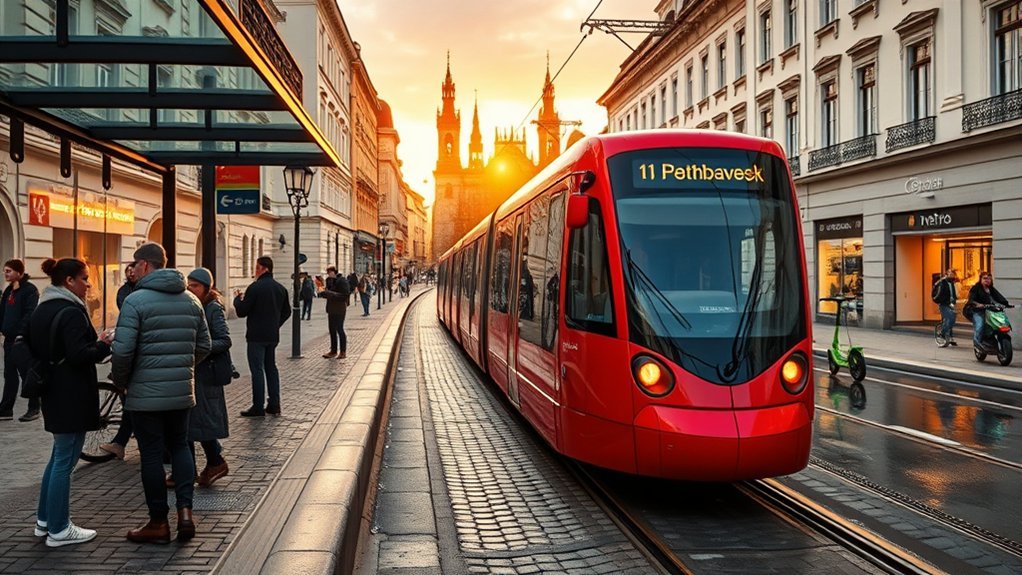
Public Transport Options
Buy tickets at vending machines, kiosks, or via the PID Lítačka mobile app, and always validate on boarding. Inspectors operate regularly and on-the-spot fines run 1,500 Kč or more. If you make more than roughly 15 one-way trips a month, the monthly pass is almost always the cheapest option. Prague is increasingly bike-friendly; services like Rekola bike-share provide good last-mile links from metro and tram stops. Seniors over 65 travel free on Prague public transport; those aged 60–64 receive a 50% discount. Students in full-time study can also access discounted passes.
Taxi and Fuel Costs
Use reputable ride-hailing apps (Bolt, Uber, Liftago) rather than unlicensed street hails — metered pricing via app is transparent and fairer. For drivers, petrol prices fluctuate with the market; budget approximately 35–40 Kč per litre as a working estimate, and factor in an annual motorway vignette if you travel on Czech motorways regularly.
Housing Options: Renting vs Buying
Renting provides flexibility and predictable outgoings and remains the most common choice among new arrivals and younger Praguers. Buying requires larger upfront capital and depends heavily on mortgage rates. Czech mortgage offers in 2026 hover around 4.5–5.0% depending on the bank, LTV ratio, and borrower profile. Property prices in Prague remain high relative to local incomes, so many residents rent for longer or target outer districts and satellite towns when considering a purchase.

The Manbook offers a blunt, practical approach to mental toughness, responsibility, and professional growth. Written by Nick Freitas, it is designed to help readers push through excuses, build discipline, and get the job done with focus and confidence. This hardcover edition is a useful pick for anyone looking for straightforward guidance on self-improvement and resilient living.

Die With Zero offers a fresh perspective on personal finance by encouraging readers to use money intentionally to create memorable life experiences instead of simply accumulating wealth. Written by Bill Perkins, this book combines practical guidance with a motivating philosophy to help readers align spending, saving, and life goals for a more fulfilling future.

These compact binoculars deliver 12x magnification and a wide field of view for clearer, farther viewing during birdwatching, travel, sports, and outdoor adventures. FMC broadband coating and BAK4 prisms help produce bright, realistic images, while adjustable eyecups and long eye relief make them comfortable for both eyeglass wearers and non-wearers. Their lightweight, portable design with rubber armor and water-resistant construction makes them easy to carry and reliable for everyday use.
Prague Neighbourhoods at a Glance
Location is the biggest single driver of rent in Prague. The following table gives a realistic sense of the range across the most commonly considered districts:
| District / Neighbourhood | Character | Typical 1-br rent (Kč/month) |
|---|---|---|
| Staré Město / Old Town (Praha 1) | Tourist-heavy, premium central location | 26,000–35,000 |
| Vinohrady (Praha 2/10) | Expat-popular, tree-lined, upscale residential | 22,000–30,000 |
| Holešovice (Praha 7) | Industrial-chic, artsy, rapidly gentrifying | 20,000–27,000 |
| Žižkov (Praha 3) | Bohemian, good value for proximity to centre | 17,000–24,000 |
| Smíchov (Praha 5) | Mixed, well-connected, convenient | 17,000–24,000 |
| Outer districts (Praha 9, 12, 13) | Quiet residential, family-oriented, longer commute | 13,000–20,000 |
| Option | Typical cost | Notes |
|---|---|---|
| Apartment in city (rent) | 18,000–28,000 Kč/month | utilities 4,000–7,500 Kč; internet ~500 Kč extra |
| Cheaper alternatives | 10,000–18,000 Kč/person | flatshare, studios, outer districts |
Salaries, Affordability and Typical Living Standards
Budgets feel tight when rent takes a large share of take-home pay. According to the Czech Statistical Office, the national average gross monthly wage reached CZK 50,282 in Q1 2026 — up 8.1% year-on-year, with real wages growing 6.4% after inflation. Prague’s average gross sits notably higher at 55,000–65,000 Kč/month for the city overall, with senior roles in IT, finance, and professional services commonly reaching 100,000 Kč+ gross.
The Czech national average gross monthly wage hit CZK 50,282 in Q1 2026 — an 8.1% nominal rise year-on-year and the fastest real wage growth since Q2 2021, per the Czech Statistical Office (June 2026).
A solo renter in Prague typically targets 55,000–70,000 Kč gross/month for a comfortable lifestyle with regular savings. Those on 40,000–50,000 Kč gross can manage with shared housing and careful budgeting. For context, Prague is roughly 35–40% cheaper than Vienna or Berlin, around 40–45% cheaper than Amsterdam or Paris, and broadly comparable to or slightly cheaper than Warsaw in 2026 — making it an attractive option for remote workers earning in stronger currencies.
Costs for Families: Childcare, Schools and Extras
Family budgets in Prague carry several significant line items beyond the basics. Public kindergartens (mateřská školka) charge minimal monthly contributions — typically 500–1,500 Kč/month — plus small fees for meals. Private preschools run 5,000–15,000 Kč/month depending on quality and language programme. International schools are the biggest variable for expat families: annual tuition at English-language international schools in Prague commonly falls in the range of 200,000–400,000 Kč per child per year, placing them well beyond what most local salaries cover without employer education support.
A rough monthly budget for two adults and one child, using a private preschool and no international school, might look like this: 2-bedroom flat in outer Vinohrady (30,000 Kč) + utilities (6,000 Kč) + groceries (12,000–15,000 Kč) + transport for two (1,100 Kč) + private preschool (8,000 Kč) + healthcare contributions (2,000 Kč) + entertainment and activities (4,000 Kč) = approximately 63,000–66,000 Kč/month before savings. A combined household gross income of 110,000 Kč+ is broadly what makes this sustainable with a reasonable buffer.
Families also budget for extracurricular activities (swimming lessons, sports clubs, music) running 2,000–5,000 Kč/month, plus one-off costs for children’s clothing and school supplies. Occasional private medical visits beyond standard public insurance coverage are an additional variable to factor in.
Money-Saving Tips and Budgeting Strategies

Use Public Transport
- Buy the annual Lítačka pass if you’re staying 12 months — it saves approximately 1,080 Kč compared to paying monthly.
- Use the PID Lítačka mobile app for purchasing and managing passes.
- Mix in Rekola bike-share or e-scooters for short first- and last-mile trips.
- Check student, senior (60+), and disability concessions — these can significantly reduce or eliminate monthly transit costs.
Share Housing Costs
Splitting rent remains the single biggest lever in any Prague budget. In flatshares, confirm upfront what is included in the advertised price, how utilities are divided, how the utility advance is reconciled at year-end, and what the deposit terms are. Ask for all of this in the tenancy contract — not just verbally — before you pay anything.
Shop Smart for Groceries
Lidl and Kaufland weekly rotating offers are a reliable way to cut grocery costs without compromising quality. Billa and Albert carry broader ranges and are well-distributed across the city. The Czech polední menu (lunch special), available at most local restaurants Monday–Friday, typically delivers soup plus a main course for 180–280 Kč — one of the best cost-to-satisfaction ratios in Prague. Avoid shopping in heavily touristed zones where everyday items can run 20–40% higher than the same products in a residential-area supermarket.
Build a Financial Buffer
Prague landlords ask for one to two months’ deposit upfront, so factor this into your initial arrival costs. Annual utility reconciliations can also produce surprise bills if heating usage was higher than the monthly advance estimated. Keeping two to three months of total expenses in liquid savings protects against appliance failures, unexpected relocation, or a gap between jobs — without falling into debt.
Warning: All figures in this guide are estimates based on published data and market averages. Actual costs can vary significantly depending on neighbourhood, property condition, individual lifestyle, and economic conditions at the time. Always verify current market prices directly — via listings platforms, utility providers, and official sources — before making housing, financial, or relocation decisions.
Frequently Asked Questions
How much does it cost to live in Prague per month?
Most singles spend 30,000–45,000 Kč monthly in 2026, depending on rent location, lifestyle, and whether housing costs are shared. A central one-bedroom with utilities and bills runs roughly 24,000–35,000 Kč before food and transport; outer districts or flatshares can bring that combined total closer to 22,000–28,000 Kč.
What is the average rent for a one-bedroom in Prague?
In 2026, expect 18,000–28,000 Kč in central districts and 13,000–22,000 Kč outside the centre. Popular expat neighbourhoods like Vinohrady or Holešovice typically sit in the 20,000–27,000 Kč range for a one-bedroom. Flatshares and studios often reduce per-person costs to 10,000–18,000 Kč.
Is Prague public transport expensive?
No — it is one of the best-value transit systems in Europe. Single rides cost 36–50 Kč for 30–90 minutes, and a monthly Lítačka pass covering all Prague zones costs only 550 Kč. An annual pass works out to approximately 460 Kč/month. The network is comprehensive, covering the whole city reliably via metro, trams, and buses well into the night.
How much are utilities and internet in Prague?
For an ~85 m² flat, basic utilities (electricity, heating, water, waste) average 4,000–7,500 Kč/month — lower in summer, higher in winter when heating is running at full capacity. Home internet typically runs 450–600 Kč/month for unlimited fibre or cable. A standard mobile contract costs 600–700 Kč/month.
Is it better to rent or buy in Prague right now?
With mortgage rates around 4.5–5.0% and high property-price multiples, most new arrivals rent first. Buying can make financial sense if you plan to stay five or more years, have a substantial down payment, and can target outer districts where prices are more accessible. For shorter stays, renting provides flexibility and avoids large upfront transaction costs.
Do I need private health insurance to live in Prague?
It depends on your status. Employees of Czech-registered companies are automatically enrolled in the public health insurance system via payroll, with the employee paying 4.5% of gross salary. EU citizens with a valid EHIC card can access essential public care. Non-EU expats not employed in the Czech Republic need private commercial health insurance — required for long-term visa applications — starting at around 1,700–2,500 Kč/month for comprehensive cover. Self-employed residents must pay a minimum contribution of approximately 2,722–3,100 Kč/month into the Czech public system.
Sources
- Czech Statistical Office — Employees & Wages (Q1 2026) — national and regional average gross wages, published 4 June 2026; used for wage figures throughout
- Prague Integrated Transport (PID) — Tariff Zones & Subscription Fares — official source for Lítačka monthly and annual pass costs
- Numbeo — Prague Cost of Living (updated June 2026) — crowdsourced price data for groceries, dining, utilities, and everyday services

BIC Cristal Xtra Smooth Blue Ball Pens deliver dependable everyday writing with a medium 1.0mm point and fluid Easy-Glide System Ink. Designed to create clear, dark lines, these pens are ideal for notes, lists, journaling, schoolwork, and office tasks. The convenient 10-count pack offers reliable performance for home, work, or classroom use.

The COOK'S CHOICE XL Better Breader Bowl makes coating chicken, fish, vegetables, and more fast, tidy, and consistent. Its extra-long tray helps prevent overcrowding, while the integrated sifter promotes even coverage with less waste. Designed for easy cleanup and convenient storage, it is a practical choice for home cooking, air frying, frying, and outdoor meal prep.

Blokus is a fast, easy-to-learn strategy board game that delivers engaging fun for kids and adults alike. Players place their pieces using one simple rule while trying to claim territory, block opponents, and fit as many pieces on the board as possible. Color-blind accessible patterns and family-friendly gameplay make it a great choice for game nights and parties.

1 thought on “Cost of Living in Prague 2026: Realistic Monthly Budgets”
Pingback: Cost of Living in Prague as a Teacher - Travel and Teach Abroad