
Last updated: September 8, 2026.
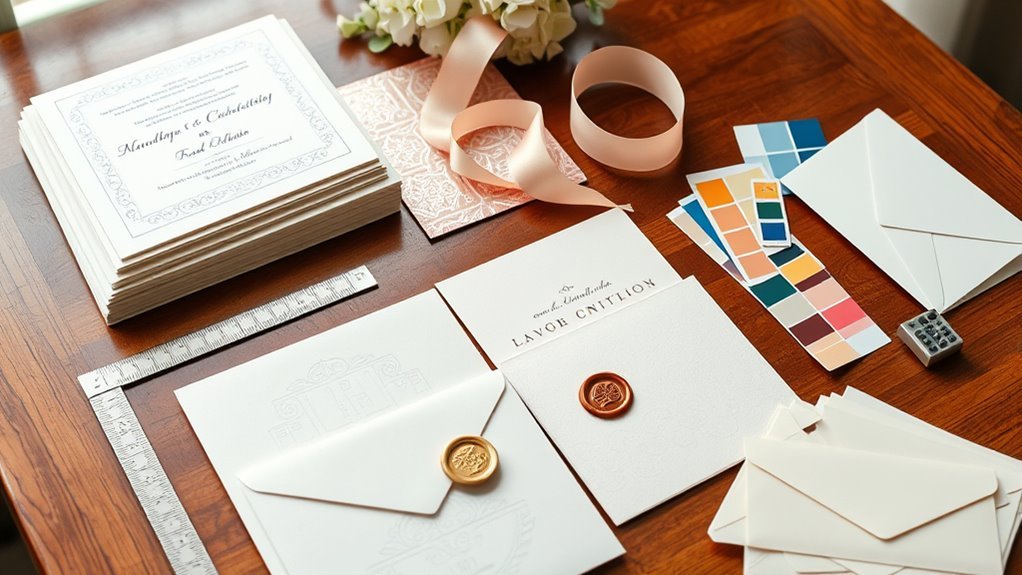
Wedding card printing costs vary widely because a basic printed invitation, a multi-piece invitation suite, and a fully custom stationery package are different products. In the U.S., The Knot’s 2026 Real Weddings Study reports that couples spend an average of $220 on wedding invitations, including RSVP cards, and $510 on total wedding stationery. For printing alone, Paperlust’s current 2026 professional-print guide puts standard digital invitations around $1 to $3 per card, flat foil around $3 to $6, custom-die foil stamping around $5 to $10, and letterpress around $6 to $15 per card. Your final cost depends on the number of invitation households, paper, print method, inserts, envelopes, postage, and finishing details.
How Much Do Wedding Cards Cost?
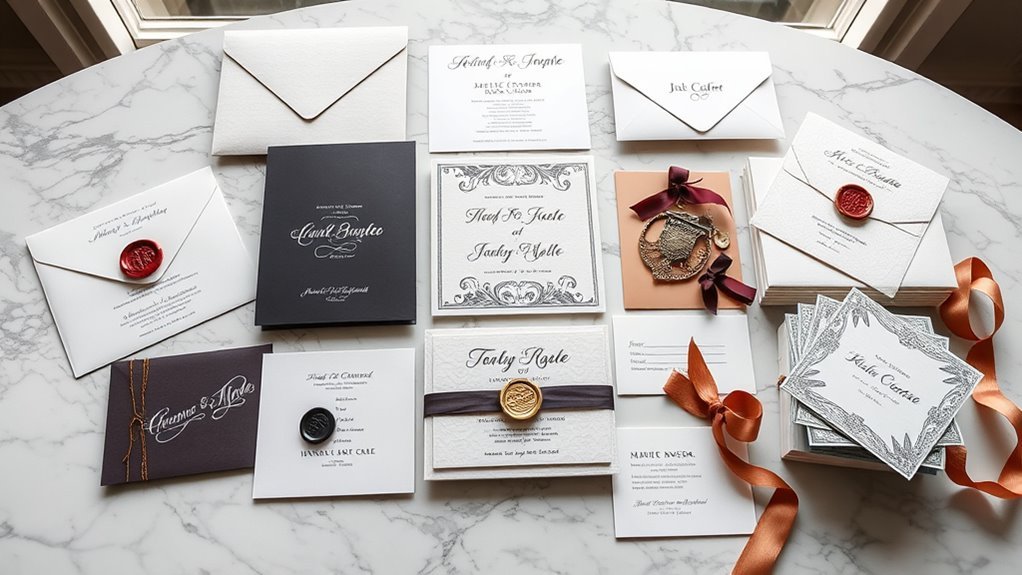
The most useful way to budget wedding invitations is to separate average spending from a printing-only quote. The Knot’s 2026 study surveyed 10,474 U.S. couples who married in 2025 and found an average spend of $220 on invitations, including RSVP cards, and $510 across wedding stationery overall.
| 2026 Cost Benchmark | Typical Price | What It Represents |
|---|---|---|
| Average wedding invitations | $220 | Average couple spending, including RSVP cards, from The Knot’s 2026 study |
| Average total wedding stationery | $510 | Invitation suite plus additional wedding paper spending in The Knot’s study |
| Professional digital printing | About $1–$3 per card | Paperlust professional-print planning benchmark; paper and quantity change the quote |
| Flat foil | About $3–$6 per card | Paperlust planning benchmark for metallic finish without a pressed custom die |
| Foil stamping | About $5–$10 per card | Paperlust planning benchmark for custom-die foil printing with a tactile pressed impression |
| Letterpress | About $6–$15 per card | Paperlust planning benchmark for premium pressed printing, usually on thicker specialty stock |
The print-method ranges above come from Paperlust’s 2026 printing-cost guide. They are useful planning ranges from one professional-print source, not guaranteed quotes or universal U.S. market averages.
A printer’s per-card quote is not the same as the average amount a couple spends on invitations or on the full wedding stationery package.
For 100 standard 5 x 7 digital invitation cards, Paperlust’s current planning guide places professional online printing around $150 to $300 before shipping and suite extras. Its guide estimates a 100-piece digital suite with an RSVP card and details card at roughly $300 to $500 before shipping. Current printer pricing can fall outside those ranges: for example, Anthology Print lists 100 standard 5 x 7 cards at $118 single-sided or $163 double-sided with basic envelopes.
At the luxury end, professional stationery designers operate in a different price category. The Knot reports that custom invitation and enclosure-card work from professional designers can run about $4,000 to $7,000 for roughly 100 guests, while semi-custom invitations and enclosure cards from professional designers are typically under $2,000. Some designers quote substantially higher depending on artwork, printing methods, assembly, and the number of stationery pieces.

This bright white cardstock delivers smooth, professional-quality printing for projects at home, school, or the office. Its sturdy 65 lb weight adds durability for covers, signs, table tents, and other creative uses, while acid-free construction helps preserve your work over time. Compatible with inkjet, laser, copier, and offset printing, it provides reliable results across a wide range of applications.

Create versatile eye looks with this 10-shade eyeshadow palette featuring a mix of shimmer and matte finishes in flattering nude, pink, brown, and plum tones. The creamy, blendable formula delivers smooth application and rich color payoff for both everyday makeup and more dimensional styles. Made with skin-loving ingredients, this palette is also 100% vegan and cruelty-free.

Q-tips Original Cotton Swabs are a versatile everyday essential for home, beauty, and first aid tasks. Made with 100% cotton and soft tips at both ends, they provide gentle care for sensitive skin while helping with makeup touch-ups, small cleaning jobs, and hard-to-reach spaces. Their trusted quality and recyclable packaging guidance make them a practical choice for daily use.
How to Estimate Your Total Wedding Card Printing Cost
A useful invitation budget should include more than the main card. Use this formula before comparing printers:
Total invitation budget = printing + inserts and envelopes + design or finishing charges + shipping and tax + outbound postage + paper-RSVP return postage, if used.
For a concrete example, use 100 actual mailed invitations rather than 100 wedding guests. Anthology Print currently lists 100 standard 5 x 7 single-sided cards with basic envelopes at $118 and double-sided cards at $163. At the current $0.82 stamped one-ounce letter rate, outbound postage for 100 envelopes is $82.
| 100-Mailing Example | Printing | Outbound Postage | Base Total | With 100 Prepaid 1-oz RSVP Returns |
|---|---|---|---|---|
| Single-sided standard cards | $118 | $82 | $200 | $282 |
| Double-sided standard cards | $163 | $82 | $245 | $327 |
These examples use one printer’s current standard-card prices plus USPS postage. The totals do not include RSVP-card printing, details cards, premium envelopes, shipping, tax, calligraphy, liners, foil, letterpress, wax seals, or other upgrades. Their purpose is to show why a headline card price is only one part of the final stationery budget.
What Drives Wedding Card Printing Prices?
The biggest pricing factors are the number of invitations you actually need, your printing method, paper, number of inserts, finishing work, and postage. Guest count is not the same as invitation count. Couples and families living at one address generally receive one invitation rather than one invitation per person.
A practical starting formula is:
Required print quantity = number of invitation households or mailing groups + an extra-card buffer.
Ordering roughly 10% to 15% extra invitations can cover addressing mistakes, keepsakes, late additions, lost or damaged copies, and photography without forcing a small second print run.
- Invitation quantity: Count households or mailing groups, not individual guests.
- Printing method: Digital is usually the lowest-cost professional method; foil and letterpress cost more.
- Paper and shape: Heavier, textured, specialty, or unusually shaped stock can increase printing and mailing costs.
- Suite size: RSVP cards, details cards, liners, belly bands, and extra envelopes add material and production costs.
- Customization: Original illustration, calligraphy, custom dies, multiple ink colors, and manual assembly can raise the quote.
- Postage: Weight, dimensions, thickness, rigidity, and machinability affect the final mailing cost.
When comparing quotes, ask each printer to price the same quantity, paper, card size, number of printed sides, envelopes, inserts, and finishing options. Otherwise, two apparently different prices may simply include different products.
Wedding Card Printing Cost by Print Type
Your printing method often creates the largest difference in per-card cost. The ranges below are 2026 professional-print planning benchmarks from Paperlust rather than fixed industry prices.
| Printing Method | Approx. Cost per Card | Best Fit | Main Cost Driver |
|---|---|---|---|
| Digital printing | $1–$3 | Budget-friendly color designs and larger runs | Paper choice and quantity |
| Flat foil | $3–$6 | Metallic accents without a deep pressed impression | Foil coverage and stock |
| Foil stamping | $5–$10 | Premium metallic finish with tactile impression | Custom die, setup, stock, and quantity |
| Letterpress | $6–$15 | High-end tactile invitations | Custom plates, ink colors, labor, and thick stock |
Digital printing is usually the most economical professional choice because it does not require a separate plate or die for each design element. It also handles full-color artwork, photographs, watercolor designs, and gradients efficiently.
Flat foil adds a metallic layer without pressing a custom die deeply into the paper. It provides the foil look at a lower price than traditional foil stamping.
Traditional foil stamping uses a custom die and can create a tactile impression. Paperlust’s current printing-cost guide places the finished card around $5 to $10 each, while the premium over a comparable digital card can be roughly $1.50 to $5 per card depending on the job.
Letterpress is normally the most expensive of these four methods. Each ink color can require separate setup, and the process is commonly paired with thick specialty stock.
DIY vs Professional Wedding Invitation Printing Cost
The cheapest route depends on whether you already have a finished design, suitable equipment, and time for printing and trimming. Paperlust’s July 2026 printing guide provides the following planning ranges for 100 invitations. These are vendor estimates, not national averages.
| Printing Route | Approx. Cost for 100 | Best Fit |
|---|---|---|
| Home printing | $80–$220 | Small, simple digital jobs when you already have suitable equipment |
| Local copy or print shop | $150–$350 | Simple digital printing when you want to inspect paper or proofs locally |
| Online professional printing | $180–$600+ | Professionally cut cards and access to more paper and finishing options |
| Full-service stationer | $800–$3,500 for boutique work; higher for fully bespoke work | Design help, consultation, premium production, and more hands-off service |
Home printing can save money on a simple digital design, but paper, ink, test prints, trimming, jams, and wasted sheets reduce the apparent savings. A normal home printer also cannot reproduce true letterpress or commercial foil stamping.
A useful middle option is to create or buy a print-ready design and send the finished file to a professional printer. That removes much of the custom-design cost while still giving you commercial printing, cutting, and paper options.
Compare Paper Stocks, Trim, and Foil
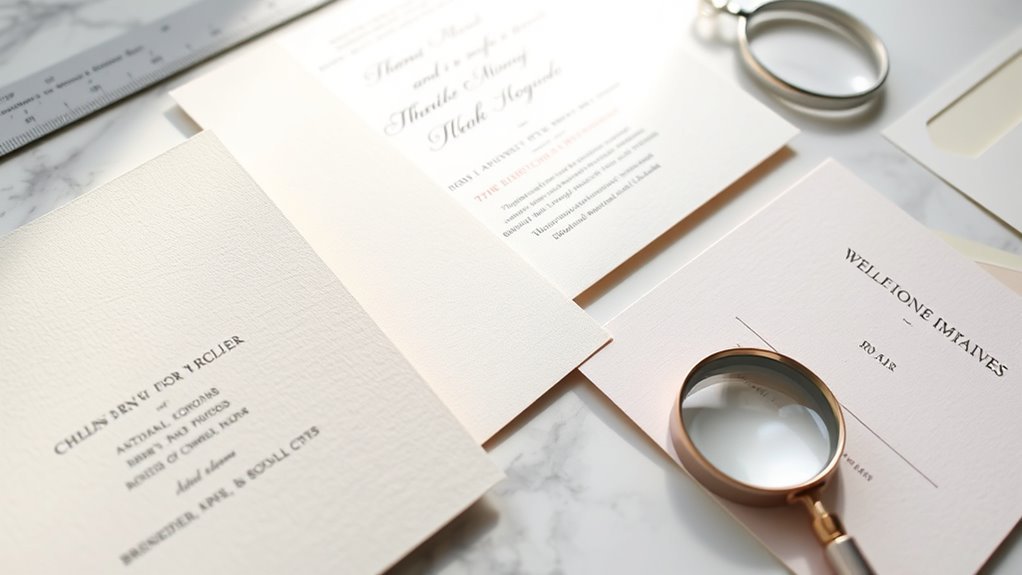
Paper, card shape, and finishing details can change both printing and postage. Standard matte cardstock is usually easier to keep within budget than thick cotton, pearl, double-thick, handmade, or specialty stocks.
Current printer price lists illustrate the range. For example, Anthology Print lists standard 5 x 7 options including 14pt matte and other paper choices, with prices changing according to stock, quantity, and whether the card is printed on one or two sides.
Trim style also matters. Standard rectangular cards are generally the simplest to print and mail. Rounded, arched, scalloped, ticket, wavy, square, or fully custom shapes can add production cost, and certain shapes can also affect postage.
Paper Stock Choices
Paper affects thickness, texture, ink appearance, durability, and mailing weight. Before committing to a large order, compare physical samples rather than choosing only from screen images.
- Standard matte: versatile and usually one of the lower-cost professional choices.
- Premium or double-thick stock: heavier feel but generally higher material and postage risk.
- Linen: textured surface that creates a more traditional finish.
- Pearl or glossy: adds sheen and can change how photographs and colors appear.
- Cotton or specialty stock: commonly paired with premium processes such as letterpress.
Paper thickness should be evaluated with the whole invitation suite, not just the main card. Several thick pieces in one envelope can push the mailing above the basic one-ounce postage tier.
Trim Style Options
Standard rectangular cards normally provide the easiest combination of printing, envelope selection, and postage. Specialty cuts can make the design more distinctive, but the surcharge depends on the printer rather than on a universal trim-price schedule.
Choose the card shape before pricing envelopes and postage. A design that looks inexpensive at the printing stage can cost more once specialty envelopes or nonmachinable mailing rules are included.
Foil Finish Colors
Gold, silver, rose gold, and other foil colors can create a premium appearance, but the printing process, foil coverage, die setup, paper, and quantity usually matter more to cost than the color name alone. Available colors and specialty-foil surcharges vary by printer.
- Gold: traditional metallic finish.
- Silver: cool, modern metallic finish.
- Specialty or glitter foil: availability and surcharge depend on the printer.
- Colored foil: useful when matching a specific stationery palette.
For budgeting, treat custom-die foil stamping as roughly a $5 to $10 per-card planning category from the cited Paperlust guide rather than assuming it automatically adds $5 to $10 on top of another finished-card price.
How Wedding Invitation Suites Affect Cost
An invitation card and an invitation suite are not interchangeable price categories. A basic invitation may include only the main card and outer envelope. A fuller suite can add an RSVP card, return envelope, details card, liners, bands, or other pieces.
The Knot’s 2026 Real Weddings Study reports $220 average spending on wedding invitations, including RSVP cards, and $510 on wedding stationery overall. That $510 figure should not be described as the printing cost of one invitation suite; it reflects broader stationery spending.
Premium designer work is also a separate market from standard online printing. Professional custom invitation and enclosure-card packages can cost several thousand dollars because the price includes original design work, consultation, revisions, specialty printing, materials, and sometimes assembly.
When comparing a $2 digital card with a $2,500 semi-custom stationery package, you are not comparing equivalent services. Always check exactly what the quote includes.

This multitasking undereye corrector helps instantly even the look of skin tone while reducing the appearance of dark circles, puffiness, and fine lines. Its full-coverage formula is infused with moisturizing, skin-loving ingredients like caffeine, vegan squalane, and hyaluronic acid for a smooth, hydrated finish. Designed for a natural, crease-free look, it delivers complexion-perfecting benefits with a clean, cruelty-free formula.

Carolina Herrera 212 VIP Black is a bold men's eau de parfum that blends aromatic amber and woody notes for a confident, evening-ready signature scent. Absinthe, lavender, leather, dark musk, and vanilla create a smooth yet intriguing trail designed to stand out at dinners, date nights, and special occasions. Crafted by Carolina Herrera, it delivers long-lasting wear with a modern, luxurious edge.

This hardcover Christian book by John Bevere explores biblical teaching on the return of Christ and the call to prepare spiritually. It offers thoughtful New Testament study insights, making it a valuable resource for readers seeking deeper understanding of end-times themes and faithful living.
How Quantity Changes Wedding Card Prices
Per-card prices often fall as order quantity increases because setup and production costs are spread across more pieces. A current printer’s price list shows how substantial that difference can be.
| Quantity | Standard 5 x 7 Single-Sided | Standard 5 x 7 Double-Sided |
|---|---|---|
| 100 invitations | $118 total | $163 total |
| 200 invitations | $165 total | $212 total |
| 300 invitations | $225 total | $270 total |
These are current Anthology Print examples for standard 5 x 7 cards with basic envelopes, not national averages. They show the economics of bulk printing: increasing quantity does not necessarily increase the total in a straight line because the per-card rate can decline.
Bulk Order Savings
Bulk savings depend on the printer and printing process. Digital jobs can become cheaper per card at larger quantities, while letterpress and foil jobs benefit when fixed plate or die setup costs are spread over more pieces.
- Get quotes for the exact quantity you expect to mail plus your extra-card buffer.
- Compare the same paper and number of printed sides across printers.
- Ask whether envelopes are included.
- Check whether a second small print run would carry new setup charges.
- Review a proof before approving the complete production run.
Do not order hundreds of unnecessary invitations just to chase a lower unit price. The goal is the lowest total cost for the quantity you actually need.
Guest Count Pricing
Guest count affects stationery spending, but invitations are normally mailed by household or mailing group. Count the actual envelopes you need before deciding how many cards to print.
The Knot’s 2026 study reports average wedding-stationery spending of about $130 for weddings with 1–50 guests, $180 for 51–100 guests, and $260 for 101 or more guests. These are spending averages, not printer quotes or per-card prices.
A couple with 100 guests may therefore need substantially fewer than 100 mailed invitations when many guests are couples or families sharing an invitation. After counting actual mailing groups, add enough spare cards for errors, keepsakes, photography, and last-minute additions.
How to Save on Wedding Card Printing
The easiest savings usually come from reducing the number of pieces, choosing an efficient print method, and avoiding mailing features that trigger extra postage.
- Count mailing groups, not guests. Do not print one invitation for every individual person when multiple guests will share an invitation.
- Use digital printing. It is usually the lowest-cost professional printing method.
- Use digital RSVPs. A wedding website or QR code can eliminate the printed RSVP card, return envelope, and return postage.
- Keep the main envelope rectangular. Standard machinable mail is easier to keep at basic postage rates.
- Mix printing methods. If you want letterpress or foil, use it on the main invitation and print supporting inserts digitally.
- Order spare cards in the first run. A small reprint can be disproportionately expensive because setup costs return.
- Weigh a fully assembled sample. Check postage before buying stamps for the whole order.
Also compare what vendors include. Free basic envelopes, addressing, proofs, or shipping can make a higher per-card quote cheaper overall than a low headline price with several add-on charges.
When to Order Wedding Cards for Delivery
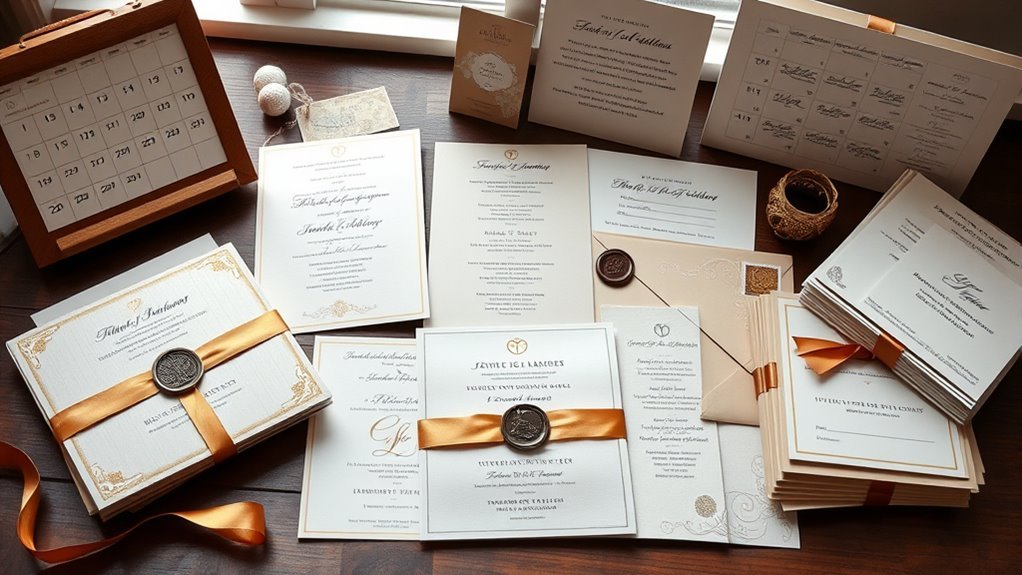
Separate your ordering date from your mailing date. According to The Knot’s current invitation timeline, pre-designed online invitations are best ordered roughly 12 to 14 weeks before the wedding so there is time for production, shipping, addressing, and reprints.
For a standard wedding, plan to have the invitations finished well before the six-to-eight-week mailing window.
Traditional etiquette guidance generally places the mailing date at six to eight weeks before the wedding. Paper RSVPs benefit from staying closer to the eight-week side because guests need time to receive and return them.
For out-of-town guests, The Knot recommends roughly eight weeks. Invitations traveling internationally need additional mailing time; its current guidance suggests about nine to ten weeks. Digital RSVPs can reduce the time spent waiting for a reply to travel back through the mail.
Production time also depends on the printing method. Digital printing is generally faster than letterpress or custom-die foil because premium methods require extra setup.
How Much Does Wedding Invitation Postage Cost in 2026?
As of July 12, 2026, a stamped U.S. First-Class Mail letter weighing up to one ounce costs $0.82. The current USPS Notice 123 price list shows $1.11 for a two-ounce stamped letter and a $0.49 nonmachinable surcharge for letters with qualifying nonmachinable characteristics.
That means 100 standard one-ounce invitations require at least $82 in outbound postage, while 150 require at least $123. If you include a pre-stamped paper RSVP return envelope, budget return postage separately as well.
Shape matters. Under the current USPS physical standards for letters, a letter with an aspect ratio below 1.3 or above 2.5 is nonmachinable. A square envelope has an aspect ratio of 1, so a square letter is nonmachinable and can trigger the current $0.49 surcharge.
Heavy multi-piece suites, excessive thickness, rigid elements, clasps, uneven contents, and other nonmachinable features can also cost more. Assemble one complete invitation and have its weight, dimensions, and machinability checked before buying postage for the full batch.
Sources Checked for 2026 Pricing
This article was refreshed on September 8, 2026 using current survey data, printer price lists, professional-print planning benchmarks, wedding-planning guidance, and the current USPS rate and physical-standards tables. Vendor prices are examples and can change; they should not be presented as universal market averages.
- The Knot — 2026 average wedding invitation and stationery spending
- Paperlust — 2026 professional printing-method and printing-route benchmarks
- Anthology Print — current quantity and paper pricing examples
- USPS — current First-Class Mail pricing
- USPS — current physical standards and nonmachinable criteria for letters
- The Knot — current invitation ordering and mailing timeline
- Zola — current wedding invitation budgeting and extra-order guidance
Frequently Asked Questions
How Much to Print 100 Wedding Invitations?
For 100 standard 5 x 7 digital invitation cards, Paperlust’s 2026 professional-print planning guide puts the range around $150 to $300 before shipping and extras. A current Anthology Print price list shows $118 for 100 single-sided standard cards and $163 for 100 double-sided cards with basic envelopes, so actual quotes vary by paper, provider, printing method, and what is included.
How Much Do 300 Wedding Invitations Cost?
One current Anthology Print price list shows 300 standard 5 x 7 cards at $225 single-sided or $270 double-sided, with basic envelopes. Treat that as a vendor example, not a universal average; foil, letterpress, premium paper, inserts, and shipping can move the total much higher.
How Much Does It Cost for 200 Wedding Invitations?
One current Anthology Print price list shows 200 standard 5 x 7 invitations at $165 single-sided or $212 double-sided with basic envelopes. Premium paper, foil, letterpress, inserts, custom design, shipping, and postage are separate cost variables.
How Much Does It Cost to Send 150 Wedding Invitations?
If you truly mail 150 standard one-ounce rectangular letters, outbound postage alone is at least $123 at the current $0.82 stamped-letter rate. Paper RSVP return postage is additional. Many weddings need fewer mailed invitations than guests because couples and families can share an invitation. Heavy or nonmachinable pieces cost more.
What Is the Cheapest Professional Way to Print Wedding Invitations?
Standard digital printing is generally the lowest-cost professional method. Paperlust’s current planning benchmark is about $1 to $3 per standard invitation card, while foil and letterpress cost more because they require additional materials, setup, dies, plates, or press work.
Do Square Wedding Invitations Cost More to Mail?
Yes, a square letter is nonmachinable under USPS aspect-ratio rules because its length-to-height ratio is 1, below the machinable minimum of 1.3. The current nonmachinable surcharge is $0.49 in addition to the applicable letter postage.
How Many Wedding Invitations Should I Order?
Count the households or mailing groups that need separate invitations rather than ordering one card per guest. Then add roughly 10% to 15% extra for addressing mistakes, keepsakes, photography, lost mail, and last-minute additions. If two people at the same address should receive separate invitations, count them as separate mailing groups.
Conclusion
For a realistic wedding card printing budget, start by counting mailing groups rather than guests. Next, choose the print method and get comparable quotes for the same paper, size, quantity, envelopes, inserts, and finishing. Then add outbound postage and, if you use paper RSVPs, return postage. Current 2026 planning benchmarks put standard professional digital printing around $1 to $3 per card, while foil and letterpress can cost several times more. Keeping printing, suite extras, design work, and postage separate makes it much easier to compare vendors and understand the true total before you order.

This Pokémon card bundle gives collectors and players a fun mix of 50 assorted cards plus one double rare legendary card for extra excitement. It also includes an LCC deck box that can store up to 100 cards, making it easy to organize and protect your collection at home or on the go.

This practical guide brings together traditional skills and self-sufficiency knowledge in one accessible reference. It helps readers learn time-tested home, craft, and survival techniques with clear guidance suited for beginners and hobbyists alike. Ideal for anyone interested in homesteading, DIY living, or preserving old-fashioned know-how.

Die With Zero offers a fresh perspective on personal finance by encouraging readers to use money intentionally to create memorable life experiences instead of simply accumulating wealth. Written by Bill Perkins, this book combines practical guidance with a motivating philosophy to help readers align spending, saving, and life goals for a more fulfilling future.
