
California offers several ways for older anglers to lower the cost of fishing, but turning 65 does not automatically qualify you for a discount. The main senior program is limited to California residents age 65 or older who receive Supplemental Security Income (SSI) or Cash Assistance Program for Aged, Blind, and Disabled Legal Immigrants (CAPI).
Quick Answer
California does not give every senior a fishing discount based on age alone. In 2026, California residents age 65 or older who receive SSI or CAPI can buy a reduced-fee sport fishing license for $10.04. Other qualifying anglers may receive free licenses, while everyone else needs a standard, short-term, or lifetime license.
Key Takeaways
- The 2026 reduced-fee senior sport fishing license costs $10.04.
- You must be a California resident, be at least 65, and receive SSI or CAPI.
- The reduced-fee license is valid for 365 days from the date of purchase.
- Report cards and validations may still be required and are purchased separately.
- California’s 2026 Free Fishing Days are July 4 and September 5.
- Fishing from a qualifying public ocean or bay pier does not require a license, but other fishing regulations still apply.
At a Glance
| Time Required | About 10–20 minutes to prepare the form; allow up to 15 business days for processing |
| Difficulty | Easy if your SSI or CAPI verification is current |
| Documents Needed | Completed application, California driver’s license or DMV ID copy, and current SSI or CAPI verification |
| Cost | $10.04 in 2026, plus any required report cards or validations |
Eligibility for Reduced-Fee and Free Sport Fishing Licenses
California’s reduced-fee senior license has three main requirements. You must:
- Be 65 years of age or older.
- Be a California resident.
- Receive benefits through SSI or CAPI.
CDFW requires fresh verification from the Social Security Administration or California Department of Social Services each year. Acceptable SSI records may include a Benefit Verification Letter or forms such as SSA-L8151, SSA-L8155, or SSA-L8166. CAPI recipients need a statement confirming that they currently receive CAPI benefits.
Warning: Turning 65 does not by itself qualify you for California’s reduced-fee license. A senior who does not receive SSI or CAPI must use another license option unless the person qualifies under a separate free or reduced-fee program.
Other Free and Reduced-Fee Programs
CDFW also provides special licenses for several groups. These programs are based on the applicant’s circumstances, not simply on senior age.
- Low-income Native American anglers: A California resident Native American who is financially unable to pay for a resident license may apply for a free license. First-time applicants must provide tribal enrollment, a Certificate of Degree of Indian Blood, or an official tribal membership or identification card. The current application allows documentation to be uploaded through a CDFW customer account or submitted by mail. Learn more through CDFW Tribal Resources.
- Blind anglers: Applicants must meet California’s legal vision standard and provide certification from a licensed optometrist or ophthalmologist.
- Developmentally disabled anglers: Applicants must use the category-specific CDFW application and provide the required professional certification.
- Severely mobility-impaired anglers: A qualifying California resident must be permanently unable to move from place to place without an assistive mobility device. A licensed physician must certify the condition.
- Disabled veterans: An honorably discharged resident or nonresident veteran with a service-connected disability rating of at least 50% may prequalify for a reduced-fee license. The 2026 fee is $10.04 at a CDFW office or $10.54 from a license agent after eligibility is added to the applicant’s customer record.
The first free license for a qualifying blind, developmentally disabled, or mobility-impaired angler is processed through the CDFW License and Revenue Branch. Application and certification requirements differ by category, so use the form linked from the official CDFW sport fishing license page.
How Much California Seniors Pay in 2026
The best license depends on whether you qualify for a special program and how often you plan to fish. California’s regular and reduced-fee sport fishing licenses are valid for 365 days from the purchase date.
| License option | 2026 fee | Who it is for |
|---|---|---|
| Reduced-fee low-income senior | $10.04 | California residents age 65+ who receive SSI or CAPI |
| Resident 365-day license | $64.54 | California residents age 16+ who do not qualify for a special license |
| One-day license | $21.09 | Residents or nonresidents fishing on one specified day |
| Two-day license | $32.40 | Residents or nonresidents fishing for two consecutive days |
| Lifetime license, age 62+ | $709.00 | California residents who want lifetime fishing privileges |
California’s other 2026 lifetime fishing prices are $1,160.25 for ages 10–39 and $1,045 for ages 40–61. A lifetime license holder must claim the current 365-day license entitlement each year, but there is no new base-license charge.
Note: The $478.75 Lifetime Fishing Privilege Package is an optional add-on for lifetime license holders. It includes lifetime access to a Second-Rod Validation, Ocean Enhancement Validation, North Coast Salmon Report Card, and Steelhead Report Card. It is not a standalone annual fishing license.
Products Worth Considering

FISHING LICENSE HOLDER W/ZIP CLOSURE

【MATERIAL】: oFloral License plate frame is made from premium quality aluminum, which can provide long-lasting protection from corroding, rusting and aging, durability for long lasting usage.Personalized Car Frame Can Perfect to Put on Your Front of Car or for Decorative Purposes Around the House Like in Your Bedroom, Garage, Basement, Ect.

Durable Material: Car license plate is crafted from high-quality ETP (electrolytic tinplate) with 2 layers of clear epoxy lacquer coating making the car tag water-proof, rust-proof, and weather-resistant
Required Report Cards and Validations for Senior Anglers
A reduced-fee or free sport fishing license does not replace species-specific report cards or area validations. These items must be purchased separately at the regular applicable price.
| Item | General 2026 listed fee | When it is required |
|---|---|---|
| Ocean Enhancement Validation | $7.30 | Fishing in ocean waters south of Point Arguello, except with a one- or two-day license or from a qualifying public pier |
| Second-Rod Validation | $20.26 | Using two rods or lines in eligible inland waters |
| Recreational Crab Trap Validation | $2.98 | Taking crabs with qualifying crab traps; it is not required for hoop nets or crab loop traps |
| North Coast Salmon Report Card | $9.21 | Fishing for salmon in the Smith or Klamath-Trinity river systems |
| Steelhead Report Card | $10.29 | Fishing for steelhead in inland waters |
| Sturgeon Fishing Report Card | $8.13 for the 2026–27 card | Fishing for sturgeon, including catch-and-release fishing |
| Spiny Lobster Report Card | $12.70 | Taking spiny lobster |
The table uses CDFW’s general published 2026 prices. A total at a CDFW office can be slightly lower for some optional items because a license-agent handling fee may not apply.
Warning: Report cards may be required even when you do not need a sport fishing license. This includes children under 16, people fishing from qualifying public piers, and anglers participating on a Free Fishing Day.
Special 2026 Sturgeon Rules
California’s white-sturgeon fishery is catch-and-release only. The 2026 fishery is closed from July 1 through September 30, and the 2026–27 Sturgeon Fishing Report Card is scheduled to become available on August 15, 2026. You must carry a valid card when fishing for sturgeon even if you do not intend to keep a fish.
Fishing seasons, emergency closures, and gear rules can change. Check the current CDFW fishing regulations before every trip, and follow the reporting deadline printed on each card.
How to Apply and Where to Buy a Reduced-Fee License
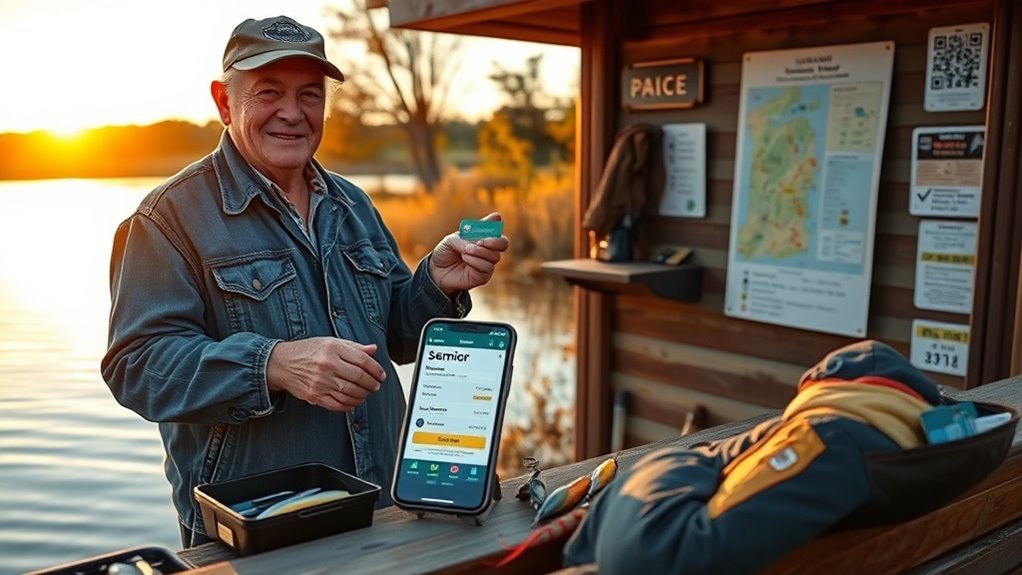
The reduced-fee low-income senior license is not sold through the regular online license store. However, the completed application and supporting documents may be submitted in person or by mail to a CDFW sales office.
Products Worth Considering
CALIFORNIA STATE FLAG DESIGN: Features a textured, raised California flag design for an authentic, high-end look and feel. HEAVY-DUTY ALUMINUM: Thicker than most decorative...
Step 1: Get the Current Application
Download the 2026 Reduced-Fee Sport Fishing License Application, form DFW 356. Use the current-year form because fees and optional-item prices can change annually.
Step 2: Gather Your Documents
| What to bring or include | Why it is needed |
|---|---|
| Completed and signed DFW 356 form | Records your eligibility, residency, contact details, and certification |
| Photocopy of a California driver’s license or DMV ID | Confirms identity, age, and customer information |
| Current SSI Benefit Verification Letter or accepted SSA statement | Confirms current SSI eligibility |
| Current CAPI statement, when applicable | Confirms current CAPI eligibility |
| Payment of $10.04 plus optional items | Pays for the 2026 reduced-fee license and any selected validations or cards |
Step 3: Complete and Sign the Form
Fill in all applicant information, select SSI or CAPI as the basis for eligibility, and sign the certification. Incomplete or unsigned applications are returned, which delays processing.
Step 4: Submit the Application
You may submit the application and documents in person or by mail to a CDFW sales office. Use the CDFW License and Revenue Branch and sales-office directory to confirm the nearest location, current hours, and available counter services.
Step 5: Pay the Fee
CDFW offices do not accept cash. The application permits payment by check, money order, Visa, or Mastercard. Do not mail cash.
Step 6: Allow Time for Processing
CDFW instructs applicants to allow up to 15 business days for review and processing. Keep copies of the completed form and supporting records.
Step 7: Renew with Current Verification
SSI or CAPI eligibility must be verified every year. CDFW states that reduced-fee senior licenses requiring this verification must be renewed annually through a CDFW License Sales Office.
Pro Tip: Call the office before making a long trip. Some regional locations accept applications but do not issue licenses over the counter, and office hours or payment services may change.
Tips to Save on Fishing Costs and Free Fishing Days
License discounts are only one way to keep fishing affordable. Choose the option that matches how often and where you fish.
Products Worth Considering

【Sand-Resistant & Beach Ready】Designed for beach trips, camping, and outdoor adventures. The smooth microfiber surface helps prevent sand from sticking to the towel, allowing sand to be easily shaken off after use for quick and convenient cleanup.

Below-the-Knee Length: Unlike ankle-grazing capri, our hiking shorts hit the perfect spot just below the knee. These Bermuda shorts provide sun protection while also offering a great coverage for concealing scars or wrinkles on the knees and upper legs

Reliable Grip on Ice & Snow: Equipped with durable steel studs that bite into icy and snowy surfaces, these slip-on traction cleats greatly reduce the risk of slips and falls. Whether you’re walking, hiking, or shoveling snow, you can move with more stability
Use California’s 2026 Free Fishing Days
California’s two Free Fishing Days in 2026 are Saturday, July 4, and Saturday, September 5. Anyone may fish without buying a sport fishing license on those dates.
A Free Fishing Day removes the license requirement, not the fishing rules. Bag limits, size limits, closures, gear restrictions, fishing hours, and report-card requirements remain in force.
Fish From a Qualifying Public Pier
A sport fishing license is not required when recreationally fishing from a qualifying public pier in California ocean or bay waters. The structure must meet the state’s legal definition, including free and unrestricted public access and a primary fishing purpose.
Be careful with jetties, breakwaters, docks, seawalls, beaches, and adjacent rock walls. Some qualify for the exemption, while others do not. Review CDFW’s public-pier list and shore-fishing guidance before relying on the exemption.
Compare Short-Term and Annual Costs
A one-day license may suit an occasional trip, but repeated one-day purchases can quickly cost more than a 365-day resident license. Compare the number of planned outings before buying.
Buy Only the Extras You Need
Do not purchase every validation automatically. Choose report cards and validations according to the species, number of rods, gear, and fishing area you will use. One- and two-day licenses are already exempt from the Ocean Enhancement Validation requirement.
Reuse and Share Equipment
Repair serviceable rods and reels, borrow equipment for a first trip, and check local tackle swaps or community fishing clinics. Shared transportation can also reduce fuel and parking costs.
Check Current SHARE Fishing Opportunities
CDFW’s SHARE Fishing Program creates limited public fishing opportunities through agreements with participating landowners. Available locations, dates, drawings, access permits, and fees vary, so review the current listing rather than assuming that year-round discounted access is available.
Frequently Asked Questions
Do all California seniors receive a discounted fishing license?
No. The low-income senior license is limited to California residents age 65 or older who currently receive SSI or CAPI. Seniors who do not meet those requirements need a regular, short-term, lifetime, or other qualifying special license.
Do seniors need a fishing license on a private pond?
California has a narrow exemption for the property owner and the owner’s invited guests when no compensation is charged, the fish are not taken for profit, and the pond is wholly enclosed by the property, offstream, and unconnected to state waterways. A license may still be required when any condition is not met.
Can a nonresident caregiver obtain the reduced-fee senior license?
A caregiver may help an eligible senior complete or deliver the paperwork, but the license is issued to the qualifying angler. The senior must personally meet California’s age, residency, and SSI or CAPI requirements and must sign the application.
Are senior fishing-license ages and discounts the same in every state?
No. Each state sets its own age thresholds, residency periods, prices, exemptions, and documentation rules. California’s low-income senior program should not be used as a guide to another state’s requirements.
What is the 2026 replacement fee for a lost California fishing license?
The general 2026 duplicate sport fishing license fee is $14.30. A duplicate may be purchased online, from a license agent, or at a CDFW sales office. Replacing a lost sturgeon report card requires a separate affidavit and must be handled through a CDFW sales office.
Do seniors need a license when fishing from shore or a pier?
Age does not change the location rules. A license is generally required from a beach, shoreline, dock, or nonqualifying structure. No license is required from a legally qualifying public pier in ocean or bay waters, although seasons, bag limits, size limits, gear restrictions, and report-card requirements still apply.
Can the reduced-fee senior fishing license be purchased online?
No. It is not sold through the regular online license store. The completed application, identification, benefit verification, and payment may be submitted in person or by mail to a CDFW sales office. Annual SSI or CAPI verification is required.
Are report cards required on a Free Fishing Day or public pier?
Yes, when you fish for a species that requires one. The license exemption does not remove requirements for steelhead, sturgeon, North Coast salmon, or spiny lobster report cards.
Conclusion
California’s reduced-fee senior fishing license can make regular fishing much more affordable, but it is available only to residents age 65 or older who receive SSI or CAPI. Use the current application, include complete benefit and identification records, and allow time for processing. Before each trip, confirm the rules for your water, species, report cards, and validations so your license-free or reduced-fee outing remains legal.
Sources
- California Department of Fish and Wildlife — Sport Fishing Licenses and Report Cards — 2026 license prices, eligibility, report cards, validations, duplicate fees, and license rules
- CDFW 2026 Reduced-Fee Sport Fishing License Application — SSI/CAPI documentation, submission methods, payment, and processing instructions
- CDFW Tribal Resources — Free Low-Income Native American Sport Fishing License eligibility and documentation
- CDFW Free Fishing Days — official 2026 dates and regulations that remain in effect
- CDFW Beach Fishing and Public Pier Guidance — public-pier definitions, exemptions, and shore-fishing rules
- California Fish and Game Code Section 7145 — general license requirement and the limited private-pond exemption
