
Washington makes it inexpensive for children to start fishing because anglers age 15 and younger generally do not need a standard fishing license. However, young anglers may still need a catch record card, a Puget Sound crab endorsement, or the Columbia River Salmon and Steelhead Endorsement, depending on their age, target species, and fishing location.
Quick Answer
A Washington fishing license generally costs $0 for resident and nonresident anglers age 15 and younger. A standard license is required beginning at age 16. Children of any age may still need catch record cards or species-specific endorsements, and 15-year-olds need a Columbia River endorsement when targeting salmon or steelhead in covered waters.
Key Takeaways
- Anglers age 15 and younger generally do not need a standard Washington fishing license.
- Everyone needs the correct catch record card when fishing for salmon, steelhead, sturgeon, halibut, or Puget Sound Dungeness crab.
- A 15-year-old needs a $7.10 Columbia River Salmon and Steelhead Endorsement when fishing for those species in covered Columbia River waters.
- At age 16, the angler must purchase the appropriate adult resident or nonresident license.
- Always check current WDFW regulations and emergency rule changes before the trip.
At a Glance
| Standard License Age | Required beginning at age 16 |
| Cost Under Age 16 | $0 for the standard fishing license |
| Possible Documents | Catch record card, crab endorsement, or Columbia River endorsement |
| License Year | April 1 through March 31 |
| Next Free Fishing Weekend | June 12–13, 2027, for eligible species |
Note: Washington fishing seasons can change through emergency rules. This article summarizes current requirements, but the latest WDFW fishing regulations control if a rule changes.
Washington Youth Fishing License Overview and Eligibility
Under current Washington rules, anglers age 15 and younger generally do not need a standard fishing license. This applies to both Washington residents and visitors from another state.
The age rules are easiest to understand in three groups:
- Ages 0–14: No standard fishing license is required. Catch record cards and certain species documents may still be required.
- Age 15: No standard fishing license is required, but a Columbia River Salmon and Steelhead Endorsement is required when targeting salmon or steelhead in covered Columbia River waters and tributaries.
- Age 16 and older: The angler must purchase the appropriate adult fishing license and any required catch cards or endorsements.
A child does not have to be accompanied by a licensed adult to qualify for the under-16 standard license exemption. Adult supervision is still strongly recommended for safety, fish handling, hook removal, and compliance with area rules.
For most children in Washington, the standard fishing-license cost is $0—not a discounted annual youth fee.
Pro Tip: Decide what species the child will target before getting documents. Trout fishing at a local lake may require no youth paperwork, while salmon, steelhead, sturgeon, halibut, and Puget Sound crab require additional records.
Current Washington Fishing License Costs for Families
The current 2026–27 WDFW fishing license fee schedule lists no annual standard fishing-license fee for anglers under 16. Once the angler turns 16, adult resident or nonresident prices apply.
| License Type | Resident Age 16+ | Nonresident Age 16+ |
|---|---|---|
| Annual freshwater | $39.95 | $115.85 |
| Annual saltwater | $40.71 | $81.70 |
| Annual combination | $74.37 | $170.00 |
| 1-day combination | $14.90 | $27.05 |
| 2-day combination | $20.98 | $39.19 |
| 3-day combination | $25.53 | $48.30 |
Annual licenses for the current license year are valid from April 1, 2026, through March 31, 2027. Short-term licenses cover one, two, or three consecutive days.
The short-term prices are not youth-under-16 fees. They become useful when a family member is 16 or older and only plans to fish for a few days.
Products Worth Considering

Enough to Use: you will receive 6 pieces of fishing license holders, and 6 pieces of safety pins, abundant in quantity, enough for you to choose and replace, can meet your different needs; You can also share them with your friends

FISHING LICENSE HOLDER W/ZIP CLOSURE

Secure & Dry - With a clear waterproof zip closure, this heavy-duty badge holder keeps your license and tags protected from the elements. Adventure with confidence.
Residency Rules and Proof
Residency does not change the standard fishing-license cost for an angler under 16 because both resident and nonresident children generally fish without that license.
Residency becomes financially important when the angler turns 16. Washington resident adult licenses usually cost less than nonresident licenses.
Under Washington residency rules, a person generally must maintain a permanent place of abode in Washington for at least 90 days before purchasing a resident license and show an intent to continue living in the state. A Washington driver’s license, Washington identification card, qualifying military documents, or other approved evidence may be used.
A person claiming Washington residency also cannot claim resident fishing or hunting privileges in another state. When normal identification is unavailable, contact WDFW Licensing before purchasing at the resident rate.
Where and How to Get Licenses, Cards, and Endorsements
Most children do not need to buy a standard license, but a parent may still need to obtain a catch record card, crab endorsement, or other document in the child’s name.
Washington offers several ways to obtain fishing documents:
- Mobile: Use the MyWDFW or Fish Washington app to buy and display eligible licenses and electronic catch record cards.
- Online: Use the WDFW licensing system to purchase products connected to the angler’s WILD account.
- By phone: Call WDFW Licensing at 360-902-2464.
- In person: Visit an authorized WDFW license dealer.
- Print at home: Paper customers can print eligible licenses and records through their account.
The MyWDFW and Fish Washington apps can display license privileges and support electronic catch reporting. Choose either a mobile or paper record system carefully and follow WDFW instructions if changing formats.
Federal and state law require applicants age 16 and older to provide a Social Security number before purchasing a license, whether the purchase is completed online, by phone, through an app, or in person.
Note: Put every required document in the name of the person who will fish. Catch cards and endorsements cannot be shared between family members.
Products Worth Considering
[Compliance] This license plate is a decorative craft item, not a real license plate. It is for interior decoration only and is prohibited from being installed on vehicles. Please comply with US laws and state regulations.

【MATERIAL】: oFloral License plate frame is made from premium quality aluminum, which can provide long-lasting protection from corroding, rusting and aging, durability for long lasting usage.Personalized Car Frame Can Perfect to Put on Your Front of Car or for Decorative Purposes Around the House Like in Your Bedroom, Garage, Basement, Ect.

Decorative Item Only: This product is a vintage-style decorative license plate, crafted as a replica/artifact. It is NOT a real license plate and cannot be used as such. Please comply with all applicable laws—it must NOT be mounted on any vehicle to replace, cover, or imitate an official license plate. Use only for indoor or outdoor decoration where legally permitted.
Short-Term Licenses and Free Fishing Weekend
Short-term licenses are mainly useful for anglers age 16 and older. A child age 15 or younger generally does not need a one-, two-, or three-day standard fishing license.
Washington also holds an annual Free Fishing Weekend. The 2026 event took place June 6–7. The next announced Free Fishing Weekend is June 12–13, 2027.
During Free Fishing Weekend, people of any age or residency can fish for many species without purchasing a license. However, the waiver does not cover every fishery.
Warning: A license and the required catch documents are still needed during Free Fishing Weekend when fishing for or harvesting salmon, steelhead, sturgeon, halibut, or shellfish. Seasons, limits, closures, and gear rules also remain in effect.
Free Fishing Weekend can be a good time to introduce an adult friend to fishing. It does not usually change much for a child under 16 because the child already qualifies for the standard license exemption.
Products Worth Considering

STARTER FISHING GEAR KIT includes: 65 inch camo green telescopic fishing rod, spinning reel, minnow net, beginner’s guide, fishing lures, carry case and tackle box stocked with gear.

【Functional Fishing Lures Kit】 Our fishing tackle box with tackles included is equipped with 140PCS comprehensive lures hooks accessories for a fishman to start a fishing trip. With a wide range of bionic baits,spoon Lures, fishing hooks, pliers, weight and other accessories, this fishing tackle with lures pliers set is a practical choice for anglers across waters.

Universal Fishing Accessory Kit:This is a bait kit that is good for beginners in fishing It contains both freshwater and saltwater baits, including VIB, soft bait, top water bait, glitter, and more It also comes with a hook and weighted lead blocks. This set of boxes can basically meet your needs for fishing accessories
Required Catch Record Cards and Endorsements for Youth
A license exemption does not exempt a child from catch reporting. Everyone, including anglers younger than 16, must carry the correct paper or electronic catch record card when fishing for:
- Salmon
- Steelhead
- Sturgeon
- Halibut
- Puget Sound Dungeness crab
The angler must record retained catch immediately, before continuing to fish or putting crabbing gear back into the water. A paper card must be completed in ink. Electronic-card users must record the catch through the authorized app.
The standard fish catch record card is issued at no charge. Halibut and Puget Sound crab have additional card or endorsement procedures, so select the exact species in the WDFW licensing system rather than assuming the standard card covers every fishery.
Catch Record Card Reporting Deadlines
- Fish catch record cards: Due by April 30 after the license year ends.
- Summer Puget Sound crab cards: Due by October 1 after the summer season.
- Winter Puget Sound crab cards: Due by February 1 after the winter season.
Paper cards must be reported even if the angler caught nothing. Electronic-card users must complete the required no-harvest report in the app.
Columbia River Salmon and Steelhead Endorsement
Beginning January 1, 2026, anglers age 15 and older need a Columbia River Salmon and Steelhead Endorsement when fishing recreationally for salmon or steelhead in the Columbia River and many Washington tributaries.
- Age 14 and younger: The endorsement is not required.
- Age 15: The endorsement costs $7.10.
- Age 16 and older: The total endorsement cost is $8.75 for residents and nonresidents.
Two-Pole Endorsement
A two-pole endorsement allows an angler to use two fishing poles at the same time only in waters where two-pole fishing is allowed. Current Washington guidance requires the endorsement for anglers age 16 and older. The endorsement does not override a lake, river, or marine-area rule that prohibits two poles.
Puget Sound Dungeness Crab
A young crabber needs the appropriate Puget Sound crab endorsement and catch record card even when no standard fishing license is required. WDFW issues youth crab documentation at no charge, but the child must carry and maintain it while crabbing.
Rules for Fishing With Children on Private Property
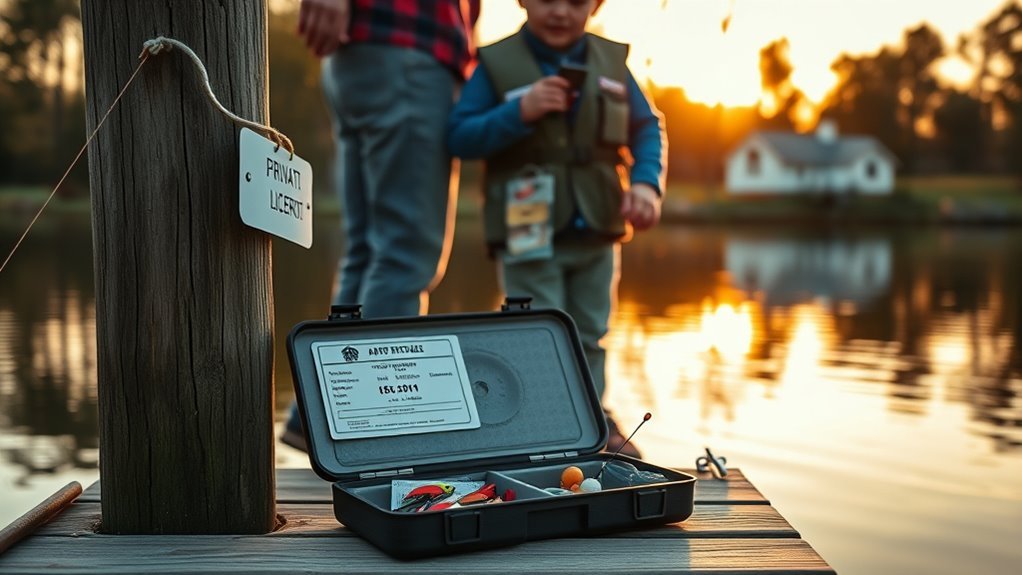
Private ownership does not give the public permission to enter or fish. Always obtain the landowner’s permission before crossing or using private property.
Written permission is a smart way to prevent misunderstandings because it can document the date, location, guests, access route, and any conditions set by the owner. However, do not assume that a particular permission form creates a fishing-license exemption.
Age and Supervision Rules
The same general age rule applies: a child age 15 or younger normally does not need a standard Washington fishing license, while an angler age 16 or older does.
Adult supervision is recommended for all young children, especially near deep water, steep banks, docks, boats, hooks, knives, or moving current. The supervising adult should check:
- The child’s age and required documents
- The pond, lake, or stream’s current fishing rules
- Species, size, and daily limits
- Gear restrictions and seasonal closures
- The landowner’s access conditions
Landowner Permission Is Needed
A fishing license is not permission to trespass. Obtain the owner’s consent before entering private land, parking, launching a boat, walking along a bank, or fishing from a private dock.
Written permission is especially useful when the owner is not present. Keep a copy with the group and follow any limits on dates, vehicles, gates, fires, pets, litter, or harvested fish.
Do Private Ponds Have Different License Rules?
Do not assume that every privately owned pond is outside WDFW regulation. A pond may still be treated as Washington water, particularly if it connects to natural waters or contains regulated fish.
Before relying on a private-water exemption, contact WDFW Licensing or the appropriate regional office and describe the pond, its water source, connection to other waters, and fish-stocking history. Regardless of license status, landowner permission remains necessary.
Fishing Safety for Children
A license exemption does not reduce the need for close supervision. Use a properly fitted life jacket around boats, deep water, swift current, slippery rocks, or cold water.
Washington law requires children age 12 and younger to wear a U.S. Coast Guard-approved life jacket while a vessel under 19 feet is underway when the child is on an open deck or open cockpit, subject to limited statutory exceptions. A wearable life jacket must also be available for every person aboard a vessel.
- Use eye protection when casting.
- Leave enough space between anglers.
- Teach children to look behind them before casting.
- Carry pliers or a hook-removal tool.
- Keep knives and loose tackle out of a young child’s reach.
- Wash hands before eating and after handling fish or bait.
- Check weather, water temperature, and current before leaving home.
Warning: Cold Washington water can quickly affect breathing and movement. A child should wear a fitted life jacket whenever there is a realistic risk of falling into deep or moving water, even when the law does not specifically require it.
Family Fishing Checklist
- Confirm each angler’s age.
- Identify the target species.
- Check whether a catch record card or endorsement is required.
- Review the current rules for the exact water.
- Check emergency rule changes and closures.
- Confirm land access, parking, and launch requirements.
- Pack life jackets, drinking water, sun protection, pliers, and a first-aid kit.
- Carry the required paper documents or a charged phone with the mobile records.
Frequently Asked Questions
Does a child need a fishing license in Washington?
An angler age 15 or younger generally does not need a standard Washington fishing license. A license is required beginning at age 16. Catch record cards and certain endorsements can still apply before age 16.
Does a 15-year-old need any fishing document?
Possibly. A 15-year-old does not need the standard fishing license but needs a catch record card for record-card species. The angler also needs the $7.10 Columbia River Salmon and Steelhead Endorsement when targeting those fish in covered waters.
Do children need catch record cards?
Yes. The requirement applies at every age when fishing for salmon, steelhead, sturgeon, halibut, or Puget Sound Dungeness crab. Retained catch must be recorded immediately.
Do Washington youth fishing documents work in another state?
No. Washington’s age exemptions, catch cards, and endorsements do not replace another state’s license or private-water rules. Check the destination wildlife agency and obtain the property owner’s permission before fishing.
Are there sibling or family discounts?
WDFW does not list a standard sibling discount in its current fishing fee schedule. Most families do not need one for younger children because each angler age 15 or younger generally pays $0 for the standard license.
Can a Washington fishing license be purchased as a gift?
Current WDFW licensing information does not advertise a general gift-certificate program for fishing licenses. Licenses and catch records are tied to the individual angler’s WILD account and identity. Contact WDFW Licensing before attempting to purchase a product for another person.
Does a youth license include entry to fishing events or tournaments?
A license exemption does not guarantee event entry. Washington youth events may have their own age limits, registration periods, attendance caps, fees, and adult-supervision rules. Review the organizer’s requirements before attending.
Are fishing tackle restrictions based on a child’s age?
Most Washington tackle restrictions depend on the water, season, and target species rather than the angler’s age. Juvenile-only waters and youth events can have separate participation rules. Check the regulation listing for the exact location.
Conclusion
Most Washington anglers age 15 and younger can fish without buying a standard license, making the basic youth license cost $0 for residents and nonresidents. The important step is checking whether the child needs a catch record card, crab endorsement, or Columbia River endorsement.
Once the angler turns 16, adult license prices apply. Before every outing, confirm the rules for the exact water, target species, season, and fishing method. Carry the required records, obtain permission before using private property, and give young anglers close supervision around hooks, boats, and cold water.
Sources
- Washington Department of Fish and Wildlife: Fishing and Shellfishing Licenses — licensing age, purchase methods, Social Security number requirement, and catch-card overview
- Washington Department of Fish and Wildlife: Fishing License Types and Fees — current annual, temporary, and endorsement prices
- Washington Department of Fish and Wildlife: Catch Record Cards — covered species, recording duties, and reporting deadlines
- Washington Department of Fish and Wildlife: Columbia River Salmon and Steelhead Endorsement — age threshold, covered fisheries, and fees
- Washington Department of Fish and Wildlife: Free Fishing Weekend — current dates and excluded species
- Washington State Parks: Wear a Life Jacket — child life-jacket requirements and boating safety
