
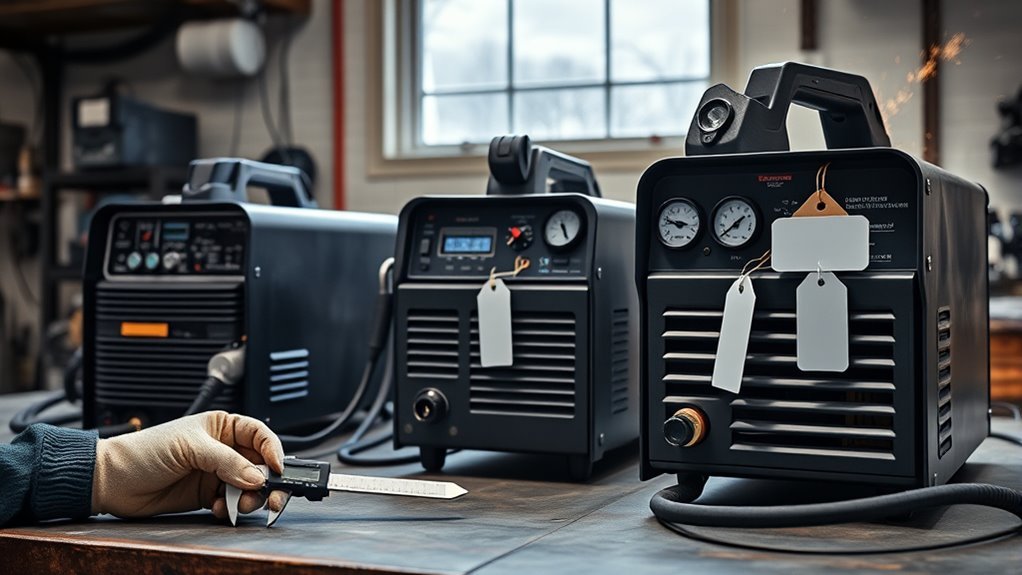
Welding machine prices range from compact hobby units that cost a few hundred dollars to production and engine-driven systems priced well into five figures. The right budget depends on the welding process, metal type, material thickness, input power, workload, included accessories, and support you need. Prices in this guide were checked on July 29, 2026, but dealer promotions, package contents, shipping, and local taxes can change the final amount.
Quick Answer
Most welding machines cost about $150 to $1,500 for home and light-shop use in 2026. Professional MIG, TIG, and multiprocess systems often run $2,000 to $9,000, while engine-driven or production packages can exceed $15,000. Add PPE, electrical work, gas, consumables, and accessories before setting your final budget.
Key Takeaways
- Budget flux-core and compact multiprocess machines may start near $150, while established-brand home-shop MIG units commonly cost about $450 to $1,700.
- AC/DC TIG, pulsed MIG, higher duty cycles, aluminum capability, and industrial input power raise the price.
- A machine-only price may exclude shielding gas, a cylinder, PPE, a foot pedal, a spool gun, a cart, or even the torch needed for every advertised process.
- Check your outlet, breaker, material thickness, and required process before comparing brands.
- For career data, use current Bureau of Labor Statistics figures rather than unsupported shortage or salary claims.
At a Glance
| Time Required | About 30–60 minutes to compare power, process, package contents, warranty, and local supply costs |
| Difficulty | Moderate; technical ratings and incomplete packages can make direct comparisons difficult |
| Tools Needed | Material list, maximum thickness, outlet and breaker details, process requirements, and local gas-supplier quotes |
| Cost | About $300–$2,000 for many complete home setups; $2,000–$9,000+ for advanced shop systems |
What Does a Welding Machine Cost in 2026?
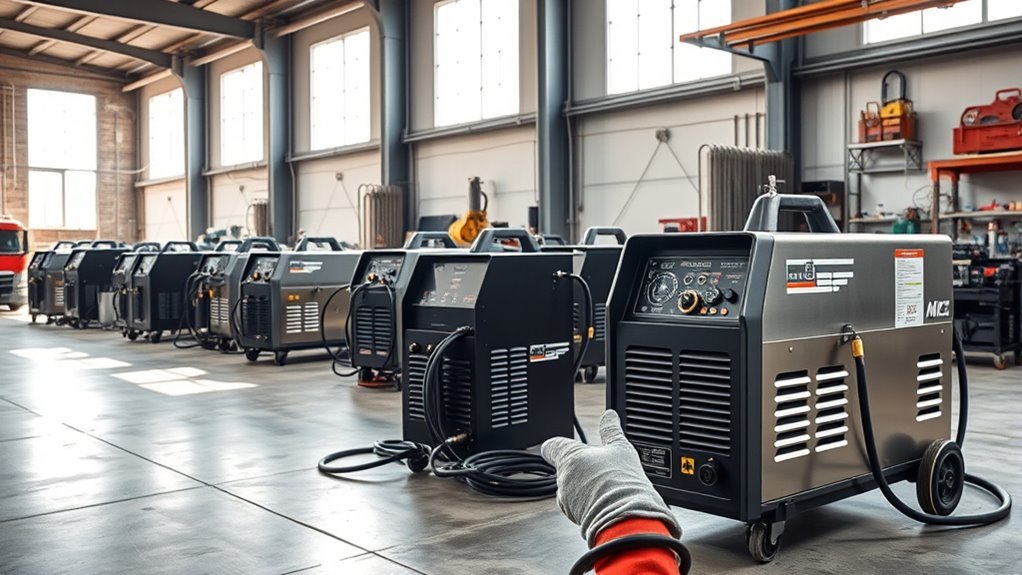
A welding machine can cost less than $200 or more than $15,000. The wide range exists because a small 120-volt flux-core machine and an industrial pulsed-MIG or engine-driven power source are built for very different jobs.
Current manufacturer and retailer examples show how broad the market is:
- A compact YesWelder FLUX-135PRO was listed at $159.
- The Lincoln Electric WELD-PAK 90i MIG carried a $478 MSRP.
- The Miller Thunderbolt 210 MV stick welder had an $849 list price.
- The Miller Millermatic 142 MIG welder had a $1,141 list price.
- The Miller Multimatic 235 multiprocess machine had a $3,623 list price.
- The industrial Miller Millermatic 355 had an $8,538 list price.
Note: A list price is not always the price you will pay. Dealers may offer rebates, temporary discounts, different packages, or freight charges. Record the model number and package number before comparing two listings.
Use the following ranges as planning estimates rather than guaranteed prices:
| Machine type | Typical planning range | What changes the price |
|---|---|---|
| Flux-core or compact MIG | $150–$1,200 | Gas capability, wire-feed quality, voltage, output, and included gun |
| Portable stick | $250–$1,600 | Dual voltage, electrode capability, rated output, leads, and warranty |
| TIG | $850–$4,500 for many hobby and shop units | DC versus AC/DC, high-frequency start, pulse, pedal, torch, and cooling |
| Multiprocess | $400–$4,500 for many portable units | Included processes, AC TIG, aluminum support, accessories, and controls |
| Industrial or engine-driven | $4,000–$20,000+ | Production output, auxiliary power, engine, air compressor, feeders, and automation |
The useful comparison is not machine price versus machine price. It is the cost of two complete setups that can safely perform the same work.

The DeLonghi Water Filter helps reduce scale buildup and unwanted impurities that can affect your coffee machine's performance and taste. Its active carbon and ion-exchange technology helps improve brew consistency, maintain flavor, and reduce the need for frequent descaling. Designed as an OEM authorized replacement part, it fits select DeLonghi models for reliable everyday maintenance.

Post-it Super Sticky Easel Pads are designed to keep ideas visible and organized during meetings, training sessions, brainstorming, and project planning. The large premium paper resists marker bleed-through and sticks securely to many surfaces, then repositions without surface damage. A sturdy backcard and portable handle make them easy to move between rooms and use with most easel stands.

This hardcover cookbook offers fast, approachable recipes designed for busy days and low-energy nights. Caroline Chambers focuses on simple, flavorful meals that help you get dinner on the table without overthinking it. It's a practical pick for home cooks who want quick weeknight inspiration and minimal-fuss cooking.
Welding Machine Cost by Type and Skill Level
Skill level can help narrow the budget, but it should not be the only factor. A beginner repairing thin mild steel has different needs from a beginner who wants to TIG-weld aluminum. Match the machine to the work rather than buying solely from a “beginner,” “professional,” or “industrial” label.
Beginner Welder Costs
For hobby repairs, metal art, lawn-equipment work, and light fabrication, a beginner machine may cost about $150 to $600. The lowest-priced units are often flux-core machines or compact multiprocess models with limited accessories.
A complete beginner setup usually costs more than the power source. A practical starting allowance is:
- Machine: $150–$600
- Helmet, gloves, protective clothing, and safety glasses: approximately $100–$300
- Initial wire, electrodes, contact tips, and practice metal: approximately $50–$200
- Clamps, cleaning tools, and basic metal-preparation tools: approximately $75–$300
A gasless flux-core setup avoids the initial shielding-gas cylinder expense, but it usually produces more smoke and spatter than gas-shielded MIG. It is useful outdoors because wind does not blow away an external shielding-gas cloud.
Intermediate Machine Pricing
Intermediate machines commonly cost about $700 to $2,500. This tier includes stronger MIG units, dual-voltage machines, better wire-feed systems, DC TIG packages, and multiprocess welders intended for regular shop use.
Compare these details:
- Input voltage: A 120/240-volt machine offers more flexibility than a 120-volt-only model.
- Rated output and duty cycle: These show how much current the machine can provide and how long it can weld within a stated test period.
- Material rating: Use the manufacturer’s thickness chart instead of relying on amperage alone.
- Package contents: Confirm whether the regulator, TIG torch, pedal, electrode holder, spool gun, and consumables are included.
- Service: Check warranty terms, local repair access, and replacement-part availability.
The Miller Millermatic 142, for example, is rated for mild steel through 3/16 inch and includes a MIG gun, work lead, regulator, gas hose, wire, drive rolls, and contact tips. Shielding gas, PPE, a spool gun, and a cart are not included.
Pro-Grade Equipment Budget
Professional shop machines often cost $2,000 to $9,000. Production, engine-driven, multioperator, and specialized systems can exceed $10,000 or even $20,000 when feeders, running gear, torches, cooling systems, remote controls, or auxiliary-power features are included.
- Premium portable MIG, TIG, or multiprocess: commonly $2,000–$4,500
- Industrial pulsed-MIG or advanced TIG: commonly $4,000–$9,000+
- Engine-driven and field-service packages: commonly $8,000–$20,000+
- Feeders, guns, torches, coolers, carts, and remotes: may add hundreds or thousands of dollars
A higher price can be justified when the machine provides the required output, repeatable settings, a longer duty cycle, faster setup, less rework, and dependable service. Those benefits matter only when they match the actual workload.
What Changes the Price of a Welder?
Welder type sets the starting point, but capability and package contents often explain the largest differences between two machines.
| Price driver | Why it matters |
|---|---|
| Welding process | MIG, flux core, stick, TIG, submerged arc, and multiprocess systems require different hardware and controls. |
| AC/DC TIG | AC output is normally required for conventional TIG welding of aluminum and raises the price compared with basic DC TIG. |
| Input power | Dual-voltage and industrial three-phase machines need additional power electronics and may require electrical work at the property. |
| Rated output and duty cycle | Machines designed to weld longer at higher output need more cooling and heavier components. |
| Aluminum capability | A spool gun, push-pull gun, AC TIG output, pulse controls, or special drive system may be required. |
| Digital controls | Memory, pulse, synergic settings, parameter limits, and automatic setup can raise the price. |
| Package contents | A ready-to-weld package can include equipment that costs hundreds of dollars when purchased separately. |
| Warranty and service | Dealer support, parts access, repair turnaround, and warranty exclusions affect long-term ownership cost. |
Pro Tip: Download the manual or specification sheet before buying. Compare rated output, duty cycle, required breaker size, supported processes, included accessories, and consumable part numbers—not only the maximum amperage printed on the front panel.
Budget for Machine, PPE, and Gas
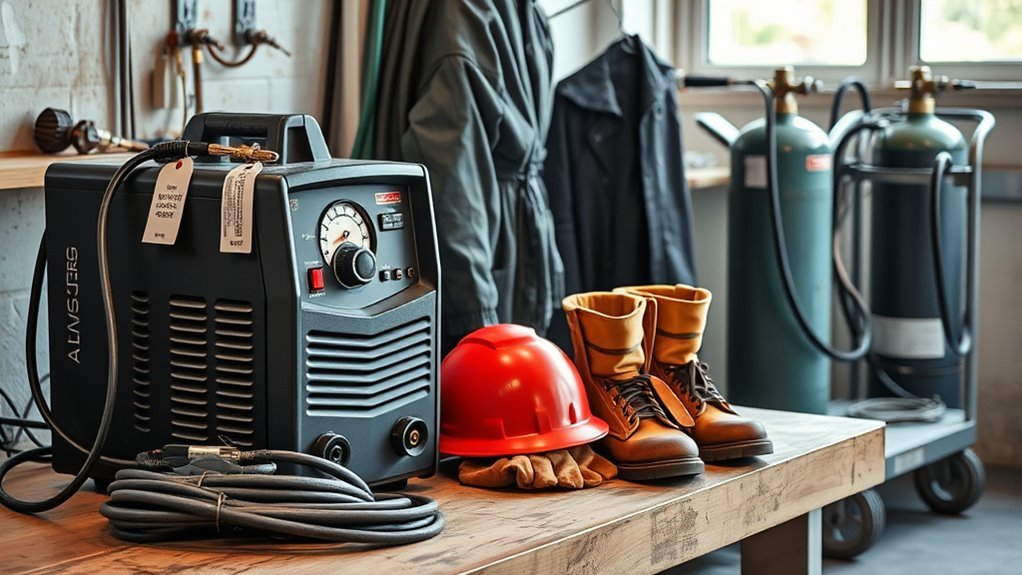
The machine may represent only half of a starter budget. Gas-shielded MIG and TIG setups need more supporting equipment than a simple flux-core or stick setup.
Warning: Welding can expose you and nearby people to fumes, gases, ultraviolet and infrared radiation, burns, fire, noise, and electric shock. Use suitable PPE, screens, ventilation, and fire controls, and follow the machine manual and applicable rules. Never weld on a used drum, tank, or container unless it has been properly cleaned and made safe. See OSHA’s welding hazard guidance.
Include the following categories in your total:
- PPE: Welding helmet, safety glasses, gloves, flame-resistant clothing, suitable footwear, and hearing protection where needed.
- Metal preparation: Clamps, wire brushes, chipping hammer, grinder, discs, files, and a clean work surface.
- Shielding gas: Cylinder purchase or lease, deposit, initial fill, regulator or flowmeter, hose, exchanges, and delivery fees.
- Consumables: Wire, electrodes, tungsten, filler rod, nozzles, contact tips, cups, collets, liners, drive rolls, and anti-spatter products.
- Electrical supply: Correct receptacle, breaker, wiring, plug, and an appropriately rated extension lead where permitted.
- Accessories: Cart, spool gun, TIG torch, foot pedal, electrode holder, remote control, and water cooler.
- Safety controls: Welding screens, ventilation or fume extraction, fire extinguisher, and safe cylinder storage.
How to Price Shielding Gas
There is no dependable national “per cylinder” price because suppliers use different cylinder sizes and ownership systems. Ask a local welding-gas supplier these questions:
- Is the cylinder purchased, leased, rented, or exchanged?
- Does the quote include a deposit or annual lease charge?
- What cylinder capacity is included?
- Is the price for pure argon, carbon dioxide, or an argon blend?
- Are delivery, hazardous-material, energy, or environmental fees added?
- Can the cylinder be exchanged at another branch?
Keep the cylinder and valve-protection requirements in mind when planning storage and transportation. Do not assume a cylinder included in a private sale is owned outright or can be filled by your preferred supplier.
Sample First-Year Welding Budgets
These are broad planning ranges, not quotes:
| Setup | Planning budget | Usually includes |
|---|---|---|
| Basic flux-core | $300–$900 | Machine, PPE, wire, clamps, cleaning tools, and practice steel |
| Gas MIG | $700–$2,000 | Machine, PPE, regulator, cylinder arrangement, gas, wire, cart, and tools |
| AC/DC TIG | $1,200–$4,500 | Machine, torch, pedal, argon setup, tungsten, filler rod, PPE, and preparation tools |
| Multiprocess home shop | $900–$3,000 | Machine and enough accessories to use the required processes |
A new 240-volt circuit can raise any of these totals. Have a qualified electrician verify that the circuit, receptacle, grounding, and overcurrent protection match the manufacturer’s requirements.
Best Welding Machine Price Ranges for Home Use
For occasional mild-steel repairs, the strongest value often falls between $300 and $900. This range includes compact flux-core machines, basic stick units, and some dual-voltage multiprocess welders.
For more frequent work, smoother wire feeding, thicker material, or gas-shielded MIG, a budget of $700 to $1,700 provides more established-brand options. TIG welding and aluminum work normally require a larger budget because the machine and accessories are more complex.
Beginner Welder Budget
A beginner should choose a machine from the project list backward:
- List the metals you will weld.
- Record the thinnest and thickest material.
- Choose the process that suits the work environment and finish requirements.
- Check whether 120-volt power is enough or a 240-volt circuit is available.
- Use the manufacturer’s rated-thickness and duty-cycle information.
- Price every missing accessory and consumable.
- Add PPE and a safe work-area budget.
For thin mild-steel repairs, a 120-volt flux-core or MIG machine may be enough. For thicker material, frequent welding, aluminum, or precision work, the required machine may cost more even when the operator is new.
Best Value Picks
The best-value category depends on the work:
- Lowest initial cost: Flux-core or compact stick for mild-steel repair.
- Easiest general home-shop process: Gas-capable MIG with stable wire feeding and readily available consumables.
- Outdoor repair: Stick or self-shielded flux core, because wind can disturb external shielding gas.
- Clean, controlled welds: TIG, with DC for steel and stainless or AC/DC when conventional aluminum TIG is required.
- Several processes in limited space: Multiprocess, provided the package includes the accessories needed for each process.
Thermal protection, clear controls, standard consumables, accessible service information, and a realistic rated output usually matter more than a long feature list.
MIG vs TIG vs Stick: Which Costs Less?
Stick and flux-core machines usually create the lowest-cost working setups because they do not require an external shielding-gas cylinder. MIG often offers the easiest learning curve for common home fabrication, while TIG usually costs more because it needs additional controls, a torch, shielding gas, tungsten, filler rod, and often a pedal.
| Process | Upfront cost | Ongoing costs | Best fit |
|---|---|---|---|
| Stick | Usually low | Electrodes, holders, leads, and preparation tools | Outdoor repair, thicker steel, farm, and maintenance work |
| Flux core | Usually low | Wire, tips, nozzles, liners, and cleaning supplies | Portable mild-steel work and outdoor use |
| MIG | Low to medium | Gas, wire, tips, nozzles, liners, and cylinder costs | General fabrication, automotive work, and fast production |
| TIG | Medium to high | Argon, tungsten, filler rod, cups, collets, and torch parts | Precise steel, stainless, thin metal, and aluminum work |
Multiprocess machines can reduce the number of power sources in a shop, but they do not remove the need for process-specific torches, guns, gas, filler metal, and consumables.
How to Set Your Welding Budget
Set the budget in this order so that an attractive machine price does not hide a costly mismatch.
- Define the work. List the metal, thickness, joint type, work location, and expected hours of use.
- Choose the process. Decide whether MIG, flux core, stick, TIG, or a combination is required.
- Check available power. Record the outlet voltage, breaker capacity, phase, and distance from the work area.
- Compare rated performance. Review the rated output, duty cycle, thickness chart, and supported filler sizes.
- Audit the package. Mark every required item as included or missing.
- Add safety and workspace costs. Include PPE, screens, ventilation, fire controls, and safe cylinder storage.
- Add operating costs. Price gas, filler metal, tips, nozzles, electrodes, tungsten, grinding media, and replacement parts.
- Evaluate support. Compare warranty coverage, nearby service, consumable availability, and expected repair turnaround.
- Add a reserve. Keep part of the budget for electrical work, unexpected accessories, and initial practice materials.
A cheaper unit can cost more in the first year if it needs a separate torch, pedal, regulator, spool gun, cart, adapter, or electrical upgrade. A more expensive machine is not automatically better; it is better only when its extra capability solves a real requirement.

This Milwaukee SHOCKWAVE socket adapter set is designed to convert drill and impact driver output for use with sockets, making it a versatile addition to any tool kit. Built for durability and repeated use, the adapters are engineered to deliver reliable performance on demanding fastening tasks. The compact 3-piece set covers common drive sizes for everyday repair and maintenance work.

This Lasko pedestal fan delivers powerful, widespread airflow with three quiet speed settings to help keep bedrooms, living rooms, and home offices comfortable. Its adjustable height up to 54 inches, tilt-back head, oscillation, and included remote make it easy to direct cooling exactly where you need it. Built-in safety features and simple no-tool assembly add convenience and peace of mind for everyday indoor use.

The COWAY Mighty air purifier is designed to help clean large home spaces with a four-stage filtration system that captures fine particles, allergens, smoke, odors, and VOCs. Its real-time air quality monitor, auto mode, eco mode, timer, and filter alerts make it easy to maintain fresher indoor air with less effort. The washable pre-filter and HEPA filtration help support long-term performance for bedrooms, living rooms, and other busy areas.
New vs. Used Welding Machines
A used welder can reduce the purchase price, especially for simple transformer-based stick machines and established industrial equipment. However, missing parts and hidden repairs can erase the savings.
Before buying used:
- Confirm the exact model, serial number, input voltage, phase, and rated output.
- Test every advertised process under load when possible.
- Inspect power cords, plugs, leads, connectors, fans, displays, wire drives, and gas fittings.
- Check whether replacement boards, guns, torches, drive rolls, and consumables remain available.
- Ask whether the machine has been exposed to water, conductive grinding dust, or heavy impact.
- Verify cylinder ownership separately; possession of a cylinder does not always prove that it can be legally exchanged or refilled.
- Include the cost of missing leads, regulators, pedals, torches, or feeders in the comparison.
Note: A used premium machine with local parts support may be a better buy than a new machine with no repair network. For inverter machines, the price and availability of replacement circuit boards deserve special attention.
When Renting a Welder Makes Sense
Renting can be more economical when you need an engine-driven welder, high-output machine, specialized process, or extra production capacity for a short project. It also lets you confirm whether a machine suits the work before making a large purchase.
Ask whether the rental price includes leads, feeder, gun, torch, remote, trailer, fuel, damage waiver, delivery, and consumables. Compare the full rental period with the cost of purchasing and later reselling a machine.
Common Welder Buying Mistakes
- Buying from maximum amperage alone.
- Ignoring the rated output and duty cycle.
- Assuming every multiprocess machine includes a complete TIG setup.
- Buying DC TIG when AC TIG is needed for the planned aluminum work.
- Forgetting the cost of a 240-volt circuit or industrial power requirement.
- Comparing a machine-only listing with a ready-to-weld package.
- Ignoring the price and availability of proprietary consumables.
- Buying a spool gun before confirming compatibility.
- Underbudgeting ventilation, PPE, screens, and fire protection.
- Choosing a machine with no practical repair or warranty support.
Frequently Asked Questions
Is welding a good career in 2026?
Welding can offer a stable skilled-trade career, but demand and pay vary by industry, location, qualifications, and schedule. The U.S. Bureau of Labor Statistics projects 2% employment growth from 2024 to 2034 and about 45,600 openings per year, mostly from workers changing occupations or leaving the labor force.
How much does a welding machine cost?
A compact hobby machine may cost about $150 to $600. Many established-brand home and light-shop machines cost $600 to $2,000. Premium MIG, TIG, and multiprocess equipment often costs $2,000 to $9,000, while production and engine-driven systems can exceed $15,000.
Can welders make $100,000 a year?
It is possible, but it is not typical. BLS reported a $51,000 median annual wage in May 2024, while the highest 10% earned more than $75,850. Six-figure income may involve extensive overtime, travel, per diem, inspection or supervisory duties, specialized qualifications, difficult conditions, or business ownership.
What is the projected need for welders?
BLS reports that welders, cutters, solderers, and brazers held about 457,300 jobs in 2024. Employment is projected to reach about 467,200 by 2034, an increase of 9,900 jobs. Approximately 45,600 openings are projected each year over the decade.
Do all MIG welders need shielding gas?
No. Self-shielded flux-core wire does not use an external shielding-gas cylinder. Solid-wire MIG normally does. Some wire-feed machines support only flux core, while others support both processes, so check the polarity settings, drive system, regulator connection, and manufacturer specifications.
Is a multiprocess welder worth the extra cost?
It can be worthwhile when you regularly need several processes and want one portable power source. Check what the package includes, because the TIG torch, foot pedal, spool gun, regulator, or electrode holder may be optional. A single-process machine may offer better value when one process covers nearly all your work.
Conclusion
For most home users, the realistic welding budget is not just the advertised machine price. A basic flux-core setup may stay below $900, while a gas-MIG, TIG, or well-equipped multiprocess shop can cost $1,000 to several thousand dollars. Define the metal, thickness, process, power supply, and workload first. Then compare complete packages, safety equipment, gas arrangements, consumables, warranty support, and electrical requirements. That approach prevents a low sticker price from becoming an expensive mismatch.
Sources
- U.S. Bureau of Labor Statistics: Welders, Cutters, Solderers, and Brazers — employment, wage, training, and 2024–2034 outlook data.
- Occupational Safety and Health Administration: Welding Hazards and Solutions — welding fumes, radiation, burns, electric shock, and PPE guidance.
- Lincoln Electric TIG Welding Equipment — current TIG models, capabilities, and manufacturer pricing examples.
- Miller Thunderbolt 210 MV — current portable stick-welder specifications and list-price example.
- Miller Multimatic 235 — current premium multiprocess specifications and list-price example.
- Miller Millermatic 355 — industrial MIG capabilities, package contents, and list-price example.

CHI 44 Iron Guard Thermal Protection Spray helps shield hair from heat damage during blow-drying, curling, and flat-ironing. Its lightweight, non-greasy formula absorbs quickly to reduce frizz, add shine, and keep hair soft and manageable without buildup. Designed for daily styling, it supports smoother, stronger-looking strands and longer-lasting styles.

This heavy-duty foam coil cleaner quickly dissolves grease, oil, stains, and dirt from air conditioner coils, fan blades, reusable filters, and other HVAC components. Its self-rinsing, low-VOC formula helps neutralize odors, leaves a fresh lemon scent, and includes corrosion inhibitors to protect metal surfaces while cleaning. Designed for convenient aerosol application, it reaches tight spaces and helps restore efficiency without the need for rinsing in most uses.

PUMIE Scouring Sticks provide a powerful chemical-free way to remove toilet bowl rings, hard water deposits, rust, and stubborn grime from bathrooms, kitchens, and other hard surfaces. Made from natural pumice, they deliver deep cleaning performance without harsh ingredients, making them a practical choice for families, janitorial tasks, and everyday home maintenance.
