
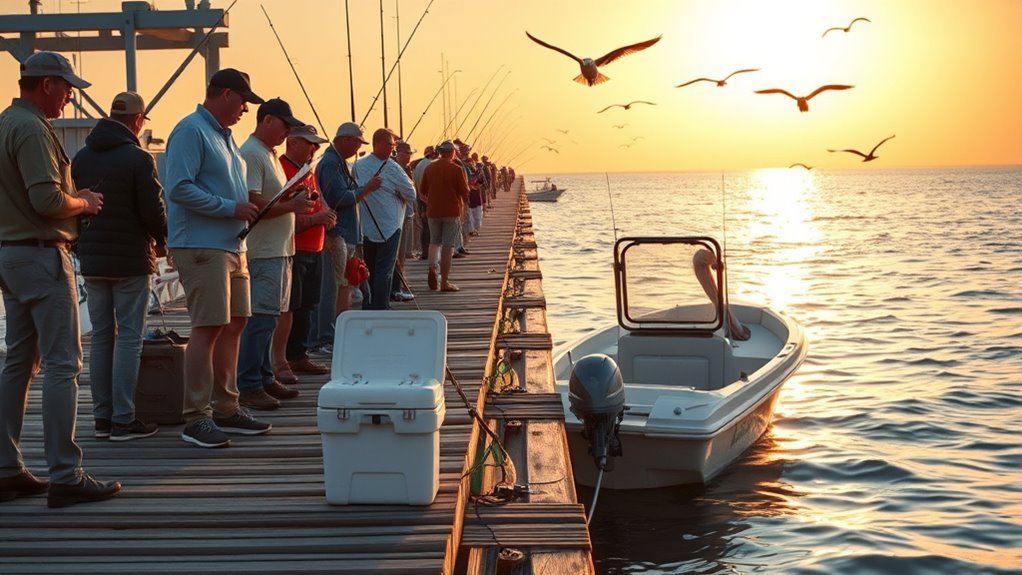
You’ll pay $30.05 for an annual resident saltwater license and $64.90 if you’re a nonresident 16 or older; residents 65+ and those under 16 are exempt. Short-term options include a $12.35 resident trip license valid 168 hours and a seven-day nonresident trip license around $24 plus issuance fees. A $10 Gulf Reef Fish endorsement is required to target reef species. Continue for details on registrations, veterans discounts, and enforcement.
Annual Saltwater License Rates and Fees

While Alabama charges residents $30.05 for an annual saltwater fishing license, nonresidents aged 16 and older pay $64.90, and residents 65+ are exempt. A resident trip license runs $12.35 for 168 consecutive hours, and the Gulf Reef Fish Endorsement — required for certain species — adds $10.00.
You’ll weigh annual license benefits against costs: for residents, the $30.05 annual permits unrestricted seasonal access to saltwater areas, reducing per-trip expense if you fish multiple times annually.
Fishing license comparisons show nonresidents face a higher barrier at $64.90, which may still be cost-effective for frequent visitors compared with repeated short-term fees.
The $10 Gulf Reef Fish Endorsement is an incremental regulatory cost tied to target species and should factor into your budgeting when reef species are intended targets.
Exemption for residents 65+ removes administrative burden and cost.
Use empirical trip frequency and target-species plans to choose the most economical option.
Products Worth Considering

ROLL TIDE Alabama Embossed aluminum license plate in team colors

ALABAMA STATE FLAG DESIGN: Features the bold red and bright white of the Alabama state flag with full embossed detail.

Made of zinc alloy metal
Seven-Day and Short-Term License Options
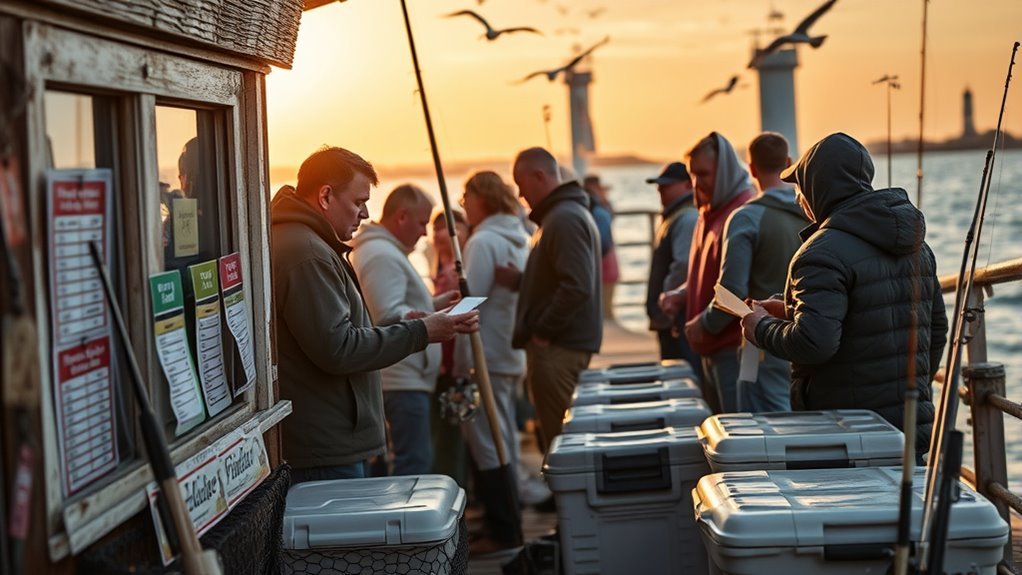
If you need a short-term option, the Seven-Day Trip Nonresident Saltwater Fishing License costs $24 plus a $1 issuance fee and is valid for 168 hours from the chosen start time.
That seven-day license permits common methods like rod and reel, artificial bait, gigging, and crab traps, while other short-term fees may be adjusted for residents of certain neighboring states if their rates are lower.
All fees collected from these short-term licenses are remitted monthly to fund management and development of Alabama’s saltwater fisheries.
Products Worth Considering

Great for Every Fan!

Embossed aluminum Oval license plate in team colors
Officially licensed product
Seven-Day Trip License
For a short coastal trip, the Seven-Day Trip License gives nonresidents aged 16 and older legal access to Alabama saltwater fisheries for 168 consecutive hours from your chosen start time, costing $24 plus a $1 issuance fee.
You’ll find clear license benefits: short-term access without annual commitment, lawful use of common fishing methods, and alignment with state seasons and limits.
The permit authorizes rod-and-reel angling, artificial bait, and permitted crab traps when you follow regulations. Fees may be adjusted under Section 9-11-69 to reflect resource management needs and user equity.
You must carry the license while fishing in state waters; failure to comply risks fines and other penalties.
The Seven-Day option suits visitors seeking targeted, compliant access.
Short-Term Trip Fees
The Seven-Day Trip License is one of two short-term options designed for visitors who need brief, lawful access to Alabama’s saltwater fisheries without buying an annual permit.
You’ll pay $24 plus a $1 issuance fee for 168 hours of valid fishing duration from your chosen start time, which gives clear short term benefits for week-long visits.
Compare that to the nonresident annual license at $44 plus $1; you’ll decide based on expected trips.
Note fees can change under Section 9-11-69, so plan for regulatory adjustments.
Residents of FL, GA, LA, TN, or MS may face special fee provisions if Alabama’s charges are lower than their state’s.
Use the short-term option when fewer days justify lower cost.
Residency and Exemption Rules
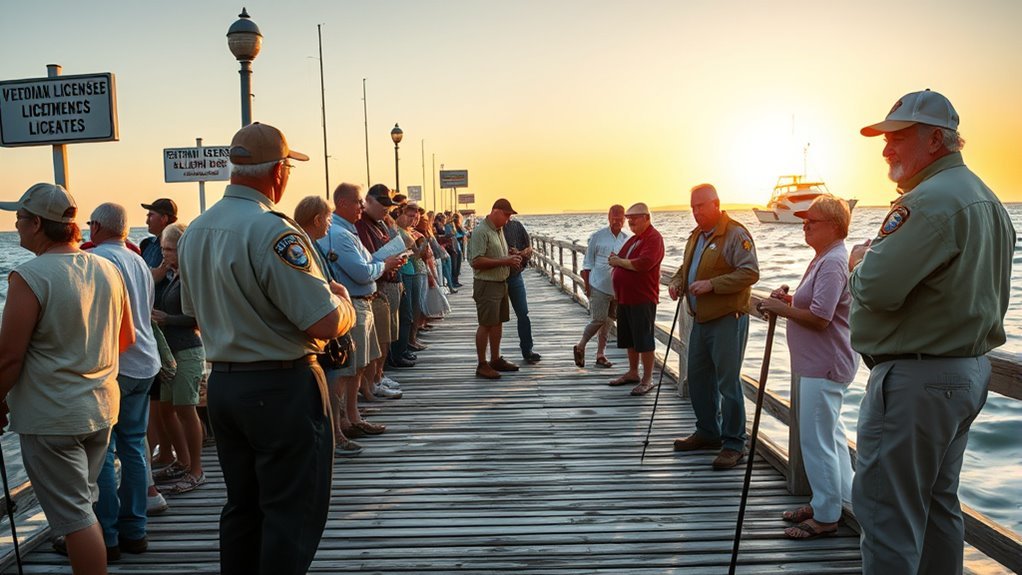
While Alabama requires most residents to carry a saltwater fishing license, specific age-based exemptions and an alternative registration option change who actually needs one: you must comprehend residency requirements and exemption criteria to determine your obligations.
Residents under 16 and those 65 or older are exempt from licensing; these clear age-based rules reduce administrative burden for those groups.
Residents under 16 and those 65 and older are exempt from saltwater fishing licenses, simplifying requirements.
If you’re 16 or older and don’t buy an annual saltwater license, you must complete a Saltwater Angler Registration, though the 65+ exemption still applies.
Fishing solely from a licensed pier exempts you from both license and registration.
Registration is free for eligible residents and supports enforcement and data collection.
- Age exemptions: under 16 and 65+ avoid licenses.
- Saltwater Angler Registration: required 16+ without annual license.
- Pier-only fishing: exempts both license and registration.
- Registration benefits: free, guarantees compliance and data for management.
Registration Requirements for Residents

If you’re a resident 16 or older who doesn’t buy an annual saltwater license, you’re required to complete a free Saltwater Angler Registration, though residents 65+, lifetime license holders, and those fishing only on licensed piers are exempt.
You’ll register online or through designated state outlets, and the process is straightforward and cost-free for eligible residents.
This registration both documents participation for resource management and protects you from penalties that can result from noncompliance.
Resident Registration Exemptions
Because residents 16 and older who don’t buy an annual saltwater license must register for the Saltwater Angler Registration, you should confirm your status to remain compliant and support fisheries data collection.
Use registration benefits and exemption criteria to determine whether you need to act; the registration is free and documents participation for management purposes. Exemptions reduce administrative burden but don’t remove conservation responsibilities.
- Age-based exemptions: under 16 and 65+ are exempt from licensing and registration.
- License-based exemptions: lifetime saltwater license holders needn’t register.
- Location-based exemptions: anglers fishing only on licensed piers are exempt.
- Compliance implications: even if exempt, you must follow size, bag, and seasonal rules.
Review your status against these criteria to stay compliant and support monitoring.
How to Register
Having confirmed whether you fall under any exemptions, you’ll need to complete the free annual Saltwater Angler Registration if you’re a resident 16 or older who hasn’t purchased an annual saltwater license.
You’ll follow a straightforward registration process online or at authorized agents; provide basic ID and residency proof, then record contact and minimal fishing activity details. The system documents participants to support resource management and monitor effort trends.
Renewals are required annually—registrations expire August 31—so you must re-register each season to maintain angler compliance. If you hold a lifetime saltwater license, are 65 or older, or fish only on a licensed pier, you’re exempt.
Keep your confirmation proof while fishing to demonstrate compliance if inspected.
Special Endorsements and Reef Fish Permit Costs
When you target Gulf reef species, you’ll need the Gulf Reef Fish Endorsement, a $10 annual fee across the listed states (or a one-time Lifetime endorsement for $220), which both documents participation and funds targeted conservation and management efforts.
You’ll also see that special endorsement benefits extend beyond compliance: they provide data for stock assessments and enforce size/season rules that promote reef fish conservation. Paying the fee guarantees you’re legally allowed to harvest regulated species and contributes directly to monitoring programs.
- Compliance: endorsement required to target reef fish, reducing illegal take and improving regulatory effectiveness.
- Data collection: documented participation yields catch and effort information used in management decisions.
- Funding: small fees finance conservation actions, enforcement, and stock rebuilding initiatives.
- Long-term access: lifetime options simplify renewal and lock in support for sustainable fisheries.
Choose the annual or lifetime endorsement based on your fishing frequency and commitment to sustainable reef fisheries.
Products Worth Considering

Fishing Guide for Anglers – A must for avid fishermen. This fish chart features more than 150 fish and shark’s in the Gulf of Mexico / Gulf of America and boasts rules,...
Pier, Spearfishing, and Trip License Pricing
If you primarily fish from piers, rely on short trips, or use a spear, note that license costs are tiered by activity and residency: an annual pier license runs $17.65 for residents and $24.45 for nonresidents, a resident spearfishing license is $6.00 (valid in both fresh and saltwater), and a seven‑day trip license costs $12.35 for residents versus $35.65 for nonresidents; remember the $10 Gulf Reef Fish Endorsement still applies when targeting reef species.
You should match the license to your typical effort: choose an annual pier license if you focus on pier fishing year-round, a seven‑day trip license for short visits, or the spearfishing license if you employ spearfishing techniques.
Cost-effectiveness depends on frequency and target species; for reef species you’ll add the $10 endorsement regardless of basic license. The resident spearfishing option offers broad habitat coverage at low cost.
For budgeting, compare anticipated trip counts to annual prices and include endorsement fees when reef fishing is likely.
Products Worth Considering

Product Material: Our license plate frame is made of premium quality aluminum, which ensures that the plate frame will never wear out. Corrosion resistant, Personalized Car Frame Can Perfect to Put on Your Front of Car,Decorate your car to make it look more beautiful and unique.


Add a touch of humor and flair to your car with this funny "Weekend Hooker" front license plate. Perfect for the bass fishing enthusiast, this custom car tag is a great gift for men, especially for dads, husbands, or any fishing fanatic. Whether you're an outdoorsman or just enjoy a good laugh, this novelty license plate is sure to bring a smile to your face and enhance your fishing-themed car decor. Let your personality shine on the road with this fun and unique accessory.
Disabled and Veterans License Programs
Beyond standard pier, trip, and spearfishing fees, several discounted options target veterans and people with disabilities to keep saltwater angling affordable and accessible.
You’ll find targeted disabled fishing programs and veteran fishing opportunities that reduce cost barriers and expand participation. Evidence shows programs range from event-specific permits to low-cost annual credentials.
- The Disabled Saltwater Fishing Three-Day Event License costs $100 and covers up to 20 individuals with disabilities, enabling organized group events.
- The Physically Disabled Saltwater Trip License specifically supports disabled participants in fishing events, improving access for single outings.
- Alabama’s Resident Disabled Military Veterans Saltwater License is $3.50, a low-fee model promoting inclusivity for veterans.
- The Veterans Appreciation License (for 20% disabled veterans) is $3.60 and covers both freshwater and saltwater, while disabled residents can get a Saltwater Annual License for $3.50.
These offerings demonstrate a policy mix of event-focused and annual low-cost licenses to maximize participation and equity.
All Access and Package Pricing Breakdown

One clear way to compare value is to look at All Access package prices: Alabama residents pay $57.05 while non‑residents pay $141.15, Florida residents pay $124.45, Louisiana residents $139.20, and Mississippi residents $150.32, showing substantial interstate variation that likely reflects differing fee structures and included privileges.
You should use a fishing package comparison lens to evaluate whether higher fees align with broader access or extra services. The data show Alabama residents receive the lowest All Access rate; non‑resident and neighboring state rates cluster between $124 and $150, suggesting regional parity for non‑locals.
Complementary package costs—pier access at $17.65 (Alabama) and $24.15 (Louisiana, Florida), and spearfishing at $46.05 (Alabama) versus $83.40 (non‑residents)—help refine pricing analysis by isolating specific privileges.
You can weigh combinations of targeted packages against All Access to decide if bundled pricing or pay‑as‑you‑go options yield better value for your fishing needs.
Products Worth Considering

High Visibility - The fluorescent orange color ensures your waterproof fishing license holder is easy to spot, so you can quickly grab it when needed. Ideal for outdoor enthusiasts.

Secure & Dry - With a clear waterproof zip closure, this heavy-duty badge holder keeps your license and tags protected from the elements. Adventure with confidence.

FISHING LICENSE HOLDER W/ZIP CLOSURE
Regulations, Permit Obligations, and Enforcement
While Alabama sets clear fee and exemption rules to regulate saltwater fishing, you should know the specific permit obligations and penalties that enforce compliance.
You must hold an annual saltwater fishing license ($30.05 residents, $64.90 non-residents) or, if a resident aged 16+, complete Saltwater Angler Registration when you don’t buy the annual license. Residents 65+ and under-16 are exempt.
Enforcement links fees to fishing sustainability: fines fund conservation and deter illegal take.
- You’re required to carry the appropriate license or registration when fishing in state saltwater; failure is a violation of regulatory compliance.
- Non-residents without a license face a minimum $50 fine and possible Class B misdemeanor charges.
- Officers routinely check documents to guarantee adherence to bag limits, seasons, and gear rules that support resource management.
- Paying fees and following rules demonstrates measurable support for long-term fishery health and science-based management.
Frequently Asked Questions
Can I Buy a License Online Using a Mobile Device?
Yes — you can buy a license online using a mobile device. You’ll find mobile app convenience and online purchase security features; reviews and payment encryption evidence show transactions are reliable and fast, reducing time and errors.
Are Refunds Available if Plans Change?
Yes — you can get refunds sometimes, but it’s not automatic like tide changes. You’ll need to follow the refund process and review cancellation policies; evidence shows approvals depend on timing, payment method, and permit type.
Do Children Under a Certain Age Need Any Paperwork?
Yes — you’ll need to follow child fishing requirements: many jurisdictions grant age exemptions (typically under 12–16). Check local regulations and carry birth proof when required; evidence-based rules vary, so confirm with your marine district.
How Are License Fees Used for Conservation?
License fees fund conservation funding by directing license fee allocation to habitat restoration, stock assessments, enforcement, and public education; you’ll see measurable population recoveries and improved ecosystem health when funds are targeted and transparently tracked.
Is There Group or Family Discount Pricing Available?
Policies vary by region, but you usually won’t get universal family fishing discounts; some agencies offer group permits or bundled options for families or organized groups, and fee schedules and eligibility criteria are published with supporting ordinance evidence.
Conclusion
You’ve seen the fees, endorsements, and exemptions laid out like coordinates on a navigation chart; now steer by the facts. Costs vary by duration, residency, and endorsements, while pier, spearfishing, and trip permits create predictable add-ons. Disabled and veteran programs cut rates, but registration remains mandatory for most anglers. Use this evidence to balance budget and legal obligations, choose the right package, and avoid fines—practical decisions that keep your outings lawful and cost-effective.
