

You’ll need a Coastal Recreational Fishing License to take saltwater finfish in coastal and joint waters. Annual fees are $19 for residents and $38 for nonresidents; ten‑day options run $8 resident/$14 nonresident and a block of ten costs $150. Lifetime licenses are $315 resident and $630 nonresident, with reduced rates for seniors and certain disabled veterans. You must carry proof, register in the free Recreational Marine Fishing Registry if 16+, and follow size/possession limits — details follow.
Requirements to Fish in Coastal and Joint Waters

If you fish for personal-consumption finfish in Coastal Fishing Waters or Joint Waters, you must hold a Coastal Recreational Fishing License (CRFL) and comply with state size and possession limits; the CRFL is nontransferable and may not be sold.
You’ll need the CRFL to legally harvest finfish in coastal ecosystems, and you must follow fishing regulations for species-specific size and bag limits at all times.
If you fish in Joint Waters, bring either the CRFL or, where allowed, a Wildlife Resources Commission inland fishing license based on location-specific rules.
Anglers aged 16 and older must also register in the no-fee Recreational Marine Fishing Registry when fishing in marine and coastal district waters.
Carry proof of your CRFL and registry when fishing; enforcement includes inspections and penalties for noncompliance.
The CRFL’s restrictions and registry requirements are designed to protect fish stocks and coastal ecosystems while providing a clear regulatory framework for recreational anglers.
Products Worth Considering
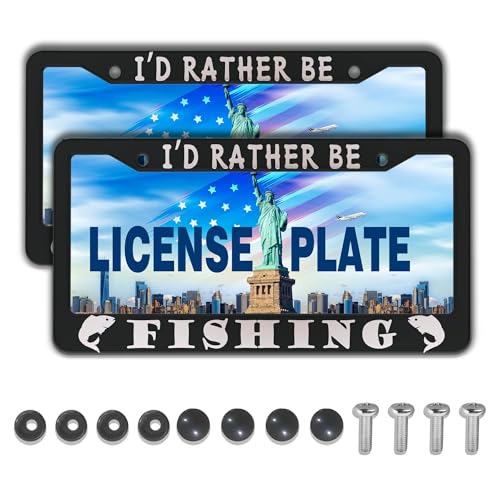
ALUMINUM FRAME: This License Plate Frame is crafted from high-quality aluminum that is resistant to corrosion, rust, and harsh weather conditions. Its rugged reliability...
Coastal Recreational Fishing License Types and Fees
Having the CRFL and knowing where it applies makes it equally important to understand the license types and fees that govern legal coastal angling. You’ll choose among standard, unified, short-term, and lifetime options; each license type reflects a specific fee structure and validity period.
The resident CRFL is $19 and nonresident $38, both valid 12 months from purchase. Unified combinations and short-term permits adjust coverage and cost.
- Standard CRFL: $19 resident, $38 nonresident, 12-month validity.
- Unified Inland/Coastal (resident): $49, covers both jurisdictions.
- Unified Sportsman/Coastal (resident): $82, broader privileges.
- Short-term: Ten-Day CRFL $8 resident/$14 nonresident; block of ten $150.
- Lifetime: $315 resident/$630 nonresident; special rates exist for seniors, legally blind, disabled veterans.
All licenses must comply with state size and possession limits and are nontransferable.
You should verify current fees and restrictions before fishing to remain compliant.
Products Worth Considering


FISHING LICENSE HOLDER W/ZIP CLOSURE

Enough to Use: you will receive 6 pieces of fishing license holders, and 6 pieces of safety pins, abundant in quantity, enough for you to choose and replace, can meet your different needs; You can also share them with your friends
Lifetime and Senior License Options

You’ll see lifetime license costs listed as $315 for resident Coastal Recreational Fishing and $630 for nonresidents, with a resident Unified Inland/Coastal lifetime option at $567 (not available to nonresidents).
Seniors qualify for reduced lifetime eligibility based on birthdate: residents born on or before August 1, 1953 can obtain the coastal lifetime license at age 65, others at 70.
Special lifetime rates also apply for legally blind individuals, adult care home residents, and disabled veterans, and lifetimes never require annual renewal.
Products Worth Considering

High Visibility - The fluorescent orange color ensures your waterproof fishing license holder is easy to spot, so you can quickly grab it when needed. Ideal for outdoor enthusiasts.

Secure & Dry - With a clear waterproof zip closure, this heavy-duty badge holder keeps your license and tags protected from the elements. Adventure with confidence.

【MATERIAL】: oFloral License plate frame is made from premium quality aluminum, which can provide long-lasting protection from corroding, rusting and aging, durability for long lasting usage.Personalized Car Frame Can Perfect to Put on Your Front of Car or for Decorative Purposes Around the House Like in Your Bedroom, Garage, Basement, Ect.
Lifetime License Costs
One-time lifetime licenses simplify long-term saltwater fishing access by replacing annual renewals with a single payment: the Coastal Recreational Fishing Lifetime License is $315 for residents and $630 for nonresidents, while residents can buy a Unified Inland/Coastal Lifetime License for $567 (no nonresident option).
You’ll get clear lifetime benefits and avoid recurring transactions, but you must still comply with current fishing regulations.
- Resident Coastal Lifetime: $315.
- Nonresident Coastal Lifetime: $630.
- Unified Inland/Coastal (resident only): $567.
- Special reduced rates for legally blind, adult care home residents, and disabled veterans.
- Lifetime licenses remain valid for your lifetime; no renewal required.
This is a regulatory, cost-focused summary to help you weigh upfront cost against long-term compliance and convenience.
Senior Discount Eligibility
If you’re a resident who’s reached the age threshold—65 if born on or before August 1, 1953, or 70 if born after that date—you qualify for discounted lifetime saltwater fishing licenses.
You meet senior eligibility for a Coastal Recreational Fishing Lifetime License priced at $315 (residents), which grants unlimited saltwater fishing for life. Alternatively, you can choose the Unified Inland/Coastal Recreational Fishing Lifetime License for $567.
These senior discounts are limited to residents; nonresidents aren’t eligible. Special reduced rates may also apply if you’re legally blind, a resident of an adult care home, or a disabled veteran.
Verify your fishing age and residency documentation when applying to confirm regulatory compliance and correct fee assessment.
Short-Term and Ten-Day Licenses

You can buy a Ten-Day Coastal Recreational Fishing License for $8 if you’re a resident and $14 if you’re a nonresident.
Each Ten-Day license is non-transferable, must be returned after expiration, and is valid for ten days while blocks of 10 cost $150 and remain valid for two years.
Short-term options let you legally take finfish for personal consumption under state regulations and are suited for infrequent anglers who don’t need an annual license.
Products Worth Considering

Material :High-Quality Metal Aluminum With High Gloss Stamped Metal License Plate.Lightweight, Waterproof,Anti-Rust And Very Durable.

The size of the license plate frame is: 12.3" x 6.3" , it fits all standard size US and Canada vehicle license plates.the stylish design frame fits ly on your car license plate.

【Material】Our License Plate Frame Is Made Of Stainless Steel, Strong And Durable.
Ten-Day License Cost
Want a short-term option for saltwater fishing? You’ll find the ten day benefits clear and practical for limited fishing activities. The fee structure and regulatory points are concise:
- Resident ten-day license: $8.
- Nonresident ten-day license: $14.
- Validity: ten consecutive days from purchase.
- Block option: 10 licenses for $150, valid two years.
- Restrictions: non-transferable; return expired licenses to the Division of Marine Fisheries.
You’ll use this when fishing briefly without annual commitment.
The policy-driven design prioritizes compliance: observe validity dates, don’t assign the license, and return it after expiration.
Budget and operational planning should factor per-trip cost versus block pricing for recurring short-term anglers.
Purchase and Validity
Following the ten-day option overview, here’s how purchase and validity work for short-term saltwater licenses: residents pay $8 and nonresidents $14 for a ten-consecutive-day Coastal Recreational Fishing Ten-Day License, blocks of ten can be bought for $150 and remain valid for two years, and all short-term licenses are non-transferable and must be returned to the Division of Marine Fisheries after they expire; these licenses are required for any recreational finfish activity in Coastal Fishing Waters and Joint Waters.
You can buy single ten-day licenses or two-year blocks; short term benefits include flexibility for infrequent anglers. Note license limitations: ten-day validity, non-transferable, and mandatory return after expiration. Compliance is mandatory; officials may request proof of valid license during enforcement.
| Type | Cost | Validity |
|---|---|---|
| Single | $8/$14 | 10 days |
| Block | $150 | 2 years |
Multiple-Use Blocks
When you need short-term access for occasional trips, multiple-use blocks let anglers buy ten Ten-Day Coastal Recreational Fishing Licenses at once for $150, providing two years of usable ten-day permits that each authorize taking finfish for personal consumption within state size and possession limits.
You’ll find this option cost-effective compared with single nonresident ($14) or resident ($8) ten-day purchases if you fish infrequently.
- Cost: block of 10 = $150 for two years.
- Per-license equivalent: $15 each versus $8 (resident) / $14 (nonresident).
- Use: each permit authorizes personal-consumption finfish within limits.
- Compliance: expired ten-day licenses must be returned to the Division of Marine Fisheries.
- Restrictions: licenses aren’t transferable or assignable; consider multi license benefits and group purchase options.
Exemptions, Permits, and Tournament Rules
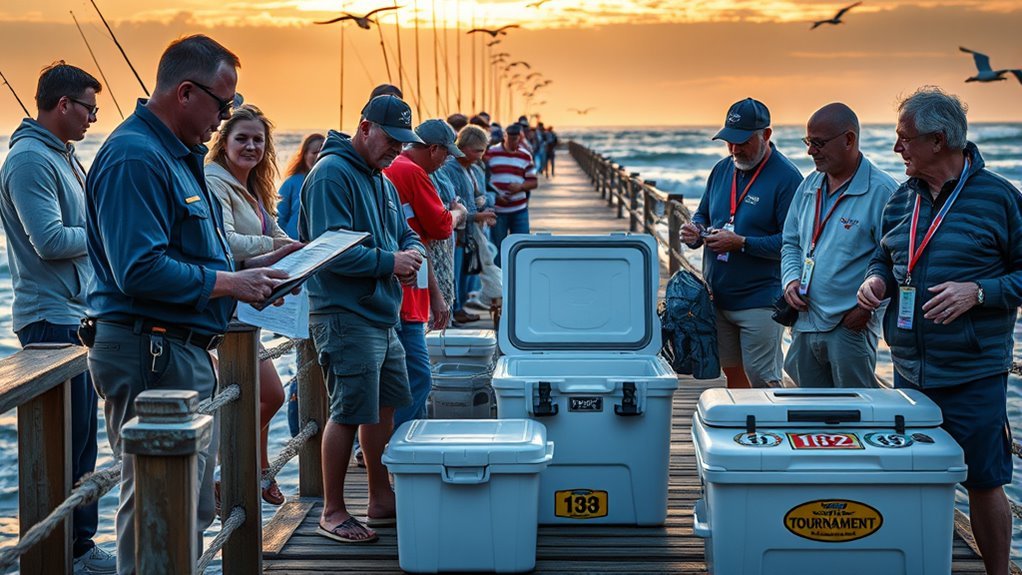
Although organized fishing events can proceed without individual recreational licenses under the Coastal Recreational Fishing License Exemption Permit, you or your organization must submit a written application and notify authorities at least 30 days before the event to obtain approval.
You’ll include event scope, participant numbers, location, dates, and handling plans to demonstrate compliance with fishing regulations and tournament guidelines. Under the exemption, harvested seafood can’t be sold; sales trigger the need for a Recreational Fishing Tournament License, which subjects the event to commercial fishing rules.
Both permits require complete written applications to verify conservation measures, gear restrictions, and catch reporting procedures. You must guarantee participants follow local bag limits, size limits, and gear limits; enforcement actions apply for violations.
Regulatory review focuses on sustainability metrics and public safety. If approved, conditions may be imposed (e.g., mandatory debriefs, catch logs). Noncompliance can revoke permit status and expose organizers to fines or suspension of future permits.
Where and How to Purchase Your License
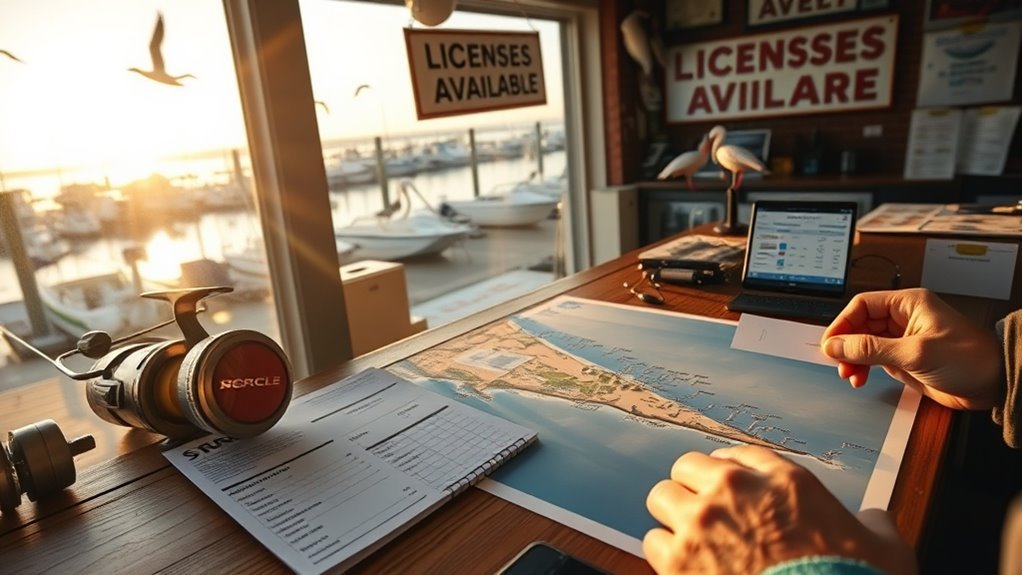
After you secure any required exemption or tournament permit, you’ll need to obtain the Coastal Recreational Fishing License through approved channels: online via the Wildlife Resources Commission system or by phone during business hours, at Division of Marine Fisheries or Wildlife Resources Commission offices, and at licensed vendors statewide.
After securing any required exemption or tournament permit, obtain your Coastal Recreational Fishing License online, by phone, in person, or from licensed vendors.
You can use online purchase options for immediate issuance or phone purchase assistance if you need help or have payment questions.
Fees: $19 resident, $38 nonresident (12-month); ten-day: $8 resident, $14 nonresident; lifetime: $315 resident, $630 nonresident.
- Use the Wildlife Resources Commission portal for fastest processing and digital receipt.
- Call during business hours for phone purchase assistance and verification of exemptions.
- Visit Division of Marine Fisheries or WRC offices for in-person transactions and ID verification.
- Licensed vendors across the state sell short-term and annual licenses; confirm payment methods.
- Retain proof of purchase on your person while fishing; licenses are effective from purchase date.
Products Worth Considering

Product Material: Our license plate frame is made of premium quality aluminum, which ensures that the plate frame will never wear out. Corrosion resistant, Personalized Car Frame Can Perfect to Put on Your Front of Car,Decorate your car to make it look more beautiful and unique.

Add a touch of humor and flair to your car with this funny "Weekend Hooker" front license plate. Perfect for the bass fishing enthusiast, this custom car tag is a great gift for men, especially for dads, husbands, or any fishing fanatic. Whether you're an outdoorsman or just enjoy a good laugh, this novelty license plate is sure to bring a smile to your face and enhance your fishing-themed car decor. Let your personality shine on the road with this fun and unique accessory.

Registration, Reporting, and Conservation Programs
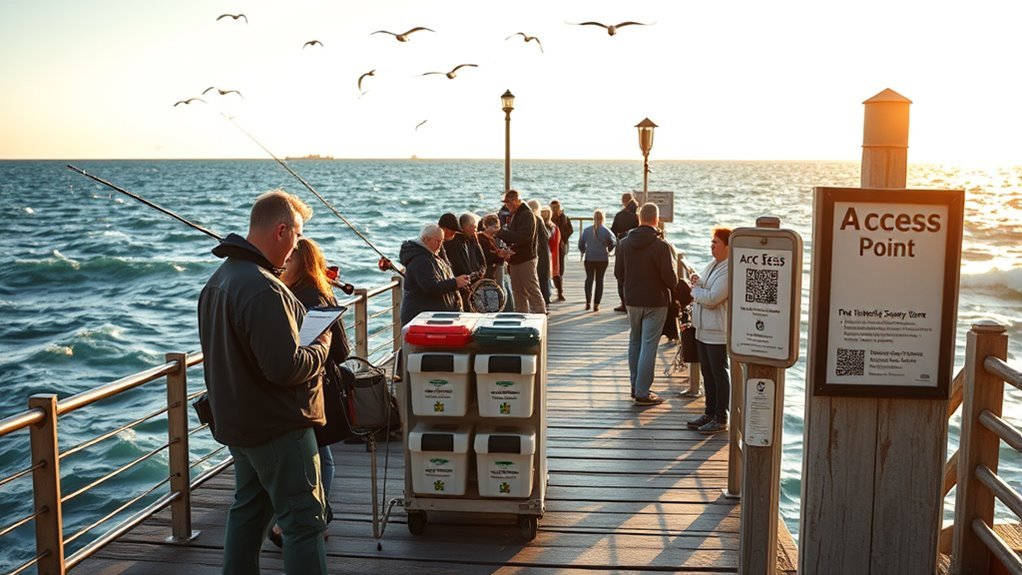
Because registration and reporting feed management decisions, you must register in New York to fish tidal waters if you’re 16 or older and keep your Recreational Marine Fishing Registry current (it’s free and valid one year from registration).
You can register online or through designated agents; registration benefits include legal compliance and generation of activity data used to set quotas and seasons. Voluntary catch reporting via eLogbook and similar platforms supplements registry data, improving species-specific abundance estimates and informing stock assessments.
You should also participate in surveys like the Access Point Angler Intercept Survey (APAIS) when requested; your responses supply effort and catch-per-unit-effort metrics critical to fisheries models.
Conservation programs funded by special plates and other sources deliver outreach, habitat protection, and monitoring that amplify conservation impact.
Follow reporting protocols and support funded initiatives so managers can apply precise regulations and maintain sustainable marine fisheries for recreational use.
Frequently Asked Questions
Can I Transfer My Coastal Fishing Fee to Another Person?
No, you can’t transfer your coastal fishing fee to another person. Check the license transfer process and fishing fee regulations for exceptions, but regulations typically prohibit transfers; you’ll need the other person to purchase their own fee directly.
Are There Discounts for Military Personnel or Veterans?
Yes — you qualify for military discounts and veteran benefits in many states; check your state agency’s regulations and required ID, since eligibility, fee waivers, and documentation vary by jurisdiction and are set by state fisheries rules.
Do Kids Need a Separate Coastal Fishing License?
Imagine a dad renewing a family permit at the pier; you’ll usually find kids fishing regulations exempt minors under a specific age, but rules vary by state — check family fishing licenses and local regs to confirm compliance.
What Happens if I Lose My Printed License While Fishing?
If you lose your printed license while fishing, you must follow the replacement process promptly; you’re still subject to license validity checks, so obtain a replacement or digital proof to avoid citations and demonstrate current authorization.
Is the Coastal Fee Refundable if I Move Out of State?
Yes — but don’t assume it’s automatic. Check refund policies: you’ll need to prove change in state residency, meet deadlines, and comply with regulations. Agencies require documentation and may deduct processing fees before refunding.
Conclusion
You’ll need the right license like a key to open the coast: choose coastal, joint-waters, lifetime, senior, short-term, or ten-day based on how long and where you fish. Exemptions, permits, and tournament rules act like guardrails; registration, reporting, and conservation programs are the compass. Buy through official vendors, follow regulations, and keep records — that precise map protects both your access and the fishery’s future, ensuring compliance and sustainability.
